





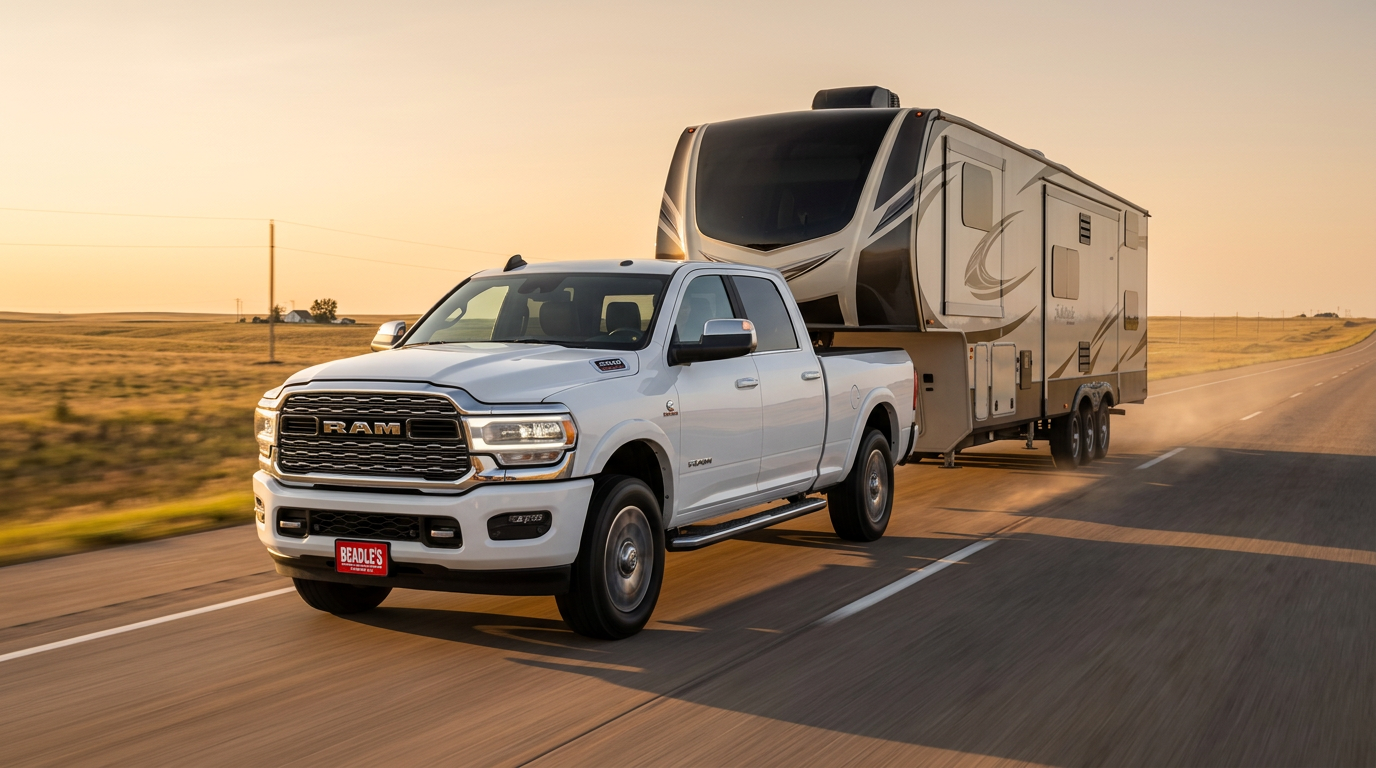
The 2026 Ram 2500 is built for serious work in South Dakota. Whether you’re pulling livestock trailers to the fairgrounds, hauling gooseneck equipment across the plains, or towing a fifth-wheel RV to your favorite camping spot, this heavy-duty truck delivers class-leading towing and payload capacity. The question isn’t whether the Ram 2500 can handle your load—it’s which engine and configuration best matches your specific needs.
In this guide, we’ll break down exact towing capacities for both the standard 6.4L HEMI V8 and the available 6.7L Cummins diesel, explain payload limits, compare fifth-wheel versus gooseneck towing, and help you understand which setup works for your operation. If you’re shopping for a 2500 in Bowdle or anywhere in South Dakota, this is your roadmap to choosing the right truck.
Table of Contents
- How much can the 2026 Ram 2500 tow?
- What is the 2026 Ram 2500 payload capacity?
- Does the Cummins diesel tow more than the HEMI?
- Can the Ram 2500 pull a 5th wheel or gooseneck trailer?
- What tow rating do I need for a livestock trailer in South Dakota?
- What towing packages are available on the 2026 Ram 2500?
How much can the 2026 Ram 2500 tow?
The 2026 Ram 2500 with the standard 6.4L HEMI V8 can tow up to 17,740 lbs in its maximum configuration, while the available 6.7L Cummins diesel pushes that to 20,000 lbs. Towing capacity varies significantly based on cab style, bed length, drivetrain, rear axle ratio, and GVWR rating.
All 2026 Ram 2500 towing figures are SAE J2807 certified—the industry standard that assumes 300 lbs of passenger weight and accounts for all trailer equipment. This means the numbers you see are realistic, tested results, not optimistic marketing claims.
| Configuration | HEMI V8 (lbs) | Cummins Diesel (lbs) |
|---|---|---|
| Reg Cab 8′ 4×2 | 17,740 | 20,000 |
| Crew Cab 6’4″ 4×4 (9,900 GVWR) | 17,120 | 19,900 |
| Crew Cab 6’4″ 4×4 (10,000 GVWR) | 17,440 | 19,900 |
| Crew Cab 6’4″ 4×4 (11,040 GVWR) | — | 19,930 |
| Crew Cab 8′ 4×4 | 16,930 | 19,770 |
| Power Wagon | 10,530 | N/A |
Notice that regular cab configurations deliver higher towing capacity than crew cabs, primarily because fewer people in the cab means lower curb weight and more capacity headroom. If maximum towing is your priority and you don’t need the crew cab, the regular cab 4×2 gives you the most capability on the HEMI.
What is the 2026 Ram 2500 payload capacity?
Payload capacity—what you can load into the truck bed—tops out at 4,580 lbs for the HEMI and 3,600 lbs for the Cummins diesel, but like towing, this varies dramatically based on configuration. A crew cab 4×4 will carry considerably less payload than a reg cab.
The difference between HEMI and Cummins payload is worth noting: the diesel’s superior weight distribution and suspension tuning prioritize towing over payload capacity. If you’re hauling heavy loads in the bed frequently, the HEMI may be the better choice for your operation.
| Configuration | HEMI V8 (lbs) | Cummins Diesel (lbs) |
|---|---|---|
| Reg Cab 8′ 4×4 | 4,580 | — |
| Crew Cab 6’4″ 4×4 (10,000 GVWR) | 3,320 | — |
| Crew Cab 6’4″ 4×4 (11,040 GVWR) | 4,010 | 3,300 |
| Crew Cab 6’4″ 4×2 (11,040 GVWR) | — | 3,600 |
| Power Wagon | 1,570 | N/A |
Remember: towing and payload both consume your truck’s weight budget (GVWR). You can’t max out both simultaneously. If you’re towing near capacity, you’ll have limited bed loading room, and vice versa. This is why understanding your specific use case is critical when specifying a 2500.
Does the Cummins diesel tow more than the HEMI?
Yes, the 6.7L Cummins turbo diesel outweighs the standard 6.4L HEMI V8 by approximately 2,200–2,300 lbs in towing capacity across most configurations. The Cummins delivers 1,075 lb-ft of torque versus the HEMI’s 429 lb-ft, and that massive diesel pulling power translates directly to higher ratings for gooseneck and fifth-wheel trailers.
However, raw towing numbers tell only part of the story. The 6.4L HEMI is cheaper (standard equipment with no upcharge), delivers more payload capacity, and still tows 17,740 lbs—more than enough for most South Dakota operators. The Cummins costs $12,995 more but excels if you’re regularly pulling above 18,000 lbs or need the superior towing comfort and stability of diesel torque. For a deeper comparison of both engines, see our 2026 Ram 2500 Cummins vs. HEMI guide.
Engine Specs at a Glance:
- 6.4L HEMI V8: 405 hp / 429 lb-ft, 8-speed auto, standard on all 2500 models
- 6.7L Cummins HO Turbo Diesel: 430 hp / 1,075 lb-ft, TorqueFlite HD 8-speed auto, +$12,995
Can the Ram 2500 pull a 5th wheel or gooseneck trailer?
Absolutely. The Ram 2500 is built for fifth-wheel and gooseneck towing—these hitches place the load much closer to the truck’s rear axle, which is why the 2500 can tow up to 20,000 lbs with them. Standard Class III and IV receivers max out around 12,500–17,740 lbs for bumper-pull trailers, but fifth-wheel and gooseneck hitches unlock the full towing potential of the truck.
To fifth-wheel or gooseneck tow on a Ram 2500, you’ll need the optional Towing Prep Group—a $745 add-on that includes 5th-wheel/gooseneck hitch mounting provisions, integrated trailer brake controller, and reinforced frame points. If you plan to tow anything over 15,000 lbs or pull a fifth-wheel RV, specify this option when ordering.
Class V receivers (bumper-pull with a ball hitch) are limited to 2,000 lbs maximum tongue weight on the Ram 2500, which is still substantial for trailers up to roughly 14,000–16,000 lbs depending on weight distribution. For anything heavier, a fifth-wheel or gooseneck hitch is required by SAE standards.
What tow rating do I need for a livestock trailer in South Dakota?
A typical double-axle livestock trailer for cattle or horses weighs 4,000–6,500 lbs empty and holds 8,000–12,000 lbs of animal weight when loaded. You’ll need a minimum towing capacity of 13,000–17,000 lbs depending on trailer size and live weight. The 2026 Ram 2500 with either engine easily handles this across all configurations.
For a gooseneck livestock trailer—common for larger operations or multiple-pen setups—you’re looking at 6,000–8,000 lbs dry weight and up to 15,000–18,000 lbs loaded. Here, the Cummins diesel becomes more attractive, offering the extra 2,200-lb towing advantage and smoother torque curve for loaded uphill pulls on South Dakota highways. Both engines will do the job, but the diesel makes it effortless.
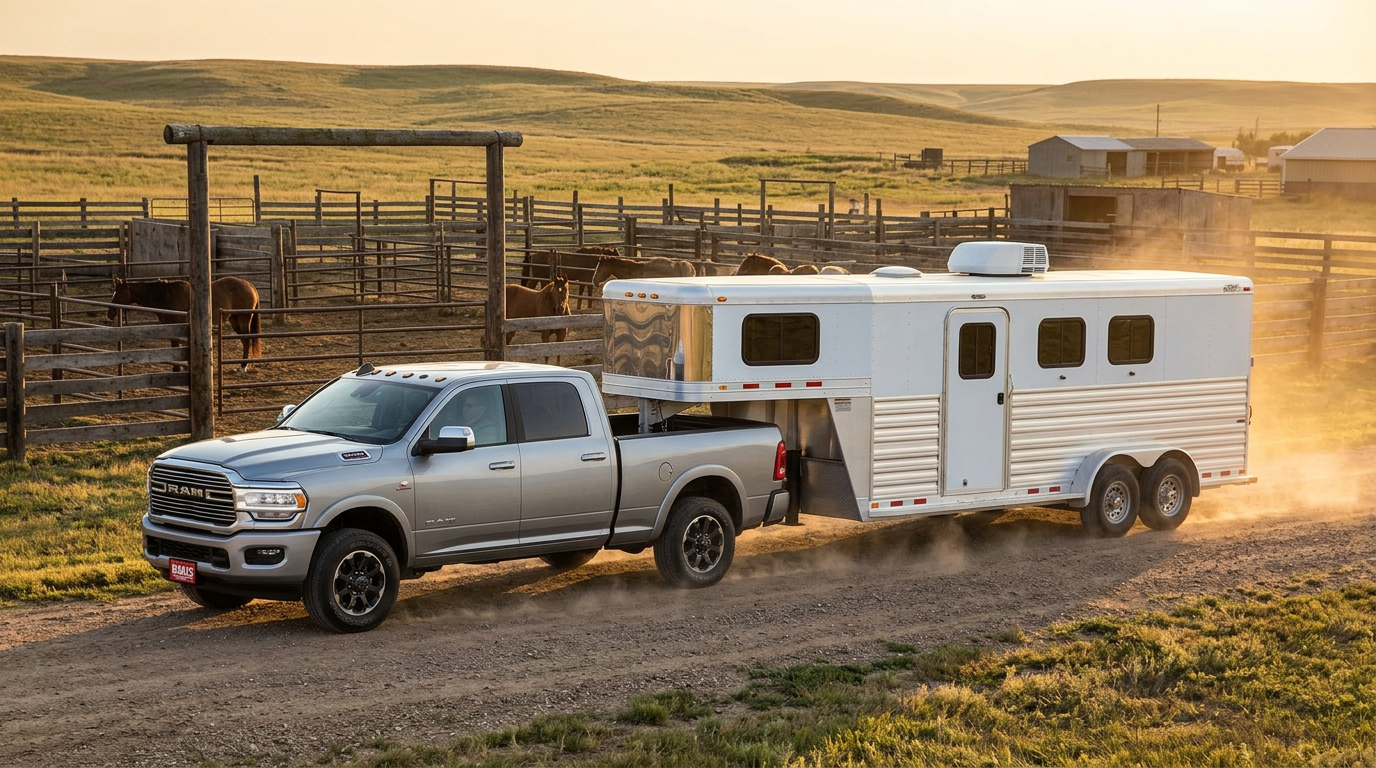
Most South Dakota ranchers and livestock operators opt for Crew Cab 4×4 configurations for comfort on long hauls and better handling in winter conditions. With an 11,040 GVWR Crew Cab 4×4, both engines deliver ample towing headroom: HEMI at 17,440 lbs, Cummins at 19,930 lbs. Pair either with the optional Towing Prep Group for integrated trailer brake control, and you have a professional livestock hauler ready for fairgrounds, sales yards, or custom work.
What towing packages are available on the 2026 Ram 2500?
Ram offers a focused towing package strategy on the 2500. The main option is the Towing Prep Group ($745), which is essential if you plan any serious pulling. This group bundles fifth-wheel/gooseneck mounting provisions, an integrated trailer brake controller, reinforced rear frame, and factory-ready hitch attachment points.
All 2026 Ram 2500 models come standard with an integrated trailer sway control system, integrated trailer brake controller wiring, and towing mirrors. These systems are automatic—no add-on needed. The main decision is whether you want the prep hardware for fifth-wheel/gooseneck (the $745 Towing Prep Group) or if a standard Class III receiver is sufficient for your bumper-pull needs.
Key Takeaways
- 2026 Ram 2500 HEMI maxes at 17,740 lbs towing; Cummins diesel reaches 20,000 lbs (both SAE J2807 certified).
- Payload capacity ranges from 1,570 lbs (Power Wagon) to 4,580 lbs (Reg Cab), depending on cab and frame configuration.
- Cummins diesel outweighs HEMI by ~2,200–2,300 lbs but costs $12,995 extra; choose based on your regular towing loads.
- Fifth-wheel and gooseneck towing require the optional Towing Prep Group ($745); standard Class V receiver tops out at 2,000 lbs tongue weight.
- Most South Dakota livestock operators choose Crew Cab 4×4 with either engine for comfort and winter stability.
- Integrated trailer brake control, sway control, and towing mirrors are standard; no extra tech package needed.
Frequently Asked Questions
Can I tow 20,000 lbs with a HEMI 2500?
Not with the 6.4L HEMI. The HEMI maxes out at 17,740 lbs. Only the 6.7L Cummins diesel reaches 20,000 lbs. If you regularly exceed 18,000 lbs, the Cummins is the better choice.
Does the 4×4 tow less than the 4×2?
Typically yes, but the difference is small—usually 200–400 lbs less on 4×4. 4×4 adds weight, but if you need it for winter traction in South Dakota (and most do), the towing capacity remains sufficient. The 4×4 advantage for safety outweighs the modest capacity loss.
What’s the difference between a fifth wheel and gooseneck hitch?
Both place the hitch in the truck bed, but fifth-wheel uses a large plate and pin, while gooseneck uses a ball hitch mounted in the bed. Gooseneck is more maneuverable and easier to couple; fifth-wheel offers more comfort in the towed RV. Both enable maximum 2500 towing capacity. Choose based on trailer design and personal preference.
Do I need a brake controller to tow with the 2500?
The 2500 comes with integrated trailer brake controller wiring (all models standard). If your trailer has electric brakes (required for trailers over 4,500 lbs gross weight in South Dakota), you’ll activate and configure the controller through the truck’s infotainment system. It’s plug-and-play; no aftermarket hardware required.
What GVWR should I choose for maximum payload?
Spec the 11,040 GVWR rating if payload capacity is your priority (boosts payload on Crew Cab 4×4 to 4,010 lbs HEMI or enables higher diesel ratings). Standard GVWR is 9,900 or 10,000 depending on trim; the 11,040 is an upgrade. Consider your typical load mix: if you tow and haul heavy bed loads equally, the higher GVWR is worth adding.
Is the Towing Prep Group mandatory?
No, but it’s highly recommended for trailers over 12,000 lbs or if you plan any fifth-wheel/gooseneck use. It’s just $745 and adds critical reinforcement and factory integration. Without it, you’ll need an aftermarket fifth-wheel hitch bolted to the frame, which is less elegant and voids some suspension warranties.
Our Final Take
I’ve spent years helping South Dakota ranchers, contractors, and RV enthusiasts find the right Ram 2500 for their operation. The bottom line: the 2026 Ram 2500 is overbuilt for most towing tasks in our region. A Crew Cab 4×4 HEMI with the standard equipment will pull livestock trailers, gooseneck equipment, fifth-wheel RVs, and construction loads with authority and confidence. The truck is capable, reliable, and more truck than many people need.
The Cummins diesel makes sense if you’re regularly at or above 18,000 lbs, or if you want the smoothest, most relaxed towing experience. But don’t feel obligated to pay the $12,995 premium unless your numbers demand it. The HEMI is plenty of engine.
What matters most is matching the right cab style, bed length, and GVWR to your real-world mix of towing, hauling, and passenger needs. If you’d like to talk through configurations specific to your operation, or if you want to test-drive a 2026 Ram 2500 configured the way you need it, stop by Beadle’s Chrysler Center in Bowdle. We’ll walk you through the specs, compare engines, and help you build a truck that earns its keep.
For a complete overview of all 2026 Ram 2500 features, trims, and capabilities, see our 2026 Ram 2500 buyer’s guide.
Lexy Tabbert — Beadle’s Chrysler Center, Bowdle, SD
Lexy is a lifelong South Dakota resident and Ram/CDJR specialist at Beadle’s Chrysler Center. With a focus on heavy-duty trucks and work vehicles, Lexy guides customers through detailed spec sheets, towing comparisons, and real-world truck selection—whether you need a daily driver, weekend hauler, or full-time work rig. When Lexy isn’t at the dealership, you’ll find her supporting local ranching operations and community events across Bowdle and the surrounding area. Reach out directly to discuss 2026 Ram 2500 configurations tailored to your operation.


