





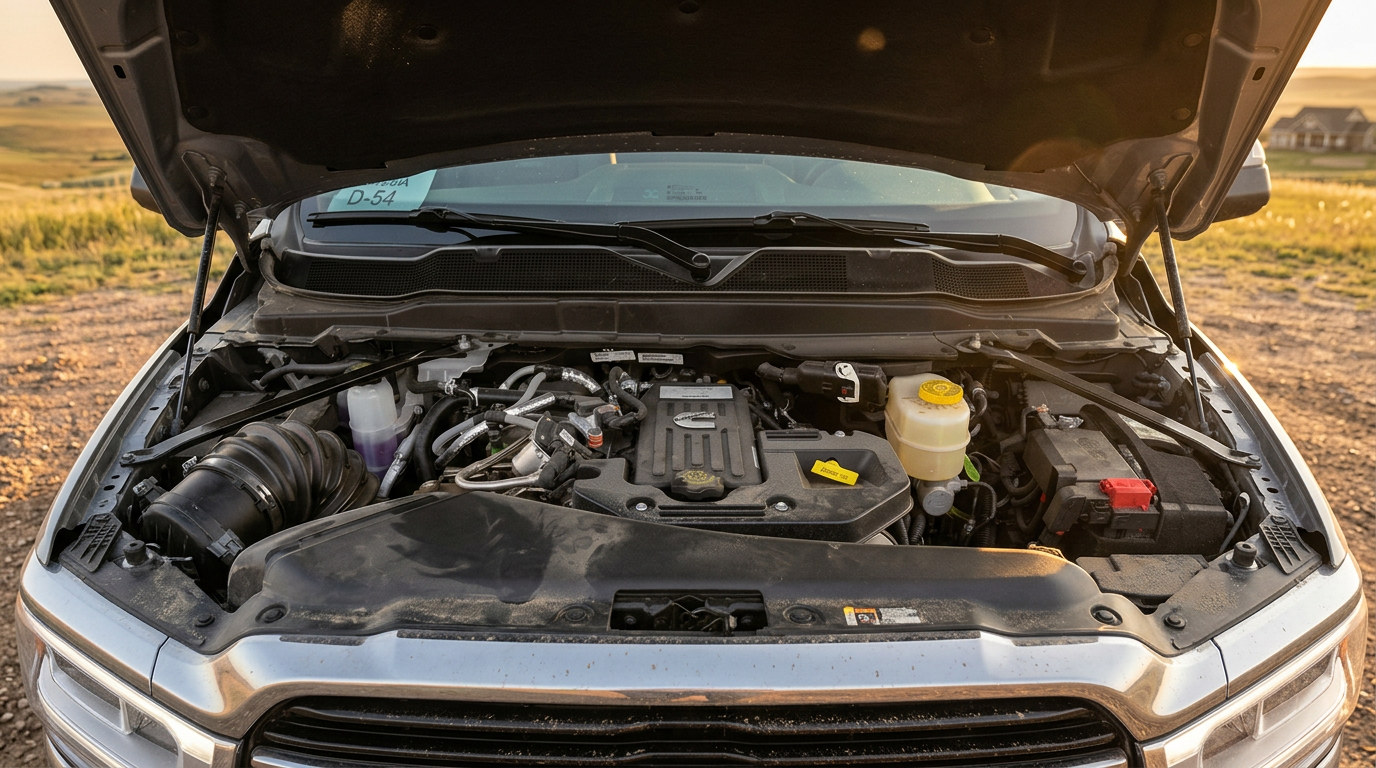
The 2026 Ram 3500 diesel-versus-gas choice is bigger than it is in any other Ram truck. Yes, both the 6.4L V8 HEMI HD and the 6.7L Cummins turbo diesel can haul and tow, but their strengths split in completely different directions — and one of them isn’t even available in your configuration.
In this guide, we’ll break down the real specs, the $12,995 question every 3500 buyer faces, and which engine makes sense for ranchers, ag operators, and contractors across the Northern Plains. If you’re shopping a 3500, this decision matters.
On This Page
Should I get the Cummins diesel or the HEMI in my Ram 3500?
The Cummins is built for towing raw power and long-term durability; the HEMI is built for payload and daily efficiency. Which one you choose depends entirely on what work you’re actually doing.
Here’s the practical breakdown: If you’re hauling horse trailers, equipment trailers, or heavy implements across the ranch, the Cummins’ 1,075 lb-ft of torque and 36,610 lb max towing capacity (on dual rear wheel models) make it the clear choice. If you’re hauling fence posts and grain in the truck bed without a heavy trailer, the HEMI’s 7,590 lb max payload capacity is worth more to you than the extra towing strength.
One more critical factor: Not all configurations offer both engines. If you’re set on a Mega Cab, Cummins only. If you want a Regular Cab 4×2, HEMI only. We’ll cover those limits in the sections below.
Why is the HEMI not available on the Mega Cab?
The HEMI’s size, weight, and support structure don’t align with the Mega Cab’s configuration. Ram reserved the Mega Cab exclusively for the Cummins diesel, making it a truck built specifically for buyers who need that towing and hauling power above all else.
This is actually a smart move from a product standpoint: Mega Cab buyers are typically experienced truck owners and operators who already know they want diesel capability. By making the Cummins standard on Mega Cab (at no upcharge), Ram simplified the model and signaled that this cab size is engineered for serious work.
If you love the Mega Cab’s spacious rear seat but want to keep your engine options open, the Regular Cab 4×4 or Crew Cab with Cummins gives you that flexibility without losing the features you want.
Is the Cummins worth $12,995 on a 3500?
Yes — but only if you’re using the truck for heavy towing or high-mileage hauling. If you’re light on trailer work, the HEMI’s fuel economy and lower purchase price win.
The $12,995 premium buys you the 6.7L I6 Cummins turbo diesel with 430 hp and 1,075 lb-ft of torque, paired with the 8-speed TorqueFlite HD automatic transmission. For context, that’s an extra $12,995 over the base 6.4L V8 HEMI HD (405 hp, 429 lb-ft) with the 8-speed 8HP75-LCV transmission.
If your monthly towing load exceeds 15,000–20,000 lbs, the diesel’s torque and transmission durability will justify the cost in the first 3–5 years of ownership. If you’re under that threshold, the HEMI’s better fuel economy and lower maintenance costs often win back that $12,995 over the same period.
For ag operators and ranchers across South Dakota, the math often favors the Cummins because the work is consistent and heavy. But if you do seasonal or light pulling, the HEMI makes more sense on your budget.
Which engine tows more on a Ram 3500 dually?
The Cummins diesel dominates in towing: 36,610 lbs max capacity on a dually (DRW) versus the HEMI’s 18,150 lbs. That’s a 20,460 lb advantage — more than double the pulling power.
Those Cummins numbers come on a Regular or Crew Cab 8-foot bed, 4×4 with a 3.42 rear axle ratio. The HEMI dually max is on a Crew Cab 8-footer, 4×2 with a 4.10 axle. Even accounting for the different axle ratios, the diesel’s torque advantage is decisive.
For Northern Plains operators pulling anhydrous ammonia tanks, gooseneck grain trailers, or livestock trailers regularly, the Cummins dually is the only realistic choice. The HEMI dually can handle lighter trailers and loads, but it’s being asked to work much harder for less output. If you’re shopping a dually 3500, towing capacity is almost certainly your primary concern — and that means Cummins.
Want to understand how dually trucks compare to single rear wheel versions? Check out our Ram 3500 SRW vs DRW guide for the full breakdown.
Which 3500 engine has the highest payload capacity?
The HEMI wins the payload battle: 7,590 lbs max on a Crew Cab dually 8-foot bed, 4×2, versus the Cummins’ 6,050 lbs on the same configuration. That’s a 1,540 lb advantage for the gas engine.
This is the flip side of the diesel’s towing dominance. The Cummins engine and transmission are heavier, which reduces payload capacity. For ranchers who work primarily with the truck bed — loading and hauling hay, grain, mineral feeders, or livestock — the HEMI’s payload advantage can be significant over the truck’s life.
Don’t assume the Cummins “hauls more” overall. It tows more, but it carries less. If your work is 60% truck bed and 40% trailer, that HEMI payload capacity might be the deciding factor. For full details on payload vs. towing, see our Ram 3500 payload and hauling guide.
Can I get a Cummins on a Regular Cab 4×2 Ram 3500?
No. The Cummins is not available on a Regular Cab 4×2 3500. If you want a diesel on a Regular Cab, you must step up to 4×4. The HEMI is available on the Reg Cab 4×2, but only in that lighter configuration.
This limitation reflects Ram’s engineering: the Cummins diesel requires the additional frame and drivetrain support of 4×4 to perform safely and reliably in the Regular Cab. For buyers who specifically want a light-duty Regular Cab 4×2 — often for short-bed work trucks in town — the HEMI is your only option.
If you need diesel power in a Regular Cab, 4×4 opens both engines to you (HEMI is standard, Cummins is +$12,995). If you’re locked on 4×2, you’re getting the HEMI, and that truck will be lighter on fuel and easier to live with daily.
Quick Engine Decision Table
| Scenario | Worth the Cummins ($12,995) | Stick with HEMI |
|---|---|---|
| Monthly Towing Load | 15,000+ lbs regularly | Under 10,000 lbs |
| Truck Bed Work | Seasonal or light | Frequent (hay, grain, etc.) |
| Fuel Budget | Flexible; value long-term durability | Want best fuel economy |
| Ownership Length | 5+ years; heavy use | 3–5 years; light-to-moderate |
| Cab Configuration | Mega Cab (diesel only) | Reg Cab 4×2 (gas only) |
How to Pick Between Cummins and HEMI for Your 3500
- Check your cab and drivetrain configuration. Log into the Ram build tool (or call us) and confirm whether both engines are available for your cab size and 4×2/4×4 choice. If only one is available, your decision is already made.
- List your typical monthly work. Write down your heaviest towing day and your average truck bed loads. If towing consistently exceeds 15,000 lbs, the Cummins ROI is stronger.
- Compare towing and payload specs for your exact configuration. Visit our towing capacity guide to see real max numbers for your cab, bed, and axle choice.
- Factor in fuel and maintenance costs over 5 years. The Cummins burns diesel (often cheaper per gallon than gas) but costs more upfront and requires specialized service. The HEMI costs less to buy and maintains with standard repairs, but drinks more fuel.
- Test drive both. Come see us at Beadle’s Chrysler Center in Bowdle and take a HEMI and Cummins out back-to-back. Feel the torque delivery, listen to the transmission, and trust your gut on what feels right for your work.
- Get a pre-qualification to see your true buying power. Once you’ve picked an engine, pre-qualify to understand your budget and whether the $12,995 premium fits your plan.
Key Takeaways
- Cummins dominates towing: 36,610 lbs max on a dually vs. HEMI’s 18,150 lbs. Diesel is the choice for regular, heavy trailer work.
- HEMI wins payload: 7,590 lbs max vs. Cummins’ 6,050 lbs. Gas engine is better for truck-bed work and lighter operators.
- Not all configs offer both engines: Mega Cab = Cummins only. Reg Cab 4×2 = HEMI only. Check your cab choice first.
- The $12,995 premium pays off if towing exceeds 15,000 lbs monthly. For light work, the HEMI’s fuel economy and lower price win.
Engine FAQ
What’s the horsepower difference between the HEMI and Cummins?
The Cummins produces 430 hp versus the HEMI’s 405 hp — a 25 hp edge for diesel. But the real power gap is in torque: Cummins delivers 1,075 lb-ft versus HEMI’s 429 lb-ft. That torque difference is what makes the diesel so much better at hauling trailers and loaded trucks uphill.
How much does Cummins diesel maintenance cost compared to the HEMI?
Diesel maintenance is more expensive upfront (oil changes, filters, injectors) but typically runs further between services. The HEMI is easier and cheaper to maintain on a per-visit basis, but you’ll service it more often. The timing and per-visit dollar amounts differ significantly — ask us for a breakdown based on your expected mileage and ownership timeline.
Can I tow 30,000 lbs with a HEMI 3500 dually?
No. The HEMI dually maxes out at 18,150 lbs. Towing beyond that rating is unsafe and voids your Ram warranty. If you regularly need to tow over 25,000 lbs, the Cummins diesel (36,610 lbs max) is not optional — it’s required.
Does the Cummins get better fuel economy than the HEMI on the 3500?
Yes, but the savings depend on your driving. Based on real-world owner reports (Ram does not publish EPA fuel economy ratings for the 3500), the Cummins typically sees 18–22 mpg highway while the HEMI runs 15–17 mpg — but diesel fuel costs more per gallon in South Dakota. On light duty, the HEMI is often more economical overall. On heavy towing, the Cummins saves money because it works more efficiently under load.
Is the 8HP75 HEMI transmission strong enough for heavy towing?
The 8HP75-LCV transmission (paired with HEMI) is robust for towing, but it’s engineered for the HEMI’s torque curve. The Cummins pairs with the heavier-duty 8-speed TorqueFlite HD transmission, which is specifically designed for diesel torque. For consistent heavy towing, the TorqueFlite HD offers more margin. For light-to-moderate trailers, the 8HP75 is reliable and proven.
My Take on the Cummins vs HEMI Question
I’ve spent a lot of time digging into every 3500 configuration we carry at Beadle’s Chrysler Center, and I can tell you: the engine choice is one of the most honest decisions you’ll make as a truck buyer. There’s no “best” answer. There’s only the right answer for your work.
The Cummins isn’t more truck. The HEMI isn’t less capable. They’re just built for different jobs. We talk to buyers who run Cummins 3500 dualies and never tow anything over 25,000 lbs — they spent extra money for capability they don’t use. We also hear from folks with HEMI dualies who are constantly maxed out because they passed on the diesel upcharge — and they’re fighting the truck instead of letting it work.
If you’re serious about towing — especially if you’re pulling ag equipment or livestock trailers 200+ days a year across the Northern Plains — the Cummins pays for itself in reliability and peace of mind. If you’re using the truck bed as much as the trailer hitch, or you’re pulling under 10,000 lbs, save the $12,995 and enjoy the HEMI’s simpler ownership and better fuel economy.
The best part? You can explore all the 3500 configurations in our full buyer’s guide, then come test drive both engines back-to-back. Sometimes the right choice isn’t what the specs say — it’s what feels right in your gut when you’re behind the wheel.
About the Author
Lexy Tabbert — Beadle’s Chrysler Center, Bowdle, SD
Lexy Tabbert is the Director of Sales and Marketing at Beadle’s Chrysler Center in Bowdle, South Dakota. She covers Ram, Jeep, Dodge, and Chrysler vehicles — helping families, ranchers, and ag operators across the region find the right truck and configuration for their needs. Learn more about Lexy.
Connect with us


