




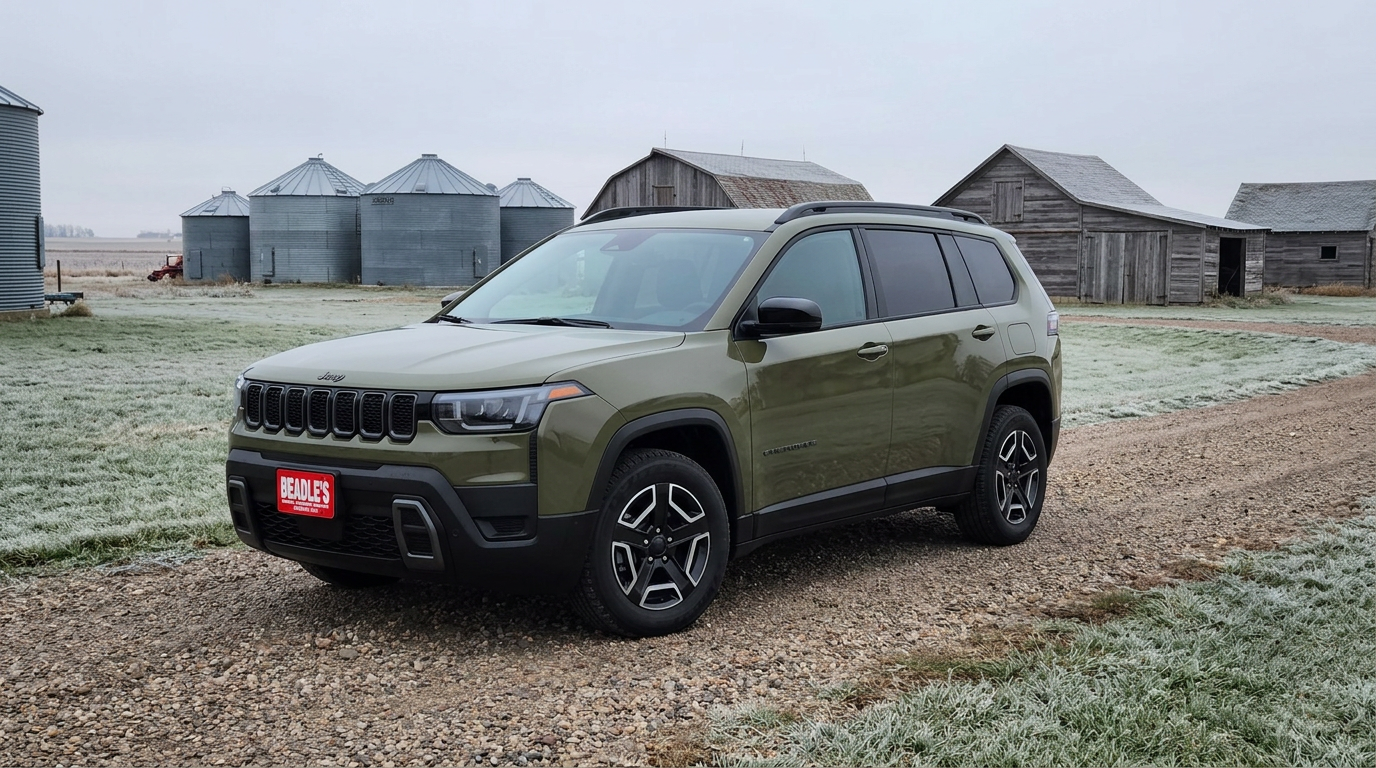
Most crossover buyers in South Dakota aren’t shopping for a rock crawler. They need a vehicle that handles graveled county roads, soft field approaches, rutted two-tracks, and seasonal mud without requiring thought or special procedure. Eight inches of ground clearance and Jeep Active Drive I on the 2026 Cherokee are engineered for exactly that kind of use.
This guide covers how the Cherokee’s Active Drive I 4×4 system actually works, what the rear-axle disconnect does, what 8 inches of clearance means on back roads in this region, and how to get the most out of the system on the roads South Dakota buyers actually drive.
On This Page
- What is Jeep Active Drive I on the 2026 Cherokee?
- How does the rear-axle disconnect system work?
- What does 8 inches of ground clearance handle?
- How does Active Drive perform on gravel and two-track roads?
- How does Cherokee 4×4 compare to a traditional truck 4WD?
- When to engage vs. let the system manage automatically
What is Jeep Active Drive I on the 2026 Cherokee?
Jeep Active Drive I is the 2026 Cherokee’s standard 4×4 system — available on every trim, with no FWD option and no upgrade required. It’s a full-time intelligent 4×4 system that monitors wheel speed and traction conditions continuously, distributing torque between front and rear axles as conditions demand.
Unlike traditional part-time 4WD systems that require the driver to manually shift into 4-High or 4-Low, Active Drive I operates automatically. There’s no lever to pull, no button to hold, and no procedure to follow before you turn onto a rough road. The system monitors and responds in real time — you drive, it manages traction.
Combined with Selec-Terrain’s four modes (Auto, Sport, Snow, Sand/Mud), Active Drive I gives the driver the ability to tell the system what kind of surface it’s operating on — and the system adjusts accordingly. On most South Dakota back roads, Auto mode and Active Drive I handle conditions without any manual input at all.
How does the rear-axle disconnect system work?
The Active Drive I system includes a rear-axle disconnect — a mechanism that decouples the rear axle from the drivetrain during low-demand conditions to reduce friction and improve fuel economy. When you’re cruising on dry pavement at highway speed with no traction demand, the rear axle disconnects, the Cherokee effectively drives on front-wheel power, and the hybrid system operates more efficiently.
When the system detects a need for all-wheel torque — wheel slip, demanding surface conditions, or a Selec-Terrain mode that requires full engagement — the rear axle reconnects automatically. Reconnection happens in milliseconds. From the driver’s seat, you don’t feel the transition.
Common Mistake
Buyers sometimes interpret the rear-axle disconnect as a weakness — “it’s not really in 4×4 all the time.” The disconnect is a fuel economy feature, not a capability compromise. When traction demand is present, the system reconnects before you’ve lost control. The tradeoff is that on surfaces where you want proactive full engagement — ice, deep mud — Snow or Sand/Mud mode keeps the system in a higher-readiness state rather than waiting to detect slip first. Use the terrain modes appropriately and the disconnect isn’t a concern.
What does 8 inches of ground clearance actually handle?
Eight inches of ground clearance is the measurement from the lowest point of the vehicle’s underbody to the ground surface. For comparison: a typical sedan has 5–6 inches, a standard crossover has 7–8 inches, and a body-on-frame truck runs 8–10 inches or more. The Cherokee’s 8 inches puts it at the capable end of the crossover segment.
What 8 inches handles on South Dakota roads: standard gravel county road washboard, moderate snow accumulation (4–5 inches of packed snow on a road surface), typical field approach ruts, low-water creek crossings on ranch roads, and most rock or debris on unpaved surfaces. What it doesn’t handle: deep snow drifts the vehicle has to push through, significant rock ledges, or conditions that require high-clearance truck-level underbody protection.
For the driving conditions most central South Dakota buyers encounter — seasonal county roads, pasture access tracks, gravel approaches, and occasional soft ground — 8 inches of clearance is sufficient. Buyers who regularly navigate terrain that challenges a half-ton pickup belong in a truck; buyers who need reliable capability on everything short of that are well-served by the Cherokee’s clearance numbers.
How does Active Drive perform on gravel and two-track roads?
Gravel is the default surface for a large portion of rural South Dakota driving, and Active Drive I handles it without any special procedure. In Auto mode, the system monitors surface conditions continuously — when loose gravel causes minor front-wheel slip, torque shifts rearward automatically to maintain directional stability.
Two-track roads — the kind that run out to pastures, hunting spots, or remote fence lines — often combine loose surface with uneven terrain and occasional soft spots. The Cherokee’s hybrid system contributes here in a specific way: the electric motors provide instant, smooth torque at low speeds, which helps maintain momentum on soft ground without the jerky throttle response of a traditional gas engine trying to modulate power at low RPM. Creeping through a soft spring pasture approach at 5 mph is where that smoothness is most noticeable.
Rough Road Cruise Control
The 2026 Cherokee includes Rough Road Cruise Control as standard equipment on all trims. On washboard gravel or uneven surfaces, this feature maintains a steady vehicle speed without the constant throttle adjustment that standard cruise control struggles with on rough terrain. For long gravel county road commutes, it reduces driver fatigue meaningfully. Engage it the same way as highway cruise control — it activates and holds speed on rough surfaces where highway cruise would normally need constant correction.
How does Cherokee 4×4 compare to traditional truck 4WD?
Traditional truck 4WD — the kind found on a Ram 1500 or Ram 2500 — uses a transfer case with selectable 2WD, 4-High, and 4-Low ranges. The driver chooses the range based on conditions, and the system locks front and rear driveshafts together mechanically in 4-High or 4-Low. At low speeds in 4-Low, the mechanical advantage is significant for extreme off-road demand.
Active Drive I operates differently: it’s a full-time intelligent system without a manual low-range selection. It continuously varies torque split rather than mechanically locking axles. For the conditions most Cherokee buyers encounter — gravel, mud, snow, soft ground — the Cherokee’s system is more convenient and equally capable. You don’t need to stop and shift into 4-High before a county road; Active Drive I is already managing traction.
Where traditional truck 4WD wins: sustained extreme off-road use, rock crawling, deep ruts requiring mechanical low-range torque multiplication, and recovery situations requiring locked axle traction. The Cherokee is not designed for those conditions and doesn’t pretend to be. For ranch and ag buyers who need that level of capability regularly, a Ram 1500 or larger truck is the right tool. For buyers who need reliable all-surface performance on everything short of extreme off-road, Active Drive I covers the job without the complexity of a manual transfer case.
When to engage vs. let the system manage automatically
Active Drive I manages traction automatically in most situations. Here’s when to let it work on its own, and when manual Selec-Terrain input improves what the system does:
- Dry or lightly wet pavement — leave it in Auto: Active Drive I and Auto mode handle all normal on-road conditions. No input needed. The rear-axle disconnect operates for fuel efficiency and the system manages traction reactively. This is the correct default for most daily driving.
- Gravel county roads — Auto handles it, Sand/Mud if it’s loose: Standard packed gravel in Auto mode is fine — the system adjusts for occasional slip automatically. If the road has been freshly graveled and the surface is genuinely loose, switching to Sand/Mud allows slightly more wheel movement to find traction without the traction control suppressing it.
- Ice or packed snow — switch to Snow proactively: Don’t wait for wheel slip. If the temperature is below freezing and any road surface could be icy, engage Snow mode before you reach the problem section. The system’s proactive throttle and braking calibration in Snow mode prevents the slip that Auto would react to after the fact.
- Soft field approaches or mud — switch to Sand/Mud: Before you turn off the gravel onto a soft approach, engage Sand/Mud. The mode allows controlled wheel spin to maintain momentum on soft ground. Switching after you’ve already bogged down in mud is less effective than setting the mode before you enter the soft section.
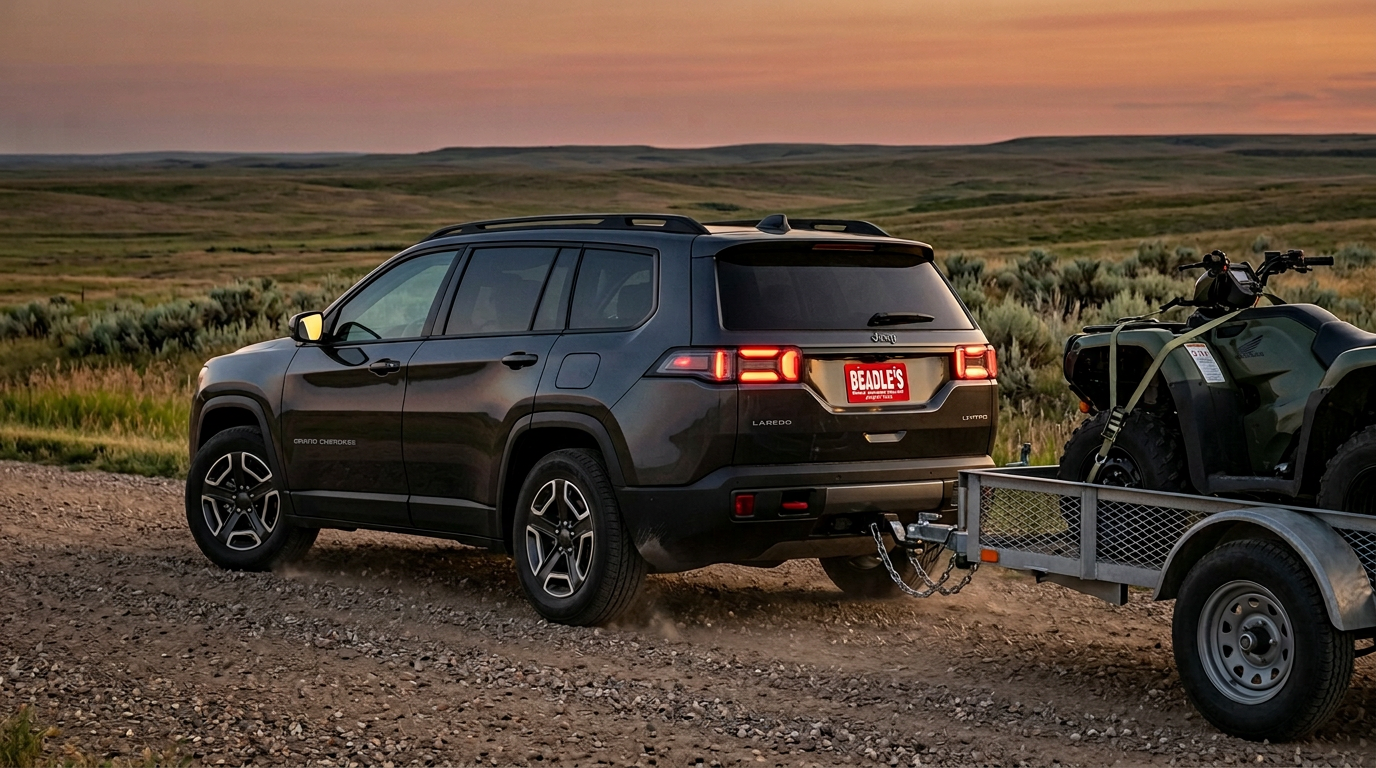
- If you get stuck — don’t spin the wheels: If the Cherokee becomes high-centered or genuinely stuck, prolonged wheel spin digs you deeper. Stop, assess whether backing out is possible, and if needed engage Sand/Mud for the recovery attempt. The 5,350-lb GVW rating means a recovery strap or come-along is viable on most vehicles your buyers would have nearby. The Cherokee’s tow hook points are accessible for exactly this situation.
Active Drive I vs. Traditional 4WD: Quick Reference
| Condition | Active Drive I (Cherokee) | Traditional Truck 4WD |
|---|---|---|
| Gravel county roads | Handles automatically | Typically 2WD — driver shifts if needed |
| Packed snow / ice | Snow mode — proactive traction | 4-High — driver must engage |
| Soft mud / field approach | Sand/Mud mode — controlled spin | 4-High or 4-Low depending on severity |
| Rock crawling / extreme terrain | Not designed for this | 4-Low — mechanical advantage |
| Daily driving ease | Fully automatic, no procedure | Requires manual shift selection |
| Fuel economy | Rear-axle disconnect saves fuel | 2WD mode needed for efficiency |
Active Drive I is standard on all five 2026 Cherokee trims. Traditional 4WD comparison based on typical body-on-frame truck architecture.
Key Takeaways
- Jeep Active Drive I is a full-time intelligent 4×4 system — standard on every 2026 Cherokee trim with no FWD option. It manages traction automatically without driver input in most conditions.
- The rear-axle disconnect improves fuel economy on pavement by decoupling the rear axle at low traction demand. It reconnects automatically in milliseconds when conditions require it.
- Eight inches of ground clearance handles standard gravel roads, moderate snow, pasture approaches, and most back-road conditions in central South Dakota. It is not a rock crawler — buyers who need sustained extreme off-road capability should be in a truck.
- Rough Road Cruise Control is standard on all trims — it maintains steady speed on washboard gravel where highway cruise control would require constant correction.
- Use Selec-Terrain proactively: Snow mode before icy roads, Sand/Mud before soft approaches. Active Drive I is reactive in Auto mode; terrain modes make it proactive.
Frequently Asked Questions
Is Jeep Active Drive I the same as AWD?
Active Drive I is Jeep’s 4×4 system, not a generic AWD system. The distinction matters in design philosophy: most crossover AWD systems are primarily on-road stability systems that reactively distribute torque. Active Drive I is built around Jeep’s 4×4 architecture, with Selec-Terrain terrain mode integration and a rear-axle disconnect for efficiency. For South Dakota’s mix of paved, gravel, snow, and soft terrain, Active Drive I provides more deliberate traction management than a typical crossover AWD system.
Does the Cherokee have a 4-Low setting?
No — Jeep Active Drive I does not have a 4-Low range. It’s a full-time intelligent 4×4 system designed for on-road and moderate off-road use, not sustained extreme off-road or rock crawling. For buyers who regularly need 4-Low mechanical low-range capability — deep recovery situations, serious rock terrain — a body-on-frame truck or a Wrangler/Gladiator with a low-range transfer case is the appropriate platform.
Will the Cherokee handle South Dakota gravel roads without damage?
Yes — the Cherokee’s 8 inches of ground clearance and 4×4 system are suited for standard gravel county road driving. Routine gravel travel does not require any special procedure or mode selection; Auto mode handles it. For loose freshly-graveled surfaces, Sand/Mud mode allows more appropriate wheel response. As with any vehicle, avoid sharp gravel edges at speed and be aware that stone chip risk to paint and glass is inherent to gravel road driving regardless of vehicle type.
What is Rough Road Cruise Control on the Cherokee?
Rough Road Cruise Control is a standard feature on all 2026 Cherokee trims that allows the cruise control system to maintain a set speed on uneven or washboard surfaces — conditions where standard adaptive cruise control typically disengages or struggles to hold a steady speed. For South Dakota buyers who commute long distances on gravel county roads, it reduces driver fatigue on rough-surface stretches without requiring constant manual throttle adjustment.
My Take on the Cherokee’s 4×4 for South Dakota Back Roads
The buyers who push back on the Cherokee’s 4×4 capability are almost always comparing it to a truck — and that’s not the right comparison. The Cherokee isn’t trying to do what a Ram 2500 does. What it does do is handle every surface a rural South Dakota driver encounters on a normal week without requiring any thought or special procedure. Gravel roads, muddy field approaches, snow-packed county roads — all of it in Auto mode or with a single terrain mode selection, without stopping, without a manual shift, without worrying about it.
The Rough Road Cruise Control is one of those features that gets mentioned in the delivery walkthrough and immediately resonates with buyers who do long gravel commutes. Standard cruise control on washboard gravel is frustrating — you’re constantly hunting the right speed as the road surface changes. Rough Road Cruise Control holds it. For someone driving 20 miles of gravel county road twice a day, that’s a meaningful quality-of-life upgrade that has nothing to do with off-road capability in the traditional sense.
For the full picture on the 2026 Cherokee’s specs and what the 4×4 system looks like alongside all five trim levels, our complete 2026 Cherokee guide covers all of it. Stop by Beadle’s in Bowdle if you want to see Active Drive I on a specific unit — we can take it out on the gravel and show you exactly how it behaves.
About the Author
Lexy Tabbert — Beadle’s Chrysler Center, Bowdle, SD
Lexy Tabbert is the Director of Sales and Marketing at Beadle’s Chrysler Center in Bowdle, South Dakota. She covers Ram, Jeep, Dodge, and Chrysler vehicles — helping families, ranchers, and ag operators across the region find the right truck and configuration for their needs. Learn more about Lexy.
Connect with us


