





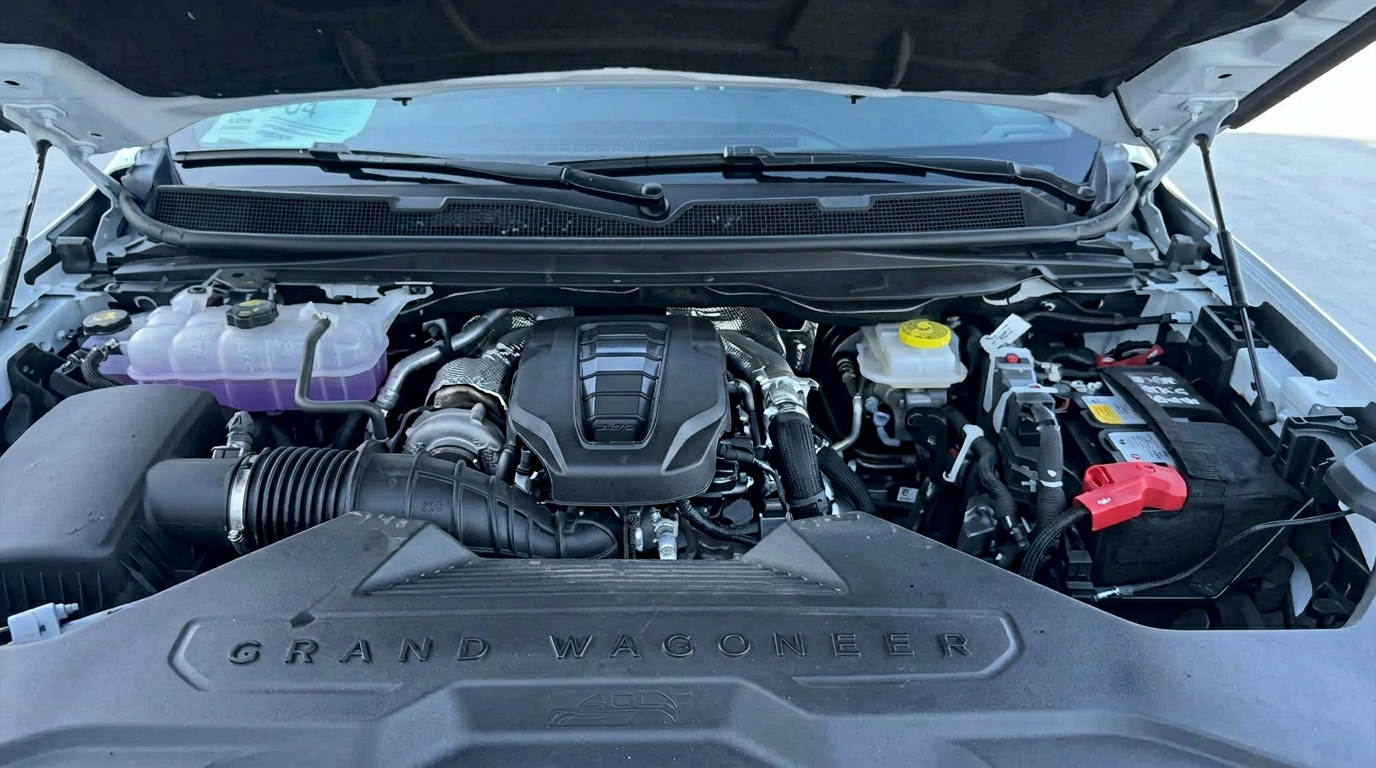
The 2026 Jeep Grand Wagoneer L runs a different engine than the 2025 model — and unless you’re tracking model-year changes closely, the swap is easy to miss. Jeep moved from the Hurricane Twin Turbo High Output (HO) in 2025 to the Hurricane Twin Turbo Standard Output (SO) for 2026. Same 3.0L inline-six twin-turbo architecture, different tune. The SO produces 420 hp and 468 lb-ft of torque per Jeep’s capability page, paired with a new in-house 8-speed automatic transmission.
This guide explains why Jeep made the swap, what 420 hp actually feels like in a full-size luxury family SUV, the real-world fuel economy story, what to think about for reliability on a relatively new engine family, and the range-extender hybrid Jeep has signaled is coming later in 2026.
On This Page
- What engine does the 2026 Grand Wagoneer L have?
- Why did Jeep swap from the 2025 Hurricane HO to the new SO?
- What does 420 hp actually feel like in this vehicle?
- What’s the real-world fuel economy and driving range?
- How reliable is the new Hurricane SO engine?
- When is the range-extender hybrid coming?
- Quick reference: 2025 HO vs 2026 SO
- How to maximize fuel economy on long South Dakota drives
- Key takeaways
- Frequently asked questions
What engine does the 2026 Grand Wagoneer L have?
Every 2026 Grand Wagoneer L — the 4×2, 4×4, Limited, and Summit — runs the same powertrain: the 3.0L Hurricane Twin Turbo Standard Output inline-six paired with an 8-speed automatic transmission and Engine Stop-Start technology. There is no V-8 option, no diesel option, and no hybrid in the 2026 lineup at launch. That changes later in 2026 when the range-extender hybrid arrives — but for the entire current lineup, it’s one engine across all four trims.
Per Jeep’s capability page, the Hurricane Twin Turbo SO produces 420 horsepower and 468 lb-ft of torque. Those are the OEM-direct figures. The 8-speed automatic is a new in-house Stellantis transmission for 2026 — Jeep moved away from the ZF-sourced 8-speed used in the 2025 model. Engine Stop-Start is standard, as is the Heavy Duty Engine Cooling on every trim — both relevant for a vehicle that may spend time idling at boat ramps or pulling steady highway loads in summer heat.
Why did Jeep swap from the 2025 Hurricane HO to the new SO?
This is the part of the 2026 story that competing reviews tend to gloss over. The 2025 Grand Wagoneer L ran the Hurricane Twin Turbo High Output (HO) — same 3.0L inline-six architecture, but tuned for higher peak figures (in the neighborhood of 510 hp on competing publications). The 2026 model uses the Standard Output (SO) tune at 420 hp and 468 lb-ft. That’s a real reduction in peak horsepower.
The reason: the 2026 Grand Wagoneer L is positioned at a substantially lower starting price than the 2025 model — high $60s for the base 4×4 versus mid $90s for the 2025 entry trim. To hit that price point, Jeep made several decontenting choices, and the engine tune is one of them. The HO became reserved for higher-output applications elsewhere in the Stellantis lineup; the SO became the standard powertrain for the more accessible Grand Wagoneer L lineup.
Whether the change matters depends on what you actually need from the vehicle. For a buyer using the Grand Wagoneer L the way most buyers do — family transport, recreational towing, long highway drives — 420 hp is genuinely sufficient. For a buyer who specifically wanted the 510-hp tune for a specific reason, the 2025 model may still be available used, and that’s a fair conversation to have. The full 2025-vs-2026 change list is covered in our what changed for 2026 guide.
What does 420 hp actually feel like in this vehicle?
The Hurricane SO doesn’t feel like a sports-car engine in a luxury SUV — and it shouldn’t. What it does feel like: smooth, effortless, and torque-rich at the speeds you actually drive. The 468 lb-ft of torque is the more important number for daily use; that’s what gets the truck moving from a stop, climbs a Black Hills grade with a trailer, and merges onto I-90 at full freeway speed without the engine having to work hard.
Compared to a naturally aspirated V-8 — say a 6.2L from a Tahoe High Country — the Hurricane SO trades a rumbly soundtrack for a more refined, quieter delivery and stronger low-end response. There’s no induction roar through the cabin. The twin turbos build boost smoothly and the engine feels relaxed in the rev range you spend most of your time in.
For context: the Grand Wagoneer L 4×4 has a curb weight in the 6,200-pound range. 420 hp moving that much vehicle is roughly the same power-to-weight ratio as many full-size SUVs in this segment. Acceleration won’t impress anyone with a stopwatch, but it’s never an issue in real driving. The truck pulls confidently up a grade, gets out of its own way merging, and never feels labored.
What’s the real-world fuel economy and driving range?
EPA-rated at 16 city, 22 highway, 18 combined per the window sticker on the in-stock 4×4 we have on the lot. Those are reasonable numbers for a 6,500-pound luxury 3-row SUV with a turbocharged engine. The same EPA estimate puts annual fuel cost at $2,750.
Real-world fuel economy varies with driving style, terrain, load, and weather — but for South Dakota highway driving at 70 mph on cruise control with a moderate load, 22 mpg is a fair expectation. In stop-and-go conditions or with the cabin loaded full of family and gear, expect closer to the 16 city number.
Where the Hurricane SO genuinely earns its keep is fuel-tank range. The 30.5-gallon tank gives you real distance between fill-ups: roughly 670 miles of highway range theoretical, around 550 miles combined. In practical terms, Bowdle to Minneapolis at 390 miles is comfortably one tank with margin. Long multi-state runs are achievable with a single fuel stop along the way. For families that drive long distances regularly, the range advantage matters more than 1–2 mpg either way.
How reliable is the new Hurricane SO engine?
Honest answer: the Hurricane Twin Turbo family is a relatively new engine for Stellantis — introduced in the Wagoneer family in 2023. Long-term reliability data isn’t yet available the way it is for, say, a 5.7L HEMI V-8 with two decades of fleet data. That doesn’t mean it’s unreliable; it means the data set is shorter.
What’s covered by warranty
Per the window sticker, every new Grand Wagoneer L includes a 5-year / 60,000-mile Powertrain Limited Warranty and a 3-year / 36,000-mile Basic Limited Warranty. The powertrain coverage protects the engine and transmission specifically — the part of the vehicle most relevant to the new-engine-family question.
For buyers who specifically want the longer reliability track record of an established engine — say, the 5.7L HEMI V-8 — the Grand Wagoneer L isn’t where you find it. That’s a Ram or Durango conversation. For buyers who are comfortable with a newer engine family from a major manufacturer with full powertrain warranty coverage, the Hurricane SO is a reasonable choice. As with any new engine generation, regular maintenance and following the recommended service intervals matter more than they do on a long-proven design.
When is the range-extender hybrid coming?
Jeep has signaled that a range-extender hybrid (REEV) Grand Wagoneer variant is coming later in 2026, borrowing technology from the Ram REV 1500 program. Reported figures point to a combined output substantially higher than the SO’s 420 hp, with electric-only range supplemented by an onboard generator running the Hurricane engine.
What we don’t have yet: an exact launch date, confirmed pricing, confirmed trim availability, or final EPA figures. That information will be released closer to the on-sale date, and as soon as Jeep confirms the details for our region we’ll update this content.
Practical advice for buyers asking about it: if the hybrid is the version you specifically want, it makes sense to wait. If you need a vehicle now and the gas Hurricane SO covers your needs, the current model is on the lot and the hybrid arriving later doesn’t make it less of a vehicle today. If you tow heavy or run long distances on remote highways, the gas powertrain may actually be the more practical choice long-term — range-extender hybrids favor city and short-trip use over interstate hauling.
Quick reference: 2025 Hurricane HO vs 2026 Hurricane SO
| Spec | 2025 Hurricane HO | 2026 Hurricane SO |
|---|---|---|
| Architecture | 3.0L I-6 twin-turbo | 3.0L I-6 twin-turbo |
| Horsepower (peak) | ~510 hp (per published reviews) | 420 hp (Jeep capability page) |
| Transmission | 8-speed auto (ZF-sourced) | 8-speed auto (Stellantis in-house) |
| Engine Stop-Start | Standard | Standard |
| 2025 trim availability | Series II / Series III only | All four 2026 trims |
Worth it if: you want the most accessible price point on a Grand Wagoneer L and 420 hp covers your needs — the 2026 SO is the right answer.
Skip it if: you specifically wanted the higher-output HO tune from 2025 — a used 2025 Series II or Series III may still be on the market and is a different conversation.
Want to feel the Hurricane SO yourself? Check what’s currently on the lot.
Search Grand Wagoneer L InventoryHow to maximize fuel economy on long South Dakota drives
A handful of small habits make the difference between hitting 22 mpg highway and falling well short of it on the Hurricane SO. None are unique to this engine, but the truck rewards drivers who use them.
- Set adaptive cruise around 70 mph on the interstate. Above 75 mph, fuel economy falls off quickly with an SUV-shaped vehicle pushing through air. The Active Driving Assist system holds speed steady and helps maintain consistent throttle.
- Use Auto mode for Selec-Terrain in normal driving. Snow, Mud, and Sport modes adjust shift mapping and traction in ways that hurt fuel economy. Save them for when you actually need them.
- Let Engine Stop-Start work. The standard ESS shuts the engine off at extended idles. It’s working as designed — disabling it costs measurable fuel over a year of stop-and-go.
- Avoid heavy roof loads when possible. The standard adjustable roof rail crossbars (with HD Tow) are useful, but anything tall on the roof costs significant fuel economy at highway speed. Use a hitch-mounted carrier when feasible.
- Check tire pressure monthly. Underinflated tires cost real fuel economy. The Tire Pressure Monitoring System catches major drops, but 2-3 psi low can still cost 1-2 mpg.
Key Takeaways
- Every 2026 Grand Wagoneer L runs the 3.0L Hurricane Twin Turbo SO inline-six — 420 hp and 468 lb-ft per Jeep’s capability page, paired with a new in-house 8-speed automatic.
- The 2026 engine is a tune-down from the 2025 Hurricane HO (~510 hp). The trade-off enables the substantially lower starting price for the lineup.
- EPA-rated at 16 city / 22 highway / 18 combined. The 30.5-gallon fuel tank gives roughly 670 miles of highway range and around 550 miles combined — Bowdle to Minneapolis is comfortably one tank.
- 5-year / 60,000-mile Powertrain Limited Warranty plus 3-year / 36,000-mile Basic Limited Warranty cover the engine and transmission specifically.
- The range-extender hybrid Grand Wagoneer is signaled for later in 2026. No firm launch date or pricing yet — wait if it’s specifically the version you want.
Frequently Asked Questions
What engine does the 2026 Jeep Grand Wagoneer L have?
Every 2026 Grand Wagoneer L trim runs the 3.0L Hurricane Twin Turbo Standard Output (SO) inline-six paired with an 8-speed automatic transmission and Engine Stop-Start. There is no V-8 or diesel option. A range-extender hybrid is signaled for later in 2026.
How much horsepower does the 2026 Grand Wagoneer L Hurricane Twin Turbo make?
420 horsepower and 468 lb-ft of torque per Jeep’s capability page. That’s the Standard Output (SO) tune, a step down from the 2025 model’s High Output (HO) tune. The lower output is part of how Jeep delivered the substantially lower starting price for the 2026 lineup.
What kind of fuel economy can I expect from the 2026 Grand Wagoneer L?
EPA rates the 2026 Grand Wagoneer L 4×4 at 16 city, 22 highway, 18 combined per the window sticker. The 30.5-gallon fuel tank gives roughly 670 miles of theoretical highway range and 540 miles combined. Real-world economy varies with driving style, load, weather, and terrain, but South Dakota interstate driving at 70 mph with cruise control should hit the highway figure.
Is the new Hurricane Twin Turbo SO engine reliable?
The Hurricane Twin Turbo family is a relatively new engine, introduced in the Wagoneer lineup in 2023. Long-term fleet reliability data isn’t as deep as it is for the 5.7L HEMI V-8 with two decades of history. The 5-year / 60,000-mile Powertrain Limited Warranty covers the engine and transmission specifically. Buyers who specifically want a long-proven engine family may prefer a Ram or Durango with the HEMI V-8.
When will the plug-in hybrid or range-extender Grand Wagoneer L be available?
Jeep has signaled the range-extender hybrid (REEV) Grand Wagoneer variant for later in 2026, borrowing technology from the Ram REV 1500 program. No firm launch date, pricing, or trim availability has been confirmed at the time of writing. As soon as Jeep releases details for our region, we’ll update this guide. If the hybrid is specifically the version you want, waiting may be the right call. If you need a vehicle now and the gas powertrain covers your needs, the current model is on the lot.
My Take on the New Hurricane SO
The engine question is one of the more common ones I get from buyers cross-shopping the Grand Wagoneer L against a Tahoe High Country or Expedition Platinum, and the honest answer is that 420 hp is enough power for what almost every buyer in this segment actually does with the vehicle. The HO-to-SO swap looks dramatic on a spec sheet — it’s a 90-hp drop on paper — but in real driving, the 468 lb-ft of torque is doing most of the work, and that figure is competitive with naturally aspirated V-8 alternatives in the segment.
My honest take for South Dakota families: the Hurricane SO is a smooth, quiet, torque-rich engine that fits the rest of the vehicle’s character. It’s not a muscle-car powerplant, and it doesn’t try to be. The 30.5-gallon tank and the long range between fill-ups are arguably more important to buyers driving 200 to 400 miles in a stretch than peak horsepower, and the Hurricane SO delivers there. For buyers who specifically want the higher-output 2025 HO tune, that’s a used-market conversation now — and one we’re happy to help with.
For the rest of the 2026 picture — refresh, capability, tech, colors, and safety — read our 2026 Jeep Grand Wagoneer L overview. If towing is part of why you’re cross-shopping the powertrain, our recreational towing guide covers how the Hurricane SO handles real loads. And if you want to feel the engine for yourself, come drive one — twenty minutes on the highway will tell you whether the SO tune fits the way you actually drive.
About the Author
Lexy Tabbert — Beadle’s Chrysler Center, Bowdle, SD
Lexy Tabbert is the Director of Sales and Marketing at Beadle’s Chrysler Center in Bowdle, South Dakota. She covers Ram, Jeep, Dodge, and Chrysler vehicles — helping families, ranchers, and ag operators across the region find the right truck and configuration for their needs. Learn more about Lexy.
Connect with us


