




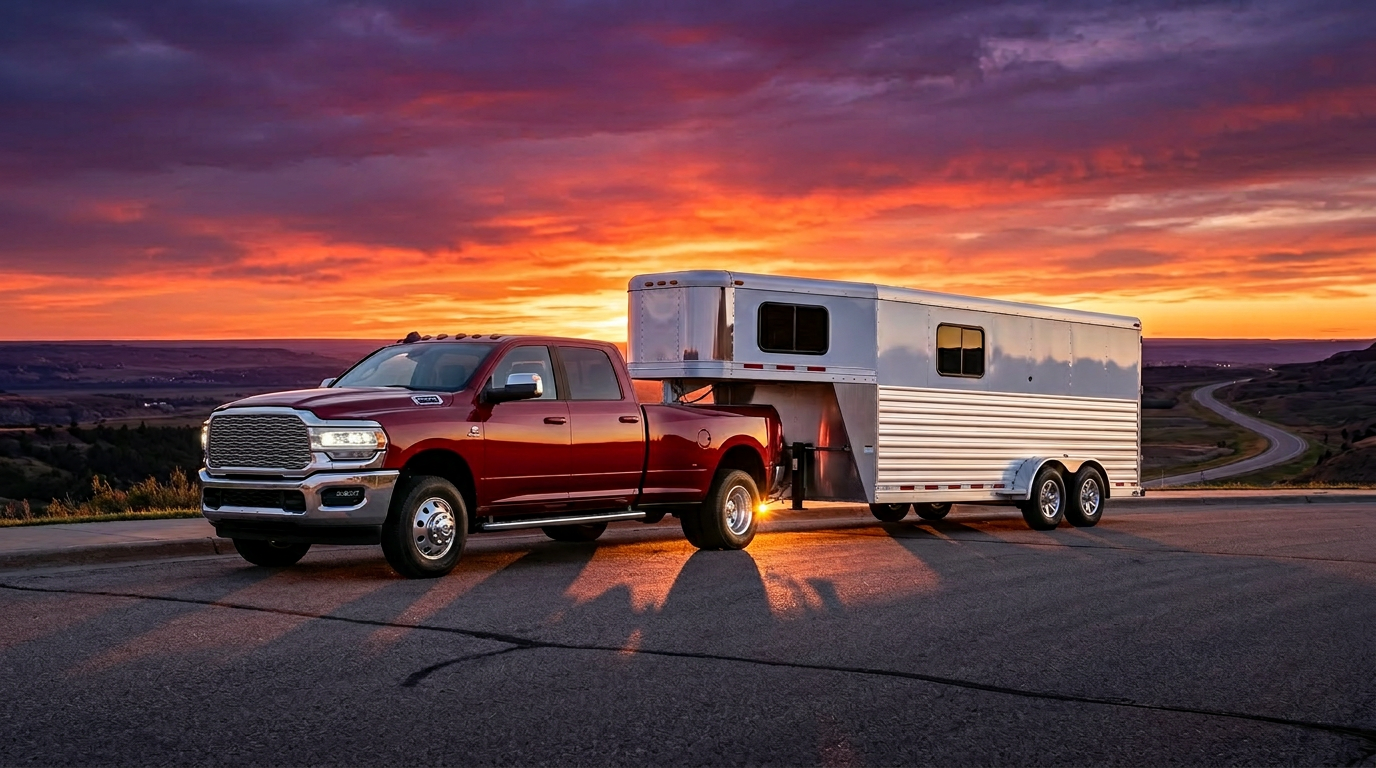
If you ranch in South Dakota and you’re shopping for a new Ram, you already know the brochure answer is useless. The right trim is the one matched to your actual loads, your actual mileage, and the way you actually spend your week — not the one a national ad campaign decided to push this quarter.
This guide walks through what working ranchers actually order at Beadle’s Chrysler Center: which Ram and which trim for which job, what the 2500 versus 3500 decision really comes down to, and the package decision most ranchers wish they hadn’t skipped. Verified 2026 specs throughout, with the configurations our customers ask for most often called out plainly.
On This Page
- Match the Truck to the Job, Not the Brochure
- The Ram 1500 Pick: Big Horn or Laramie with the Hurricane I-6
- The Ram 2500 Pick: Big Horn or Laramie 4×4 with the 6.7L Cummins
- When You Actually Need a 3500 Instead of a 2500
- 1500 vs. 2500 vs. 3500: Which Truck for Which Job?
- Power Wagon and Rebel: When Off-Road Spec Earns Its Keep
- The Package Decision Most Ranchers Regret Skipping
- How to Spec the Right Ram for Your Operation
Match the Truck to the Job, Not the Brochure
A ranch truck has to do four things well in South Dakota: pull what you actually pull, run the highway miles between operations without punishing your back, start in January at minus-fifteen, and last long enough to pay for itself. Most brochures answer the first question and assume the rest.
Out here on the high plains, that means an honest conversation about gooseneck weight, diesel power, four-wheel drive, and the upgraded tires that earn their keep on gravel and pasture. We ask a lot of questions before we spec a truck because the answers shift the order in real ways — and the right Ram for a cow-calf operation isn’t the same as the right Ram for a custom-harvest crew running between counties.
The Ram 1500 Pick: Big Horn or Laramie with the Hurricane I-6
For ranchers whose daily haul is a single-axle livestock trailer, a flatbed of fence supplies, or a tandem-axle utility, the Ram 1500 Big Horn or Laramie 4×4 with the 3.0L Hurricane twin-turbo I-6 is the most-ordered build at Beadle’s. The Hurricane Standard Output makes 420 horsepower and 469 lb-ft of torque; the High Output version steps up to 540 horsepower and 521 lb-ft.
Properly equipped, a 1500 Crew Cab 4×4 with the Hurricane HO and the right axle ratio tows up to 11,550 pounds — enough for a fully-loaded gooseneck stock trailer with a small cut of cattle, most fifth-wheel campers, or a tandem-axle equipment trailer. The 5.7L HEMI V8 with eTorque returns for 2026 as an available option on Big Horn through Limited Longhorn for buyers who prefer the traditional V8.
When the 1500 Stops Being the Right Truck
If you’re regularly pulling more than about 12,000 pounds, hauling a fifth-wheel camper over 30 feet, or running a gooseneck full of bred heifers across two counties — the 1500 has reached its honest ceiling. Step up to the 2500. Owning the right tool for the job costs less than wearing out the wrong one.
The Ram 2500 Pick: Big Horn or Laramie 4×4 with the 6.7L Cummins
The most-ordered Ram 2500 build at Beadle’s is a Big Horn or Laramie Crew Cab 4×4 with the 6.7L Cummins I-6 High-Output Turbo Diesel. The Cummins HO makes 430 horsepower and 1,075 lb-ft of torque — the highest standard diesel torque rating in the heavy-duty pickup segment for 2026 — paired with the TorqueFlite HD 8-speed automatic transmission.
For working ranchers, the Cummins is the right answer when you tow heavy regularly, want maximum payload headroom, or plan to keep the truck for 200,000-plus miles. The 6.4L HEMI V8 (405 horsepower, 429 lb-ft) is the lower-cost gas alternative and a legitimate choice for occasional towing — but the Cummins is what our customers ask for when the truck is a working vehicle.
| Ram 2500 Crew Cab 4×4 | 6.7L Cummins (3.42 axle) | 6.4L HEMI (4.10 axle) |
|---|---|---|
| Horsepower | 430 hp | 405 hp |
| Torque | 1,075 lb-ft | 429 lb-ft |
| Max Trailer Weight | 19,930 lb (gooseneck, 11,040 GVWR) | 17,330 lb (8′ bed, 11,040 GVWR) |
| Powertrain Warranty | 5-year / 100,000-mile | 5-year / 60,000-mile |
Figures from the 2026 Ram Heavy Duty Payload & Towing Weight Capacities chart. A fifth-wheel or gooseneck hitch is required for any Ram 2500 trailer over 20,000 pounds. Always confirm the Gross Combined Weight Rating against your specific build before pulling a trailer.
When You Actually Need a 3500 Instead of a 2500
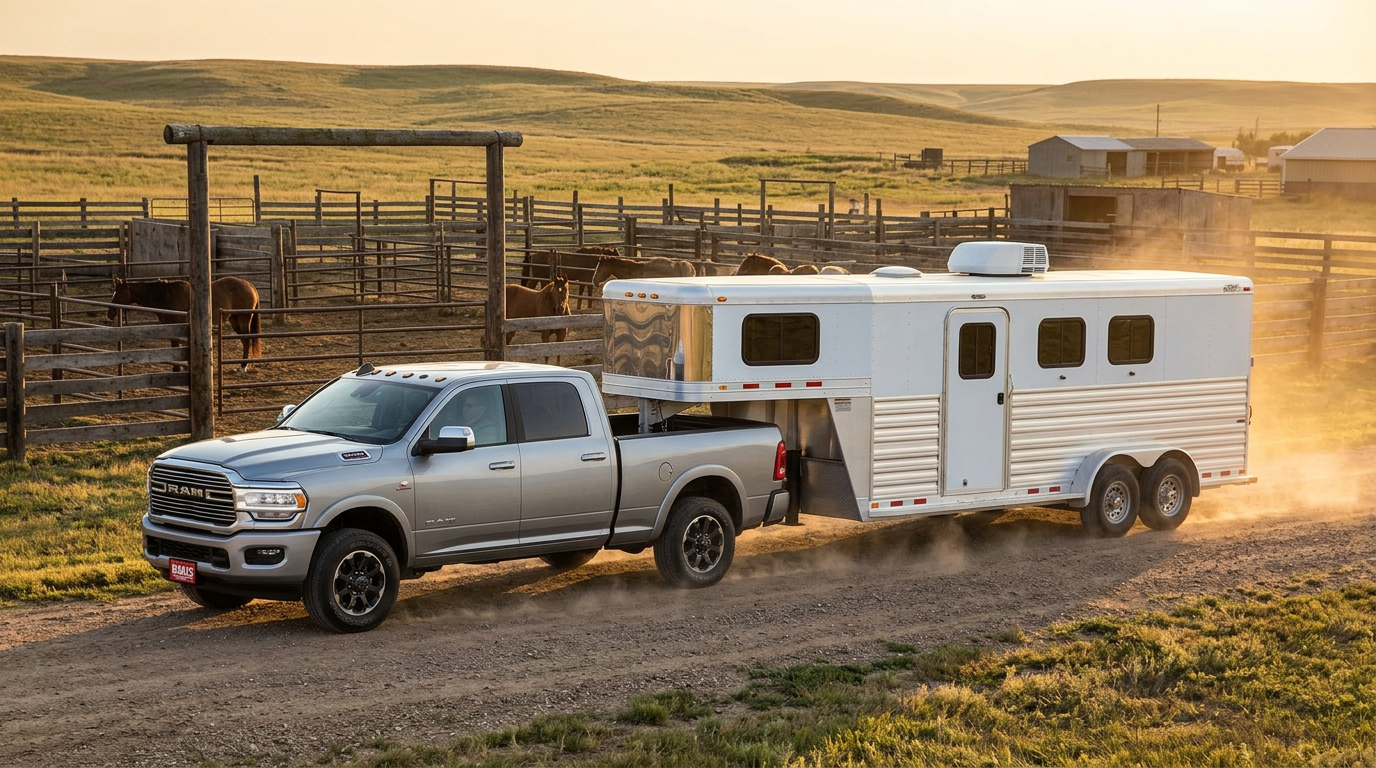
The honest answer is simpler than most buyers expect: you need a 3500 when your gooseneck or fifth-wheel weight, plus your in-bed hitch load, exceeds what a 2500 can legally and safely handle — or when you regularly run at the upper end of the 2500’s capacity and want headroom instead of stress.
A Ram 3500 SRW (single rear wheel) Crew Cab 4×4 with the Cummins HO and a 12,300-pound GVWR option will pull up to 25,180 pounds gooseneck. Step to the dually (DRW) and the same Crew Cab 4×4 Cummins with the 14,000-pound GVWR will pull up to 36,610 pounds gooseneck when properly equipped — the territory of large fifth-wheel toy haulers, big stock trailers, and equipment haulers running tractors or skid steers.
SRW vs. Dually in One Sentence
SRW gets you most of the 3500’s capability with a narrower track, easier daily-driver footprint, and lower tire-replacement costs. Dually gets you the headroom for serious gooseneck weight and the stability advantage on long fifth-wheel runs — at the cost of a wider truck and four extra rear tires to maintain.
For ranchers who tow a 30-foot loaded gooseneck regularly, a 3500 SRW Cummins is usually the right answer. For ranchers running 35-foot fifth-wheel toy haulers or hauling tractors on equipment trailers, the dually starts earning its keep.
1500 vs. 2500 vs. 3500: Which Truck for Which Job?
| If your ranch work is… | The right Ram |
|---|---|
| Daily driver, occasional small trailer (under 12,000 lb) | Ram 1500 Big Horn / Laramie 4×4 Hurricane |
| Cow-calf operation, single-axle stock trailer, regular hay hauling | Ram 2500 Big Horn / Laramie 4×4 Cummins |
| Larger gooseneck loads, fifth-wheel camper, frequent heavy haul | Ram 3500 SRW Crew Cab Cummins |
| Big fifth-wheel toy hauler, equipment trailer, max weight regularly | Ram 3500 DRW Crew Cab Cummins |
| Pasture access, rough section-line roads, off-road duty | Ram 1500 Rebel or Ram 2500 Power Wagon |
Worth it if: your operation has a real, repeating use case for the truck listed.
Skip it if: you’re spec’ing for a once-a-year haul that you could rent a trailer or hire a hot-shot for instead.
Power Wagon and Rebel: When Off-Road Spec Earns Its Keep
The Ram 2500 Power Wagon and Ram 1500 Rebel are the factory off-road builds in the lineup. The Power Wagon is the serious tool: 4×4 only, a 6.4L HEMI V8, electronic locking front and rear differentials, electronic front sway-bar disconnect, 33-inch all-terrain tires, and an integrated 12,000-pound winch. It comes with an 8,565-pound GVWR and tows up to 10,530 pounds — the lowest payload and tow rating of any 2500 because the off-road hardware uses up the capacity budget.
The Rebel is the 1500’s off-road-flavored trim: Bilstein shocks, all-terrain tires, skid plates, an electronic-locking rear axle, and a higher ride height than the standard 1500. It keeps most of the 1500’s daily-driver comfort while adding meaningful capability on rough section-line roads and pasture two-tracks.
Honest Take
Most ranchers don’t need a Power Wagon. Some do — and when you do, nothing else in the lineup substitutes. If your daily includes pasture roads, washouts after spring runoff, or trails that wash out the average half-ton, the Power Wagon earns the price tag. If your “off-road” is mostly a gravel two-track between sections, a Rebel or a properly-equipped Big Horn 4×4 covers the use case for less money.
The Package Decision Most Ranchers Regret Skipping
This is the part of the order conversation where we slow down. The packages get cut to save money up front, and within a year or two we hear the same line back: “I should have gotten that.” Here’s what’s actually inside the packages worth keeping — and why we’d rather walk you through them than have you skip them.
Ask us about each one. Some of the technology Stellantis has put into the 2026 Ram is genuinely useful, and some of it ranchers don’t realize they want until they have it. We’d rather you understand what you’re choosing than save a few hundred dollars on something you’ll regret.
Trailer Tow Max Package
Required to reach the maximum tow ratings on Ram 1500 (and unlocks the highest GVWR options on HD). Includes upgraded cooling, integrated trailer brake control, the right axle ratio, and the heavy-duty engine cooling that long uphill pulls actually need. If you’re going to tow at the limit, skipping this is the wrong place to save money.
Fifth-Wheel / Gooseneck Tow Prep Group (HD)
Factory-installed mounts in the bed, an additional 7-pin wiring harness, a 12-pin connector, and provisions for an auxiliary Mopar camera. Order it from the factory and the warranty zone is intact; install it aftermarket and you’re cutting into the bed yourself. Almost every HD buyer eventually wishes they’d ordered this from day one.
Blind Spot Monitoring with Trailer Coverage
Standard blind-spot monitoring covers the truck. The trailer-coverage upgrade extends the detection zone the full length of your trailer — so a 30-foot gooseneck doesn’t hide a passing vehicle when you change lanes on Highway 12 or Interstate 90. The package most overlooked, the one most regretted by long-haul tow customers.
360-Degree Surround View Camera + Trailer Reverse Guidance
Five cameras give you a composite overhead view, both sides of the trailer onscreen, and a cargo-bed view for hooking up gooseneck single-handed. Trailer Reverse Steering Control turns your wheel input into trailer direction — the most useful piece of new tow tech in the segment. Worth a real conversation before you order.
Snowplow Prep Group (HD)
If there’s any chance you’ll mount a plow — for the place, for hire, or for the road into the homeplace — order this from the factory. It includes the upgraded alternator, frame reinforcement provisions, and the front-axle weight rating headroom that an aftermarket plow needs. Adding it later is a different conversation entirely.
Adaptive Cruise Control & Forward Collision Warning Plus
Standard on 2026 Ram HD, but worth understanding before you assume it’s something else. Adaptive cruise holds your distance behind a slower vehicle automatically — on a long Highway 12 run pulling a trailer, that’s the difference between arriving rested and arriving worn out. Ask us to demo it on your test drive.
How to Spec the Right Ram for Your Operation
Before you call us or stop in, walk through these five steps. We’ll do the same with you on the lot — but going in with answers shortens the conversation and gets you the right truck faster.
- Weigh your worst-case load: total trailer weight plus what’s on it, fully loaded. Add a 10 percent margin for fudge factor and weather.
- Pick the truck class first: 1500 if your worst-case is under 11,000 pounds, 2500 if you’re between 11,000 and 19,000, 3500 SRW for 20,000 to 25,000, 3500 DRW for anything bigger.
- Choose engine by use, not preference: Hurricane I-6 in the 1500 for daily-plus-trailer, Cummins in the 2500/3500 if you tow heavy regularly or want 200,000-mile longevity.
- Land on a trim: Big Horn for working ranchers who want capability without the chrome, Laramie for the same buyer who also wants leather and the bigger touchscreen, Rebel or Power Wagon if your work includes real off-road.
- Build the package list: Trailer Tow Max if you’re towing at the limit, Tow Prep Group if you run gooseneck or fifth-wheel, Blind Spot with trailer coverage if you run highway, surround camera if you hook up alone, Snowplow Prep if there’s any chance.
Key Takeaways
- The most-ordered Ram 1500 ranch build at Beadle’s is a Big Horn or Laramie 4×4 with the 3.0L Hurricane I-6.
- The most-ordered Ram 2500/3500 ranch build is a Big Horn or Laramie Crew Cab 4×4 with the 6.7L Cummins High-Output diesel (430 hp / 1,075 lb-ft).
- Step from a 2500 to a 3500 SRW when your gooseneck regularly exceeds 19,000 pounds; step to dually (DRW) for fifth-wheel weight above 25,000 pounds.
- The package decisions ranchers most often regret skipping are Trailer Tow Max, Fifth-Wheel/Gooseneck Tow Prep, Blind Spot with trailer coverage, and Snowplow Prep on HD.
- Ask before you skip: ordering tow and tech packages from the factory is dramatically simpler than adding them aftermarket.
Frequently Asked Questions
Is the Hurricane I-6 enough engine for ranch work in a Ram 1500?
For ranchers whose worst-case haul stays under about 11,000 pounds, yes. The Hurricane Standard Output (420 hp / 469 lb-ft) handles a single-axle stock trailer, a tandem-axle utility, or a small fifth-wheel without strain. The High Output version (540 hp / 521 lb-ft) opens up the maximum 11,550-pound tow rating when paired with the right axle ratio and Trailer Tow Max Package.
Should I order a 2500 or a 3500 for towing a 30-foot loaded gooseneck?
A 30-foot loaded gooseneck typically runs 18,000 to 22,000 pounds depending on what’s on it. That’s at the upper edge of a Ram 2500’s capability and squarely in 3500 territory. We usually recommend a 3500 SRW Crew Cab 4×4 with the Cummins for that use case — the headroom matters when you’re loaded heavy on a windy SD highway.
What’s the difference between SRW and dually, and which one do I actually need?
SRW (single rear wheel) is one tire on each side of the rear axle. Dually (DRW) is two tires on each side, giving you a wider rear track and significantly more rear-axle weight capacity. You need the dually when your fifth-wheel pin weight or gooseneck hitch weight exceeds what an SRW can carry — usually loaded fifth-wheels over about 16,000 pounds total or goosenecks over 25,000 pounds total.
Is the Power Wagon overkill for ranching, or is it the right tool?
For most cow-calf and small-grain operations, yes — the Power Wagon is more than the day-to-day requires, and you give up payload and towing capacity to get the off-road hardware. For ranches with rough section-line roads, washout-prone pasture access, or steep approach angles where a regular 2500 gets stuck, the Power Wagon is the only factory truck that does the job. Talk to us about your worst access scenario before you decide.
What’s the most-skipped package that ranchers later wish they’d ordered?
Two things tie: Blind Spot Monitoring with trailer coverage and the Fifth-Wheel/Gooseneck Tow Prep Group. The blind spot upgrade extends detection along your trailer length, which makes long highway tows safer. The tow prep group puts the factory mounts and wiring in your bed before delivery — aftermarket installs are doable but invasive. We’d rather walk you through both than see you wish you’d added them.
What axle ratio should I order on a 2500 Cummins for gooseneck towing in SD?
The Cummins HO is paired with a 3.42 axle ratio across the Ram 2500/3500 lineup, and that ratio is calibrated for the diesel’s torque curve. You don’t pick a different ratio with the Cummins — you pick the GVWR option that matches your loaded weight. For maximum gooseneck capability on a 2500 Cummins, that’s the 11,040-pound GVWR with the right Tow Prep build.
Why do most Beadle’s ranch customers go diesel instead of the gas HEMI on HD?
Two reasons: torque under load and longevity. The 6.7L Cummins makes 1,075 lb-ft compared to the 6.4L HEMI’s 429 lb-ft — meaningful when you’re pulling a loaded gooseneck up a long South Dakota grade. And the Cummins routinely runs 250,000 to 400,000 miles in working ranch service. The HEMI is a real option for occasional towing and a lower up-front cost; the Cummins is what our regular-haul customers ask for.
My Take on Picking the Right Ram for Ranch Work
After enough years at Beadle’s Chrysler Center, the conversations start sounding similar. A rancher comes in with a worst-case load in mind and a budget that has to make sense, and the job is matching the right truck to the way the operation actually runs — not the way a brochure imagines it. The most useful thing I can do is ask questions until we both know what you actually need.
My recommendation, every time: order the tow and tech packages from the factory. Buyers cut them to save money and we hear about it later. The technology in the 2026 Ram is genuinely useful, especially for long highway tows and gooseneck work, and you don’t have to understand every package on day one to be willing to ask about them. We’d rather walk you through what’s inside than have you skip something you’d want.
If you’d like the full picture of what we stock and order at Beadle’s, here’s the complete new Ram trucks guide for South Dakota buyers. And if you’re anywhere in our service area — SD, ND, MT, MN, or IA — give us a jingle and we’ll make a plan that fits your operation.
About the Author
Lexy Tabbert — Beadle’s Chrysler Center, Bowdle, SD
Lexy Tabbert is the Director of Sales and Marketing at Beadle’s Chrysler Center in Bowdle, South Dakota. She covers Ram, Jeep, Dodge, and Chrysler vehicles — helping families, ranchers, and ag operators across the region find the right truck and configuration for their needs. Learn more about Lexy.
Connect with us


