





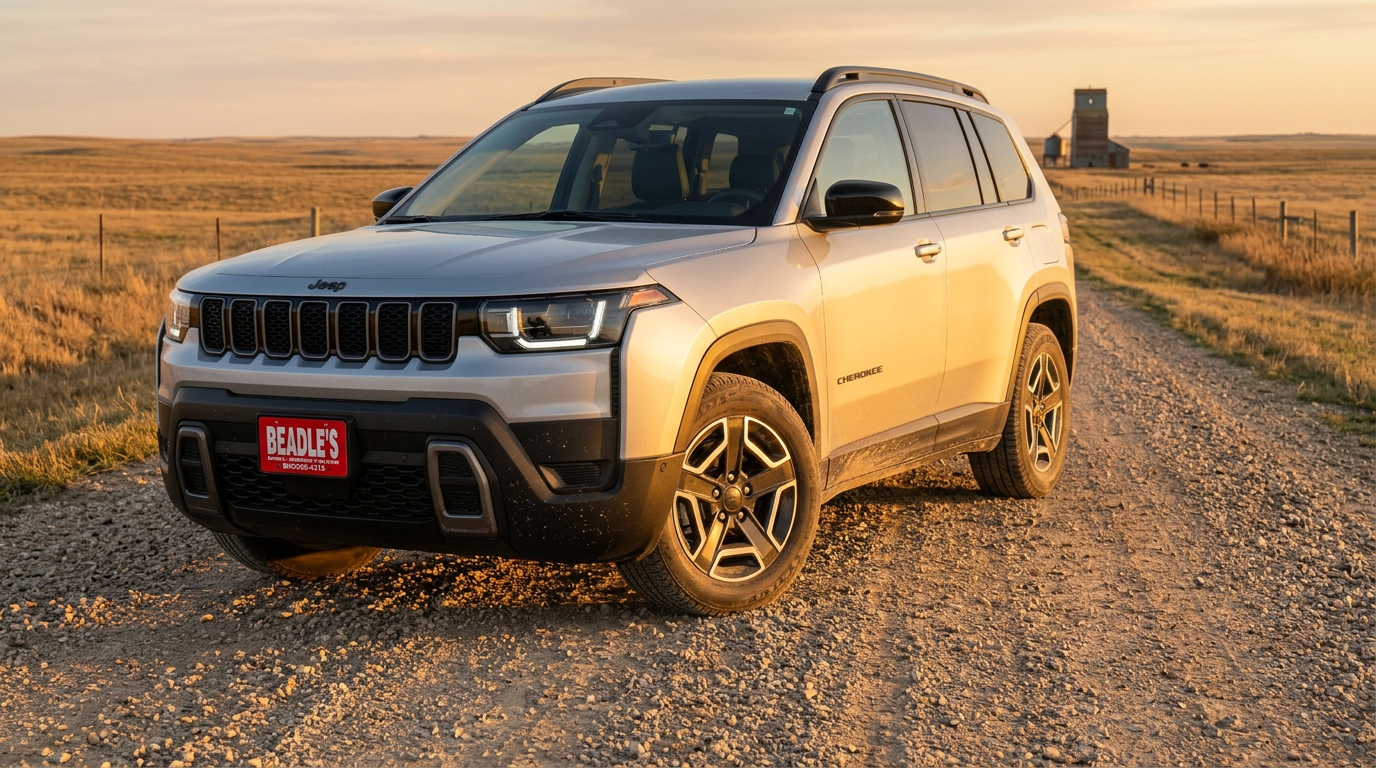
Five hundred miles per tank in a 4×4 SUV — without plugging in, without changing how you drive, without a gas station stop between Bowdle and Rapid City. That’s what the 2026 Jeep Cherokee’s self-charging hybrid delivers, and for South Dakota buyers who cover real distances on a regular basis, the numbers matter.
This guide breaks down the 2026 Cherokee’s estimated 37 mpg combined rating — what it means on actual South Dakota roads, how range changes by season, how it compares to competing crossovers, and what driving habits get the most out of the hybrid system on long rural drives.
On This Page
- What is the 2026 Cherokee’s fuel economy rating?
- What does 37 mpg mean on real South Dakota roads?
- How far can the Cherokee go on a full tank?
- How does fuel economy change in winter vs. summer?
- How does the Cherokee’s fuel economy compare to other crossovers?
- How to maximize range on long South Dakota drives
What is the 2026 Cherokee’s fuel economy rating?
The 2026 Jeep Cherokee is rated at an estimated 37 mpg combined, driven by the 1.6L I4 turbocharged hybrid powertrain paired with two electric drive motors. This is a self-charging hybrid — the battery charges through regenerative braking and engine output while driving, with no plugging in required. The system manages energy recovery automatically; there’s no mode to engage or charging routine to follow.
The 37 mpg figure is an estimated combined rating — a blend of city and highway driving. For South Dakota buyers who spend the majority of their miles on open highway, real-world economy often comes in close to or better than the combined estimate, since highway driving at steady speed is where the hybrid system’s energy recovery is most consistent.
Common Mistake
Buyers sometimes compare the Cherokee’s 37 mpg estimated combined to a conventional SUV’s highway-only number and conclude the difference is smaller than they expected. The comparison should be combined-to-combined — most non-hybrid midsize crossovers rate in the mid-to-upper 20s combined. The Cherokee’s hybrid advantage is most visible on mixed driving: town errands, county road commutes, and the highway segments in between, which describes most rural South Dakota driving.
What does 37 mpg actually mean on South Dakota roads?
EPA estimates are measured in controlled test cycles. Real-world economy depends on road type, speed, load, temperature, and driving behavior — all of which vary significantly in central South Dakota. Here’s how the Cherokee’s hybrid system tends to perform across the driving conditions buyers in this area actually face:
| Driving Condition | Expected Economy | Why |
|---|---|---|
| Open highway (65–75 mph) | Near or above 37 mpg | Steady-speed cruising, consistent regenerative recovery on deceleration |
| Town/in-town stops | Varies — hybrid advantage | Regenerative braking on every stop recovers energy that conventional vehicles waste as heat |
| Gravel county roads | Near combined estimate | Lower average speed means more electric-motor contribution at low demand |
| Towing (with Trailer Tow Group) | Reduced — varies by load | Additional weight and aerodynamic drag reduce both gas and hybrid efficiency |
| Cold start, sub-zero temps | Below estimate until warm | Battery charges and discharges more slowly in extreme cold; gas engine carries more load |
Real-world economy varies by driver behavior, conditions, and load. The 37 mpg figure is an estimated combined rating.
How far can the 2026 Cherokee go on a full tank?
The 2026 Cherokee delivers over 500 miles of estimated range per tank. For buyers in central South Dakota, that range has practical meaning: Bowdle to Rapid City is roughly 230 miles. Bowdle to Sioux Falls is about 240 miles. Bowdle to Bismarck is around 175 miles. On a single tank, you can make most common round trips in the region without stopping for fuel.
The 500-mile figure assumes mixed driving at or near the 37 mpg combined estimate. At sustained highway speeds — which describes most rural South Dakota travel — real-world range can come close to or exceed that number in favorable conditions. In winter or under heavier load, expect something closer to the 400-mile range as a conservative planning figure.
Range in Rural SD Context
Gas stations in central South Dakota can be 40–60 miles apart on some routes. Even in a conservative winter scenario, the Cherokee’s 400-plus mile range gives you significant buffer. The recommendation: treat the half-tank mark as your fill-up trigger in rural driving, not the quarter-tank warning. That keeps you well clear of range anxiety on any road in the region.
How does fuel economy change in winter vs. summer?
All vehicles — hybrid or conventional — experience reduced fuel economy in cold weather. For the Cherokee’s hybrid system, the cold-weather impact has two components: the gas engine runs more frequently at cold starts while the battery warms up, and battery charge and discharge efficiency drops in sub-zero temperatures.
In practical terms, a Cherokee owner in Bowdle should expect noticeably better economy from May through September than from November through February. Summer highway driving on dry roads at steady speed is when the hybrid system operates closest to the 37 mpg estimate. January driving at -10F with the heat running full and a cold battery will produce lower economy — budget conservatively for winter months and you won’t be caught short.
The remote start feature (available Laredo and above) reduces the cold-start fuel economy penalty meaningfully: a pre-warmed engine and battery contribute to better efficiency from the moment you pull out of the driveway, rather than running on cold-start enrichment for the first 5–10 minutes of the drive. It’s one of the practical fuel economy benefits of the remote start feature beyond cabin comfort.
How does the Cherokee’s fuel economy compare to other crossovers?
The Cherokee’s estimated 37 mpg combined stands out in its segment. Most non-hybrid midsize crossovers with standard 4×4 or AWD rate in the low-to-mid 20s combined — meaning the Cherokee delivers roughly 50 percent better estimated economy than a comparable non-hybrid 4×4 crossover on mixed driving.
The comparison that matters most for buyers in this market: at $3.50 per gallon and 15,000 miles per year, a crossover getting 25 mpg costs approximately $2,100 in fuel annually. A Cherokee at 37 mpg costs approximately $1,420 — a difference of about $680 per year. Over five years of ownership, that’s roughly $3,400 in fuel savings, which offsets a meaningful portion of the Cherokee’s price premium over a base non-hybrid 4×4 crossover.
For buyers putting above-average miles on the vehicle — rural commutes, regular long-distance runs — the savings compound. At 20,000 miles annually, the annual fuel difference grows to roughly $900, and five-year savings approach $4,500. Fuel prices fluctuate and real-world economy varies, but the directional math consistently favors the Cherokee’s hybrid system for high-mileage rural drivers.
How to maximize range on long South Dakota drives
The Cherokee’s hybrid system manages energy recovery automatically — you don’t need to drive it differently to take advantage of it. But a few habits consistently improve real-world range, especially on long rural drives.
- Use remote start on cold mornings: Pre-warming the engine and battery before you drive reduces the cold-start efficiency penalty. A 10-minute remote start warm-up in January means the hybrid system is operating closer to its efficient range from the first mile of the drive, not the tenth.
- Brake early and smoothly on the highway: The Cherokee recovers energy through regenerative braking every time you decelerate. Anticipating stops and easing off the throttle earlier — rather than braking hard at the last moment — gives the system more time to recover energy. On a long highway run with regular deceleration for towns or intersections, this habit adds up.
- Use Auto or Sport mode on open highway — not Snow mode: Snow mode’s conservative throttle calibration is the right call on winter roads, but it’s not optimized for fuel economy on dry highway. When conditions allow Auto mode, the system manages the rear-axle disconnect and electric motor contribution for efficiency. Save Snow mode for when conditions actually warrant it.
- Keep tire pressure at spec through the seasons: Tire pressure drops approximately 1 PSI for every 10-degree Fahrenheit drop in temperature. South Dakota winter temperature swings can drop tire pressure 5–8 PSI below summer inflation. Under-inflated tires increase rolling resistance and reduce economy. The Cherokee’s Selectable Tire Fill Alert makes it easy to check — use it at the start of each season.
- Fill up at or above half tank on rural routes: This is less about economy and more about range management. With 500-plus miles of estimated range, you won’t run out of fuel — but in areas where stations are 50+ miles apart, keeping the tank above half eliminates any concern about finding an open station after hours or in a weather event.
Key Takeaways
- The 2026 Cherokee is rated at an estimated 37 mpg combined — a self-charging hybrid that requires no plugging in. Battery charges automatically through regenerative braking and engine output while driving.
- 500-plus miles of estimated range per tank covers most common South Dakota round trips on a single fill-up — Bowdle to Rapid City and back is well within range.
- Cold weather reduces economy — budget conservatively for November through February. Remote start (Laredo and above) reduces the cold-start penalty by pre-warming the engine and battery.
- At 15,000 miles per year, the Cherokee’s hybrid system saves an estimated $680 annually in fuel compared to a non-hybrid 4×4 crossover at 25 mpg combined. High-mileage drivers see proportionally greater savings.
Frequently Asked Questions
Does the 2026 Cherokee need to be plugged in to charge?
No. The 2026 Cherokee is a self-charging hybrid — the battery charges automatically through regenerative braking and the gas engine while you drive. There is no charging port, no charging cable, and no plugging in required. It operates exactly like a conventional gas vehicle from a fueling and routine standpoint — fill it with regular unleaded, drive it, and the hybrid system manages everything else.
What fuel does the 2026 Cherokee use?
The 2026 Cherokee runs on regular unleaded gasoline — no premium required, no special fuel. The hybrid system adds no fueling complexity: you fill the tank at a normal gas station just as you would with any conventional vehicle. Confirm the fuel specification on the window sticker or owner’s manual of any specific unit.
Does towing reduce the Cherokee’s fuel economy?
Yes — towing a trailer reduces fuel economy on any vehicle, hybrid or not. Additional weight and aerodynamic drag from a trailer require more engine output, which increases fuel consumption. The Cherokee’s hybrid system still contributes during towing, but economy will be meaningfully below the 37 mpg combined estimate when pulling near the 3,500-lb tow limit. Plan range conservatively on towing trips — treat 300-350 miles as your range buffer when towing.
Is 37 mpg accurate in real-world South Dakota driving?
The 37 mpg combined is an estimated EPA figure based on standardized test cycles. Real-world economy depends on speed, temperature, load, and driving behavior. For South Dakota buyers doing primarily open highway driving in moderate weather, real-world economy often comes close to the combined estimate. Winter cold start conditions and towing will reduce economy below the estimate. Mixed rural driving — town, county road, and highway combined — is where the hybrid system’s stop-start energy recovery delivers meaningful economy versus a conventional gas crossover.
My Take on the Cherokee’s Fuel Economy for South Dakota Buyers
The fuel economy conversation at Beadle’s usually starts with range and ends with the math. Buyers who cover real miles — commuting between towns, making supply runs, driving kids to activities in Mobridge or Aberdeen — quickly see that the Cherokee’s hybrid system pays for itself in a way that’s hard to ignore when fuel prices climb. The $680-per-year estimate at 15,000 miles is a conservative starting point; higher-mileage drivers see the savings compound faster.
What I tell buyers most often is that the self-charging hybrid part is the piece that matters most: there’s nothing to plug in, nothing to manage, no range anxiety about finding a charging station. You fill it with regular gas the same way you always have, and the hybrid system does its work without asking anything from you. For a buyer who wasn’t considering a hybrid before, that simplicity tends to change the conversation.
For a full look at the 2026 Cherokee’s powertrain and how the hybrid system works, our complete 2026 Cherokee guide covers all of it. And if you want to talk through the real numbers for your specific driving situation, stop by Beadle’s in Bowdle — we can work through what the fuel savings actually look like for your annual mileage.
About the Author
Lexy Tabbert — Beadle’s Chrysler Center, Bowdle, SD
Lexy Tabbert is the Director of Sales and Marketing at Beadle’s Chrysler Center in Bowdle, South Dakota. She covers Ram, Jeep, Dodge, and Chrysler vehicles — helping families, ranchers, and ag operators across the region find the right truck and configuration for their needs. Learn more about Lexy.
Connect with us


