




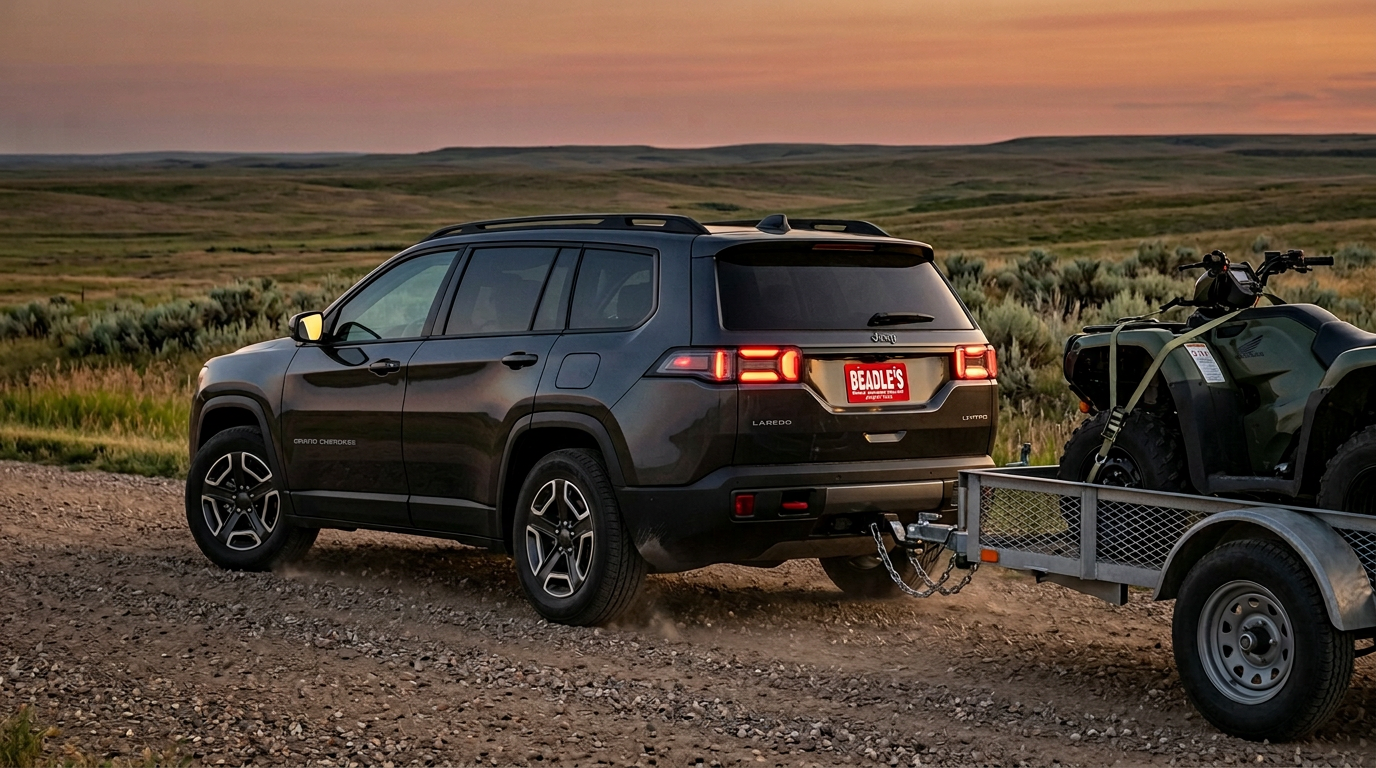
If you’re shopping a Jeep Cherokee for South Dakota roads — and you haul anything at all — the towing question comes up fast. Can it pull a livestock trailer? What about a small boat, or a loaded utility trailer heading to a work site? The answer depends on one specific piece of equipment: the Trailer Tow Group.
This guide breaks down the 2026 Jeep Cherokee’s towing capacity, what that number means for South Dakota buyers in practical terms, what equipment you need to tow at the full rating, and an honest look at what the Cherokee can — and can’t — handle.
On This Page
- How much can the 2026 Cherokee tow?
- Does the Cherokee need special equipment to tow?
- What can 3,500 lbs actually pull on a South Dakota property?
- How does the hybrid system affect towing performance?
- How does the Cherokee compare to other crossovers for towing?
- How to verify your trailer is within the Cherokee’s tow limit
How much can the 2026 Jeep Cherokee tow?
The 2026 Jeep Cherokee is rated to tow up to 3,500 lbs when properly equipped with the Trailer Tow Group. That rating is available on the Laredo, Limited, and Overland — the Trailer Tow Group is not available on the base Cherokee 4×4.
The Cherokee’s towing capability comes from its 1.6L turbocharged hybrid powertrain paired with standard 4×4 on every trim. While 3,500 lbs isn’t in the same league as a Ram 1500 or Ram 2500, it’s a meaningful number for a compact crossover — enough to cover the utility loads, light livestock, and recreational trailers that a lot of South Dakota buyers actually use day to day.
Trailer Tow Group Required for Full Rating
The 3,500-lb towing rating only applies with the Trailer Tow Group equipped. Without it, towing capability is reduced. If towing is a priority, confirm the Trailer Tow Group is included on any Cherokee you’re considering — we verify this on every unit at Beadle’s.
Common Mistake
Most buyers compare their trailer’s GVWR to the Cherokee’s 3,500-lb rating and assume they’re clear. But GVWR is the maximum the trailer can weigh — not what it actually weighs loaded. A 2-horse trailer with a 4,000-lb GVWR might only weigh 2,600 lbs empty. Always weigh your actual loaded setup before deciding whether the Cherokee can handle it.
Does the Cherokee need special equipment to tow?
Yes — the full 3,500-lb tow rating requires the Trailer Tow Group ($995 MSRP), which is available on the Laredo, Limited, and Overland. It is not available on the base Cherokee 4×4. The group includes the Class III receiver hitch, 7-and-4-pin wiring harness, Blind Spot with Trailer Detection, Trailer Hitch Zoom, and compact spare tire.
Beyond the Trailer Tow Group, towing safety follows the same fundamentals as any vehicle: tongue weight needs to stay within limits, trailer brakes may be required by South Dakota law for heavier trailers, and the Cherokee’s stability system helps manage handling on highway pulls. If you’re new to towing with the Cherokee, the owner’s manual towing section covers load distribution and tongue weight specifics for your setup.
South Dakota Trailer Brake Law
South Dakota law requires independent trailer brakes above certain gross weight thresholds — if you’re pulling near the Cherokee’s 3,500-lb limit, verify your specific trailer setup meets current SD brake requirements before your first pull. A brake controller can be added as an aftermarket option if needed.
What can 3,500 lbs actually pull on a South Dakota property?
Three thousand five hundred pounds is a practical number for light to medium utility work. Here’s how common trailer types used across central and western South Dakota stack up against that limit.
| Trailer Type | Typical Loaded Weight | Cherokee Can Handle? |
|---|---|---|
| Utility trailer (6×10, loaded) | 800–1,500 lbs | Yes |
| ATV/UTV trailer (1 unit) | 1,200–2,200 lbs | Yes |
| Small aluminum boat + trailer | 1,500–3,000 lbs | Yes — verify weight |
| 2-horse trailer (empty) | 2,400–3,200 lbs | Marginal — verify weight |
| 2-horse trailer with horses | 3,800–5,500 lbs | No — exceeds limit |
| Small livestock trailer (2–4 calves) | 2,500–3,500 lbs | At or near limit |
| 4-horse trailer or hay wagon | 5,000+ lbs | No — needs a truck |
The Cherokee is a strong match for buyers who need a daily-driver crossover that can also handle light utility pulls, weekend ATV runs, or a small boat to Lake Oahe. It’s not designed to replace a pickup for heavy livestock work — and it doesn’t try to be. If your regular trailer runs push 3,500 lbs or heavier, a Ram 1500 or Ram 2500 is the right tool.
How does the Cherokee’s hybrid system affect towing performance?
The 2026 Cherokee’s self-charging hybrid system doesn’t change how you connect or manage a trailer — you hook up and go. But there are a few things worth knowing about how a hybrid crossover behaves under towing load compared to a conventional engine.
Under towing load, the hybrid system draws more heavily on the combustion engine and less on the electric motor. Fuel economy will drop from the EPA-estimated 37 mpg combined — expect something closer to the mid-to-upper 20s depending on trailer weight, road grade, and speed. This is normal for any hybrid pulling a load; the efficiency advantage is real when driving unloaded and recovers once the trailer is disconnected.
What Changes When You’re Towing
Fuel economy drops under tow load — plan for it on longer hauls. The 4×4 system and Selec-Terrain remain fully operational with a trailer attached. Regenerative braking may feel different with trailer weight behind the vehicle; allow more stopping distance and use engine braking on grades.
How does the Cherokee compare to other crossovers for towing?
The 3,500-lb tow rating puts the Cherokee near the top of the compact crossover class for towing. Many non-truck-based crossovers in this segment are rated in the 1,500–2,700 lb range, making the Cherokee’s standard 4×4 and 3,500-lb capacity a meaningful differentiator when light towing is part of the buying decision.
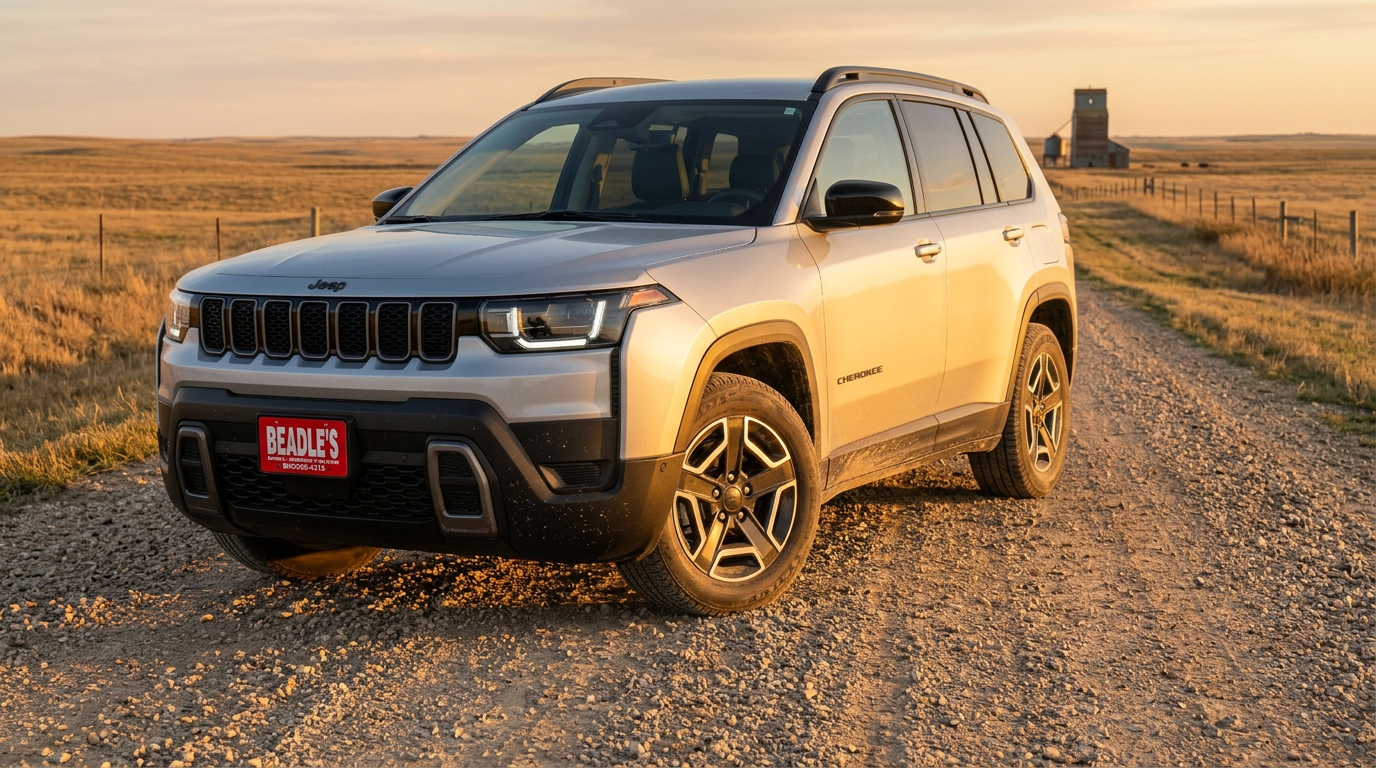
The Selec-Terrain system adds real-world capability on unimproved boat ramps and muddy field access roads — situations where most other crossovers’ traction systems aren’t tuned to perform. The combination of 4×4, Selec-Terrain, and 8 inches of ground clearance makes the Cherokee more capable than the tow rating alone suggests for buyers regularly operating on South Dakota gravel and seasonal access roads.
Is the Jeep Cherokee the right tow vehicle for your situation?
| Your Situation | Cherokee Works | Consider a Truck Instead |
|---|---|---|
| Trailer type | Utility, ATV, small boat, light livestock loads under 3,500 lbs | Horse trailers, hay wagons, heavy equipment over 3,500 lbs |
| Tow frequency | Occasional weekend or seasonal pulls | Daily or weekly heavy hauling |
| Primary vehicle use | Daily driver that also tows occasionally | Dedicated work vehicle where towing is the primary job |
| Fuel efficiency priority | Important — estimated 37 mpg combined when unloaded | Less of a concern relative to raw towing output |
Worth it if: You need a comfortable, fuel-efficient 4×4 daily driver that can handle occasional light trailer pulls — ATVs, small boats, utility trailers, light livestock loads under 3,500 lbs.
Skip it if: Your trailer regularly runs over 3,500 lbs, or you’re hauling horses, large livestock loads, or heavy farm equipment on a routine basis. A Ram 1500 or Ram 2500 is the right conversation for that work.
How to verify your trailer is within the Cherokee’s tow limit
Before you hook up, confirm your actual loaded trailer weight — not just the trailer’s empty weight or its manufacturer rating. Here’s how to do it right.
- Find your trailer’s GVWR: The Gross Vehicle Weight Rating is stamped on the trailer’s VIN plate. GVWR is the maximum the trailer can weigh fully loaded — use this number, not the empty weight.
- Weigh your actual loaded trailer: Grain elevators, livestock sale barns, and highway scales can weigh a loaded trailer for a few dollars. Know the real number before you pull.
- Confirm the Trailer Tow Group is on your Cherokee: Check the window sticker or ask us at Beadle’s. The full 3,500-lb rating only applies with this package installed.
- Check tongue weight: Tongue weight — the downward force on the hitch ball — should be approximately 10–15% of total trailer weight. Too much or too little causes trailer sway.
- Verify South Dakota brake requirements: Trailers over 3,000 lbs gross weight require independent trailer brakes under SD law. Confirm your setup meets this requirement before your first pull.
Key Takeaways
- The 2026 Cherokee tows up to 3,500 lbs — but only with the Trailer Tow Group equipped. Confirm it’s on the vehicle before you buy.
- That rating covers utility trailers, small boats, ATV rigs, and light livestock loads — it won’t handle horse trailers or heavy farm equipment.
- The hybrid system works normally while towing; fuel economy drops under load but recovers once the trailer is disconnected.
- Standard 4×4 and Selec-Terrain add real capability on unimproved ramps, muddy access roads, and the seasonal terrain common across central SD.
Frequently Asked Questions
Can the 2026 Jeep Cherokee pull a horse trailer?
It depends on the trailer and load. A small 2-horse straight-load trailer empty may fall within the 3,500-lb limit, but loaded with two horses it typically exceeds that rating significantly. The Cherokee is not the right vehicle for routine horse hauling — a Ram 1500 or heavier truck is the appropriate choice. If you’re only moving one small horse occasionally, weigh your specific loaded trailer before deciding.
Does every 2026 Cherokee trim come with towing capability?
The Trailer Tow Group is available across Cherokee trim levels, but it’s an option — not standard equipment on every vehicle. If towing is a priority, confirm the Trailer Tow Group is included on any specific unit you’re looking at. At Beadle’s Chrysler Center, we can check the window sticker on any Cherokee in inventory and confirm exactly what’s equipped.
Will towing hurt the Cherokee’s fuel economy?
Yes — any vehicle’s fuel economy drops under tow load, and the Cherokee is no exception. The EPA-estimated 37 mpg combined applies when driving unloaded. Under tow load, expect a notable drop depending on trailer weight, speed, and road grade. The hybrid efficiency advantage returns once the trailer is disconnected.
Can the Cherokee tow a boat to Lake Oahe?
For a small aluminum fishing boat or jon boat with trailer — typically 1,500–2,500 lbs combined — yes, the Cherokee with the Trailer Tow Group handles that well. The standard 4×4 and ground clearance also help on the unimproved boat ramps common around Lake Oahe. For larger fiberglass boats or heavier rigs pushing above 3,500 lbs, a truck is the right choice.
My Take on the Cherokee’s Towing Capability
When someone comes into Beadle’s asking about the Cherokee for towing, the conversation almost always lands in the same place: what exactly are you pulling? That question matters more than the spec sheet number. A buyer who needs to move ATVs to a hunting access road or pull a small boat to the river is in a very different situation than someone who moves horses or hauls large livestock loads week in and week out.
For the first group — light to moderate utility towing paired with a comfortable, fuel-efficient daily driver — the Cherokee with the Trailer Tow Group is a genuinely capable match. The standard 4×4 and Selec-Terrain add real utility that a lot of other crossovers at this price point can’t match, especially on the unimproved access roads and seasonal gravel common out this way. For buyers who are regularly moving heavier loads, I’ll be straight with you: a Ram 1500 is the right conversation.
If you want to dig into the full Cherokee spec sheet — trims, features, and what each package includes — our complete 2026 Jeep Cherokee guide covers all of it. And if you’re in the area, stop by Beadle’s Chrysler Center in Bowdle — we’ll pull up exactly what’s in inventory and confirm what’s equipped on each unit before you make any decisions.
About the Author
Lexy Tabbert — Beadle’s Chrysler Center, Bowdle, SD
Lexy Tabbert is the Director of Sales and Marketing at Beadle’s Chrysler Center in Bowdle, South Dakota. She covers Ram, Jeep, Dodge, and Chrysler vehicles — helping families, ranchers, and ag operators across the region find the right truck and configuration for their needs. Learn more about Lexy.
Connect with us


