




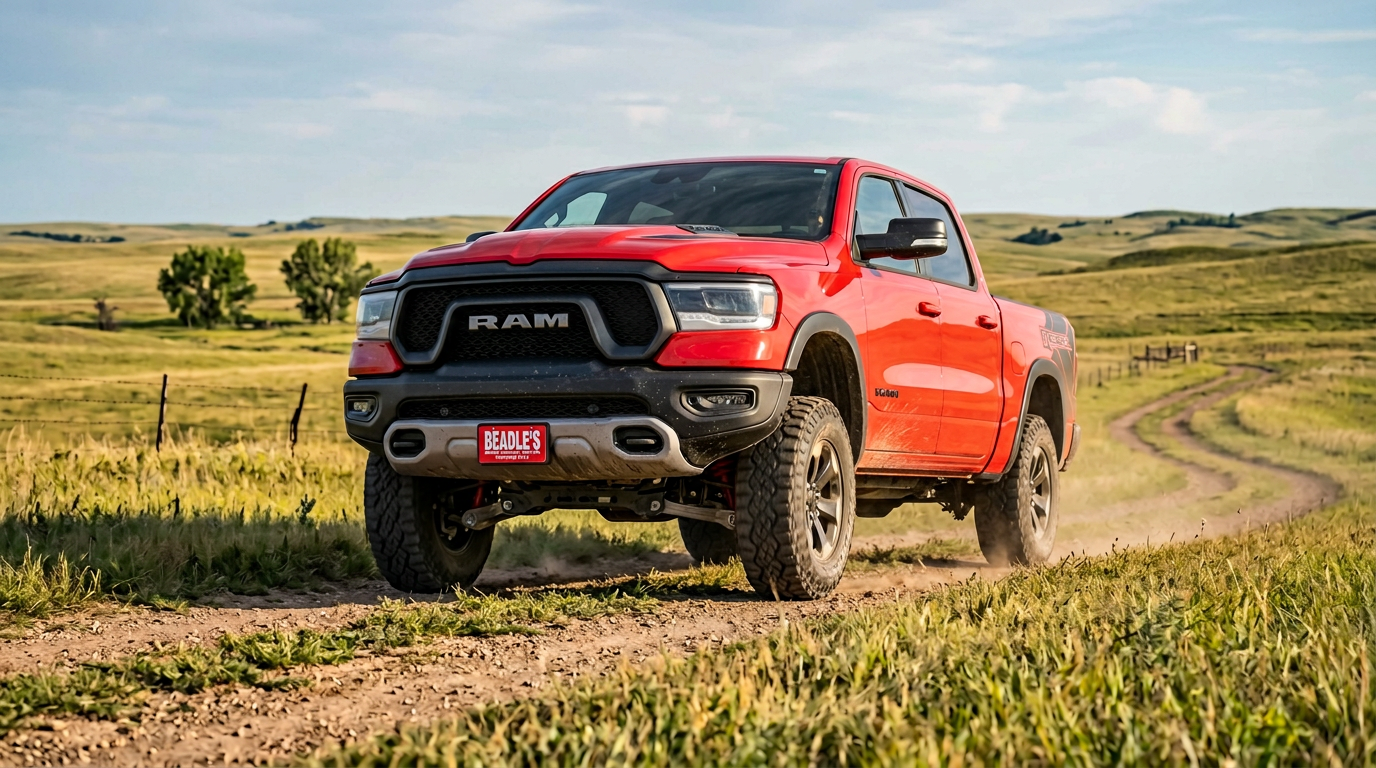
The Ram 1500 Rebel comes with a factory 2-inch lift, Bilstein shocks, skid plates, and all-terrain tires. For buyers in rural South Dakota, the question is whether those upgrades are worth the price premium — or whether they deliver real value for how you actually use the truck.
This guide covers what the Rebel’s factory off-road equipment actually does on the roads and terrain around Bowdle, Mobridge, Ipswich, and the rest of north-central South Dakota. Not what it looks like in a commercial — what it does in daily use.
In This Guide
- What Does the Ram 1500 Rebel Actually Include?
- How Does the Rebel Handle South Dakota Gravel Roads?
- What Do the Factory Lift and Bilstein Shocks Actually Do?
- Skid Plates: When Do They Matter?
- All-Terrain Tires: Worth It for SD Buyers?
- Rebel vs. Big Horn: Is the Premium Worth It?
- Does the Rebel Tow as Well as Other Ram 1500 Trims?
- Is the Rebel Good in South Dakota Winters?
- Key Takeaways
- Common Questions
What Does the Ram 1500 Rebel Actually Include?
The Rebel is Ram’s factory off-road trim for the 1500. It is not a cosmetic package — the hardware changes are real. Standard Rebel equipment includes:
- Factory 2-inch suspension lift over the standard Ram 1500 ride height
- Bilstein performance off-road shocks, front and rear
- Factory skid plates protecting the transfer case and fuel tank
- 33-inch all-terrain tires (confirm specific tire on window sticker)
- Rebel-specific front and rear fascias with more clearance than standard trims
- Blacked-out exterior trim, Rebel badging, and off-road appearance package
- Available Rebel HO (RHO) with the 540 hp Hurricane HO engine
The Rebel is available with the Hurricane SO I6, Hurricane HO (RHO package), or HEMI V8 depending on configuration. It is available in Crew Cab with 5’7” or 6’4” bed.
How Does the Rebel Handle South Dakota Gravel Roads?
This is the question most relevant to buyers around Bowdle, Ipswich, Gettysburg, and the surrounding area. Gravel roads in north-central South Dakota range from well-maintained county roads to washboard township roads to two-track field access. The Rebel is built for exactly this environment.
The factory lift provides additional clearance that matters on rocky section-line roads and approaches to grain bins and machine sheds. The Bilstein shocks absorb the jarring, rhythmic impacts of washboard gravel more effectively than the standard Ram 1500 suspension — the truck floats more and pounds less. Buyers who spend 20–40 minutes daily on gravel notice this immediately.
The all-terrain tires provide more confident traction on loose gravel, especially in wet conditions. South Dakota gravel roads after a rain event can be slick in ways that catch highway-tire trucks off guard. The AT tires are a meaningful upgrade in those conditions.
What Do the Factory Lift and Bilstein Shocks Actually Do?
The 2-inch suspension lift raises the truck’s body relative to the axles, increasing ground clearance under the frame, skid plates, and running boards. This matters for field access roads with deep center crowns, approaches with sharp lip angles, and situations where the standard Ram 1500 would drag its undercarriage.
Bilstein is a performance shock brand used on purpose-built off-road vehicles. The Bilstein monotube shocks on the Rebel are stiffer and more responsive than the standard Ram 1500 dampers, controlling body roll better during directional changes at speed on uneven surfaces. On pavement, the ride is slightly firmer than the Big Horn or Laramie — noticeable but not uncomfortable. Off pavement, the Bilstein shocks make the truck feel significantly more composed.
Buyers who are considering adding a suspension lift aftermarket should know that a quality lift kit with comparable shocks typically costs $2,500–$5,000 installed. The Rebel includes this from the factory at a price premium that is often comparable to or less than the aftermarket equivalent.
Skid Plates: When Do They Matter?
The Rebel’s factory skid plates cover the transfer case and fuel tank — the two most vulnerable components when a truck goes over rocks, stumps, or sharp terrain edges. On maintained gravel roads, skid plates are rarely needed. On approaches to pivots, fence lines, or waterways where rough ground is the norm, they provide real protection.
Most buyers in this region have at some point driven over something they did not see coming. Skid plates are the component you do not notice until the moment you need them. For buyers who regularly access rough ground as part of their operation, the Rebel’s factory skid plate coverage is worth having.
All-Terrain Tires: Worth It for South Dakota Buyers?
All-terrain tires are a trade-off. They provide better traction in loose gravel, mud, wet grass, and light snow compared to standard highway tires. They are louder at highway speeds, and they typically show slightly lower fuel economy than the equivalent highway tire. For buyers who drive primarily on the interstate at 80 mph, the noise and economy trade-off may not be worth it. For buyers who spend significant time on gravel and field access roads, the AT tires are a genuine capability upgrade.
An important note for SD winter buyers: all-terrain tires are not winter tires. For serious SD winter driving, dedicated winter tires are the correct tool. The Rebel’s AT tires perform better than standard all-season tires in light snow and packed surfaces, but they are not optimized for the ice conditions that develop on north-central SD roads in January and February.
Is the Rebel Worth It Compared to the Big Horn?
The Rebel runs approximately $10,000–$15,000 more than a comparable Big Horn with similar drivetrain and options. Here is how to think about whether that premium is justified:
The Rebel is worth the premium if:
- You drive gravel roads daily as part of your operation
- You regularly access rough field approaches or unimproved roads
- You would otherwise spend $3,000–$5,000 on an aftermarket lift and shocks
- The AT tire traction benefit matters for your specific use
The Rebel is not worth the premium if:
- You drive primarily on paved roads and highway
- The off-road capability will rarely be used
- You prefer a softer highway ride over off-road composure
- Budget is a priority and the Big Horn covers your daily needs
For buyers who are between the Rebel and Laramie, the decision comes down to use: if rough terrain is regular, Rebel. If long-distance comfort and interior quality are the priority, Laramie. The trim comparison is covered in full in the 2026 Ram 1500 trim guide.
Does the Rebel Tow as Well as Other Ram 1500 Trims?
Yes, with the right engine and package. The Rebel with the Hurricane SO I6, Trailer-Tow Group, and 3.92 axle ratio tows competitively within the Ram 1500 lineup. The suspension lift does not meaningfully reduce towing capacity when the truck is properly configured. The all-terrain tires do not affect the tow rating.
The Rebel HO (RHO package with the 540 hp Hurricane HO) has a lower tow rating — up to 8,360 lbs in that configuration per the OEM towing guide. Buyers who want maximum towing should spec the Rebel with the SO Hurricane, not the RHO. For a full towing breakdown by configuration, see the 2026 Ram 1500 towing guide.
Is the Ram 1500 Rebel Good in South Dakota Winters?
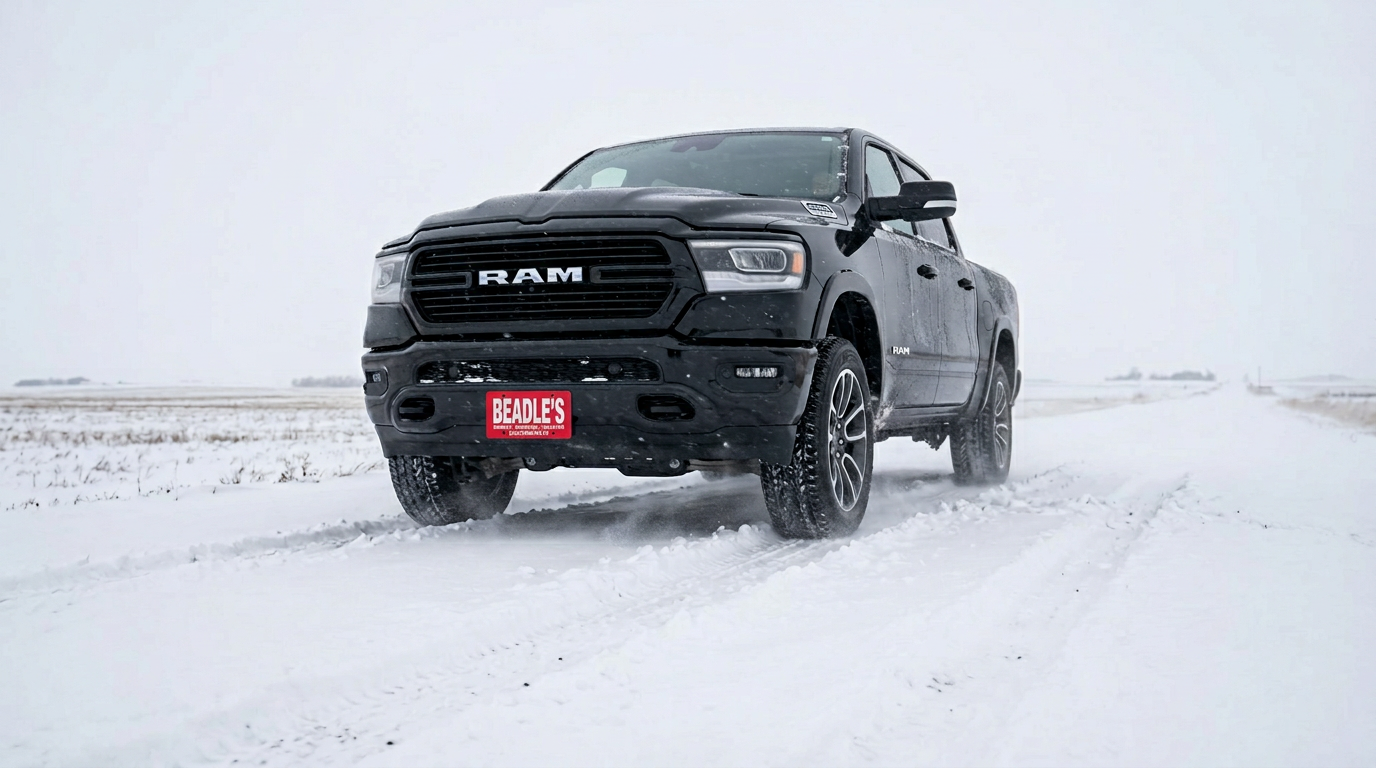
The Rebel’s 4×4 system, increased ground clearance, and all-terrain tires make it a capable winter truck within its design intent. The additional clearance helps in deeper snow where standard trucks scrape bottom. The AT tires provide better traction than standard all-seasons on packed snow and light ice.
For serious SD winter conditions — hard ice, heavy drifting, prolonged below-zero temperatures — the limiting factor is always the tire, regardless of the truck. The Rebel’s factory AT tires are a step up from highway tires in winter, but dedicated winter tires mounted on a set of steel wheels remain the most effective winter preparation for any truck in this region.
Key Takeaways
- The Rebel includes a factory 2-inch lift, Bilstein shocks, skid plates, and all-terrain tires — these are functional, not cosmetic upgrades
- For buyers who drive gravel roads daily, the Rebel’s suspension is noticeably better than standard Ram 1500 trims on rough surfaces
- The Bilstein shock upgrade alone often costs $2,000–$3,000 aftermarket; the Rebel includes it from the factory
- The Rebel with Hurricane SO tows competitively; the Rebel HO (RHO) carries a lower tow rating of approximately 8,360 lbs
- AT tires are not winter tires — for serious SD ice conditions, dedicated winter tires are the correct tool
- The Rebel is the right choice for gravel-road and rough-terrain buyers; the Laramie is the right choice for pavement and highway comfort
- The Rebel is not a rock crawler — it is an excellent rural South Dakota daily driver with real off-road capability
Frequently Asked Questions
Is the Ram 1500 Rebel good for gravel roads in South Dakota?
Yes. The Rebel’s factory 2-inch lift, Bilstein shocks, and all-terrain tires are well-matched to the gravel roads, rough field approaches, and mixed-surface driving common in north-central South Dakota. The Bilstein shocks absorb washboard gravel better than the standard Ram 1500 dampers, and the AT tires provide more confident traction on loose and wet gravel. For buyers who spend significant time on gravel as part of their daily routine, the Rebel delivers real functional value.
What is the difference between the Rebel and the Big Horn?
The Big Horn is the comfort-value trim with cloth seating, an 8.4-inch screen, and standard Ram 1500 suspension. The Rebel adds a 2-inch factory lift, Bilstein performance shocks, skid plates, all-terrain tires, and Rebel-specific exterior trim. The Rebel runs approximately $10,000–$15,000 more than a comparable Big Horn. The premium is justified for buyers who regularly use the off-road capability; it is not for buyers who drive primarily on pavement.
Can the Ram 1500 Rebel tow a livestock trailer?
Yes. The Rebel with the Hurricane SO I6, Trailer-Tow Group, and 3.92 axle ratio tows competitively within the Ram 1500 lineup. The suspension lift and AT tires do not meaningfully reduce towing capacity in standard Rebel configurations. The Rebel HO (RHO) carries a lower tow rating of approximately 8,360 lbs. Confirm your specific build’s tow rating on the driver’s door jamb sticker.
Is the Ram 1500 Rebel good in snow?
The Rebel’s 4×4 system, additional ground clearance, and all-terrain tires make it a capable truck in light-to-moderate SD winter conditions. For hard ice and heavy winter driving, dedicated winter tires mounted on a separate set of wheels remain the most effective upgrade for any truck in this region. The Rebel’s AT tires are a step up from standard all-seasons in winter but are not optimized for ice.
What is the Rebel HO (RHO)?
The Rebel HO is an optional package that adds the 540 hp High Output Hurricane I6 to the Rebel trim. It carries a lower tow rating than the standard Rebel with the SO Hurricane — approximately 8,360 lbs in its configuration. It is the performance-focused Rebel option for buyers who want maximum horsepower. For buyers who need maximum towing, the SO Hurricane is the stronger configuration.
My Take on the Rebel for South Dakota Buyers
I recommend the Rebel to buyers who are honest with themselves about how they use their truck. If you drive a section-line gravel road every day, access pivot corners and field approaches regularly, and have ever bottomed out a standard truck on rough ground, the Rebel’s factory package addresses all of those situations. The Bilstein shocks alone are worth a significant portion of the premium — the daily driving difference on rough gravel is real and immediate.
Where I steer buyers away from the Rebel is when the off-road equipment is aspirational rather than practical. If your route is pavement to pavement and the gravel sections are incidental, the Laramie gives you a better interior experience for similar money. The Rebel’s AT tires also add road noise that the Laramie’s highway tires do not — something that matters on two-hour highway drives to Bismarck or Sioux Falls.
The Rebel sits in a unique position in this market. Most buyers who need what it offers are in rural areas where the capability gets genuinely used. If that describes your operation, it is worth a serious look. The full trim and model context is in the 2026 Ram 1500 overview, and current Rebel inventory at Beadle’s is on the Ram 1500 lineup page.
About the Author
Lexy Tabbert provides research-driven truck configuration guidance for buyers across north-central South Dakota. Beadle’s Chrysler Center has served the Bowdle, Mobridge, Ipswich, and Gettysburg area for decades, specializing in Ram trucks for farm, ranch, and rural use.
Feature availability and pricing estimates are subject to change. Towing figures sourced from the official 2026 Ram 1500 Payload & Towing Guide. Always confirm specific build ratings on the driver’s door jamb sticker. © Beadle’s Chrysler Center, Bowdle, SD.
Connect with us


