





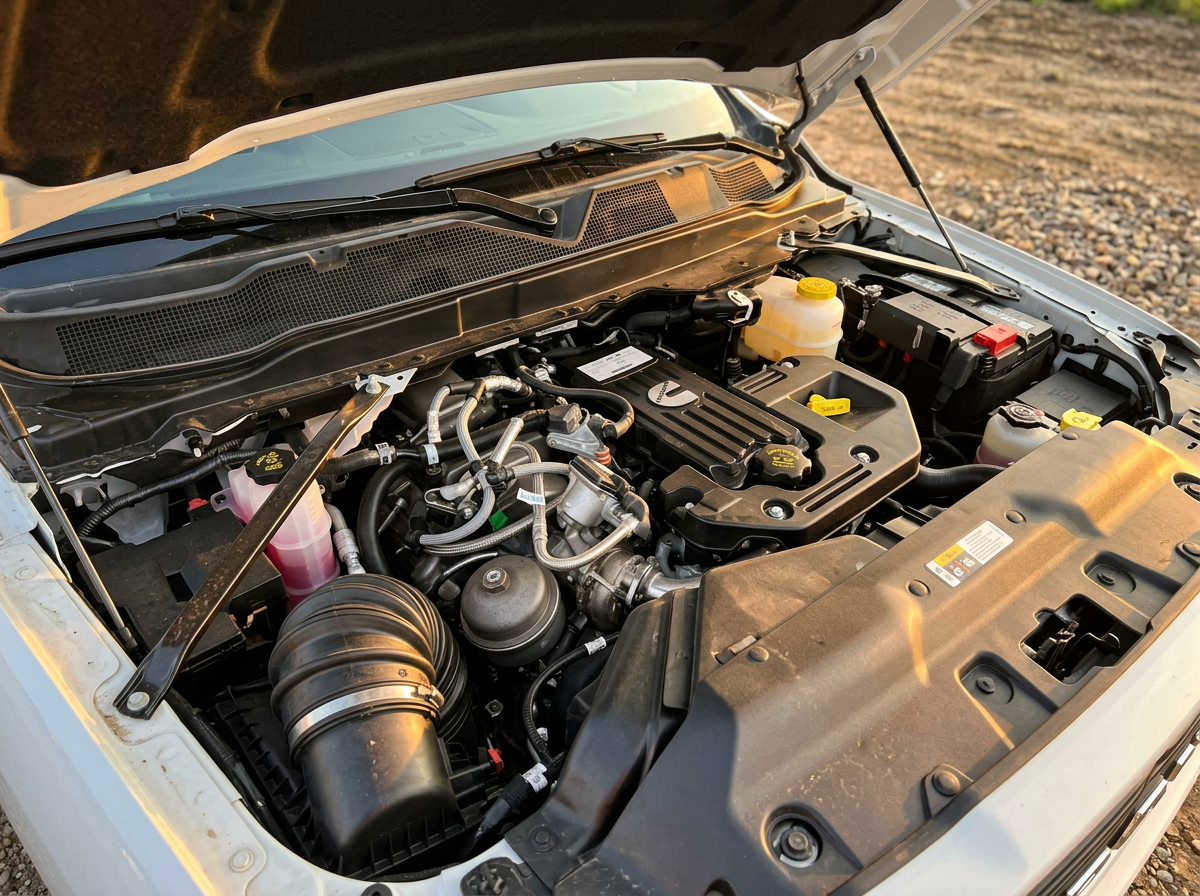
The 2026 Ram 2500 gives you a choice between two powerhouse engines: the gasoline 6.4L HEMI V8 and the diesel 6.7L Cummins turbo. Both deliver impressive performance, but they excel in different ways. The HEMI offers straightforward power and lower upfront cost, while the Cummins unleashes massive torque for serious towing and hauling. Understanding the differences helps you choose the engine that matches your truck priorities.
At Beadle’s Chrysler Center in Bowdle, SD, we help Ram customers make this decision every day. Whether you’re a contractor hauling daily loads, a weekend adventurer with a fifth wheel, or someone who values fuel efficiency, there’s an engine built for your needs. Let’s break down the specs, costs, and real-world performance differences so you can drive home in the Ram 2500 that’s right for you.
Table of Contents
- Should I get the Cummins diesel or the HEMI in my Ram 2500?
- How much more does the Cummins cost than the HEMI?
- What is the torque difference between the Cummins and the HEMI?
- Is the Cummins worth the $12,995 upgrade?
- Which engine is better for daily driving vs heavy towing?
- How does fuel economy compare between the two engines?
Should I get the Cummins diesel or the HEMI in my Ram 2500?
The answer depends on how you’ll use your Ram 2500. Both engines are available on Rebel models and deliver serious capability—but they’re engineered for different priorities.
The 6.4L HEMI V8 is the standard gasoline engine, featuring 405 horsepower and 429 lb-ft of torque. It comes at no additional cost and pairs with an 8-speed automatic transmission. The HEMI feels responsive for everyday driving, offers familiar gasoline refueling infrastructure, and handles towing up to 17,740 lbs. It’s the choice for owners who want proven technology, simpler maintenance, and no premium fuel upcharge.
The 6.7L Cummins High-Output turbo diesel delivers 430 horsepower but 1,075 lb-ft of torque—an extraordinary 646 lb-ft advantage over the HEMI. This engine is engineered for towing heavy loads, with a maximum capacity of 20,000 lbs. The trade-off is a $12,995 premium, diesel fuel costs (often higher per gallon than gasoline), and diesel-specific maintenance. If you’re regularly pulling fifth wheels, trailers, or carrying maximum payload, the Cummins torque becomes invaluable.
How much more does the Cummins cost than the HEMI?
The Cummins 6.7L turbo diesel carries a $12,995 upfront premium compared to the standard 6.4L HEMI V8 on 2026 Ram 2500 models. This is the manufacturer’s suggested engine upgrade cost and is consistent across Rebel and other Cummins-compatible trims.
However, the true cost of ownership extends beyond the sticker. Diesel fuel typically costs 10-50 cents more per gallon than regular gasoline, depending on your region and current market conditions. The Cummins delivers better fuel economy in highway and towing scenarios, which can offset some of the purchase premium over time. Routine maintenance (oil changes, DEF fluid) is also more involved with diesel engines.
For heavy-duty users, the Cummins premium often pays for itself through higher resale value, improved towing efficiency, and reduced strain on the engine during demanding work. For light-to-moderate users, the HEMI’s lower entry price and simpler ownership may represent better value.
What is the torque difference between the Cummins and the HEMI?
This is where the engineering philosophies of these two engines truly diverge. The torque gap is massive.
| Engine | Horsepower | Torque (lb-ft) | Towing Capacity | Payload |
|---|---|---|---|---|
| 6.4L HEMI V8 | 405 hp | 429 lb-ft | 17,740 lbs | 4,580 lbs |
| 6.7L Cummins HO Turbo Diesel | 430 hp | 1,075 lb-ft | 20,000 lbs | 3,600 lbs |
The Cummins produces 646 lb-ft more torque than the HEMI—that’s a 150% increase. To put this in perspective, the Cummins torque output exceeds many pickup truck engines entirely. This immense torque is why diesel-powered Ram 2500 trucks feel planted and controlled when towing heavy loads. The engine doesn’t strain; it simply delivers steady, relentless pulling power.
The HEMI’s 429 lb-ft is still respectable and sufficient for recreational towing, but it doesn’t match the Cummins in load management. If you’re regularly towing trailers exceeding 15,000 lbs or frequently operating at max payload capacity, the Cummins torque advantage becomes a meaningful comfort and safety factor.
Is the Cummins worth the $12,995 upgrade?
Whether the Cummins upgrade justifies its cost depends on three key factors: your towing frequency, your annual miles, and your ownership timeline.
The Cummins makes financial sense if: You tow regularly (more than once per month), pull trailers heavier than 12,000 lbs, haul near-maximum payload, or operate in mountainous terrain where diesel efficiency shines. Diesel engines retain resale value better than gasoline counterparts in the truck market, sometimes recovering $4,000-$6,000 of the upgrade cost at trade-in. Over a 5+ year ownership period with heavy towing, fuel economy gains and reduced transmission/engine strain can offset the $12,995 premium.
The HEMI remains the smarter choice if: You tow occasionally (a few times per year), primarily use the truck for daily commuting or light hauling, or plan to keep the truck for fewer than 5 years. The HEMI’s lower purchase price, cheaper fuel infrastructure, and simpler maintenance make it the economical option for moderate-use owners. You’ll never feel like you’re missing capability for typical truck duties.
At Beadle’s Chrysler Center, we recommend talking through your actual towing plans in detail. Many owners overestimate their towing frequency and underestimate the diesel fuel cost. A honest assessment of how you’ll use the truck reveals whether the Cummins premium is an investment or an unnecessary expense.
Which engine is better for daily driving vs heavy towing?
Daily driving and towing place different demands on a pickup engine, and each power plant has distinct characteristics for each scenario.
Daily Driving: HEMI Advantage The 6.4L HEMI feels more responsive in everyday traffic. It accelerates briskly from stops, merges smoothly, and delivers that familiar gasoline engine responsiveness. The HEMI doesn’t require cold-start warmup time (unlike some diesel engines in winter), and refueling takes seconds at virtually any gas station. Noise and vibration are minimal compared to diesel engines. For owners who spend 80%+ of their time commuting or running errands, the HEMI provides the most pleasant driving experience. It’s simpler to own, easier to service, and requires no special diesel fuel management.
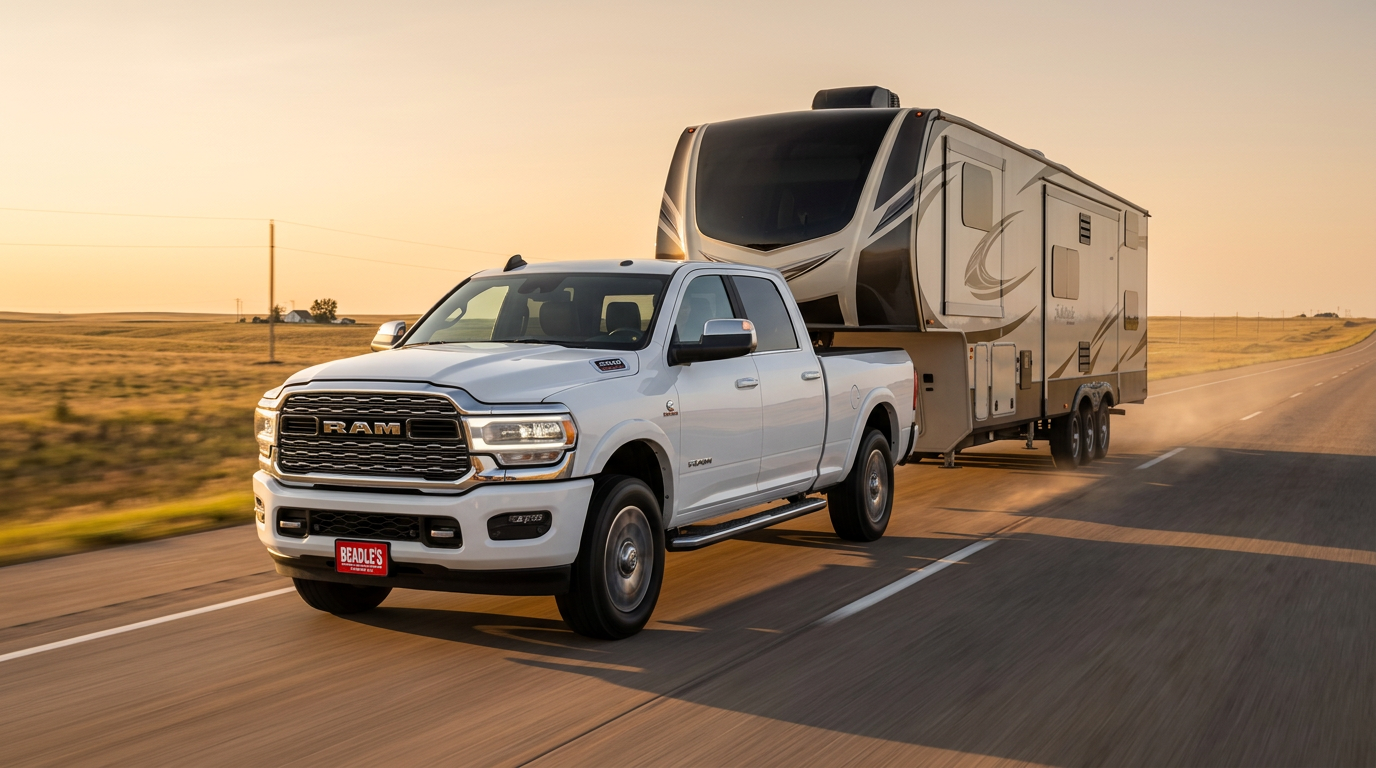
Heavy Towing: Cummins Dominance When a loaded trailer is in tow, the Cummins transforms the truck into a specialized towing machine. That 1,075 lb-ft of torque means the engine stays cool and relaxed even at gross combination weight. You don’t feel the strain of climbing hills or merging onto highways with 15,000+ lbs behind you. The Cummins holds lower RPMs during towing, reducing engine wear, noise, and heat stress. Transmission longevity improves because the torque converter doesn’t work as hard. For serious towing, the Cummins isn’t just better—it’s in a different category.
The reality for most 2026 Ram 2500 owners: if you tow a fifth wheel 3-4 times per year, the HEMI covers those trips adequately. If you tow weekly or regularly max out capacity, the Cummins becomes essential. See our complete towing guide for detailed capacity charts and real-world examples.
How does fuel economy compare between the two engines?
Fuel economy is where diesel engineering delivers measurable, long-term savings—but the math depends on how you drive.
Highway and Towing (Cummins Wins) The 2026 Ram 2500 6.7L Cummins achieves approximately 20-23 MPG on the highway under ideal conditions, and importantly, maintains relatively consistent efficiency even when towing. The gasoline HEMI typically returns 14-17 MPG on the highway and drops significantly under towing loads. For owners who log high annual mileage or tow frequently, diesel fuel economy can cut fuel costs by 25-35% over gasoline. If you tow 5,000 miles per year, that advantage compounds into meaningful savings.
City and Local Driving (More Balanced) In stop-and-go city driving, the efficiency gap narrows. The HEMI achieves 13-15 MPG city, while the Cummins drops to around 16-18 MPG in urban conditions. Neither engine excels in short-trip, low-speed driving, so daily commuting doesn’t yield as dramatic a fuel savings advantage for diesel.
The Diesel Fuel Cost Variable Diesel typically costs $0.20-$0.50 more per gallon than regular gasoline, depending on your market and current oil prices. In some regions and seasons, diesel and gasoline prices converge. This variable makes the “fuel savings” calculation uncertain. A Cummins owner who logs 20,000 miles annually on the highway will see clear fuel-cost advantage. A Cummins owner who drives mostly in the city and rarely tows may not recover the $12,995 premium through fuel savings alone.
Key Takeaways
- The 6.4L HEMI offers 405 hp / 429 lb-ft at no cost and delivers responsive daily driving with towing up to 17,740 lbs.
- The 6.7L Cummins HO diesel produces 430 hp / 1,075 lb-ft of torque with a 20,000 lb towing capacity for a $12,995 premium.
- The Cummins torque advantage (646 lb-ft more) makes heavy towing and maximum payload operations significantly easier and safer.
- HEMI is the choice for occasional towing, daily commuting, and owners prioritizing lower purchase cost and simpler ownership.
- Cummins justifies its cost for regular heavy towing, high annual mileage, and 5+ year ownership with highway-heavy driving.
- Diesel fuel economy advantage (20-23 highway MPG vs 14-17) only materializes on highway miles and towing—city driving economies are similar.
- Resale value typically favors diesel trucks, potentially recovering $4,000-$6,000 of the upgrade premium at trade-in.
Frequently Asked Questions
My Recommendation as Lexy Tabbert from Beadle’s Chrysler Center: I’ve helped hundreds of customers in Bowdle, South Dakota choose between these two powerplants, and here’s what I’ve learned: the right choice isn’t always the one with the most torque or the lowest price. It’s the one that matches how you actually live.
If you’re honest about towing infrequently, the HEMI’s 17,740 lb capacity handles recreational trailers just fine, and you’ll save $12,995 plus the cost of premium diesel fuel over ownership. You’ll get a truck that feels lively every single day and requires no special maintenance knowledge.
But if you’re towing regularly—whether it’s a contractor managing job sites or an adventurer with a fifth wheel—the Cummins isn’t an upgrade; it’s the correct tool. That 1,075 lb-ft transforms the experience from “this works” to “this was designed for this.” The engine feels unstressed, your transmission lasts longer, and your towing becomes safer and more enjoyable.
Both engines are built on decades of Ram reliability. The difference is that one prioritizes flexibility and value, while the other specializes in serious hauling. Visit our dealership in Bowdle, and we’ll test drive both. Talk through your real towing plans, and we’ll help you understand which 2026 Ram 2500 engine delivers the best value for your needs. Learn more about the full Ram 2500 lineup on our 2026 Ram 2500 overview.
About the Author
Lexy Tabbert — Beadle’s Chrysler Center, Bowdle, SD
Lexy Tabbert is the Director of Sales and Marketing at Beadle’s Chrysler Center in Bowdle, South Dakota. She covers Ram, Jeep, Dodge, and Chrysler vehicles — helping buyers across the region find the right truck and configuration for their needs. Learn more about Lexy.
Connect with us


