




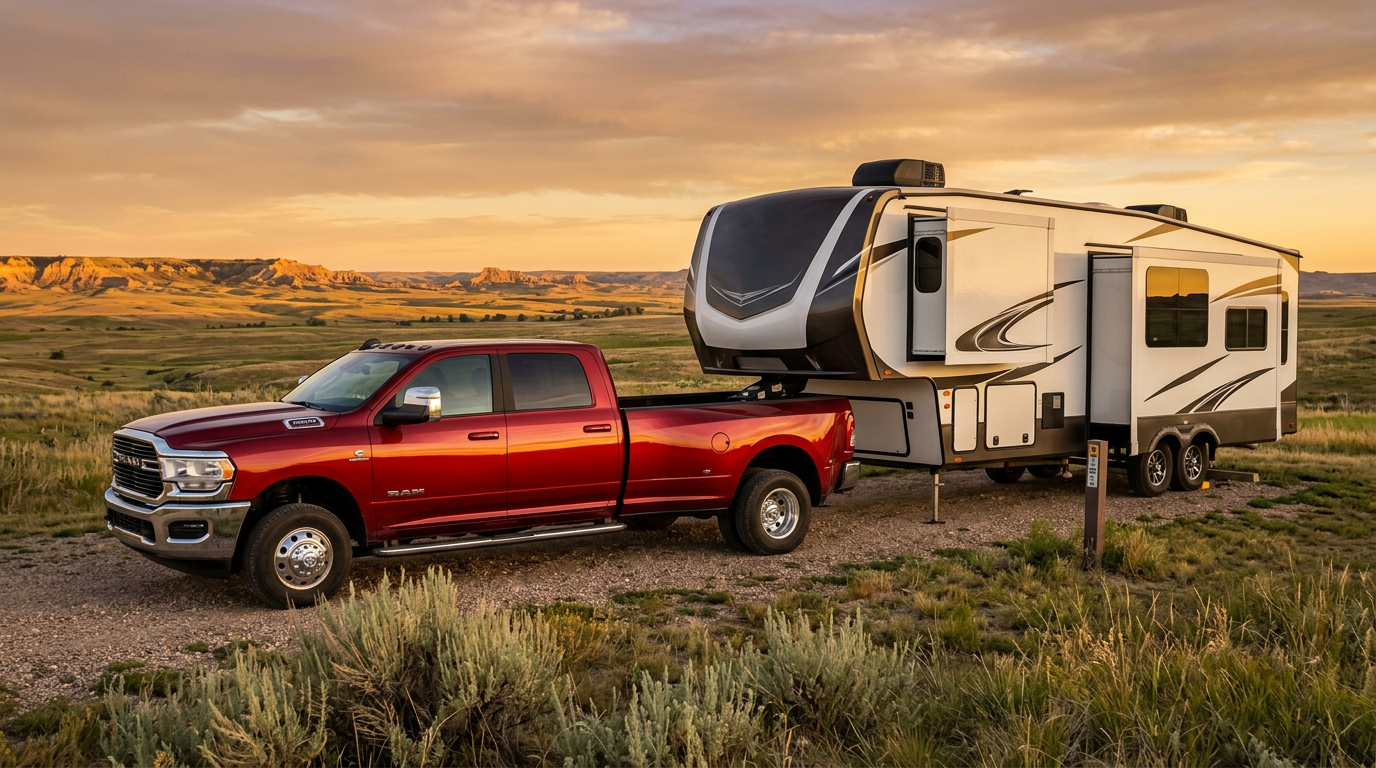
If you’re eyeing a large fifth-wheel camper, a gooseneck horse trailer, or a livestock hauler, the difference between a standard Class V receiver hitch and a fifth-wheel or gooseneck hitch isn’t just about the hardware — it’s about the engineering underneath. The Ram 3500 is built to handle both, but only if you configure it correctly.
This guide walks you through the Ram 3500’s fifth-wheel and gooseneck capabilities, the $745 prep group that sets you up for success, tongue weight rules that matter, and which truck configuration will actually handle the big trailer you want to pull. Whether you’re a Black Hills camper or a South Dakota rancher, get the details that dealers often skip.
On This Page
- Does the Ram 3500 come ready to tow a 5th wheel?
- What is the 5th Wheel/Gooseneck Towing Prep Group on the Ram 3500?
- What is the maximum tongue weight on the Ram 3500?
- When do I need a 5th-wheel or gooseneck hitch instead of a conventional hitch?
- What is the best Ram 3500 configuration for pulling a large 5th wheel camper?
- Can I tow a gooseneck livestock trailer with a Ram 3500 SRW?
Does the Ram 3500 come ready to tow a 5th wheel?
Not out of the box. The base Ram 3500 ships with a standard bed and provisions for a Class V receiver hitch — which works great for conventional trailers. But if you want to mount a fifth-wheel or gooseneck hitch, you need to order the factory 5th Wheel/Gooseneck Towing Prep Group ($745) from the start.
This prep group includes factory 7-pin bed wiring, a 12-pin connector in the bed, and structural provisions for an aftermarket fifth-wheel or gooseneck hitch platform. Without it, you’re adding complexity and cost after purchase — and potentially limiting your options for large trailers.
Bottom line: If you even suspect you’ll want to pull a fifth-wheel or large gooseneck trailer, order the prep group when you buy. It’s $745 now, or it’s $2,000+ and a service visit later.
What is the 5th Wheel/Gooseneck Towing Prep Group on the Ram 3500?
The 5th Wheel/Gooseneck Towing Prep Group ($745) is a factory option that builds the structural and electrical foundation for a fifth-wheel or gooseneck hitch. It includes three critical components:
Factory 7-pin bed wiring connects trailer lights and functions directly from the truck’s electrical system. 12-pin connector in the bed handles power distribution for the hitch and any trailer-mounted accessories (brake controller, battery charger, etc.). Structural provisions reinforce the truck frame and bed floor to safely anchor the fifth-wheel or gooseneck hitch platform.
When you buy a Ram 3500 with this prep group, installing an aftermarket fifth-wheel or gooseneck hitch becomes straightforward: the hitch installer bolts to factory mounting points and taps into the existing 12-pin connector. Without the prep group, you’re installing a hitch to a truck bed that wasn’t engineered for the concentrated load and towing dynamics of a fifth-wheel or gooseneck trailer.
What is the maximum tongue weight on the Ram 3500?
Tongue weight matters because it sits directly over the truck’s rear axle — and too much will overload it. The Ram 3500 has different limits depending on your hitch type and truck configuration.
Class V receiver hitch (conventional trailers): Maximum tongue weight is 2,300 lbs on the 3500, compared to 2,000 lbs on the Ram 2500. Fifth-wheel or gooseneck hitch: The maximum tongue weight guideline is 15% of the gross trailer weight (GTW) — which is more than the 10% rule for conventional hitches. This is because fifth-wheel and gooseneck hitches distribute the tongue weight more directly over the truck’s rear wheels, where the dual rear wheels (on a DRW model) can handle it.
Example: If you’re pulling a 24,000 lb gross trailer weight with a fifth-wheel hitch, the maximum safe tongue weight is 3,600 lbs (15% of 24,000). If you tried that with a conventional Class V receiver hitch, you’d max out at 2,300 lbs and create an unsafe, unbalanced load.
When do I need a 5th-wheel or gooseneck hitch instead of a conventional hitch?
You need a fifth-wheel or gooseneck hitch when your trailer gross weight rating (GTWR) exceeds 23,000 lbs — or when tongue weight would exceed the receiver hitch limits. Here’s the practical breakdown:
Under 23,000 lbs GTWR: A Class V receiver hitch works fine. Many horse trailers, utility trailers, and small fifth-wheels fall into this range, and they’ll tow safely on a conventional hitch.
23,000–36,000+ lbs GTWR: A fifth-wheel or gooseneck hitch becomes mandatory. Large livestock trailers, anhydrous ammonia tanks, big grain trailers, and most modern fifth-wheel campers live in this range. The fifth-wheel or gooseneck hitch is engineered to handle both the raw weight and the tongue weight load without compromising safety or handling.
Key advantage of fifth-wheel/gooseneck hitches: They reduce tongue weight per the 15% rule (vs. 10% for receiver hitches), which lowers the load on the truck’s rear axle and suspension. This means you can tow heavier trailers with better control, shorter stopping distances, and less wear on the truck. For ranchers and ag operators regularly pulling livestock trailers or grain trailers, the fifth-wheel hitch is worth the $745 prep group investment.
What is the best Ram 3500 configuration for pulling a large 5th wheel camper?
If you’re planning a Black Hills or Montana camping trip with a large fifth-wheel camper (24,000–38,000 lbs), you need the right Ram 3500 configuration from the ground up. Here’s what wins:
Cummins diesel engine: The 6.7L Cummins delivers 1,075 lb-ft of torque and can tow up to 36,610 lbs on a dually (DRW) configuration — with 4×4 drive and a 3.42 rear axle. A HEMI on a dually maxes out at 18,150 lbs, so if you want a large fifth-wheel, diesel is essential.
Dual rear wheels (DRW): Single rear wheel (SRW) 3500s max out at 26,080 lbs with the Cummins diesel. That works for mid-size fifth-wheels, but if you want flexibility and reserve capacity, the DRW configuration gives you the extra traction and load-carrying ability for heavier campers and rough terrain.
Auto-Level Rear Air Suspension: The Ram 3500’s class-exclusive auto-level rear air suspension automatically adjusts ride height under load, keeping your truck level when you’re hooked to a heavy fifth-wheel. This improves stability, reduces sway, and makes towing feel controlled even on rough roads. Pair this with the Max Tow Package to get the best platform.
The ideal fifth-wheel-pulling Ram 3500: Cummins diesel, crew cab 8-foot bed, DRW, 4×4, 3.42 rear axle, with 5th Wheel/Gooseneck Towing Prep Group and the Max Tow Package. This configuration gives you 36,610 lbs of towing capacity, auto-leveling suspension, integrated brake controller, and all the infrastructure to safely and comfortably pull a large fifth-wheel camper across the Northern Plains.
Can I tow a gooseneck livestock trailer with a Ram 3500 SRW?
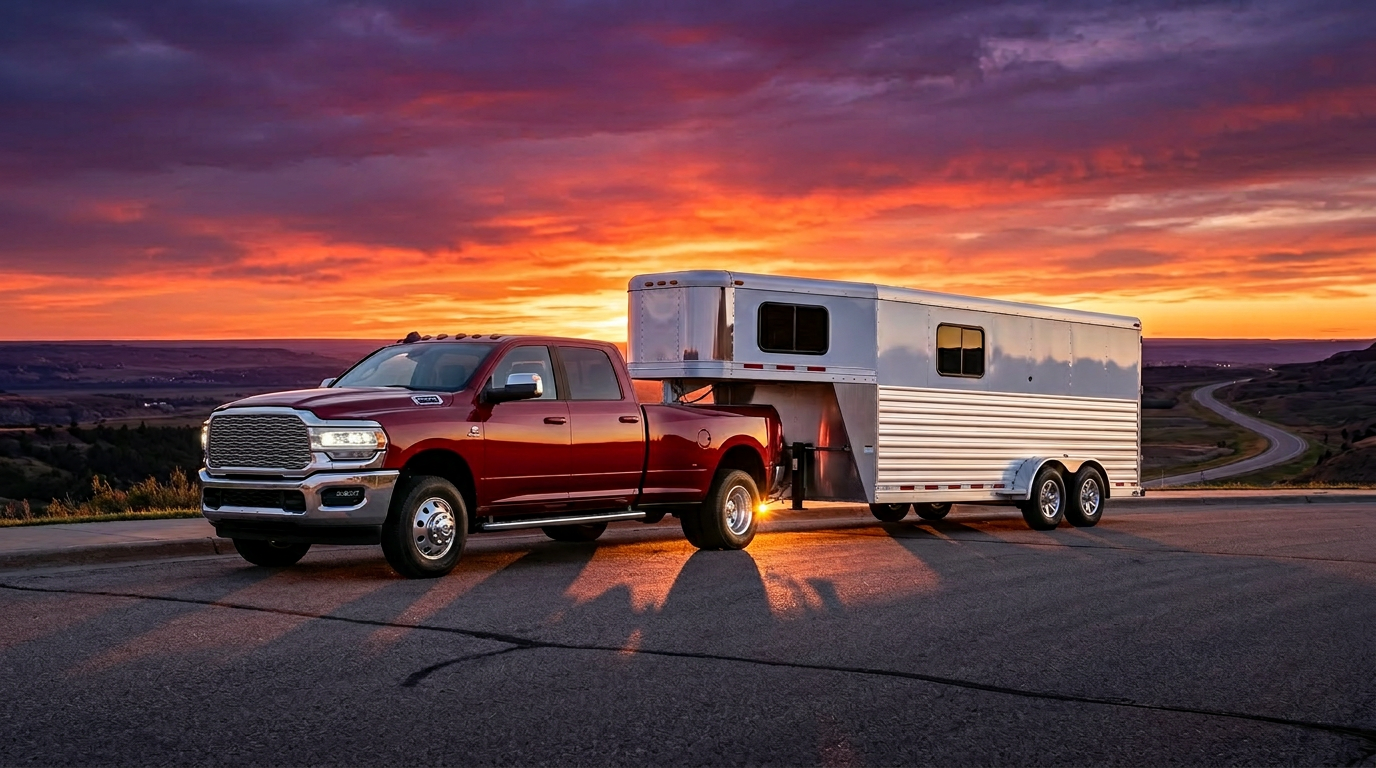
Yes, but with limits. A Ram 3500 single rear wheel (SRW) with a Cummins diesel can tow up to 26,080 lbs with a gooseneck hitch. That’s enough for many livestock trailers, small to mid-size gooseneck grain trailers, and horse trailers. But it’s not the maximum that the truck is capable of.
SRW vs. DRW for gooseneck towing: The SRW 3500 has a single rear wheel on each side, while the DRW has dual wheels. That single rear wheel on the SRW can only carry a percentage of the load that dual wheels can. For a light gooseneck livestock trailer (8,000–12,000 lbs), the SRW is fine. For anhydrous ammonia tanks or heavily loaded grain trailers (20,000–36,000 lbs), you’ll want the dual rear wheels to distribute the load safely and maintain control.
Real-world scenario: A South Dakota rancher pulling a loaded livestock trailer to the stockyards — typically 15,000–20,000 lbs — can use an SRW 3500 with Cummins. But if that same operator is pulling anhydrous ammonia in the spring or heavily loaded grain in the fall, the DRW becomes the safer choice because it distributes tongue weight across four rear wheels instead of two.
Don’t discount the SRW 3500 for gooseneck work — it’s a smart choice for many North Dakota and South Dakota operations. Just be honest about your heaviest load and make sure the truck you choose has the GCWR and towing capacity to handle it safely. For details on SRW vs. DRW overall, check our SRW vs. DRW dually guide.
5th Wheel vs. Gooseneck Hitch Comparison
| Feature | 5th Wheel Hitch | Gooseneck Hitch |
|---|---|---|
| Mounting Location | Over rear axle in truck bed | Over rear axle in truck bed (lower profile) |
| Common Trailers | Fifth-wheel campers, RVs | Livestock trailers, grain trailers, equipment haulers |
| Tongue Weight Limit | 15% of GTW (3,600 lbs on 24,000 lb trailer) | 15% of GTW (same as 5th wheel) |
| Turning Radius | Tighter (over axle pivot) | Tight (ball mount style) |
| Stability Under Load | Excellent (mass centered over truck) | Excellent (same advantage) |
How to Choose the Right 5th Wheel or Gooseneck Configuration
- Identify your heaviest trailer. Know the gross trailer weight (GTW) of the largest trailer you’ll pull. If it’s over 23,000 lbs, you need a fifth-wheel or gooseneck hitch — not a conventional receiver hitch.
- Calculate required tongue weight. For a fifth-wheel or gooseneck, use 15% of the GTW. A 30,000 lb trailer requires 4,500 lbs of tongue weight. Make sure your truck’s suspension and frame can handle it.
- Choose your engine: Cummins or HEMI? If you’re pulling over 23,000 lbs regularly, Cummins is mandatory. The HEMI DRW maxes at 18,150 lbs — not enough for large fifth-wheels or gooseneck trailers. See our towing capacity guide for detailed engine comparisons.
- Decide: SRW or DRW? Single rear wheels max out at 26,080 lbs (Cummins). Dual rear wheels max out at 36,610 lbs (Cummins). For large fifth-wheels or heavy livestock/grain trailers, DRW gives you safety margin and load distribution.
- Order the 5th Wheel/Gooseneck Towing Prep Group ($745). Do this when you buy the truck. Factory wiring, 12-pin connector, and bed floor reinforcement cost $745 now — or $2,000+ and dealer complications later.
- Add the Max Tow Package for air suspension. This includes the class-exclusive auto-level rear air suspension that keeps your truck level under load. Essential if you’re regularly towing a heavy fifth-wheel.
- Work with a hitch installer after delivery. Once your Ram 3500 arrives, a professional installer will bolt the fifth-wheel or gooseneck hitch to the factory mounting points and connect it to the 12-pin connector. This is a straightforward 4–6 hour job.
Key Takeaways
- Order the 5th Wheel/Gooseneck Towing Prep Group ($745): Factory 7-pin wiring, 12-pin connector, and bed floor provisions make aftermarket hitch installation straightforward and engineered for safety.
- Tongue weight limit is 15% of GTW: A 24,000 lb fifth-wheel camper allows 3,600 lbs of tongue weight — much higher than the 10% rule for receiver hitches, which is why fifth-wheels and goosenecks are designed for heavy trailers.
- Fifth-wheel or gooseneck required over 23,000 lbs: Ram mandates this for safety. Receiver hitches max out at 2,300 lbs tongue weight and are not suitable for large campers or trailers.
- Cummins DRW is the sweet spot for large fifth-wheels: 36,610 lbs max capacity with auto-level air suspension and dual rear wheels. HEMI DRW tops out at 18,150 lbs — not enough for most modern fifth-wheel campers.
- SRW 3500 (Cummins) works for lighter gooseneck work: 26,080 lbs max capacity is adequate for small to mid-size livestock and grain trailers, but DRW is safer for heavier loads and rough terrain.
5th Wheel & Gooseneck Towing FAQ
What’s the difference between a fifth-wheel and a gooseneck hitch?
Both fifth-wheel and gooseneck hitches mount in the truck bed and distribute tongue weight over the rear axle. The main difference: fifth-wheels use a sliding kingpin connection that automatically adjusts turning radius, while goosenecks use a ball mount (similar to a standard hitch but larger and mounted over the axle). For campers, fifth-wheels are standard. For livestock and grain trailers, either works — goosenecks are slightly cheaper to install and maintain. Both support the same 15% tongue weight rule and towing capacity limits on the Ram 3500.
Can I add a fifth-wheel hitch to my Ram 3500 without the prep group?
Technically yes, but it’s not recommended. Without the factory prep group, the hitch installer has to drill into the frame and bed floor, run new wiring (no factory 12-pin connector), and potentially reinforce areas Ram didn’t engineer for fifth-wheel loads. You’ll spend $2,000–$3,000 instead of $745, and you’ll lose the safety assurance of factory engineering. Always order the prep group at purchase.
What is GCWR, and why does it matter for fifth-wheel towing?
GCWR (Gross Combined Weight Rating) is the maximum weight of the truck plus the trailer together. The Ram 3500 has a GCWR up to 45,000 lbs, depending on configuration. If your Cummins DRW weighs 7,000 lbs and your fifth-wheel camper weighs 38,000 lbs, the combined weight is 45,000 lbs — at the limit. You can’t exceed GCWR even if your towing capacity (36,610 lbs) allows a heavier trailer. Always check both towing capacity AND GCWR when planning a large fifth-wheel purchase.
Does the auto-level rear air suspension really make a difference when towing a fifth-wheel?
Yes, absolutely. The Ram 3500’s class-exclusive auto-level rear air suspension automatically adjusts ride height when you hook up a heavy fifth-wheel, keeping the truck level and your camper level. This improves safety, reduces sway on highways, shortens braking distances, and makes the overall towing experience much more controlled. It also reduces wear on your suspension and tires. If you’re pulling a large fifth-wheel regularly, the auto-level suspension (included in the Max Tow Package) is worth the investment.
What’s the maximum tongue weight for a 24,000 lb fifth-wheel camper on a Ram 3500?
For a fifth-wheel hitch, use 15% of gross trailer weight. On a 24,000 lb camper, that’s 3,600 lbs maximum tongue weight. Make sure your Ram 3500’s rear suspension and frame can handle 3,600 lbs concentrated over the rear axle — most Cummins DRWs can handle this easily, but verify your specific configuration with Ram specs or a dealer before finalizing camper specs.
My Take on Fifth-Wheel and Gooseneck Towing with the Ram 3500
I’ve talked to a lot of families who want to pull a large fifth-wheel camper across the Northern Plains, and I’ve worked with ranchers and ag operators who move livestock and grain trailers day in and day out. The Ram 3500 is built for both jobs — but only if you set it up correctly from the start.
The biggest mistake I see is buyers skipping the $745 fifth-wheel/gooseneck prep group because they think it’s optional. It’s not. Once you decide you want to pull a large fifth-wheel or gooseneck trailer — even if that decision comes a year later — you’re looking at aftermarket installation costs and complications. Spend the $745 when you order. It’s the cheapest insurance you can buy.
The second thing I always tell folks: if your trailer is over 23,000 lbs, you’re not negotiating with a receiver hitch. You need a fifth-wheel or gooseneck, and you need a truck engineered for it. On the 3500, that means Cummins diesel, ideally with dual rear wheels and the Max Tow Package. Yes, it’s more money upfront. But when you’re pulling 36,000 lbs across South Dakota with an auto-leveling suspension keeping your camper stable, and your brake controller managing the load without your truck fighting it — that’s peace of mind worth the investment.
For Black Hills trips or Montana vacations, it’s the difference between a truck that’s working hard and a truck that’s doing what it was designed for. Come talk to us at Beadle’s Chrysler Center, and let’s make sure your Ram 3500 is configured to handle the trailer you actually want to pull — not the one that fits a standard receiver hitch. For full specs, cab options, and trim comparisons, see our complete 2026 Ram 3500 buying guide.
About the Author
Lexy Tabbert — Beadle’s Chrysler Center, Bowdle, SD
Lexy Tabbert is the Director of Sales and Marketing at Beadle’s Chrysler Center in Bowdle, South Dakota. She covers Ram, Jeep, Dodge, and Chrysler vehicles — helping families, ranchers, and ag operators across the region find the right truck and configuration for their needs. Learn more about Lexy.
Connect with us


