





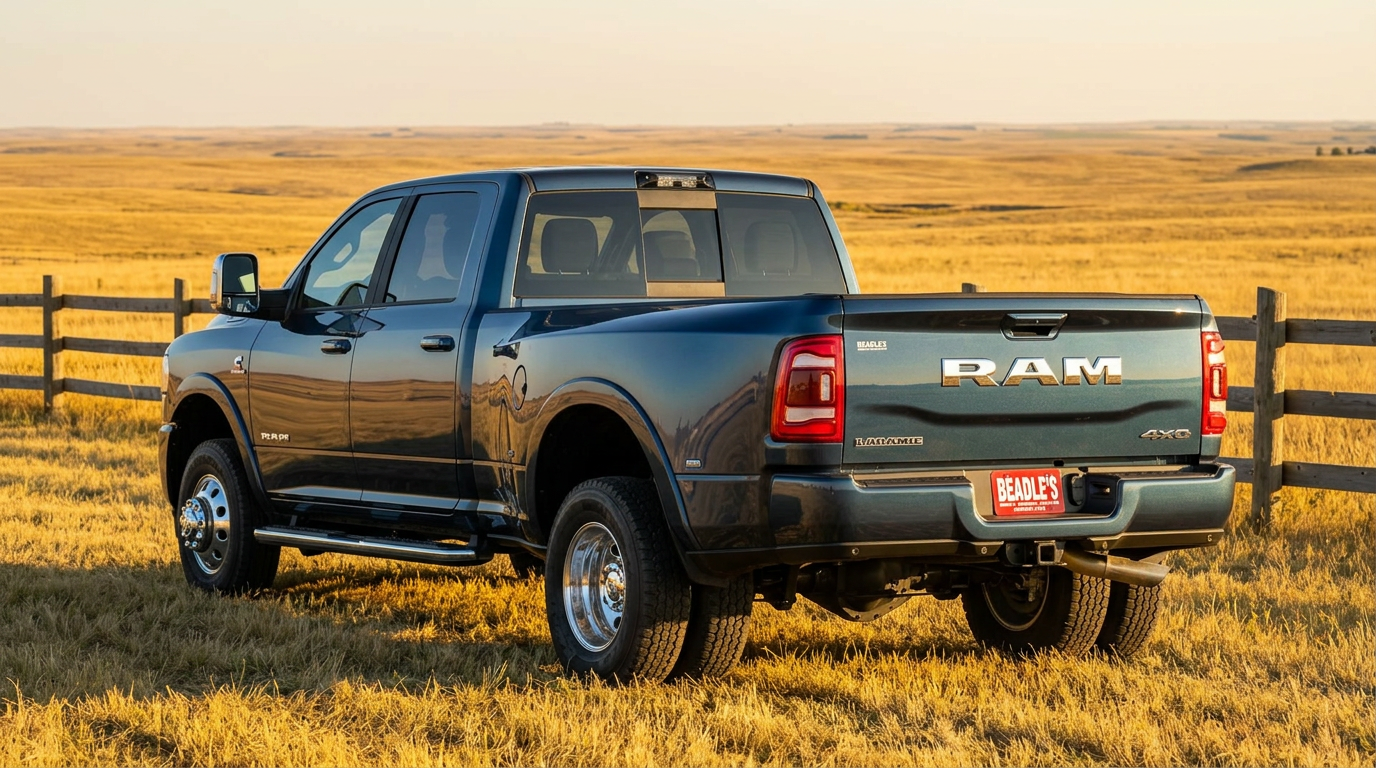
2026 Ram 3500 SRW vs DRW: Do You Need a Dually?
If you’re shopping for a heavy-duty truck in South Dakota, you’ve probably stood in front of a Ram 3500 and wondered: should I go with single rear wheels or dual rear wheels? It’s one of the biggest decisions you’ll make, and the answer depends entirely on what you’re actually towing and hauling.
I’ve spent a lot of time researching the Ram 3500 lineup, and I’ve talked to dozens of local owners—ranchers pulling gooseneck trailers, RV enthusiasts towing fifth-wheels, contractors who need maximum payload. The differences between SRW and DRW go way beyond looking at a spec sheet. There are real trade-offs: towing capacity, daily drivability, maintenance costs, and how the truck handles gravel roads and winter weather here in South Dakota.
What’s Inside
- What is the difference between SRW and DRW on the Ram 3500?
- Do I need a dually to tow a 5th wheel camper?
- How much more can a Ram 3500 dually tow than an SRW?
- Is a dually harder to drive and park than a single rear wheel?
- Does a dually cost more in tires and maintenance?
- Can I daily-drive a Ram 3500 dually in South Dakota?
What is the difference between SRW and DRW on the Ram 3500?
The main difference is simple: SRW means single rear wheel (one wheel on each side), and DRW—also called a “dually”—means dual rear wheels (two wheels on each side). But that simple change ripples through the entire truck’s capabilities and behavior.
A dually sits higher and wider in the rear because of the extra wheels. Ram engineers reinforce the rear axle, suspension, and frame to handle the extra weight and stress. The GVWR (Gross Vehicle Weight Rating) jumps from 11,040–12,300 lbs on an SRW to 14,000 lbs on a DRW. That higher GVWR means you can legally carry more total weight—truck plus cargo plus passengers.
Here’s the critical part: Ram only offers DRW on Crew Cab configurations. If you want a Reg Cab or Mega Cab Ram 3500, you’re limited to SRW. That matters if you need the compact footprint of a shorter cab or the interior space of a Mega Cab with maximum towing.
The dual wheels also change how the truck behaves on the road. There’s more contact patch with the ground, better stability when loaded, and less swaying when you’re on gravel or dealing with South Dakota wind. But you’re also dealing with a wider rear end—something worth considering on narrow ranch roads or when backing up to a barn.
Do I need a dually to tow a 5th wheel camper?
Not always—but it depends on the weight of the trailer you’re pulling.
Here’s what Ram specifies: Any fifth-wheel or gooseneck trailer over 23,000 lbs requires a fifth-wheel or gooseneck hitch — not necessarily a dually. A Cummins SRW can still legally tow up to 26,080 lbs with a gooseneck hitch. You only need DRW if your trailer exceeds that SRW limit.
Most mid-size fifth-wheel campers (30–35 feet) weigh between 8,000 and 15,000 lbs, so an SRW with a Cummins engine could tow them comfortably. A Cummins-powered SRW can tow up to 26,080 lbs, which covers a lot of RV owners’ needs. But if you’re pulling a big two-bedroom luxury fifth-wheel or a 40-foot gooseneck with livestock equipment, you need a dually—and probably a Cummins.
The second consideration is stability and comfort. We hear from buyers who’ve towed with an SRW and felt nervous on I-90 in windy conditions or dealing with the weight transfer when backing up. A dually’s dual wheels give you that extra confidence and control, especially if you’re towing in winter or on gravel.
How much more can a Ram 3500 dually tow than an SRW?
The towing advantage depends heavily on which engine you choose. Let me break down the real-world numbers:
Cummins 6.7L Turbo Diesel: A DRW can tow up to 36,610 lbs, while an SRW maxes out at 26,080 lbs. That’s a 10,530 lb difference—enough for a large gooseneck trailer with equipment, livestock, or a massive RV setup. This is where a dually really shines for serious agricultural and commercial work.
HEMI 5.7L Gasoline: The difference is much smaller. An SRW HEMI can tow 17,730 lbs, and a DRW HEMI tops out at 18,150 lbs. That’s only a 420 lb advantage—barely noticeable. If you’re considering a HEMI, the SRW towing capacity might be all you need, and you’d save money on fuel and maintenance.
For most recreational towing in South Dakota (fifth-wheels, enclosed car trailers, small gooseneck equipment), an SRW Cummins covers nearly every use case. You only step up to a DRW if you’re regularly pulling livestock trailers, large shop equipment, or commercial loads.
Is a dually harder to drive and park than a single rear wheel?
Yes, but not dramatically—and most owners adapt quickly.
A dually is wider across the rear axle (about 8.5 feet bumper-to-bumper vs. 6.5 feet on an SRW). You notice it when backing into a tight spot or navigating a narrow mountain road. Parking at a Sioux Falls Walmart requires more awareness. Farm roads with shallow ditches on both sides become trickier.
That said, the extra width also gives you a steadier platform. Duallys don’t bounce or sway as much, which some drivers prefer over time. If you’re experienced with full-size trucks, the adjustment takes a few weeks. If you’re new to heavy-duty trucks, an SRW might be more forgiving.
Winter driving in South Dakota is worth mentioning. The dual rear wheels improve traction in snow and ice, which is a genuine safety advantage. The trade-off is that you need to be more deliberate with your backing maneuvers on frozen surfaces.
For daily use—running into town, picking up supplies, light hauling—an SRW wins on maneuverability. For serious work pulling loaded trailers, a dually’s extra stability often outweighs the tighter turning radius.
Does a dually cost more in tires and maintenance?
Yes, and it’s worth factoring into your total cost of ownership.
A dually requires four rear tires instead of two, so tire replacement is roughly twice the cost. You’re also replacing tires twice as often if you keep the same mileage. Over the life of the truck, that’s a significant expense—potentially $3,000–$5,000 more than an SRW.
Brake maintenance is similar. Two extra rear wheels mean more brake pads and rotors to service. The suspension components are heavier-duty on a DRW, so replacement parts cost more. Nothing catastrophic, but the routine maintenance adds up.
The Cummins diesel engine itself doesn’t vary between SRW and DRW, so fuel economy and major mechanical repairs are equivalent. The real cost difference is consumables: tires, brakes, and suspension wear. For a rancher or contractor running the truck hard year-round, budget an extra $500–$800 annually for maintenance on a dually.
Insurance might be slightly higher on a DRW, too, depending on your coverage and the insurer’s rating.
Can I daily-drive a Ram 3500 dually in South Dakota?
Absolutely—thousands of South Dakotans do. But “daily-drive” means different things to different people.
If you mean running into Bowdle for groceries, meeting with feed suppliers, and making the occasional 2-hour drive to Huron, a dually works fine. You’ll sit higher, get a commanding view of the road, and feel the extra presence. Fuel economy is reasonable for a dually—most owners see 12–15 mpg on the highway with a Cummins, slightly better with a HEMI.
The catch: you need to respect the truck’s size. Narrow parking spaces are tighter. Backing up takes longer. You’ll never forget you’re driving a wide-load vehicle. For some people, that’s a dealbreaker for daily use. For others—especially rural South Dakota where roads are wider and towns are smaller—it’s no issue at all.
Winter is where a dually shines for daily driving. The extra traction and stability in snow and ice make it genuinely safer than an SRW in rough conditions. Many South Dakota owners choose a dually specifically because they drive in winter weather year-round.
Our advice: if you’re primarily daily-driving with occasional towing, an SRW is more practical and cheaper. If your daily driving involves any loaded towing (even once a month), a dually is the safer, more stable choice—and you’ll grow to love the extra security on rough roads.
SRW vs DRW Quick Comparison
| Feature | SRW | DRW (Dually) |
|---|---|---|
| Cummins Max Towing | 26,080 lbs | 36,610 lbs |
| HEMI Max Towing | 17,730 lbs | 18,150 lbs |
| Cummins Max Payload | 4,400 lbs | 6,050 lbs |
| HEMI Max Payload | 4,970 lbs | 7,590 lbs |
| GVWR | 11,040–12,300 lbs | 14,000 lbs |
| Width (rear) | ~6.5 ft | ~8.5 ft |
| Tire Cost (per set) | Lower | ~2x Higher |
| Winter Traction | Good | Excellent |
| Parking Ease | Easier | Tighter |
| Available Cabs | All (Reg, Crew, Mega) | Crew Cab Only |
| Worth it if… | Light-to-moderate towing, daily driving, budget-conscious | Heavy towing, livestock, winter driving, stability priority |
| Skip it if… | Pulling trailers over 23,000 lbs, extreme winter conditions | Primarily daily-driving, tight parking lots, fuel costs matter |
How to Decide: SRW or DRW?
- Weigh your typical load. If you’re regularly pulling trailers heavier than 23,000 lbs, a dually is required. If you’re under 15,000 lbs and not daily towing, an SRW is sufficient.
- Check your cab preference. Need a Reg Cab or Mega Cab? You’re locked into SRW. If a Crew Cab works for you, DRW is an option.
- Consider seasonal driving. If you drive loaded in snow and ice regularly (like most South Dakota ranchers), a dually’s winter traction is worth the extra cost and width.
- Calculate maintenance budget. Add $500–$800 annually for dually maintenance (tires, brakes) versus an SRW. Over 10 years, that’s significant.
- Test-drive both. Spend an afternoon with an SRW and a DRW. Back up. Turn tight. Feel the difference in stability under load. Your comfort level matters more than specs.
- Talk to local owners. We have plenty of SRW and DRW Ram 3500 owners in the Bowdle area. Their real-world experience is invaluable for South Dakota driving.
Key Takeaways
- SRW vs DRW is a capability and lifestyle choice, not just a spec decision. An SRW handles most recreational towing and daily driving. A DRW is built for heavy work and winter confidence.
- Cummins owners get a massive towing advantage with a DRW (36,610 vs 26,080 lbs). HEMI buyers see minimal difference. Choose your engine first, then decide on wheels.
- A dually costs more to own (tires, maintenance) but gives you higher GVWR, better winter traction, and maximum legal towing. It’s an investment in capability and safety, not just appearance.
- Daily driving a dually is practical in rural South Dakota, but requires respect for its width and maneuverability. Test-drive one before committing.
Frequently Asked Questions
Can I put a DRW bed on an SRW Ram 3500?
Not practically or legally. The frame, axle, suspension, and GVWR are engineered differently for each configuration. Retrofitting a DRW bed onto an SRW frame compromises structural integrity and violates your truck’s GVWR. It’s also not something any reputable shop would tackle. If you need a dually, buy a dually.
What’s the fuel economy difference between SRW and DRW?
Real-world difference is minimal—usually 1–2 mpg worse on a DRW, mostly because of extra weight and rolling resistance from the additional tires. A Cummins SRW might see 14–16 mpg highway; a DRW might see 12–15 mpg. For HEMI models, the difference is even smaller. Don’t choose based on mpg; both are thirsty trucks.
Do I need special insurance for a DRW?
Not special, but your premium might be slightly higher because of the truck’s higher GVWR and towing capacity. Talk to your agent. Some insurers rate based on GVWR; others base it on use (work truck vs. personal). For commercial or heavy towing, expect higher premiums either way, SRW or DRW.
Can a DRW fit in my garage?
It depends on your garage width. A DRW is roughly 8.5 feet wide (bumper to bumper), versus 6.5 feet for an SRW. If your garage is tight, measure it. Many rural garages and pole barns aren’t designed for a dually. Outdoor parking is common for dually owners in South Dakota.
My Take on SRW vs DRW
Here’s the honest truth: I’ve spent time with both configurations, and there’s no universally “right” answer. I’ve talked to ranchers who bought an SRW and regretted not going with a dually because they felt nervous towing a loaded gooseneck. I’ve also talked to contractors who said their DRW is overkill and the parking headaches drove them crazy.
The real decision comes down to three questions:
First: What are you actually towing? If it’s recreational (fifth-wheel camper, boat, enclosed trailer), an SRW Cummins covers 95% of use cases. If it’s agricultural (livestock, equipment, gooseneck commercial work), a DRW is the safer, legally preferred choice for loads over 23,000 lbs.
Second: How often are you towing? If it’s seasonal—maybe a weekend trip to the Black Hills with a camper—an SRW is efficient and practical. If you’re towing something almost every week, a DRW’s stability and confidence become invaluable, especially in winter.
Third: What matters more—capability or practicality? A dually is built for work. It’s wider, costs more to maintain, and demands respect on the road. But it’s also steadier, safer in bad weather, and legal for the heaviest legal trailers. An SRW is nimble, cheaper, and perfectly adequate for most owners. Neither is wrong; they’re just different tools.
We hear from buyers who’ve owned both, and most say the choice depends on their current life stage. Young families towing a camper? SRW wins. Established ranchers pulling livestock? Dually wins. The best choice is the one that matches your actual needs—not what you think you might need someday.
Want all the Ram 3500 specs, towing numbers, and configuration details in one place? Read our complete 2026 Ram 3500 buying guide before you decide.
About the Author
Lexy Tabbert — Beadle’s Chrysler Center, Bowdle, SD
Lexy Tabbert is the Director of Sales and Marketing at Beadle’s Chrysler Center in Bowdle, South Dakota. She covers Ram, Jeep, Dodge, and Chrysler vehicles — helping families, ranchers, and ag operators across the region find the right truck and configuration for their needs. Learn more about Lexy.
Connect with us


