





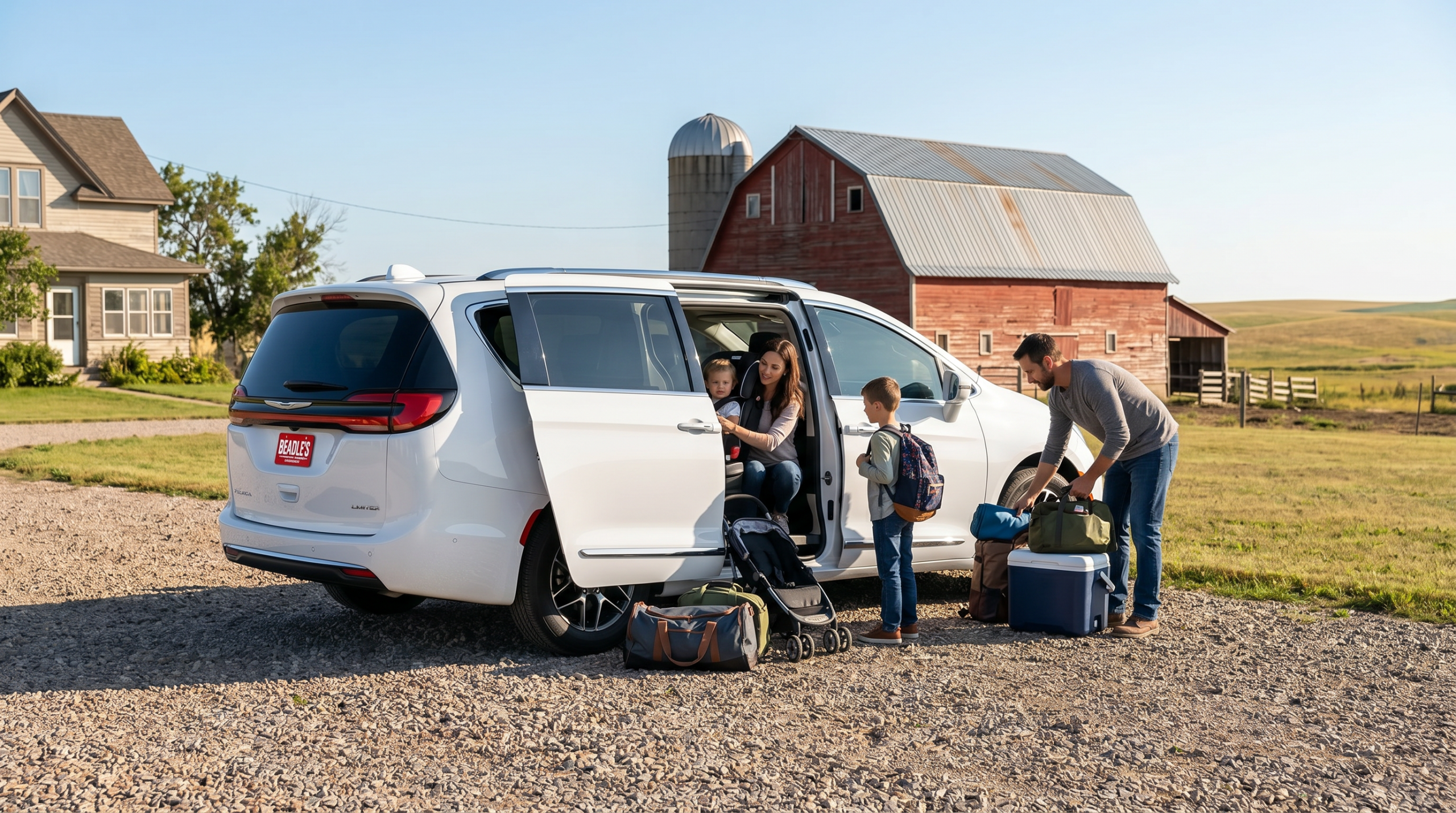
Quick Answer
The 2027 Chrysler Pacifica fits Dakota families wanting three-row space, available all-wheel drive, and Stow ‘n Go flexibility. It’s gas-only now — a 3.6L V6 at about 20 mpg combined with AWD. Choose the Select AWD; pick a Toyota Sienna hybrid only if fuel economy is your top priority.
Buying a family hauler in the Dakotas comes down to a few honest questions: will it fit everyone, can it handle a gravel road in February, and will it actually make your life easier on a busy weekday? The 2027 Pacifica answers most of those well — but it’s not the right pick for every single buyer, and we’d rather tell you that up front.
This guide is built to help you decide. We’ll lay out exactly who the Pacifica is best for, whether a gas-only minivan still makes sense, why it beats a three-row SUV for a lot of families, and who should honestly look elsewhere.
Who is the 2027 Pacifica best for?
The 2027 Pacifica is built for the family that needs to move people and gear, not just look like they might. If you’ve got three rows to fill — kids, car seats, the occasional extra passenger — and you want the flexibility to swap between hauling people and hauling stuff on the same trip, this is where the Pacifica shines.
For families around Bowdle and across the high plains, three things tend to seal it: real interior space, available all-wheel drive for snow and gravel, and Stow ‘n Go seating that folds the second and third rows flat into the floor without hauling seats out to the garage. That combination — AWD plus second-row Stow ‘n Go — is something you genuinely can’t get on any other minivan.
From Beadle’s Chrysler Center
The families who love their Pacifica the most are the ones who actually use the flexibility — second row down for a lumber run on Saturday, full seven seats for church on Sunday. If you’re going to leave the seats up and bolted in all year, you’re paying for capability you won’t use, and a simpler SUV might suit you better.
Does a gas-only minivan still make sense now that the hybrid is gone?
Here’s the honest part: for 2027, the Pacifica is gas-only. The 3.6L Pentastar V6 is the single engine across the lineup, and the plug-in hybrid has been discontinued. So if you were hoping to plug in at home, that option no longer exists on a new Pacifica.
But there’s a real case for the gas V6, especially out here. It’s a proven, mechanically simple engine paired with a disconnecting all-wheel-drive system — no charging to plan around when it’s fifteen below, no range anxiety on a long stretch of empty highway, and nothing to fast-charge that you couldn’t fast-charge anyway. For a rural family that drives real distances and parks outside in the cold, a tank of gas and a warm remote-started cabin is a genuinely simpler ownership story.
The trade-off, stated plainly
What you give up is fuel economy. A gas Pacifica lands around 22 mpg combined in front-wheel drive and about 20 combined with AWD. That’s the cost of admission for the V6’s simplicity and the available all-wheel drive. If saving fuel is the thing that matters most to you, that number is the one to weigh honestly.
For most families we talk to, the math works: the V6 has the power for full loads and grades, the AWD handles the weather, and roughly 20 mpg is a fair price for not having to think about a charger in a Dakota winter.
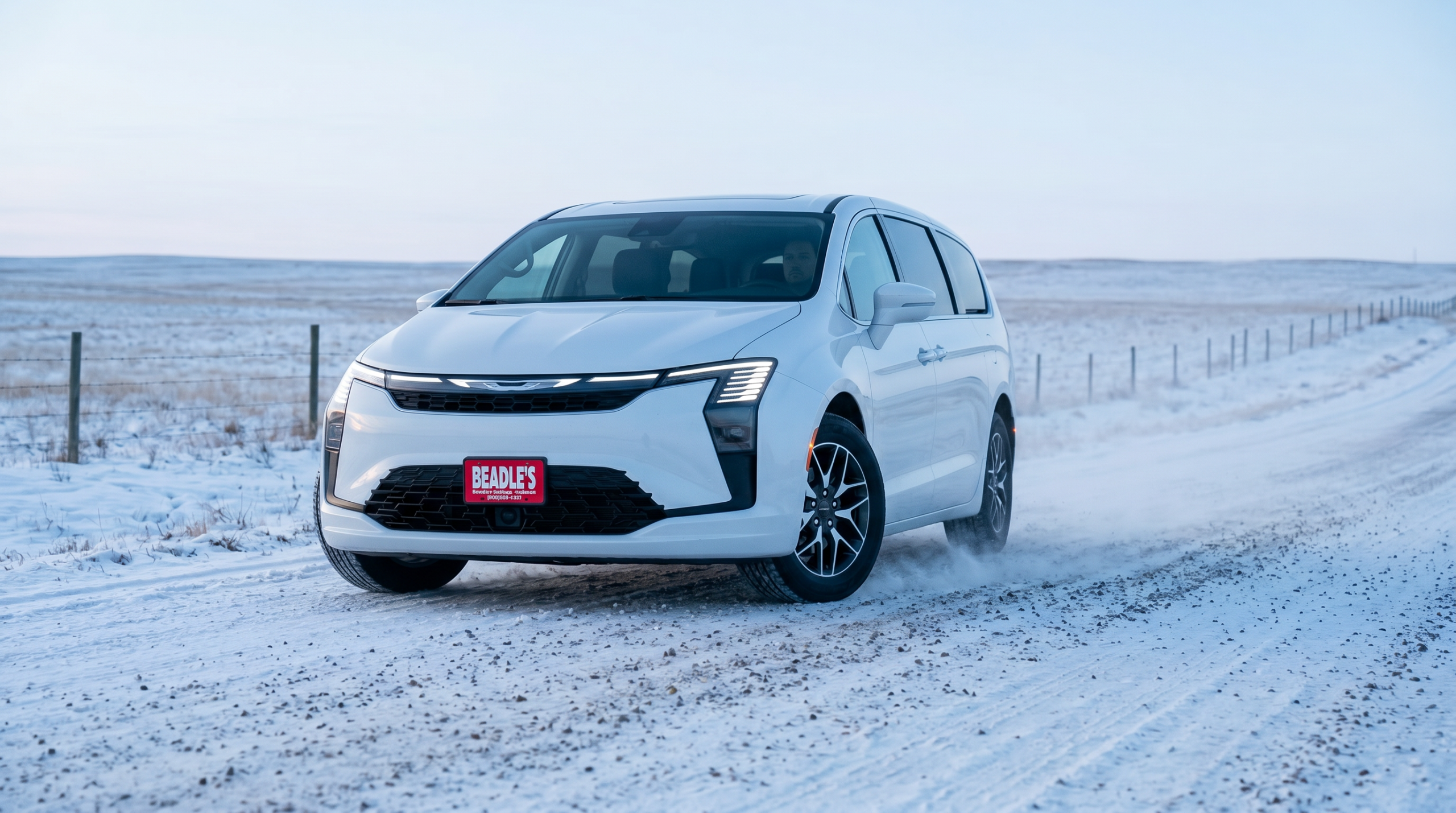
Pacifica vs. a three-row SUV — why a minivan?
A lot of families default to a three-row SUV without asking what they’re actually giving up. The honest comparison comes down to two things a crossover simply can’t match: Stow ‘n Go seating and sliding doors.
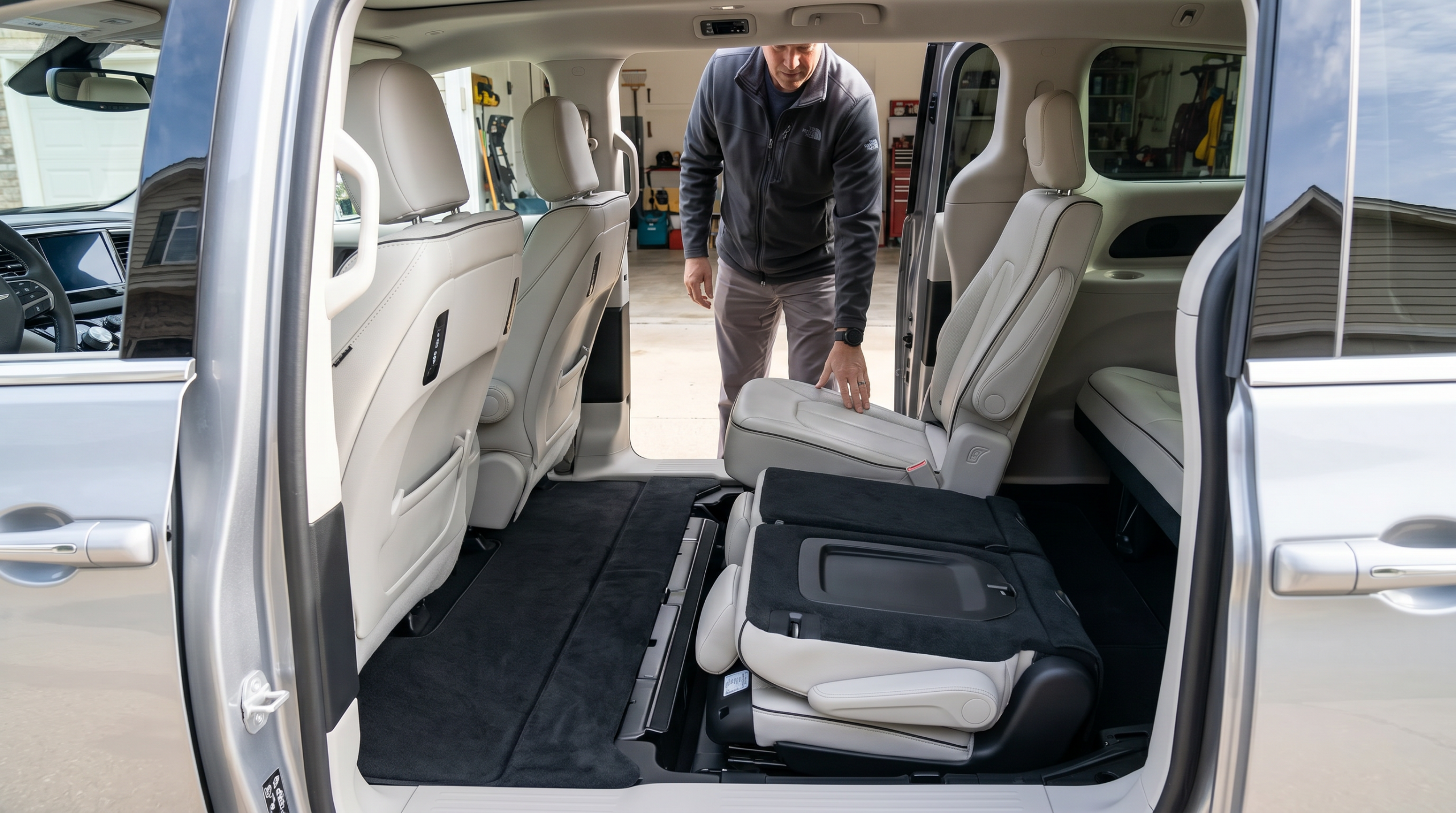
With Stow ‘n Go, the Pacifica’s second-row seats fold flat into the floor — no wrestling 50-pound seats out and finding somewhere to store them in the garage. In a three-row SUV, you either leave the seats up and live with a small cargo area, or you take them out and they live in your shop until spring. The Pacifica goes from seven seats to a flat cargo van in under a minute, in your driveway, with the seats still in the vehicle.
The sliding doors matter more than people expect, too. In a packed parking lot or a tight garage, kids and car seats load through a wide opening with no door to swing into the truck parked next to you. For the day-to-day reality of family life — buckling toddlers, loading groceries, getting in and out a dozen times a day — that’s a quality-of-life win an SUV doesn’t offer.
Who should look elsewhere?
We’d rather you buy the right vehicle than the one with our name on the door, so here’s the straight talk. If your single top priority is maximum fuel economy, the Pacifica is not your best match. The gas V6 is good for what it does, but it can’t touch a hybrid on miles per gallon.
The buyer whose number-one concern is squeezing every mile out of a gallon should cross-shop the Toyota Sienna, which is hybrid-only and lands around 36 mpg combined. You’ll give up some power, the available mechanical AWD torque the Pacifica offers, and second-row Stow ‘n Go — but if fuel cost is what keeps you up at night, that’s a fair trade to consider. For just about everything else a Dakota family cares about, the Pacifica still makes the stronger case.
Pick the Pacifica if / Look elsewhere if
| Pick the 2027 Pacifica if… | Look elsewhere if… |
|---|---|
| You need real three-row space for people and gear | You rarely carry more than four people |
| You want available AWD for snow and gravel | You only drive plowed town streets |
| You’ll actually use Stow ‘n Go flexibility | Your seats will stay up and bolted in all year |
| You value sliding doors for kids and car seats | Maximum fuel economy is your top priority |
| About 20 mpg combined is acceptable to you | You’d rather have a hybrid like the Toyota Sienna |
Bottom line: the Pacifica rewards families who use its space and flexibility and want weather capability. The one place it loses is the fuel-economy column — and only against a hybrid.
Our Recommendation
The 2027 Pacifica is a strong fit for a South Dakota or North Dakota family that wants three-row space, available all-wheel drive, and Stow ‘n Go flexibility — and doesn’t need maximum fuel economy.
We’re not going to hedge on this. If that describes you, the Pacifica is the minivan to buy, and the value sweet spot is the Select AWD. It gets you the weather capability and the second-row Stow ‘n Go that define this van, without paying up for the top-trim comfort features most families don’t need. Step up to the Limited or Pinnacle only if you specifically want the heated second row, ventilated seats, or the family-tech upgrades.
The only buyer we’d send elsewhere is the one whose top priority is fuel economy — that person should look at the Toyota Sienna hybrid. Everyone else: get the Select AWD.
Key Takeaways
- The 2027 Pacifica is best for families who want three-row space, available AWD, and Stow ‘n Go they’ll actually use.
- It’s gas-only now — a proven 3.6L V6, no charging to plan around in the cold, at the cost of about 20 mpg combined with AWD.
- Stow ‘n Go seating and sliding doors are the two things a three-row SUV can’t match for daily family life.
- If maximum fuel economy is your top priority, the Toyota Sienna hybrid is worth a look. Otherwise, the value pick is the Select AWD.
Frequently Asked Questions
Is the 2027 Chrysler Pacifica available as a hybrid?
No. The plug-in hybrid has been discontinued, so the 2027 Pacifica is gas-only. Every trim uses the 3.6L Pentastar V6 with a 9-speed automatic. If you want a hybrid minivan, the Toyota Sienna is the alternative to consider.
Which 2027 Pacifica is the best value for a Dakota family?
The Select AWD is the value sweet spot. It gets you available all-wheel drive and second-row Stow ‘n Go — the two things that define the Pacifica out here — without paying up for top-trim comfort features most families don’t need.
Why pick a Pacifica over a three-row SUV?
Two things: Stow ‘n Go seating that folds flat into the floor without removing seats, and sliding doors that make loading kids and car seats far easier in tight spaces. A three-row crossover can’t match either, which is why a lot of families who try both come back to the minivan.
What kind of fuel economy does the gas Pacifica get?
The gas V6 Pacifica is EPA-estimated around 22 mpg combined in front-wheel drive and about 20 mpg combined with AWD. That’s the trade-off for the V6’s power and simplicity. If fuel economy is your number-one concern, the Toyota Sienna hybrid lands closer to 36 mpg combined.
My Take on Whether the Pacifica Fits Your Family
When a family sits down with me to figure out if the Pacifica is the one, I don’t start with the brochure — I start with how they actually live. How many kids, how often the seats come down, how far off the pavement they really go. That conversation tells you more than any spec sheet, and it’s usually clear pretty fast whether this van is the right call.
My honest recommendation: if you want three-row room, the weather confidence of available AWD, and the Stow ‘n Go flexibility, get the Pacifica — and the Select AWD is where I’d put my own money. The only family I’d steer toward a Toyota Sienna instead is the one where fuel economy beats everything else. That’s a real reason, and I’ll tell you so to your face.
As your local South Dakota Chrysler dealer — and a convenient North Dakota Chrysler dealer for families just across the border — we’re glad to help. If you want the full picture on trims, towing, and tech, take a look at our complete 2027 Chrysler Pacifica guide. And if you’re anywhere near Bowdle, stop by Beadle’s Chrysler Center — we’ll put your family in one and figure out together whether it fits.
Keep Researching the 2027 Pacifica
Start with the full 2027 Chrysler Pacifica overview for trims, specs, and pricing. Then dig into related questions:
· How the AWD Pacifica handles a South Dakota winter
· Which Pacifica trim is right for your family
· Pacifica vs. Sienna, Odyssey & Carnival
Quick Answers
Who is the Pacifica best for? Families wanting space, AWD, and Stow ‘n Go.
Is there a hybrid for 2027? No — gas-only 3.6L V6.
Gas Pacifica fuel economy? About 22 combined FWD, 20 combined AWD.
Best value trim? The Select AWD.
Why a minivan over an SUV? Stow ‘n Go and sliding doors.
Does any other minivan offer AWD with Stow ‘n Go? No — only the Pacifica.
Who should look elsewhere? Buyers whose top priority is MPG.
What’s the MPG alternative? The Toyota Sienna hybrid (~36 combined).
Where can I see one near me? Beadle’s Chrysler Center, Bowdle, SD.
About the Author
Lexy Tabbert — Beadle’s Chrysler Center, Bowdle, SD
Lexy Tabbert is the Director of Sales and Marketing at Beadle’s Chrysler Center in Bowdle, South Dakota. She covers Ram, Jeep, Dodge, and Chrysler vehicles — helping families, ranchers, and ag operators across the region find the right truck and configuration for their needs. Learn more about Lexy.
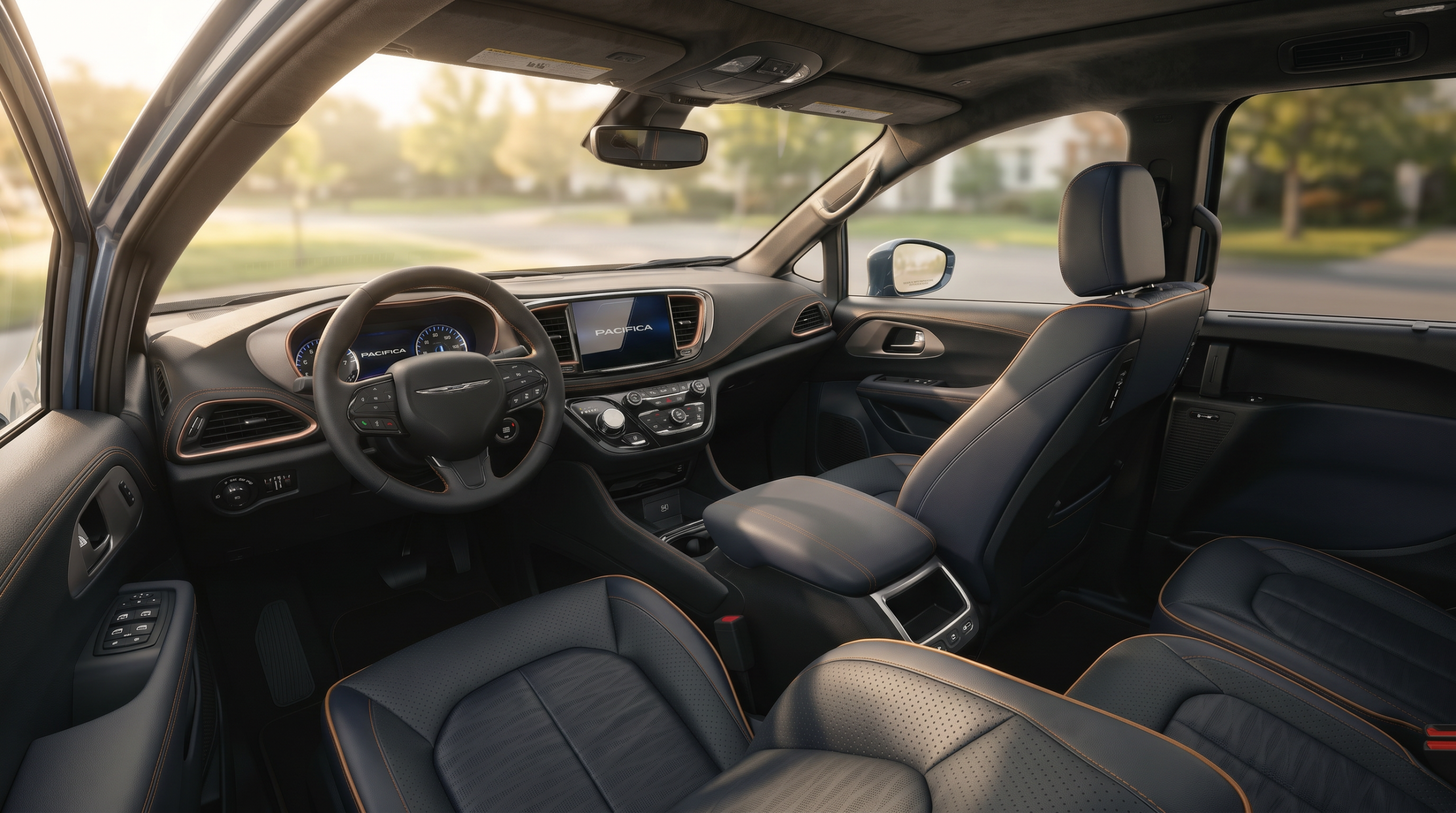
Quick Answer
Heated front seats and a heated steering wheel are standard on every 2027 Chrysler Pacifica. Ventilated front seats and heated second-row seats arrive on the Limited and Pinnacle. The Pinnacle adds premium leather, a suede headliner, Blue Agave interior, captain’s chairs, and the Ultra Console.
A minivan earns its keep on the long days — the eight-hour drive to see family, the cross-state ballgame, the trip where the grandkids are buckled in back and you just want everyone to arrive relaxed instead of restless. That’s where seat comfort, a quiet cabin, and climate control stop being spec-sheet items and start being the whole point.
This guide walks through which 2027 Pacifica has heated and ventilated seats, what makes the Pinnacle interior special, how the cabin holds up on a real road trip, and exactly which comfort features are standard versus reserved for the higher trims.
On This Page
Which Pacifica has heated and ventilated seats?
Here’s the part that surprises a lot of shoppers: heated front seats and a heated steering wheel are standard on every 2027 Pacifica, all the way down to the LX. So even the entry trim takes the chill off a cold morning before you’ve left the driveway.
What you step up for is the warm-weather and second-row comfort. Ventilated (cooled) front seats and heated second-row seats arrive on the Limited and Pinnacle. For a summer road trip, those cooled front seats are the feature people notice most — they pull heat away from your back on a long stretch of interstate, which keeps the driver fresher than air conditioning alone.
The short version
Heated front seats + heated steering wheel: standard on every trim. Ventilated front seats + heated second-row seats: Limited and Pinnacle. If cooled seats matter to you, your shopping starts at the Limited.
Both the Limited and Pinnacle also add a wireless charging pad, so phones stay topped up without a tangle of cords across the console — a small thing that adds up on a trip where everyone’s navigating, streaming, and texting ahead to the next stop.
What makes the Pinnacle interior special?
The Pinnacle is the top of the Pacifica range, and it’s built around comfort. It starts with premium leather-trimmed seats and a suede headliner — the kind of soft-touch material overhead that you don’t see in most minivans and that makes the cabin feel quieter and more finished. It’s offered in a distinctive Blue Agave interior color that sets it apart from the usual all-black minivan look.
The signature piece is the integrated Ultra Console between the front seats — a built-in storage and armrest setup that gives the driver and front passenger a genuine command-center feel rather than the open pass-through you find in lower trims. Behind it, the Pinnacle’s second-row captain’s chairs are the seats people remember: supportive, easy-sliding buckets that make the middle row feel like its own first-class section.
From Beadle’s Chrysler Center
When a customer is debating Limited versus Pinnacle, we tell them to sit in the second row, not just the driver’s seat. The Pinnacle’s captain’s chairs and the materials around them are what you feel on hour six of a drive. If the back seats are where the grandkids or guests ride most, that’s where the upgrade pays off.
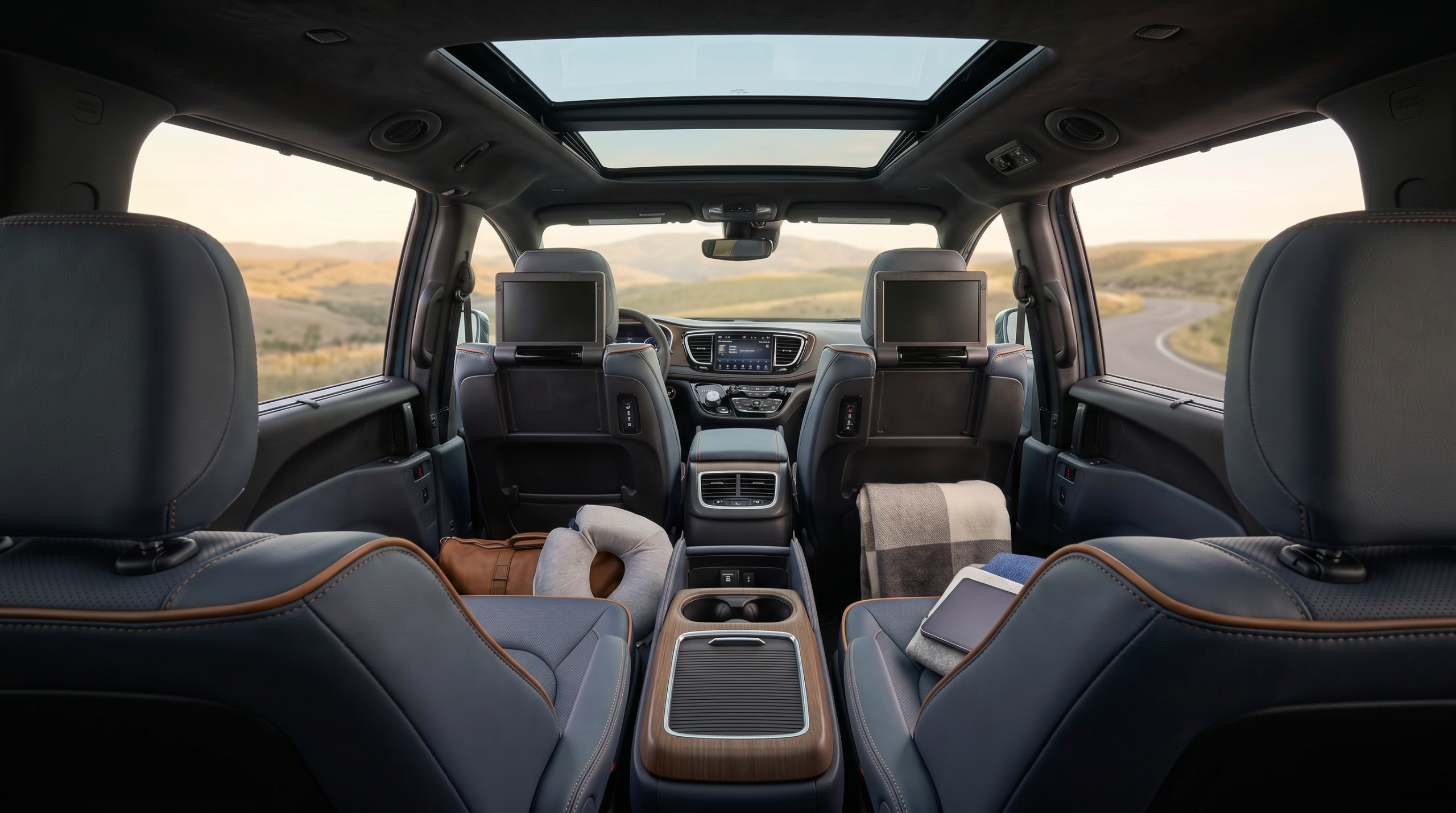
Is the Pacifica comfortable for long road trips and for grandparents hauling grandkids?
Yes — and the things that make it comfortable for a young family are the same things empty-nesters and grandparents tell us they appreciate most. The cabin is genuinely quiet at highway speed, which means less fatigue over a long day and easier conversation between the front and back rows. After eight hours, a quiet cabin is the difference between arriving worn out and arriving ready to visit.
Easy entry and exit is the other piece. The Pacifica’s low step-in height, wide-opening power sliding doors, and tall door openings make it simple to get in and out without ducking or climbing — which matters whether you’re loading a car seat or you’d just rather not crawl into a low coupe. For grandparents helping grandkids buckle in, that low, level access is a real, everyday convenience.
Tri-zone automatic climate control is standard on every trim, so the driver, front passenger, and second row can each set their own temperature. On a trip where one person runs cold and another runs hot, that ends the thermostat tug-of-war — everybody gets their own comfort zone without anyone reaching for a vent.
What comfort features come standard vs. higher trims?
The Pacifica’s strength is how much comfort comes standard before you spend a dollar on upgrades. Every trim — including the LX — comes with heated front seats, a heated steering wheel, tri-zone automatic climate control, remote start, power sliding doors, a power liftgate, and rear air conditioning with its own heater. That’s a well-equipped baseline for a long-haul vehicle.
From there, the comfort upgrades cluster on the Limited and Pinnacle: ventilated front seats, heated second-row seats, and a wireless charging pad on both, then the Pinnacle’s premium leather, suede headliner, Blue Agave interior, second-row captain’s chairs, and integrated Ultra Console on top. Knowing which features live where keeps you from overspending — if standard heated seats and tri-zone climate cover your needs, the lower trims already deliver. If you want cooled seats and a true second-row lounge, the Limited and Pinnacle are where to look.
Comfort features by trim: a quick comparison
| Comfort feature | LX / Select | Limited / Pinnacle |
|---|---|---|
| Heated front seats & heated steering wheel | Standard | Standard |
| Tri-zone automatic climate | Standard | Standard |
| Ventilated (cooled) front seats | Not available | Yes |
| Heated second-row seats | Not available | Yes |
| Premium leather, suede headliner, Ultra Console | No | Pinnacle |
Worth stepping up if: you want cooled front seats for summer drives, heated seats for the second row, or the Pinnacle’s premium leather and captain’s-chair lounge for passengers who ride in back.
Stay lower if: standard heated seats, heated steering wheel, and tri-zone climate already cover how your family travels — the LX and Select are genuinely well-equipped.
How to set up your Pacifica for a comfortable long haul
A few minutes of setup before you pull out makes a long drive noticeably better. Here’s the order we’d tackle it.
- Match the trim to who rides where: if passengers spend the trip in the second row, the Limited or Pinnacle’s heated rear seats and captain’s chairs earn their cost.
- Set each climate zone before you leave: tri-zone control lets the driver, front passenger, and second row dial in their own temperature so no one’s fighting the thermostat.
- Use remote start to pre-condition the cabin: standard on every trim — warm or cool the interior while you load up so the first mile is already comfortable.
- Stage charging up front: on Limited and Pinnacle, the wireless charging pad keeps a phone topped up cord-free for navigation and music.
- Try the seats in person: sit in both the front and second row at Beadle’s Chrysler Center to feel the difference between ventilated and standard seats before you decide.
Key Takeaways
- Heated front seats and a heated steering wheel are standard on every 2027 Pacifica, including the LX.
- Ventilated (cooled) front seats and heated second-row seats arrive on the Limited and Pinnacle.
- The Pinnacle adds premium leather, a suede headliner, the Blue Agave interior, second-row captain’s chairs, and the integrated Ultra Console.
- A quiet cabin, easy step-in entry, and standard tri-zone climate make it comfortable for long road trips and for grandparents hauling grandkids.
Frequently Asked Questions
Which 2027 Pacifica has heated and cooled seats?
Heated front seats and a heated steering wheel are standard on every trim, including the LX. Ventilated (cooled) front seats are available on the Limited and Pinnacle, which also add heated second-row seats.
Does the base Pacifica come with heated seats?
Yes. Heated front seats, a heated steering wheel, and tri-zone automatic climate control are all standard on the entry LX, so even the base Pacifica is well-equipped for cold-weather comfort.
What makes the Pinnacle interior different?
The Pinnacle adds premium leather-trimmed seats, a suede headliner, the distinctive Blue Agave interior color, second-row captain’s chairs, and the integrated Ultra Console between the front seats — the most comfortable, finished cabin in the Pacifica lineup.
Is the Pacifica comfortable for long road trips?
Yes. A quiet cabin at highway speed, easy step-in entry, standard tri-zone climate control so each row sets its own temperature, and supportive seats make the Pacifica comfortable for long drives — including for grandparents hauling grandkids.
My Take on the Pacifica for Long Hauls
When someone tells me they do a lot of long driving — whether it’s a young family on the regular trek to grandma’s or empty-nesters who finally have time to go see everyone — I steer the conversation to the second row and the seats. Standard heated seats and tri-zone climate cover most people beautifully, and that’s worth knowing before anyone spends up.
My honest recommendation: if the front seats are where you live, the Limited’s ventilated seats are the upgrade I’d make first — cooled seats change how you feel after a long summer leg. If passengers ride in back as much as up front, the Pinnacle’s captain’s chairs, premium leather, and suede headliner are the ones that make a road trip feel like a treat instead of a haul.
As your local South Dakota Chrysler dealer — and a convenient North Dakota Chrysler dealer for families just across the border — we’re glad to help. If you want the full picture on trims, tech, and safety, take a look at our complete 2027 Chrysler Pacifica guide. And if you’re anywhere near Bowdle, stop by Beadle’s Chrysler Center — sit in the second row, try the seats, and we’ll help you find the trim that fits how your family travels.
Keep Researching the 2027 Pacifica
Start with the full 2027 Chrysler Pacifica overview for trims, specs, and pricing. Then dig into related questions:
· Which Pacifica trim is right for your family
· Family convenience tech in the Pacifica
· Pacifica driver-assist & safety tech
Quick Answers
Which trims have heated front seats? Every trim, including the LX.
Heated steering wheel? Standard on every trim.
Which trims have ventilated seats? Limited and Pinnacle.
Heated second-row seats? Limited and Pinnacle.
What’s the most comfortable trim? The Pinnacle.
Pinnacle interior color? Blue Agave premium leather.
Does the Pinnacle have captain’s chairs? Yes, second-row captain’s chairs.
Is tri-zone climate standard? Yes, on every trim.
Where can I see one near me? Beadle’s Chrysler Center, Bowdle, SD.
About the Author
Lexy Tabbert — Beadle’s Chrysler Center, Bowdle, SD
Lexy Tabbert is the Director of Sales and Marketing at Beadle’s Chrysler Center in Bowdle, South Dakota. She covers Ram, Jeep, Dodge, and Chrysler vehicles — helping families, ranchers, and ag operators across the region find the right truck and configuration for their needs. Learn more about Lexy.
Quick Answer
Every 2027 Chrysler Pacifica — including the entry-level LX — comes standard with the full driver-assist suite: adaptive cruise with stop & go, forward collision warning with active braking, pedestrian braking, lane keep, and blind-spot monitoring. The Safety Sphere camera package is a separate option.
When a family asks me which Pacifica trim they need “to get the safety stuff,” I get to give them the answer they’re hoping for: you already have it. The core driver-assist suite is standard on every trim, so you’re not buying your way up the lineup just to get collision warning or blind-spot monitoring.
This guide walks through exactly what’s standard on all trims, what the optional Safety Sphere camera package actually adds, why standard safety matters on rural highways and in deer country, and whether all-wheel drive belongs in the safety conversation at all.
What driver-assist features are standard on every trim?
Here’s the part that surprises a lot of shoppers: the 2027 Pacifica’s core driver-assist suite is standard on all trims, right down to the entry-level LX. You don’t have to step up to a Limited or Pinnacle to get it. Every Pacifica leaves the lot with adaptive cruise control with stop & go, full-speed forward collision warning with active braking, pedestrian emergency braking, lane departure warning with lane keep, blind-spot monitoring, and rear cross-path detection.
In plain terms: the Pacifica can hold a set distance behind the car ahead and even bring itself to a stop in traffic, warn you and brake if a collision is coming, watch for pedestrians, nudge you back if you drift out of your lane, and flag a vehicle in your blind spot or crossing behind you as you back out. That’s a genuinely complete package — and it’s the same on a $41,000 LX as it is on a loaded Pinnacle.
The detail competitors get wrong
A lot of comparison articles lump the standard driver-assist suite together with the optional camera package and treat them as one “safety upgrade.” They’re not. The active safety tech is standard on every trim. The camera package is a separate option. Keep those two straight and the lineup gets a lot easier to shop.
For a family that just wants the protection without chasing a trim level, that standard suite is one of the strongest arguments for the Pacifica. The safety floor is high no matter where you start.
What is the Safety Sphere package and how is it different?
The Safety Sphere package is a separate option — not part of the standard suite. It’s a camera-and-parking bundle that adds a 360-degree surround-view camera, a turn-signal blind-spot camera view, and front and rear park assist with automatic stop. It’s optional on the Select and Limited and comes standard on the Pinnacle.
Notice what it does and doesn’t do. The standard driver-assist suite is the active safety net — the radar and braking systems that watch the road and intervene. Safety Sphere is about visibility and maneuvering: a bird’s-eye view for tight parking, a camera that shows your blind spot when you signal, and sensors that can stop the van during low-speed parking. Useful, especially in a crowded lot or a tight garage, but it’s a convenience-and-camera upgrade layered on top of safety tech you already have.
So if a shopper tells me they want “the safety package,” I always ask what they mean. If they want collision braking and blind-spot monitoring, that’s standard — done. If they want the 360-degree camera and self-parking help, that’s Safety Sphere, and we look at a Pinnacle or add it to a Select or Limited.
Why does standard safety matter for rural highway and deer-country driving?
Out here, most miles aren’t in town — they’re on open two-lane highway at highway speed, often at dawn or dusk when deer are moving. That’s exactly the situation where the standard suite earns its keep. Full-speed forward collision warning with active braking is watching the road ahead even when you’ve settled into the rhythm of a long, empty stretch.
Adaptive cruise with stop & go takes the fatigue out of those long hauls — it holds your following distance so you’re not constantly feathering the pedal. Lane departure warning catches the drift that creeps in on a monotonous drive. And blind-spot monitoring matters more than people expect on a highway, where closing speeds are high and a quick lane change to pass farm equipment needs to be a sure thing.
From Beadle’s Chrysler Center
The question we hear most is whether the cheaper trims “skimp” on safety to hit their price. With the Pacifica, the honest answer is no — the active driver-assist tech is the same on an LX as it is on a Pinnacle. For families putting on a lot of rural highway miles, that’s a real reason to feel good about the entry trim, not just the loaded one.
Does AWD count as a safety feature?
It’s a fair question, and the honest answer is: indirectly. The available all-wheel drive (on Select, Limited, and Pinnacle) isn’t a driver-assist system — it won’t brake for you or watch your blind spot. What it does is help you get moving and track straight on snow and gravel, which absolutely contributes to confident control in bad weather.
Think of it as two different layers. The standard driver-assist suite is the electronic safety net that works on every trim. AWD is mechanical traction that helps in winter. They complement each other, but they’re not the same thing — and AWD is never a substitute for the active safety tech, which you get regardless of drivetrain.
Standard suite vs. the Safety Sphere option
| Feature | Standard driver-assist suite | Safety Sphere package (option) |
|---|---|---|
| Adaptive cruise w/ stop & go | Standard on all trims | — |
| Forward collision & active braking | Standard on all trims | — |
| Blind-spot & rear cross-path | Standard on all trims | — |
| 360-degree surround camera | — | Optional Select/Limited, standard Pinnacle |
| Front/rear park assist w/ stop | — | Optional Select/Limited, standard Pinnacle |
You already have it if: you want collision braking, blind-spot monitoring, adaptive cruise, and lane keep — all standard on every trim, including the LX.
Add Safety Sphere if: you want the 360-degree camera and self-stopping park assist — standard on Pinnacle, optional on Select and Limited.
How to check the safety features on a Pacifica you’re considering
A few minutes up front saves any confusion later. Here’s how I’d walk through it.
- Assume the active suite is there: adaptive cruise, collision braking, blind-spot monitoring, and lane keep are standard on every trim, so the entry LX has them too.
- Decide if you want the camera package: if a 360-degree view and self-stopping park assist matter to you, that’s Safety Sphere — separate from the standard tech.
- Check the trim: Safety Sphere is standard on Pinnacle and optional on Select and Limited, so confirm which you’re looking at.
- Consider drivetrain separately: AWD adds winter traction but isn’t a driver-assist feature — weigh it on its own.
- Sit in one and try it: we’ll demonstrate the systems in person at Bowdle so you know exactly how each one behaves before you buy.
Key Takeaways
- The full driver-assist suite — adaptive cruise with stop & go, forward collision with active braking, pedestrian braking, lane departure with lane keep, blind-spot monitoring, and rear cross-path — is standard on every 2027 Pacifica, including the LX.
- The Safety Sphere package is a separate option: 360-degree surround camera, blind-spot camera view, and front/rear park assist with stop. It’s optional on Select/Limited and standard on Pinnacle.
- Standard safety matters most on rural highways and in deer country, where collision braking, adaptive cruise, and blind-spot monitoring do real work.
- AWD helps with winter traction but isn’t a driver-assist feature — it complements the standard safety tech rather than replacing it.
Frequently Asked Questions
Does the base Pacifica LX come with safety features?
Yes. The entry-level LX includes the full standard driver-assist suite: adaptive cruise control with stop & go, full-speed forward collision warning with active braking, pedestrian emergency braking, lane departure warning with lane keep, blind-spot monitoring, and rear cross-path detection. You don’t have to upgrade trims to get the core safety tech.
Is the Safety Sphere package the same as the standard safety features?
No. The standard driver-assist suite (collision braking, blind-spot monitoring, adaptive cruise, lane keep) is on every trim. The Safety Sphere package is a separate option that adds a 360-degree surround-view camera, a turn-signal blind-spot camera view, and front/rear park assist with automatic stop. It’s optional on Select and Limited and standard on Pinnacle.
Does the Pacifica have automatic emergency braking?
Yes. Full-speed forward collision warning with active braking is standard on every trim, and pedestrian emergency braking is included as well. The system can warn you and apply the brakes if it detects an impending collision ahead.
Is all-wheel drive a safety feature on the Pacifica?
Not directly. The available AWD (Select, Limited, Pinnacle) improves winter traction on snow and gravel, which helps with control, but it isn’t a driver-assist system. The active safety tech is standard on every trim regardless of whether you choose front-wheel drive or all-wheel drive.
My Take on Pacifica Safety
The thing I most want families to walk away knowing is that you don’t have to buy up the lineup to be safe in a Pacifica. The active driver-assist suite — collision braking, blind-spot monitoring, adaptive cruise, lane keep — is standard on every trim, including the LX. That’s not true of every minivan, and it’s the first thing I point out when someone assumes the cheaper trim cuts corners on safety.
Where I slow people down is the Safety Sphere package. It’s a genuinely nice option — the 360-degree camera makes tight parking easy — but it’s a camera-and-convenience upgrade, not the safety net. If you only remember one thing: the standard suite is the safety, Safety Sphere is the cameras. Don’t pay for a trim thinking you’re buying collision braking you already have.
As your local South Dakota Chrysler dealer — and a convenient North Dakota Chrysler dealer for families just across the border — we’re glad to help. If you want the full picture on trims, comfort, and winter capability, take a look at our complete 2027 Chrysler Pacifica guide. And if you’re anywhere near Bowdle, stop by Beadle’s Chrysler Center — we’ll demonstrate every one of these systems in person so you know exactly what you’re getting.
Keep Researching the 2027 Pacifica
Start with the full 2027 Chrysler Pacifica overview for trims, specs, and pricing. Then dig into related questions:
· How the Pacifica’s AWD handles a South Dakota winter
· Which Pacifica trim is right for your family
· Pacifica comfort & premium features
Quick Answers
Is safety tech standard on the LX? Yes — the full driver-assist suite is standard on every trim.
Adaptive cruise control? Standard, with stop & go, on all trims.
Automatic emergency braking? Yes — full-speed forward collision with active braking, standard.
Blind-spot monitoring? Standard on all trims, with rear cross-path.
Lane keep? Standard — lane departure warning with lane keep.
What’s the Safety Sphere package? 360 camera, blind-spot camera view, park assist with stop.
Is Safety Sphere standard? Standard on Pinnacle; optional on Select and Limited.
Is AWD a safety feature? It aids winter traction but isn’t a driver-assist system.
Where can I see one near me? Beadle’s Chrysler Center, Bowdle, SD.
About the Author
Lexy Tabbert — Beadle’s Chrysler Center, Bowdle, SD
Lexy Tabbert is the Director of Sales and Marketing at Beadle’s Chrysler Center in Bowdle, South Dakota. She covers Ram, Jeep, Dodge, and Chrysler vehicles — helping families, ranchers, and ag operators across the region find the right truck and configuration for their needs. Learn more about Lexy.
Quick Answer
The 2027 Chrysler Pacifica’s FamCAM interior camera, Stow ‘n Vac built-in vacuum, and Harman Kardon 19-speaker audio are standard on the Pinnacle and available on the Select and Limited through the new Family Tech Group. Hands-free power sliding doors and liftgate are on the Pinnacle.
Loading kids and gear into a minivan is its own small workout — diaper bag on one shoulder, a sleeping toddler in the other arm, and somehow you still have to wrestle a door open. The features that actually make that easier are the ones families ask us about most once the newness of the test drive wears off.
This guide walks through the real family-convenience tech in the 2027 Pacifica — FamCAM for watching the back seat, the built-in Stow ‘n Vac, hands-free doors and liftgate, and exactly which trims and packages get you each one.
On This Page
- What is FamCAM and how does it help watch the back seat?
- Does the Pacifica really have a built-in vacuum?
- Does it have hands-free power sliding doors and liftgate?
- What does the Family Tech Group include and which trims get it?
- Family tech by trim: who gets what
- How to get the family tech you actually want
What is FamCAM and how does it help watch the back seat?
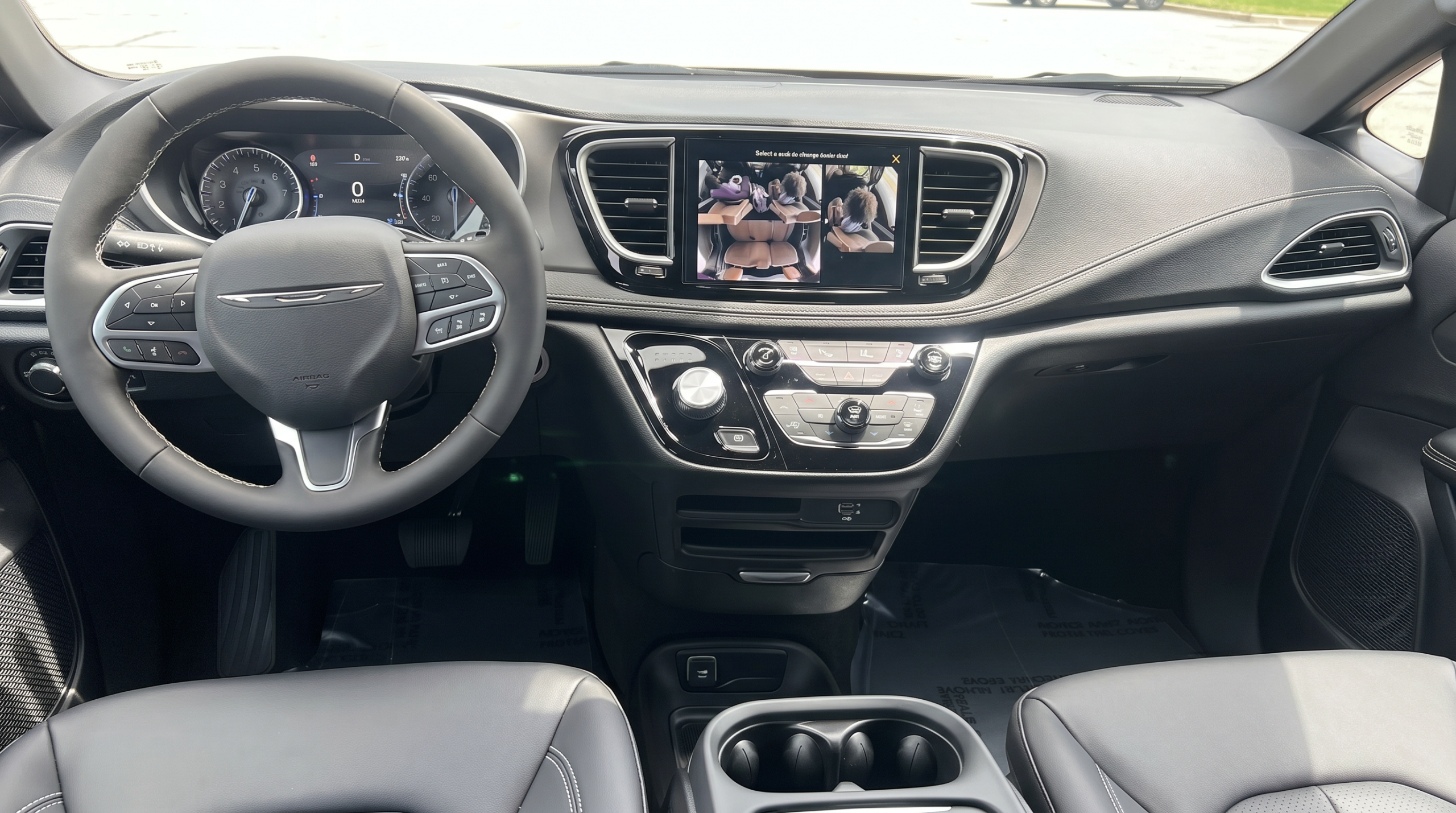
FamCAM is an interior camera mounted up high near the front of the cabin that shows the back rows right on the 10.1-inch center touchscreen. Instead of twisting around to check on a quiet toddler, you glance at the screen — and you can zoom in on a specific spot, including a rear-facing child seat, to make sure everyone’s settled.
Why parents love it
A rear-facing infant seat hides the baby from the driver completely. FamCAM lets you zoom right in on that seat without taking your hands off the wheel or asking an older kid to “check on the baby” — the kind of thing you don’t know you wanted until you’ve used it.
FamCAM is standard on the Pinnacle and available on lower trims through the Family Tech Group. It’s a genuinely useful tool for parents of little ones — and it earns its keep on long drives when the back seat goes suspiciously silent.
Does the Pacifica really have a built-in vacuum?
It does. The Stow ‘n Vac is an integrated vacuum built right into the side of the cargo area, with a hose long enough to reach all three rows. For families who deal with crushed crackers, sand from the lake, and the general aftermath of a busy week, it’s one of those features that quietly makes the van easier to live with.
The Stow ‘n Vac is standard on the Pinnacle and available on lower trims through the Family Tech Group. There’s no separate canister to lug around and no quarters to find — you just pull out the hose and clean up wherever you’re parked. For a vehicle that doubles as a daily hauler for kids and gear, it’s more practical than gimmicky.
Does it have hands-free power sliding doors and liftgate?
Yes — on the Pinnacle. Hands-free power sliding doors and a hands-free power liftgate let you open up with your hands full: a small foot motion or proximity to the van does the work, so you can walk up with a kid on your hip and a load of groceries and still get inside.
Worth being clear on the difference: every 2027 Pacifica comes standard with power sliding doors and a power liftgate you operate from a button or the key fob. The hands-free versions — where you don’t touch anything at all — are the Pinnacle’s upgrade. If walking up empty-handed to a van that opens itself sounds like a dream after a Costco run, that’s the trim to look at.
From Beadle’s Chrysler Center
The question we get is “do I really need the hands-free doors?” Our honest take: if you’re regularly loading the van with your arms full — car seats, sports gear, weekly groceries — the Pinnacle’s hands-free setup is the kind of thing you use every single day. If you mostly load one kid at a time, the standard power doors on every trim already cover you.
What does the Family Tech Group include and which trims get it?
For 2027, Chrysler split what used to be one big package into two. The Family Tech Group bundles the convenience features — FamCAM, the Harman Kardon 19-speaker audio system, the Stow ‘n Vac, navigation, rear window shades, and a few more conveniences — and it’s available on the Select and Limited. All three of those headline features come standard on the Pinnacle.
The important 2027 change: the Family Tech Group is now separate from the Theater Group. If you specifically want the rear-seat entertainment — the built-in Amazon Fire TV and seatback screens — that’s the Theater Group, a different package on the Pinnacle. So you can get FamCAM, the vacuum, and premium audio without paying for screens you may not need, or add the screens on top if movie nights are part of the plan.
Family tech by trim: who gets what
| Feature | Select & Limited | Pinnacle |
|---|---|---|
| FamCAM interior camera | Via Family Tech Group | Standard |
| Stow ‘n Vac built-in vacuum | Via Family Tech Group | Standard |
| Harman Kardon 19-speaker audio | Via Family Tech Group | Standard |
| Hands-free sliding doors & liftgate | Not available | Standard |
Worth it if: you want FamCAM, the vacuum, and premium audio — add the Family Tech Group on a Select or Limited, or step up to the Pinnacle to get them standard plus the hands-free doors.
Skip it if: you mainly want the basics — every Pacifica already has power sliding doors, a power liftgate, and remote start.
How to get the family tech you actually want
A little planning before you shop keeps you from paying for features you won’t use — or missing one you’d love. Here’s the order we’d think it through.
- Decide if FamCAM matters: if you have little ones or a rear-facing seat, it’s worth prioritizing — standard on Pinnacle, optional on Select and Limited.
- Pick the convenience bundle: the Family Tech Group brings FamCAM, the Stow ‘n Vac, and Harman Kardon audio together on the Select or Limited.
- Separate it from entertainment: remember the Theater Group (Amazon Fire TV and screens) is now its own Pinnacle package — don’t assume one includes the other.
- Weigh the hands-free doors: if you load with your arms full daily, the Pinnacle’s hands-free sliding doors and liftgate are the standout.
- Match it to your budget: we’ll help you compare a loaded Select or Limited against a Pinnacle so you only pay for what you’ll use.
Key Takeaways
- FamCAM puts the back seat on the center touchscreen and can zoom in on a rear-facing child seat — standard on Pinnacle, available via the Family Tech Group.
- The Stow ‘n Vac is a real built-in vacuum that reaches all three rows — standard on Pinnacle, available via the Family Tech Group.
- Hands-free power sliding doors and liftgate are on the Pinnacle; every Pacifica has standard power doors, a power liftgate, and remote start.
- For 2027 the Family Tech Group (FamCAM, Harman Kardon, Stow ‘n Vac) is separate from the Theater Group (Amazon Fire TV and seatback screens).
Frequently Asked Questions
Can FamCAM zoom in on a rear-facing car seat?
Yes. FamCAM shows the back rows on the 10.1-inch center touchscreen and lets you zoom in on a specific spot, including a rear-facing child seat, so you can check on an infant without turning around.
Is the Stow ‘n Vac standard on every Pacifica?
No. The Stow ‘n Vac integrated vacuum is standard on the Pinnacle and available on the Select and Limited through the Family Tech Group. It is a built-in vacuum with a hose that reaches all three rows.
Which Pacifica has hands-free sliding doors?
The hands-free power sliding doors and hands-free power liftgate are on the Pinnacle. Every 2027 Pacifica comes with standard power sliding doors and a power liftgate operated by a button or the key fob.
Is rear-seat entertainment part of the Family Tech Group?
No. For 2027 the Family Tech Group (FamCAM, Harman Kardon 19-speaker audio, Stow ‘n Vac, and navigation) is separate from the Theater Group, which adds the built-in Amazon Fire TV and seatback screens on the Pinnacle.
My Take on the Pacifica’s Family Tech
When families come in worried about whether a minivan will actually make their life easier, the features I point to first aren’t the flashy ones — they’re FamCAM and the built-in vacuum. Being able to glance at a screen instead of twisting around to check on a sleeping baby, and being able to clean up a mess without dragging out a shop vac, are the things people end up using constantly.
My honest recommendation: if you want the convenience tech without the entertainment screens, add the Family Tech Group to a Select or Limited and you’ve covered the essentials. If you load up with your arms full every day, the Pinnacle’s hands-free doors and liftgate are worth experiencing in person before you decide.
As your local South Dakota Chrysler dealer — and a convenient North Dakota Chrysler dealer for families just across the border — we’re glad to help. If you want the full picture on trims, seating, and tech, take a look at our complete 2027 Chrysler Pacifica guide. And if you’re anywhere near Bowdle, stop by Beadle’s Chrysler Center — we’ll show you FamCAM and the Stow ‘n Vac in person and talk through what fits your family.
Keep Researching the 2027 Pacifica
Start with the full 2027 Chrysler Pacifica overview for trims, specs, and pricing. Then dig into related questions:
· How Stow ‘n Go opens up family space
· Rear-seat entertainment and the Theater Group
· Uconnect 5 infotainment explained
Quick Answers
What is FamCAM? An interior camera that shows the back seat on the touchscreen.
Can it zoom on a baby? Yes — including a rear-facing child seat.
Does it have a built-in vacuum? Yes — the Stow ‘n Vac reaches all three rows.
Are FamCAM and the vacuum standard? Standard on Pinnacle; optional via Family Tech Group.
Hands-free doors? Yes, on the Pinnacle (doors and liftgate).
Standard power doors? Yes — on every Pacifica.
What’s in the Family Tech Group? FamCAM, Harman Kardon audio, Stow ‘n Vac, nav, and more.
Are the TV screens included? No — that’s the separate Theater Group.
Where can I see one near me? Beadle’s Chrysler Center, Bowdle, SD.
About the Author
Lexy Tabbert — Beadle’s Chrysler Center, Bowdle, SD
Lexy Tabbert is the Director of Sales and Marketing at Beadle’s Chrysler Center in Bowdle, South Dakota. She covers Ram, Jeep, Dodge, and Chrysler vehicles — helping families, ranchers, and ag operators across the region find the right truck and configuration for their needs. Learn more about Lexy.
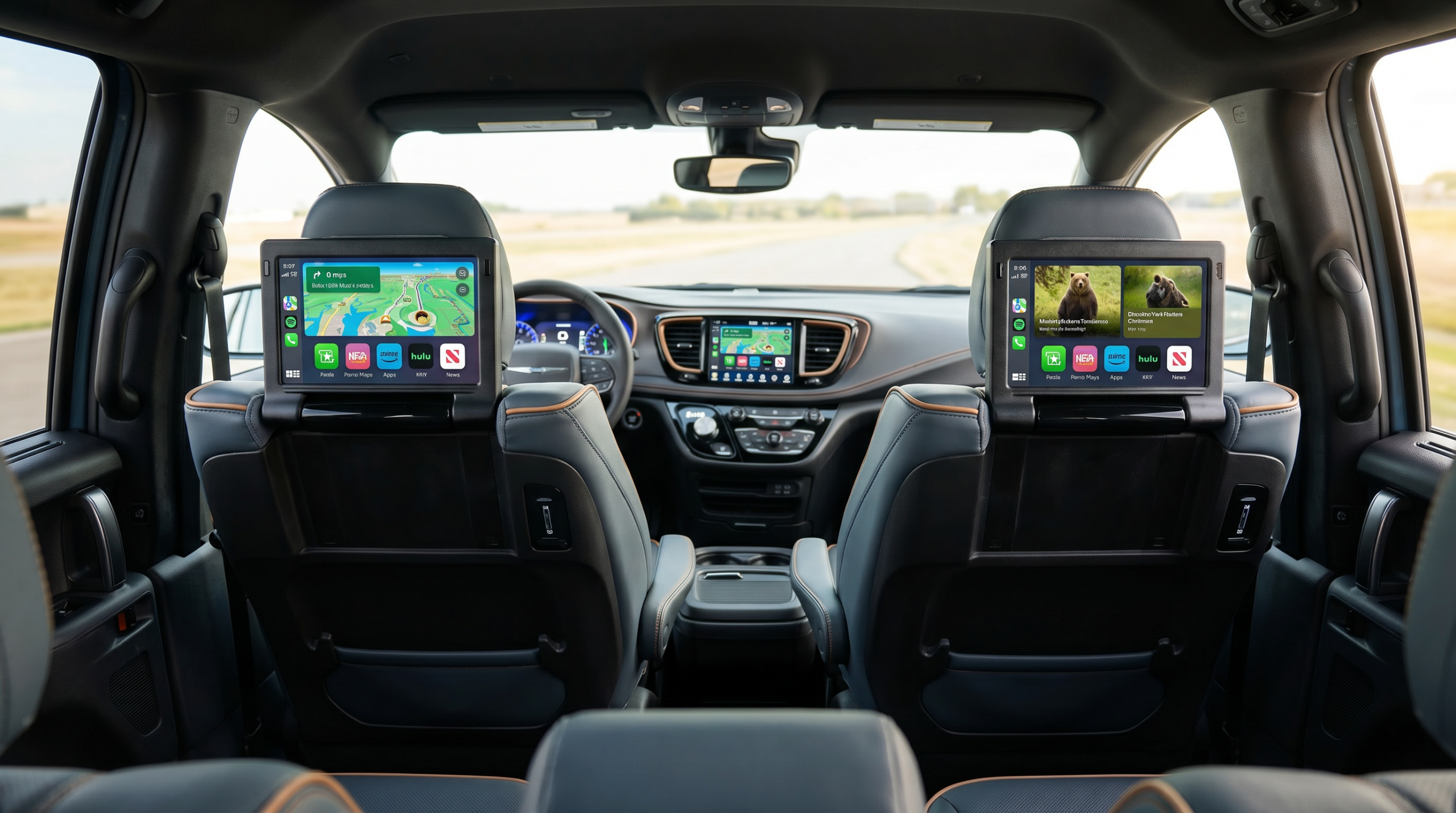
Quick Answer
The 2027 Chrysler Pacifica’s Theater Group adds built-in Amazon Fire TV, two seatback screens, and a Blu-ray/DVD player to keep kids entertained. It’s available on the Pinnacle. Downloaded shows and discs play offline through dead zones; the standard 4G Wi-Fi hotspot streams live where coverage allows.
Anyone who has driven kids across South Dakota knows the real question on a long road trip isn’t the scenery — it’s what happens in the back seat once the novelty wears off. Somewhere past the first hour, “are we there yet” starts, and a screen with their show on it is worth more than any feature on the window sticker.
This guide covers exactly what the 2027 Pacifica’s Theater Group includes, whether kids can stream Amazon Fire TV when you lose cell service, how many screens there are and whether they can play different things, and whether it’s worth checking the box for a family that road-trips.
On This Page
- What is the Theater Group rear-seat entertainment?
- New for 2027: Theater Group vs. Family Tech Group
- Can kids stream Fire TV with no cell service?
- How many screens are there, and can they play different things?
- Is the Theater Group worth it for a road-trip family?
- How to set up the Pacifica for a long road trip
What is the Theater Group rear-seat entertainment?
The Theater Group is the 2027 Pacifica’s rear-seat entertainment package. It adds built-in Amazon Fire TV, a pair of seatback video screens mounted on the backs of the front seats, a Blu-ray/DVD player, and a video remote so the kids — or you — can control what’s on. It’s available on the Pinnacle.
What makes it different from a tablet on a mount is that Fire TV is baked into the van. Second-row passengers get their own screens at the right height, the apps live in the vehicle rather than on someone’s iPad that’s about to die, and the disc player covers the movies you already own. For families who genuinely log highway hours, that’s the appeal — it turns the back of the Pacifica into something close to a small theater.
New for 2027: Theater Group vs. Family Tech Group
Here’s the part almost nobody has caught yet. For 2027, Chrysler split the old combined entertainment-and-convenience bundle into two separate packages. If you’re cross-shopping older Pacifica information, this is the single thing most likely to trip you up.
The two packages, untangled
Theater Group — the entertainment half: Amazon Fire TV, seatback video screens, Blu-ray/DVD player, and a video remote. This is the package that keeps kids watching.
Family Tech Group — the convenience half: the FamCAM interior camera for keeping an eye on the back rows, a Harman Kardon premium audio system, and the Stow ‘n Vac built-in vacuum, among other items.
The practical takeaway: if it’s the screens you want, you’re looking for the Theater Group, not the Family Tech Group. They used to travel together; now they don’t. Knowing which box does what saves you from ordering one and expecting the other.
Can kids stream Fire TV with no cell service?
This is the question that matters most out here, because plenty of the drive between towns has no bars at all. The honest answer has two parts: live streaming needs a connection, but the Pacifica is built so the kids don’t go dark when the signal does.
The built-in Amazon Fire TV streams shows and movies when you have data — and the Pacifica’s 4G Wi-Fi hotspot is standard on every trim, so the van itself can supply the connection. The catch is coverage: out on rural South Dakota highways, that signal comes and goes, so live streaming can stutter or stop where there’s no service.
The fix is the same one any seasoned road-trip parent uses: load up offline content before you leave. Download episodes and movies in your apps while you’re still on home Wi-Fi, and they’ll keep playing through the dead zones. The Blu-ray/DVD player is the other ace — a disc doesn’t care about cell coverage at all, so a stack of the kids’ favorites covers you for the whole drive, signal or not.
How many screens are there, and can they play different things?
The Theater Group adds two seatback screens, one on the back of each front seat, so both second-row passengers get their own display. That’s the layout that matters when you’ve got two kids who do not want to watch the same thing.
Because each screen is its own display with the Fire TV interface, one child can be on their show while the other watches a movie off the disc player — and headphones keep the peace so the front seats stay quiet. For families where “but I don’t want to watch that” is a daily negotiation, two independent screens is the detail that actually keeps the trip calm.
Is the Theater Group worth it for a road-trip family?
| Consideration | Built-in Theater Group | Tablets on mounts |
|---|---|---|
| Screens for the second row | Two, fixed at the right height | Depends on what you bring |
| Works with no signal | Yes — disc player and downloads | Only with downloaded content |
| Battery to worry about | No — powered by the van | Yes — and chargers, cords, dying mid-show |
| Availability | Theater Group on the Pinnacle | Any trim |
Worth it if: you take real road trips, have more than one kid, and you’re already looking at a Pinnacle.
Skip it if: your driving is mostly short and around town, or tablets you already own do the job for the occasional longer haul.
How to set up the Pacifica for a long road trip
A few minutes of prep the night before is the difference between a quiet drive and a back-seat meltdown an hour in. Here’s the order we’d tackle it.
- Download shows before you leave: while you’re on home Wi-Fi, save episodes and movies in your apps so they play through dead zones.
- Pack a few discs: the Blu-ray/DVD player is your no-signal backup — load up the kids’ favorites.
- Charge the headphones: two screens only keep the peace if each kid can hear their own show.
- Set up the Wi-Fi hotspot: standard on every Pacifica — handy for live streaming wherever you do have coverage.
- Confirm it’s the right box: rear screens come from the Theater Group, not the Family Tech Group — make sure the van you’re looking at has it.
Key Takeaways
- The Theater Group adds built-in Amazon Fire TV, two seatback screens, a Blu-ray/DVD player, and a video remote — available on the Pinnacle.
- New for 2027: Chrysler split the old bundle into the Theater Group (screens) and the separate Family Tech Group (FamCAM, Harman Kardon, Stow ‘n Vac).
- With no signal, downloaded shows and a disc keep playing; the standard 4G Wi-Fi hotspot handles live streaming where coverage allows.
- Two independent screens mean two kids can watch different things at once with headphones.
Frequently Asked Questions
Can my kids watch movies or stream shows in the back of the Pacifica with no signal?
Yes. The Theater Group’s Blu-ray/DVD player works completely offline, and shows you download to your apps before the trip keep playing through dead zones. Live streaming on the built-in Amazon Fire TV needs a connection, which the standard 4G Wi-Fi hotspot supplies wherever there’s coverage.
What’s the difference between the Theater Group and the Family Tech Group?
New for 2027, Chrysler split them. The Theater Group is the entertainment package — Amazon Fire TV, seatback screens, and a Blu-ray/DVD player. The Family Tech Group is the convenience package — the FamCAM interior camera, Harman Kardon audio, and the Stow ‘n Vac vacuum. If you want the rear screens, you want the Theater Group.
How many screens does the Pacifica have, and can they play different things?
There are two seatback screens, one behind each front seat. Each is its own display, so one child can watch a streaming show while the other plays a movie off the disc — headphones keep each kid on their own audio.
Which Pacifica trim do I need for the rear-seat entertainment?
The Theater Group is available on the Pinnacle. If rear-seat screens are a priority for your family, that’s the trim to look at — and worth confirming on any specific van, since it’s an optional group rather than standard equipment.
My Take on the Theater Group for Road-Trip Families
When a family asks me about the screens, they’re almost never asking about specs — they’re picturing a specific stretch of highway with restless kids in the back and a long way still to go. I’ve watched enough families load up for a trip to know the Theater Group earns its keep on exactly those drives.
My honest take: if you road-trip with more than one kid and you’re already shopping a Pinnacle, the built-in Fire TV and seatback screens are worth it — no dying tablets, no battle over what’s playing, and a disc player that doesn’t care about cell coverage. If your driving is mostly short trips around town, you can skip it and not miss much. And remember the 2027 wrinkle — the screens are the Theater Group, not the Family Tech Group.
As your local South Dakota Chrysler dealer — and a convenient North Dakota Chrysler dealer for families just across the border — we’re glad to help. If you want the full picture on trims, tech, and seating, take a look at our complete 2027 Chrysler Pacifica guide. And if you’re anywhere near Bowdle, stop by Beadle’s Chrysler Center — we’ll show you the seatback screens in person and walk you through what fits your family.
Keep Researching the 2027 Pacifica
Start with the full 2027 Chrysler Pacifica overview for trims, specs, and pricing. Then dig into related questions:
· Uconnect 5 infotainment, explained
· FamCAM, Stow ‘n Vac & family convenience tech
· Stow ‘n Go seating & family space
Quick Answers
What package has the screens? The Theater Group.
What’s in it? Amazon Fire TV, two seatback screens, Blu-ray/DVD, video remote.
Which trim? Available on the Pinnacle.
Theater vs. Family Tech Group? Theater = screens; Family Tech = FamCAM, audio, vacuum.
Works with no signal? Yes — disc player and downloaded content.
Can it stream live? Yes, with data — the 4G Wi-Fi hotspot is standard.
How many screens? Two, one behind each front seat.
Can they play different things? Yes — each screen is independent.
Where can I see one near me? Beadle’s Chrysler Center, Bowdle, SD.
About the Author
Lexy Tabbert — Beadle’s Chrysler Center, Bowdle, SD
Lexy Tabbert is the Director of Sales and Marketing at Beadle’s Chrysler Center in Bowdle, South Dakota. She covers Ram, Jeep, Dodge, and Chrysler vehicles — helping families, ranchers, and ag operators across the region find the right truck and configuration for their needs. Learn more about Lexy.
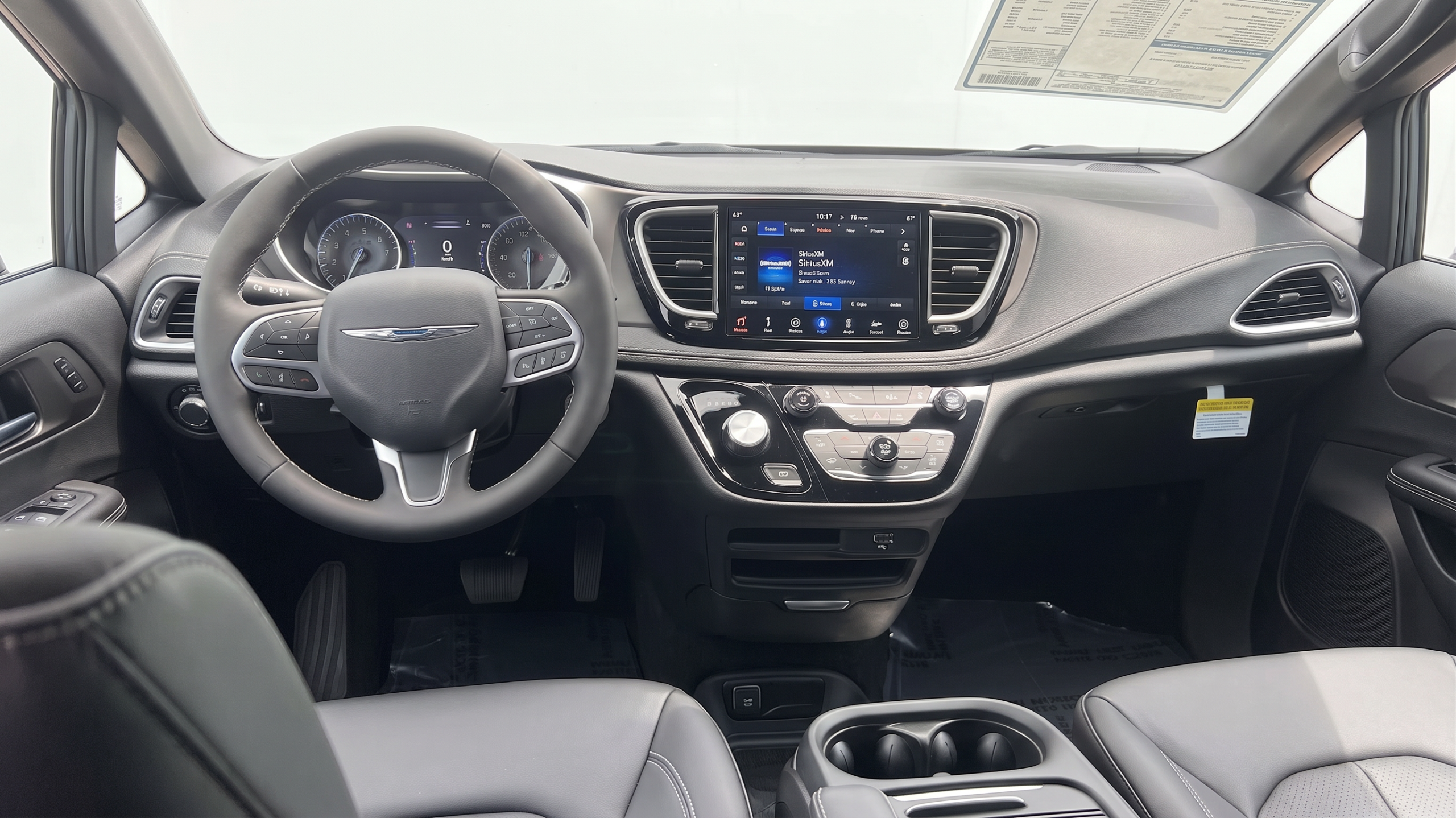
Quick Answer
Yes — every 2027 Chrysler Pacifica comes standard with Uconnect 5 on a 10.1-inch touchscreen, plus wireless Apple CarPlay and Android Auto on every trim. A 4G LTE Wi-Fi hotspot is standard across the lineup; wireless device charging is included on the Limited and Pinnacle.
When families around Bowdle start asking about the Pacifica’s screen, the real question underneath is usually simpler: will my phone just work, and will the kids stay connected on a long drive? Nobody wants to fuss with a cable every time they get in, and nobody wants a touchscreen that fights them on the highway.
This guide covers exactly what Uconnect 5 is, how big the screen is, how wireless CarPlay and Android Auto work, what comes standard versus what’s trim-gated, and whether the system holds up on the kind of long rural drives families do out here.
On This Page
What is Uconnect 5 and how big is the screen?
Uconnect 5 is Chrysler’s infotainment system, and in the 2027 Pacifica it runs on a 10.1-inch touchscreen that comes standard on every trim — from the LX all the way up to the Pinnacle. There’s no smaller base screen to settle for; the big display is the starting point.
The layout is built around large, tap-friendly tiles and a row of climate shortcuts that stay put, so you’re not digging through menus to bump the temperature. For a family vehicle, that consistency matters more than flashy graphics — everyone who drives it can find what they need fast.
Does the 2027 Pacifica have wireless Apple CarPlay and Android Auto?
Yes — and it’s wireless on every trim. The 2027 Pacifica comes standard with wireless Apple CarPlay and wireless Android Auto across the entire lineup, so your phone connects over the air without plugging in. Get in, and your maps, music, and messages are simply there.
Why wireless matters in a minivan
When you’re loading kids, bags, and a coffee, the last thing you want is to fish out a cable. Wireless CarPlay and Android Auto mean the screen is ready before you’ve finished buckling everyone in — and there’s no cord to wear out or trip the kids in back.
Because it’s standard on the LX too, you don’t have to climb the trim ladder to get the phone integration most families actually use every day. That’s a genuine value point worth knowing before you start comparing trims.
Does it have a Wi-Fi hotspot and wireless charging?
A 4G LTE Wi-Fi hotspot is standard on every 2027 Pacifica trim, so the whole family can connect tablets and laptops on the go — handy on a long highway stretch when the kids want to stream. It turns the minivan into a rolling hotspot without anyone burning through their phone data.
Wireless device charging is where the trims diverge: the wireless charging pad is included on the Limited and Pinnacle, but not on the LX or Select. If keeping a phone topped up without a cable matters to you, that’s a reason to look at the Limited and up.
From Beadle’s Chrysler Center
A question we get a lot is “does the base one still have the hotspot?” The answer is yes — the Wi-Fi hotspot is standard right down to the LX. The wireless charging pad is the piece that’s trim-gated, so if that’s on your must-have list, we’ll point you toward a Limited or Pinnacle when you come in.
Is the system easy to use on long rural drives?
For the long drives families do out here, the strength of Uconnect 5 is that the things you reach for most — navigation through CarPlay or Android Auto, voice commands, and audio — are right where you expect them, so you keep your eyes on the road. The persistent climate controls mean you’re not hunting through a menu at highway speed.
Voice control lets you set a destination or change a song without taking your hands off the wheel, which is exactly what you want on a two-lane road between towns. Pair that with the standard Wi-Fi hotspot for the back seats, and a long haul across the county goes a lot more smoothly for everyone in the van.
What’s standard vs. trim-gated?
| Feature | LX / Select | Limited / Pinnacle |
|---|---|---|
| 10.1-inch touchscreen | Standard | Standard |
| Wireless Apple CarPlay & Android Auto | Standard | Standard |
| 4G LTE Wi-Fi hotspot | Standard | Standard |
| Wireless charging pad | Not included | Included |
Good to know: the screen size, wireless phone integration, and Wi-Fi hotspot are the same across the lineup, so even an LX gives you the core connectivity.
Step up if: you want the built-in wireless charging pad — that’s where the Limited and Pinnacle separate from the lower trims.
How to set up Uconnect 5 for your family
A few minutes on day one makes the system feel effortless for everyone who drives the van. Here’s the order we’d tackle it.
- Pair each phone for wireless CarPlay or Android Auto: connect once over Bluetooth and it reconnects automatically every drive after that.
- Set up the Wi-Fi hotspot: name the network and add the kids’ tablets so the back seats are ready for the next road trip.
- Pin your favorites: put your most-used apps and shortcuts front and center on the 10.1-inch screen.
- Learn the voice commands: practice setting a destination and changing music by voice so it’s second nature on the highway.
- Confirm wireless charging fit (Limited/Pinnacle): make sure your phone case works on the charging pad before you rely on it.
Key Takeaways
- Uconnect 5 runs on a 10.1-inch touchscreen that’s standard on every 2027 Pacifica trim.
- Wireless Apple CarPlay and wireless Android Auto are standard across the entire lineup — no cable needed.
- A 4G LTE Wi-Fi hotspot is standard on all trims; wireless charging is included on the Limited and Pinnacle.
- Navigation through your phone, voice commands, and persistent climate controls make it easy to use on long rural drives.
Frequently Asked Questions
How big is the touchscreen in the 2027 Pacifica?
It’s a 10.1-inch touchscreen running Uconnect 5, and it comes standard on every trim from the LX to the Pinnacle. There’s no smaller base screen — the large display is standard across the lineup.
Does the 2027 Pacifica have wireless Apple CarPlay?
Yes. Wireless Apple CarPlay and wireless Android Auto are both standard on every 2027 Pacifica trim, so your phone connects over the air without plugging in a cable.
Is there a Wi-Fi hotspot in the Pacifica?
Yes. A 4G LTE Wi-Fi hotspot is standard on every 2027 Pacifica trim, including the LX, so the family can connect tablets and laptops on long drives.
Which trims have wireless phone charging?
The wireless charging pad is included on the Limited and Pinnacle. The LX and Select don’t include it, so step up to the Limited if built-in wireless charging is on your list.
My Take on Uconnect 5 in the Pacifica
When families ask me about the screen, what they’re really asking is “will this be one more thing to fight with?” And honestly, this is the part of the Pacifica I rarely hear complaints about. The phone just connects, the screen is big and clear, and the controls land where you’d expect them.
What I appreciate is that the core stuff — the 10.1-inch screen, wireless CarPlay and Android Auto, the Wi-Fi hotspot — is standard right down to the LX. You’re not forced up the trim ladder just to get the connectivity you actually use. If wireless charging matters to you, that’s the one piece I’d point you toward a Limited or Pinnacle to get.
As your local South Dakota Chrysler dealer — and a convenient North Dakota Chrysler dealer for families just across the border — we’re glad to help. If you want the full picture on trims, towing, and tech, take a look at our complete 2027 Chrysler Pacifica guide. And if you’re anywhere near Bowdle, stop by Beadle’s Chrysler Center — we’ll pair your phone and walk you through the system in person.
Keep Researching the 2027 Pacifica
Start with the full 2027 Chrysler Pacifica overview for trims, specs, and pricing. Then dig into related questions:
· Theater Group & rear-seat entertainment
· FamCAM, hands-free doors & built-in vacuum
· Standard safety & driver-assist
Quick Answers
What system does it run? Uconnect 5.
How big is the screen? 10.1 inches, standard on every trim.
Wireless Apple CarPlay? Yes — standard all trims.
Wireless Android Auto? Yes — standard all trims.
Wi-Fi hotspot? 4G LTE, standard on every trim.
Wireless charging pad? Limited and Pinnacle.
Does the LX get the big screen? Yes — 10.1-inch is standard.
Voice control? Yes, for navigation and audio.
Where can I see one near me? Beadle’s Chrysler Center, Bowdle, SD.
About the Author
Lexy Tabbert — Beadle’s Chrysler Center, Bowdle, SD
Lexy Tabbert is the Director of Sales and Marketing at Beadle’s Chrysler Center in Bowdle, South Dakota. She covers Ram, Jeep, Dodge, and Chrysler vehicles — helping families, ranchers, and ag operators across the region find the right truck and configuration for their needs. Learn more about Lexy.
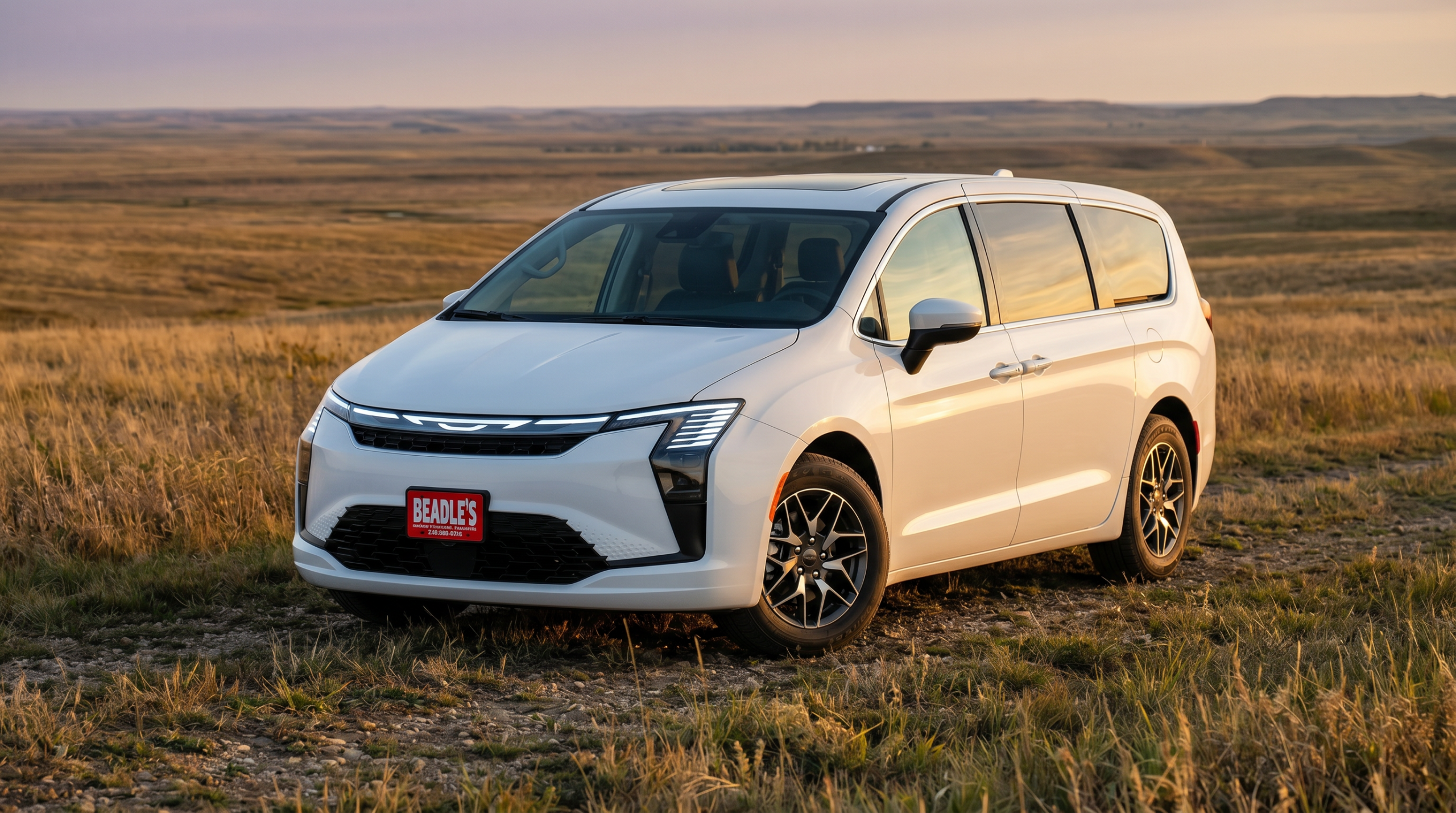
Quick Answer
Only two minivans offer all-wheel drive — the 2027 Chrysler Pacifica and the Toyota Sienna; the Honda Odyssey and Kia Carnival are front-wheel drive only. The Pacifica wins on power, towing, and 2nd-row Stow ‘n Go; the Sienna hybrid wins on fuel economy (about 36 mpg versus 20).
When a family in our part of the high plains starts shopping minivans, the conversation almost always narrows to the same handful of names: Pacifica, Sienna, Odyssey, and Carnival. And out here, the first filter isn’t the third-row legroom — it’s whether the thing has all-wheel drive at all. That single question quietly knocks two of those four off the list.
This is the honest comparison. We’ll lay out which minivans actually offer AWD, where the Pacifica beats the Toyota Sienna and where the Sienna beats it, why the Honda Odyssey and Kia Carnival sit in a different category, and which one makes the most sense for a Dakota family.
Which minivans even offer all-wheel drive?
Let’s start with the honest framing, because a lot of comparison articles get this wrong: the 2027 Chrysler Pacifica is not the only minivan you can buy with all-wheel drive. The Toyota Sienna offers AWD too. So if you ever read “the only minivan with AWD,” that claim is false, and we’re not going to make it.
What is true: only two of the four mainstream minivans offer all-wheel drive at all. The Pacifica and the Sienna do. The Honda Odyssey and the Kia Carnival are front-wheel drive only — there’s no AWD version of either, at any trim, at any price. For a family that drives gravel before the county plows it, that fact alone narrows the field to two.
Where the Pacifica earns a claim it can actually defend is this: it’s the only minivan that offers all-wheel drive combined with 2nd-row Stow ‘n Go seating. The Sienna has AWD, but its second-row seats don’t fold flat into the floor. So if you want both winter traction and the ability to swallow a sheet of plywood without hauling seats out to the garage, the Pacifica stands alone.
Pacifica vs. Sienna vs. Odyssey vs. Carnival at a glance
| Feature | Chrysler Pacifica | Toyota Sienna | Honda Odyssey | Kia Carnival |
|---|---|---|---|---|
| AWD available | Yes (Select & up) | Yes | No — FWD only | No — FWD only |
| Powertrain | Gas V6 | Hybrid (standard) | Gas V6 | Gas V6 |
| Approx. power | 287 hp | ~245 hp | ~280 hp | ~287 hp |
| Max towing | 3,600 lbs | ~3,500 lbs | ~3,500 lbs | ~3,500 lbs |
| Fuel economy (combined) | ~20 (AWD) / ~22 (FWD) | ~36 (hybrid) | ~22 | ~21 |
| Stow ‘n Go (2nd row) | Yes | No | No | No |
Power, towing, and fuel-economy figures for competitors are approximate and based on published manufacturer data; verify current specs and trim availability before you buy. The pattern, though, is consistent: the Pacifica leads on power, towing, and Stow ‘n Go; the Sienna leads decisively on fuel economy.
Pacifica vs. Sienna for winter: power vs. efficiency
This is the real matchup. Since the Odyssey and Carnival don’t offer AWD, the all-wheel-drive minivan decision in snow country comes down to the Pacifica versus the Toyota Sienna. They’re built around two different philosophies, and being clear about that is the whole point.
The 2027 Pacifica runs a 287-horsepower gas V6 with a 9-speed automatic, an intelligent disconnecting AWD system that can send torque to the rear when the fronts slip, up to 3,600 pounds of towing with the Trailer Tow Group, and 2nd-row Stow ‘n Go. It’s the powertrain you want when you’re merging onto a two-lane with a loaded van, pulling a small trailer, or want the seats gone in seconds.
The Sienna comes standard as a hybrid, makes around 245 horsepower, and is available with AWD driven by an electric motor on the rear axle. Its trump card is fuel economy — roughly 36 mpg combined, versus about 20 for an AWD Pacifica. That’s a big gap, and we’re not going to pretend it isn’t. In return, the Sienna gives up power, tows a little less, and doesn’t offer Stow ‘n Go — its second-row seats have to come out by hand.
The honest trade
The Sienna’s AWD is electric and on-demand; the Pacifica’s is a mechanical disconnecting system that can route up to 100% of torque rearward. Both get you moving in snow. The Pacifica feels stronger and tows more; the Sienna sips far less fuel. Pick the one whose strength matches how you actually drive.
One note worth making plainly: there is no 2027 Pacifica plug-in hybrid. Chrysler discontinued it, so the 2027 Pacifica is gas-only across the lineup. If a salesperson or article points you at a Pacifica PHEV for this model year, it doesn’t exist — the efficiency conversation here is strictly gas V6 versus Sienna hybrid.
How does the Pacifica compare to the Honda Odyssey and Kia Carnival?
The Honda Odyssey and Kia Carnival are both genuinely good minivans — comfortable, well-built, and worth a look if all-wheel drive isn’t on your list. But here’s the thing that matters for a high-plains buyer: neither one offers AWD. Both are front-wheel drive only, full stop.
On paper, all three are close on power and towing — the Odyssey and Carnival both run gas V6 engines in the same neighborhood as the Pacifica, and tow in the same 3,500-pound range. Where they differ is the winter-traction question and the seating flexibility. A front-drive minivan on good winter tires handles plowed roads fine, but it can’t put power to the rear wheels when a front tire is spinning on an unplowed gravel approach.
And like the Sienna, neither the Odyssey nor the Carnival offers 2nd-row Stow ‘n Go — their second-row seats are removable, but you’re lifting them out and finding somewhere to store them, not folding them into the floor. For a family that wants both winter capability and quick cargo flexibility, that combination keeps coming back to one van.
From Beadle’s Chrysler Center
We tell folks straight: if AWD isn’t a priority for you, the Odyssey and Carnival deserve a test drive — they’re good vans. But the moment “I need to get up my gravel road in February” enters the conversation, the list shrinks to the Pacifica and the Sienna, and the rest of the decision is power and Stow ‘n Go versus fuel economy.
Our Recommendation
For a snow-country South Dakota or North Dakota family that wants power, towing, and the flexibility of Stow ‘n Go, the 2027 Chrysler Pacifica — in AWD form — is the pick.
It’s the only minivan that pairs all-wheel drive with 2nd-row Stow ‘n Go, it makes more power than the Sienna, and it tows the most of the group. If, instead, your top priority is fuel economy above everything else, we’ll be honest with you: the Toyota Sienna hybrid wins on MPG, and it isn’t close — about 36 combined versus 20. Choose the Pacifica for capability and flexibility; choose the Sienna if every gallon counts more than the rest.
Which is right for a Dakota family?
Here’s how we’d sort it out at the lot, in plain terms.
- Need AWD? That immediately removes the Odyssey and Carnival — neither offers it.
- Want power, towing, and Stow ‘n Go? The Pacifica AWD is the answer, and it’s the only van that combines AWD with fold-into-the-floor seats.
- Care most about fuel economy? The Sienna hybrid wins on MPG — there’s no spin to put on that.
- Don’t need AWD at all? The Odyssey and Carnival are worth a drive, but you still give up Stow ‘n Go versus the Pacifica.
- Still deciding? Come drive an AWD Pacifica in person — the seating flexibility and the powertrain tend to settle it faster than a spec sheet does.
Key Takeaways
- Only the Pacifica and Toyota Sienna offer AWD — the Honda Odyssey and Kia Carnival are front-wheel drive only.
- The Pacifica is the only minivan that combines all-wheel drive with 2nd-row Stow ‘n Go seating.
- The Pacifica leads on power (287 hp) and towing (3,600 lbs); the Sienna hybrid wins clearly on fuel economy (~36 vs ~20 combined).
- There is no 2027 Pacifica plug-in hybrid — the lineup is gas V6 only this model year.
Frequently Asked Questions
Is the Chrysler Pacifica the only minivan with all-wheel drive?
No. The Toyota Sienna also offers all-wheel drive. The honest, defensible claim is that the Pacifica is the only minivan offering AWD combined with 2nd-row Stow ‘n Go seating. The Honda Odyssey and Kia Carnival are front-wheel drive only.
Pacifica or Sienna for a snowy climate?
Both offer AWD and handle snow well. Choose the Pacifica if you want more power, more towing (3,600 lbs), and Stow ‘n Go flexibility. Choose the Sienna if fuel economy is your top priority — its hybrid returns about 36 mpg combined versus roughly 20 for an AWD Pacifica.
Do the Honda Odyssey or Kia Carnival offer AWD?
No. Both the Honda Odyssey and Kia Carnival are front-wheel drive only — there is no all-wheel-drive version of either. If AWD is on your list, the realistic choices are the Chrysler Pacifica and the Toyota Sienna.
Does the 2027 Pacifica come as a plug-in hybrid?
No. The Pacifica plug-in hybrid has been discontinued, so the 2027 Pacifica is gas V6 only across every trim. Any efficiency comparison for this model year is the gas Pacifica versus the Toyota Sienna hybrid.
My Take on the AWD-Minivan Decision
I’d rather lose a sale than sell someone the wrong van, so here’s how I actually steer this conversation. If you don’t need all-wheel drive, the Odyssey and Carnival are good vehicles and you should drive them. But most of the families I talk to out here do want AWD once they think about a January gravel road — and that leaves the Pacifica and the Sienna.
Between those two, I won’t pretend the Pacifica wins on fuel — it doesn’t. The Sienna hybrid sips, and if that’s your number-one concern, it’s the smart buy. But if you want the stronger engine, the most towing in the class, and the only AWD van that lets you fold the second row into the floor in seconds, the AWD Pacifica is the one I’d put my own family in.
As your local South Dakota Chrysler dealer — and a convenient North Dakota Chrysler dealer for families just across the border — we’re glad to help. For the full rundown on trims, towing, and winter capability, start with our complete 2027 Chrysler Pacifica guide. And if you’re near Bowdle, stop by Beadle’s Chrysler Center — bring your real-world driving in mind, and we’ll help you pick honestly between these vans.
Keep Researching the 2027 Pacifica
Start with the full 2027 Chrysler Pacifica overview for trims, specs, and pricing. Then dig into related questions:
· How the Pacifica’s AWD handles a South Dakota winter
· Which Pacifica trim is right for your family
· What the Pacifica can tow
Quick Answers
Which minivans offer AWD? Only the Chrysler Pacifica and Toyota Sienna.
Do the Odyssey and Carnival offer AWD? No — both are front-wheel drive only.
Which has the most power? The Pacifica, at 287 hp.
Which tows the most? The Pacifica, up to 3,600 lbs.
Which has the best fuel economy? The Sienna hybrid, about 36 mpg combined.
Which has Stow ‘n Go? Only the Pacifica.
Is there a 2027 Pacifica plug-in hybrid? No — gas V6 only this year.
Best AWD pick for power and flexibility? The AWD Pacifica.
Where can I see one near me? Beadle’s Chrysler Center, Bowdle, SD.
About the Author
Lexy Tabbert — Beadle’s Chrysler Center, Bowdle, SD
Lexy Tabbert is the Director of Sales and Marketing at Beadle’s Chrysler Center in Bowdle, South Dakota. She covers Ram, Jeep, Dodge, and Chrysler vehicles — helping families, ranchers, and ag operators across the region find the right truck and configuration for their needs. Learn more about Lexy.
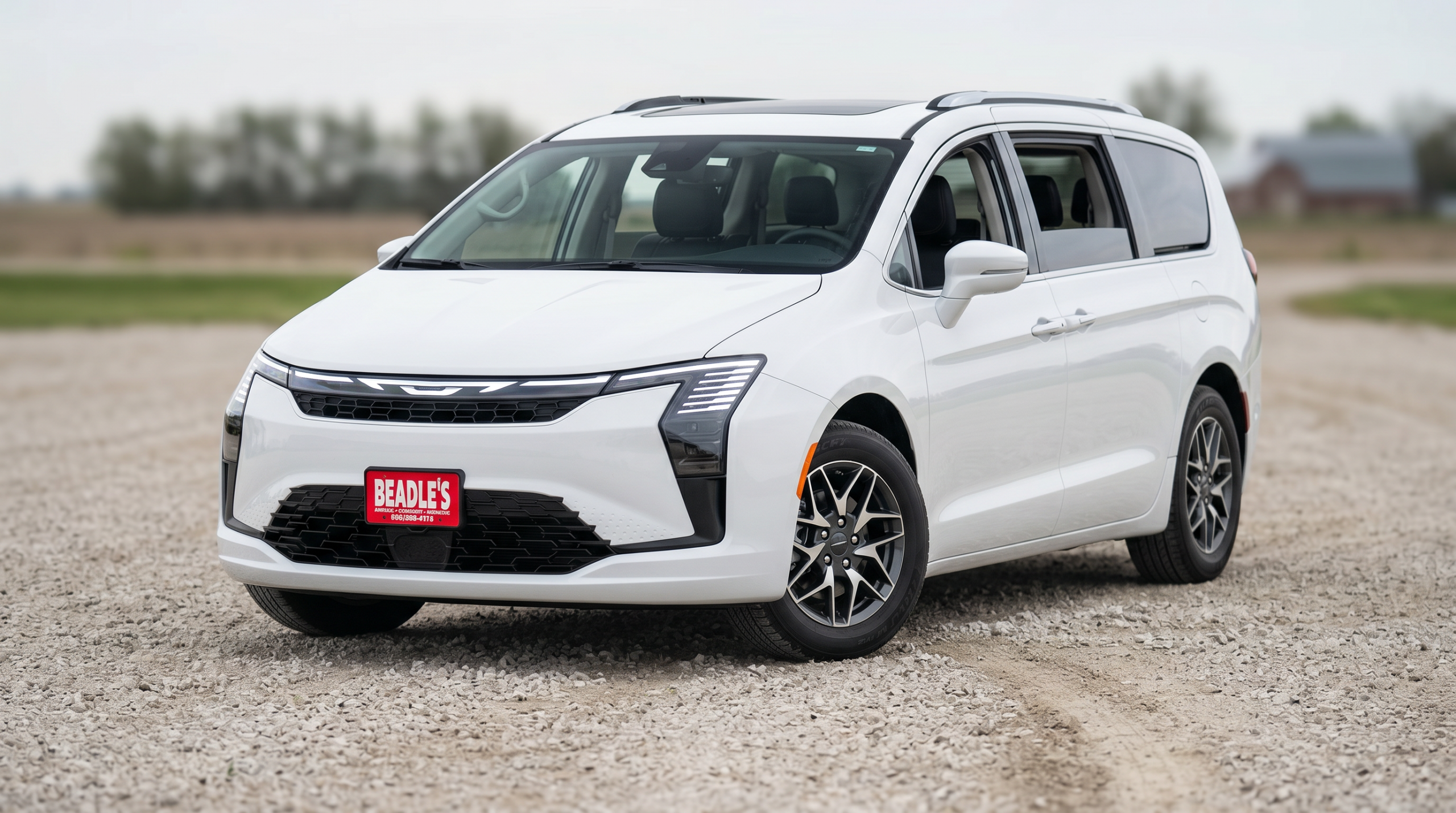
Quick Answer
The 2027 Chrysler Pacifica comes in four core trims — LX, Select, Limited, and Pinnacle — all sharing the same 287-hp V6 and a generous list of standard features. For a rural family on a budget, the Select is usually the sweet spot: it’s the most affordable way into available all-wheel drive, keeps 2nd-row Stow ‘n Go, and can add the Family Tech Group. The catch worth knowing up front: the base LX cannot be optioned with AWD — that starts at the Select.
Walking into a Pacifica decision, most families don’t need the most expensive van — they need the right one. And out here, “right” usually means enough seats, enough tech to keep everyone happy on a long drive to Aberdeen, and the option of all-wheel drive when winter rolls in. The good news is the trims are easy to sort once you know what actually changes between them.
This guide breaks down all four 2027 Pacifica trims, what really separates them, which one makes the most sense for a rural family watching the budget, and the one AWD catch that surprises shoppers every time.
What trims does the 2027 Pacifica come in?
The 2027 Chrysler Pacifica comes in four core trims, walking up from value to luxury: LX, Select, Limited, and Pinnacle. Every one of them runs the same 3.6L V6 making 287 horsepower and 262 lb-ft of torque, paired to a 9-speed automatic — so you’re never short on power no matter which trim you pick.
Pricing starts around the low $40,000s for the LX and climbs into the mid $50,000s for a Pinnacle before options and destination. Those are approximate “starting around” figures, and Chrysler has adjusted 2027 MSRPs since launch — so always confirm current pricing with us before you plan around a number.
What surprises a lot of shoppers is how much is standard even on the LX. Every 2027 Pacifica comes with a 10.1-inch Uconnect 5 touchscreen, wireless Apple CarPlay and Android Auto, a Wi-Fi hotspot, tri-zone automatic climate, heated front seats, a heated steering wheel, remote start, and the full standard driver-assist suite. So the trims aren’t about getting a “stripped” van versus a loaded one — they’re about how much comfort, tech, and convenience you want to layer on.
What’s the difference between the trims?
Since the engine, transmission, and core tech are shared, the real differences come down to seating flexibility, comfort upgrades, and family-tech features. Here’s how they stack up as you move up the ladder.
LX is the value play — fully equipped on the essentials, front-wheel drive only, with Stow ‘n Go in the 3rd row. Select is the first step up and the first trim you can get with all-wheel drive; it keeps 2nd-row Stow ‘n Go, can add eight-passenger seating, and opens the door to the Family Tech Group. Limited adds the comfort layer most families notice day to day — ventilated front seats, heated 2nd-row seats, and a wireless charging pad — and is the first trim that can add the Trailer Tow Group. Pinnacle is the top of the line, with premium leather, a suede headliner, hands-free doors and liftgate, and most of the family-tech goodies built in.
The Family Tech Group is the feature to know
For 2027, Chrysler split the old theater package in two. The Family Tech Group (available on Select and Limited) bundles the FamCAM interior camera, a 19-speaker Harman Kardon system, the Stow ‘n Vac built-in vacuum, and Uconnect 5 navigation. The separate Amazon Fire TV Theater Group (Pinnacle only) adds the built-in streaming and seatback screens. That means you can add a lot of the “premium” family features to a mid-trim Select without jumping all the way to a Pinnacle.
One more option worth flagging: the Safety Sphere 360 surround-view camera package is optional on Select and Limited and standard on Pinnacle. It’s separate from the standard driver-assist suite, which every trim already includes.
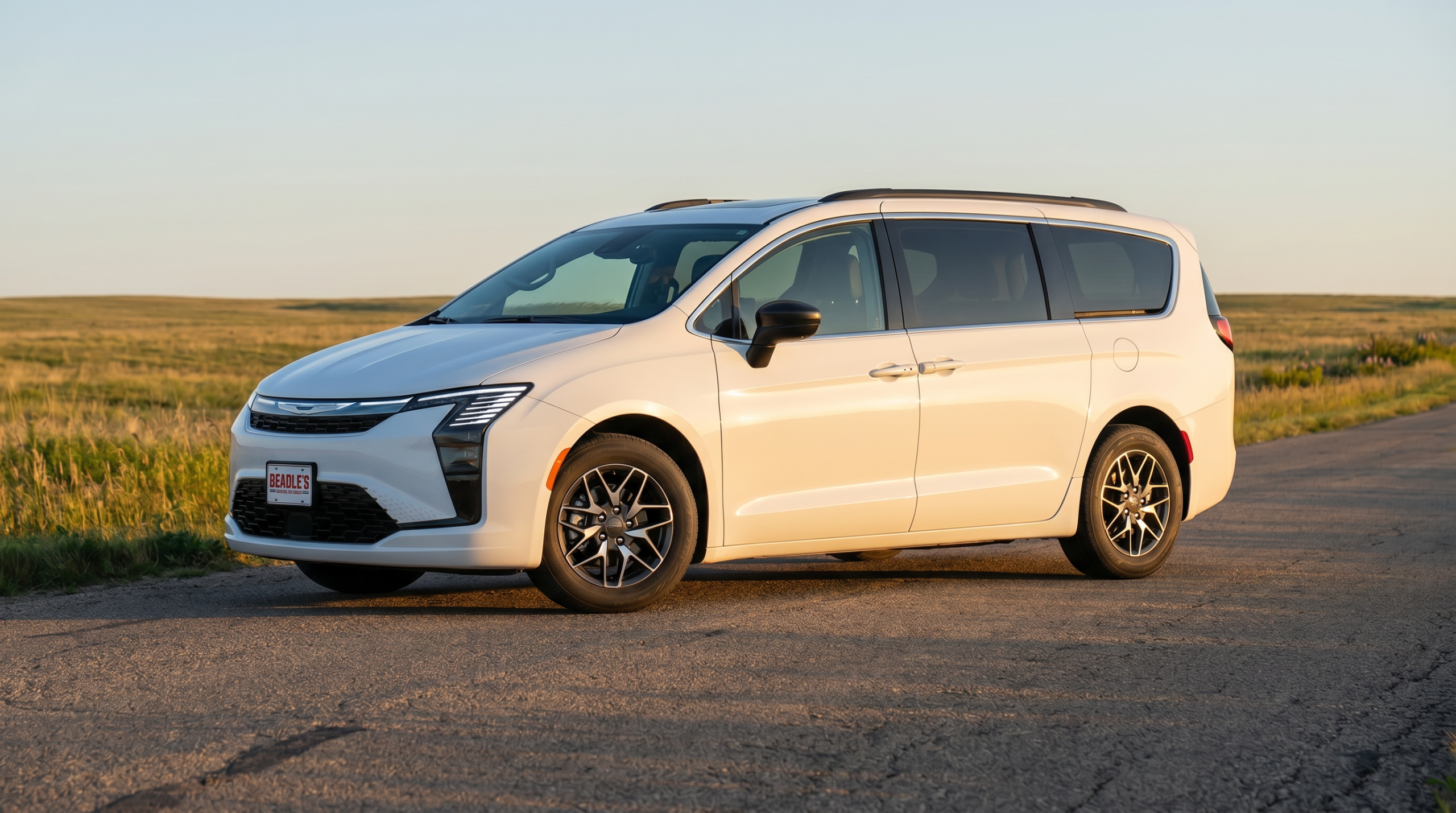
2027 Pacifica trim comparison at a glance
| Trim | AWD? | What stands out | Best for |
|---|---|---|---|
| LX | No (FWD only) | All the essentials standard; lowest price of entry | Budget-first town families who don’t need AWD |
| Select | Yes (about $3,000) | First trim with AWD; keeps Stow ‘n Go; adds Family Tech Group | Rural families on a budget who want AWD |
| Limited | Yes (about $3,000) | Ventilated front + heated 2nd-row seats, wireless charging, tow group | Comfort-focused families and light towers |
| Pinnacle | Yes (about $3,000) | Premium leather, suede headliner, hands-free doors, Fire TV | Buyers who want the loaded, top-of-line van |
Note on AWD: available on Select, Limited, and Pinnacle for about $3,000 — never on the LX. Pricing is approximate and subject to change, so confirm current pricing with us.
Which trim should a rural family buy?
For most rural families on a budget, the Select with all-wheel drive is the smart buy. It’s the most affordable way into AWD — which is what really matters when you’re on gravel before the plow comes through — and it keeps 2nd-row Stow ‘n Go for those days you need to haul something flat instead of people. From there, you can add the Family Tech Group if you want the upgraded sound and FamCAM without stepping up to a higher trim.
If your budget is tighter and you mostly stay on town and plowed roads, the LX covers the essentials and saves you the most up front. If comfort is the priority — ventilated seats for summer, heated 2nd-row seats for the kids in January, wireless charging — the Limited is worth the step. And if you simply want the nicest minivan on the lot with every convenience built in, that’s the Pinnacle.
From Beadle’s Chrysler Center
The conversation we have most often with families goes like this: they come in thinking they need the Limited or Pinnacle for the features, then realize the Select AWD with the Family Tech Group gives them the all-wheel drive and most of the tech they actually wanted for noticeably less. We’d rather put you in the trim that fits your life than the one with the biggest sticker — so tell us how and where you drive, and we’ll point you to the right one.
The AWD catch: why the LX can’t be optioned with AWD
Here’s the one that trips people up. All-wheel drive is available on the 2027 Pacifica Select, Limited, and Pinnacle for about $3,000 over the front-wheel-drive price — but it is not offered on the entry-level LX at all. The LX is front-wheel drive only, full stop. So if AWD is on your must-have list, your shopping starts at the Select, not the LX.
That matters for budget planning. A family eyeing the cheapest Pacifica to get AWD can’t simply add it to an LX — they need to step up to a Select first, then add the all-wheel-drive option. It’s still a reasonable jump, and the Select brings a few nice upgrades of its own, but it’s the kind of detail that’s easy to miss until you’re sitting down to spec one out. (That AWD price is approximate and subject to change, so confirm current pricing with us.)
The upside: the Pacifica is one of the few minivans you can buy with all-wheel drive at all — and the only one that pairs AWD with 2nd-row Stow ‘n Go on the Select and Limited. For a North Dakota or South Dakota family, that combination of traction plus a flat load floor is genuinely hard to find anywhere else.
How to choose your Pacifica trim
A few quick questions sort the lineup fast. Here’s the order we’d work through it with you.
- Do you need all-wheel drive? If yes, skip the LX — your starting point is a Select, Limited, or Pinnacle with the AWD option (about $3,000).
- Is the budget the main driver? The Select AWD is the most affordable way into all-wheel drive and keeps 2nd-row Stow ‘n Go.
- Want the upgraded family tech? Add the Family Tech Group on a Select or Limited for FamCAM, Harman Kardon audio, Stow ‘n Vac, and navigation.
- Is comfort the priority? Step up to the Limited for ventilated front and heated 2nd-row seats and wireless charging.
- Want the loaded van or plan to tow? Pinnacle brings premium leather and Fire TV; the Trailer Tow Group is available on Limited and Pinnacle.
Key Takeaways
- The 2027 Pacifica comes in four trims — LX, Select, Limited, and Pinnacle — all sharing the same 287-hp V6 and a deep list of standard features.
- For most rural families on a budget, the Select AWD is the sweet spot: cheapest way into AWD, keeps 2nd-row Stow ‘n Go, and can add the Family Tech Group.
- The AWD catch: all-wheel drive (about $3,000) is offered on Select, Limited, and Pinnacle — never on the LX, which is front-wheel drive only.
- Pricing is approximate and subject to change — confirm current pricing with us before planning around a number.
Our Recommendation
For most South Dakota and North Dakota families, buy the Pacifica Select AWD.
It’s the most affordable way into all-wheel drive, it keeps 2nd-row Stow ‘n Go for the days you need a flat load floor, and you can add the Family Tech Group to get the upgraded sound, FamCAM, and navigation without paying for a higher trim. Unless you specifically want the comfort upgrades of the Limited or the loaded Pinnacle, the Select AWD gives a rural family the traction and the tech that actually matter — at a price that makes sense.
My Take on Picking a Pacifica Trim
When a family comes in trying to decide between trims, I always start with how and where they drive — not with the feature sheet. Out here, the answer usually points the same direction: a Select with all-wheel drive covers what a rural family actually needs, and the Family Tech Group fills in most of the “nice to have” without the Limited or Pinnacle price.
My honest recommendation: if your budget is the priority and you want AWD, the Select AWD is hard to beat. If you live in the seats — long drives, kids in the back, summer heat — the Limited’s ventilated and heated seats earn their keep. And if you want the absolute nicest van on the lot, the Pinnacle is genuinely lovely. There’s no wrong answer here, just the one that fits your life.
As your local South Dakota Chrysler dealer — and a convenient North Dakota Chrysler dealer for families just across the border — we’re glad to help. If you want the full picture on AWD, towing, and tech, take a look at our complete 2027 Chrysler Pacifica guide. And if you’re anywhere near Bowdle, stop by Beadle’s Chrysler Center — we’ll walk you through the trims side by side and help you land on the right one.
Keep Researching the 2027 Pacifica
Start with the full 2027 Chrysler Pacifica overview for trims, specs, and pricing. Then dig into related questions:
· How the Pacifica’s AWD handles a South Dakota winter
· Pacifica vs. Sienna, Odyssey & Carnival
· Pacifica comfort and premium features
Quick Answers
How many trims? Four — LX, Select, Limited, and Pinnacle.
Which trim has AWD? Select, Limited, and Pinnacle.
Does the LX offer AWD? No — LX is front-wheel drive only.
How much is AWD? About $3,000; subject to change, confirm current pricing.
Best trim for a rural family on a budget? Select AWD.
What’s standard on every trim? 10.1″ Uconnect 5, wireless CarPlay/Android Auto, Wi-Fi, tri-zone climate, heated front seats and wheel, remote start, full driver-assist suite.
Where do you get FamCAM and premium audio? The Family Tech Group on Select or Limited.
Which trims can tow? Trailer Tow Group is available on Limited and Pinnacle.
Where can I see one near me? Beadle’s Chrysler Center, Bowdle, SD.
About the Author
Lexy Tabbert — Beadle’s Chrysler Center, Bowdle, SD
Lexy Tabbert is the Director of Sales and Marketing at Beadle’s Chrysler Center in Bowdle, South Dakota. She covers Ram, Jeep, Dodge, and Chrysler vehicles — helping families, ranchers, and ag operators across the region find the right truck and configuration for their needs. Learn more about Lexy.
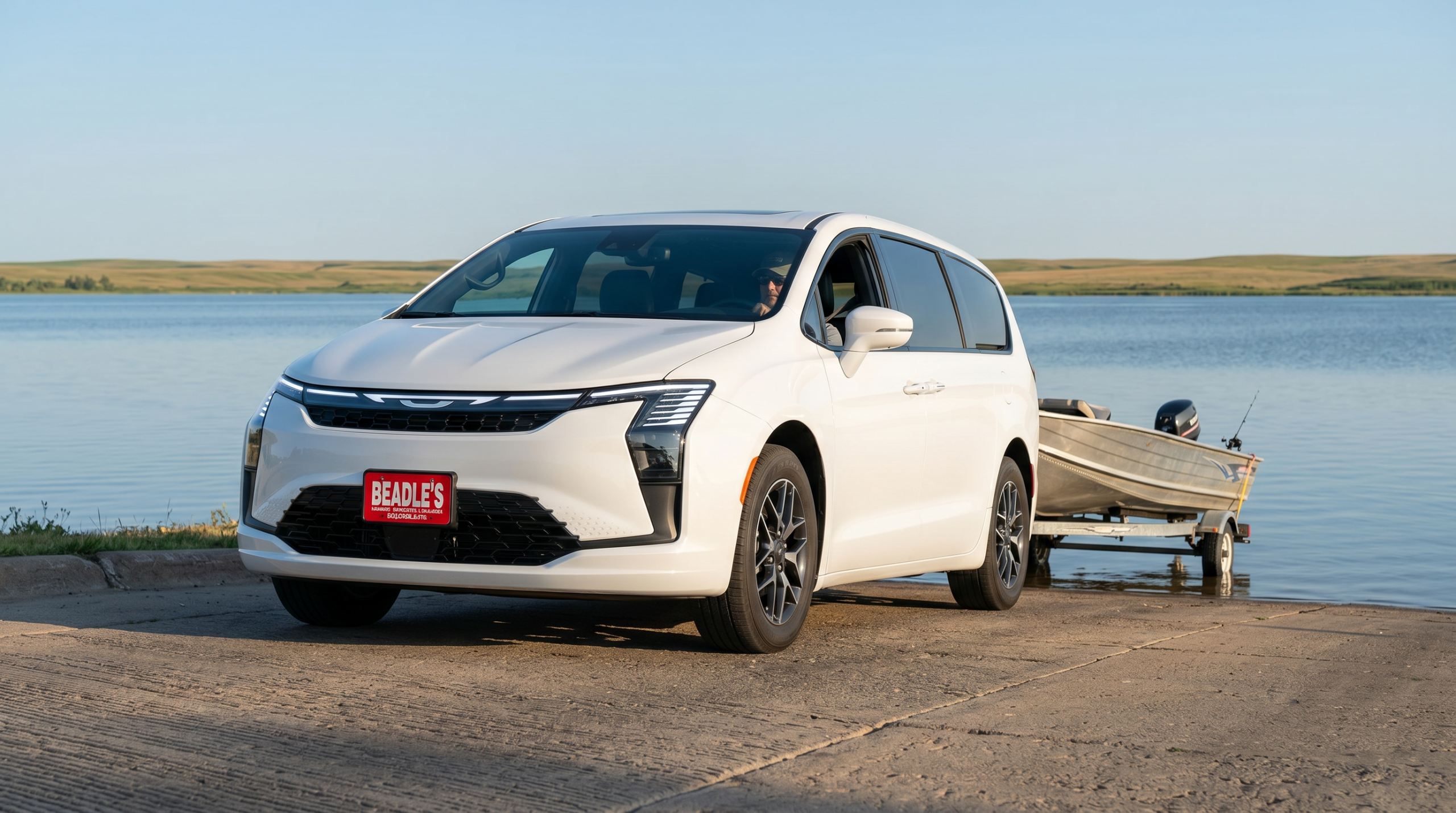
Quick Answer
Properly equipped with the Trailer Tow Group, the 2027 Chrysler Pacifica is rated to pull up to 3,600 pounds — best-in-class for a minivan. That’s plenty for a small fishing boat, a single-axle utility trailer, jet skis, or a lightweight pop-up camper. It is not a heavy-trailer or fifth-wheel tow vehicle, so match the load to the rating and you’ll be in good shape.
For a lot of Dakota families, the minivan isn’t just the school-run rig — it’s also what hooks up to the boat on a Saturday morning. The question we hear at Beadle’s Chrysler Center is a practical one: can a 3,600-pound minivan actually pull the things we tow out here, or do you need a truck for it?
This guide covers exactly how much the 2027 Pacifica can tow, what 3,600 pounds looks like in the real world, what comes in the Trailer Tow Group and which trims you can order it on, and where the honest limits are.
How much can the 2027 Pacifica tow?
The 2027 Chrysler Pacifica is rated to tow up to 3,600 pounds when it’s properly equipped with the available Trailer Tow Group. That’s best-in-class for the minivan segment, and it’s backed by the same 3.6L Pentastar V6 making 287 horsepower and 262 lb-ft of torque paired with a 9-speed automatic on every trim.
The one thing to know up front: that 3,600-pound rating only applies with the Trailer Tow Group fitted. A Pacifica without it is not set up to tow, so if pulling a boat or trailer is on your list, the tow group is the box you need to check when you order or shop. We’ll walk through exactly what that package includes a little further down.
What does 3,600 pounds actually pull?
A number on a spec sheet doesn’t mean much until you picture it hooked to a trailer. For a Dakota family, 3,600 pounds covers a lot of the weekend lineup — here’s what that rating realistically handles.
Real-world loads inside 3,600 lbs
A roughly 16-foot aluminum fishing boat on a single-axle trailer. A small or pop-up camper. A single-axle utility trailer for hauling around the place. A pair of jet skis on a trailer, or a couple of ATVs. These are the kinds of loads the Pacifica was built to handle.
Where you need to be honest is the heavy stuff. A big tandem-axle boat, a loaded car hauler, a large travel trailer, or anything pushing past that rating is truck territory — the Pacifica is not a fifth-wheel or heavy-trailer tow vehicle. Stay inside the boat, the small camper, and the light utility-trailer range and it does the job comfortably.
What’s in the Trailer Tow Group, and which trims get it?
The Trailer Tow Group is what unlocks the Pacifica’s full 3,600-pound rating, and it’s more than just a hitch. It adds a trailer hitch with a 2-inch receiver, the 7- and 4-pin wiring you need to run trailer lights, trailer-sway damping that helps the van settle a wandering trailer, and a heavy-duty radiator to keep temperatures in check when you’re loaded down.
On the trim side, the Trailer Tow Group is available on the Limited and the Pinnacle (in both front-wheel-drive and all-wheel-drive form). It isn’t offered on the LX or Select, so if towing is part of the plan, your shopping starts at the Limited. That’s a good thing to map out before you fall in love with a particular trim.
From Beadle’s Chrysler Center
The mistake we see most often is someone buying a Pacifica, then deciding a year later they want to pull a boat — and finding out their trim or build doesn’t have the tow group. If there’s any chance you’ll tow, tell us up front. It’s a simple thing to order correctly on a Limited or Pinnacle, and a frustrating one to add after the fact.
Does AWD help when you’re towing?
It can, and the place you’ll feel it most is a wet or icy boat ramp. Available all-wheel drive — offered on the Limited and Pinnacle for about $3,000 over front-wheel drive — sends power to all four wheels, which means more confidence backing a loaded trailer down a slick concrete ramp and pulling it back up without spinning the front tires.
To be clear, AWD doesn’t raise the 3,600-pound tow rating — that’s set by the Trailer Tow Group either way. What it adds is traction and composure in the conditions where towing gets dicey: a mossy ramp in spring, a gravel approach, or an early-season morning when the concrete hasn’t thawed. For a lot of boat owners around here, that peace of mind on the ramp is reason enough to pair AWD with the tow group.
Is the Pacifica the right tow vehicle for you?
| Consideration | 2027 Pacifica |
|---|---|
| Max towing (properly equipped) | Up to 3,600 lbs with the Trailer Tow Group |
| What it pulls well | ~16-ft fishing boat, small/pop-up camper, single-axle utility trailer, jet skis or ATVs |
| What it’s not built for | Large travel trailers, fifth-wheels, loaded car haulers |
| Trims with the tow group | Limited and Pinnacle (FWD or AWD) |
Worth it if: you tow a boat, jet skis, ATVs, a single-axle utility trailer, or a small camper, and you want one vehicle that hauls the family and the toys.
Skip it if: you regularly pull a large travel trailer, a fifth-wheel, or anything heavier than 3,600 pounds — that’s a job for a truck, not a minivan.
How to set up your Pacifica to tow
Getting the towing right is mostly about ordering correctly and matching the load. Here’s the order we’d tackle it.
- Start with a Limited or Pinnacle: the Trailer Tow Group is only available on these trims, so begin your search there.
- Add the Trailer Tow Group: this is what unlocks the full 3,600-pound rating, the 2-inch hitch receiver, the wiring, sway damping, and heavy-duty radiator.
- Weigh your trailer loaded: add the boat, gear, fuel, and water, then confirm the total stays inside 3,600 pounds.
- Consider AWD for the ramp: if you launch a boat on wet or icy concrete, the available all-wheel drive adds real confidence.
- Book a fit check in Bowdle: our team can confirm the wiring, hitch, and trailer-light hookup before your first trip out.
Key Takeaways
- The 2027 Pacifica tows up to 3,600 pounds — best-in-class for a minivan — but only with the Trailer Tow Group fitted.
- That rating comfortably covers a ~16-foot fishing boat, a small or pop-up camper, a single-axle utility trailer, or jet skis and ATVs.
- The Trailer Tow Group adds a 2-inch hitch receiver, 7- and 4-pin wiring, trailer-sway damping, and a heavy-duty radiator — available on the Limited and Pinnacle.
- AWD doesn’t raise the rating, but it adds real confidence on a wet or icy boat ramp. The Pacifica is not a heavy-trailer or fifth-wheel tow vehicle.
Frequently Asked Questions
How much can the 2027 Chrysler Pacifica tow?
Up to 3,600 pounds when it’s properly equipped with the available Trailer Tow Group, which is best-in-class for the minivan segment. Without the tow group, the Pacifica is not set up to tow.
What’s included in the Trailer Tow Group?
It adds a trailer hitch with a 2-inch receiver, 7- and 4-pin trailer wiring, trailer-sway damping, and a heavy-duty radiator. It’s available on the Limited and Pinnacle, in both front-wheel-drive and all-wheel-drive form.
Can the Pacifica tow a boat or a camper?
Yes, within the 3,600-pound limit. A roughly 16-foot fishing boat or a small to pop-up camper is well inside that rating. Large travel trailers and fifth-wheels are beyond what the Pacifica is built for.
Does all-wheel drive increase the towing capacity?
No. The 3,600-pound rating comes from the Trailer Tow Group regardless of drivetrain. What AWD adds is traction and confidence on a wet or icy boat ramp, which is why many boat owners pair it with the tow group.
My Take on Towing With the Pacifica
When a family asks me if the Pacifica can tow, what they usually want is one vehicle that does it all — hauls the kids during the week and the boat on the weekend. And for the loads most folks around here actually pull, it genuinely does. A fishing boat, a small camper, a utility trailer for jobs around the place: the Pacifica handles those without breaking a sweat.
My honest advice: be realistic about your heaviest load and order the Trailer Tow Group on a Limited or Pinnacle from the start. If you launch on a slick ramp, add the AWD. But if you’re regularly pulling a big travel trailer, I’ll tell you straight — that’s a truck job, and I’d rather point you right than sell you short.
As your local South Dakota Chrysler dealer — and a convenient North Dakota Chrysler dealer for families just across the border — we’re glad to help. If you want the full picture on trims, drivetrain, and tech, take a look at our complete 2027 Chrysler Pacifica guide. And if you’re anywhere near Bowdle, stop by Beadle’s Chrysler Center — we’ll check the hitch and wiring with you and make sure your setup is matched to what you tow.
Keep Researching the 2027 Pacifica
Start with the full 2027 Chrysler Pacifica overview for trims, specs, and pricing. Then dig into related questions:
· AWD in a South Dakota winter
· Which trim is right for your family
· Pacifica vs. Sienna, Odyssey & Carnival
Quick Answers
Max towing capacity? Up to 3,600 lbs, properly equipped.
What unlocks that rating? The available Trailer Tow Group.
Which trims get the tow group? Limited and Pinnacle (FWD or AWD).
What’s in the tow group? 2″ hitch receiver, 7&4-pin wiring, sway damping, HD radiator.
Can it tow a fishing boat? Yes — a ~16-ft boat is well inside the rating.
A camper? A small or pop-up camper, yes.
A fifth-wheel or big travel trailer? No — that’s truck territory.
Does AWD raise the rating? No, but it helps on a wet or icy boat ramp.
Where can I see one near me? Beadle’s Chrysler Center, Bowdle, SD.
About the Author
Lexy Tabbert — Beadle’s Chrysler Center, Bowdle, SD
Lexy Tabbert is the Director of Sales and Marketing at Beadle’s Chrysler Center in Bowdle, South Dakota. She covers Ram, Jeep, Dodge, and Chrysler vehicles — helping families, ranchers, and ag operators across the region find the right truck and configuration for their needs. Learn more about Lexy.
Quick Answer
The 2027 Chrysler Pacifica seats 7 standard (8 available on the Select), and with Stow ‘n Go you can fit three car seats across while still carrying real cargo. Fold the 3rd-row Stow ‘n Go bench flat and you have roughly 87 cubic feet for a long family road trip; fold the 2nd-row seats too (LX, Select, Limited) and it opens to about 140 cubic feet of flat floor.
When families around Bowdle start cross-shopping minivans, the question underneath all the others is usually the same: will it actually hold my kids and our stuff? Car seats, the stroller, the cooler, the bags for a week at the lake — a minivan only earns its keep if everything fits without a fight.
This guide covers exactly how Stow ‘n Go seating works, how many car seats fit and whether it grows with your family, how much cargo you get with seats up versus folded, and whether the Pacifica is genuinely comfortable for a long family road trip.
On This Page
- What is Stow ‘n Go seating and how does it work?
- How many car seats fit, and is it good for a growing family?
- How much cargo space is there with seats up vs. folded?
- Is the Pacifica comfortable for long family road trips?
- Stow ‘n Go vs. captain’s chairs: which fits your family?
- How to fold Stow ‘n Go seats flat
What is Stow ‘n Go seating and how does it work?
Stow ‘n Go is Chrysler’s signature system that lets the seats fold completely flat into the floor — no removing them, no leaving heavy benches in the garage. The 3rd-row Stow ‘n Go bench is standard on every 2027 Pacifica trim, and 2nd-row Stow ‘n Go is on the LX, Select, and Limited.
When the seats are up, the in-floor bins they fold into double as covered, lockable storage — a genuinely handy place for the things you don’t want sliding around. In about a minute you can go from a full second and third row to a flat cargo floor, and back again. That convenience is a big part of why the Pacifica is on so many family shopping lists in the first place.
How many car seats fit, and is it good for a growing family?
The 2027 Pacifica seats 7 passengers standard, with 8-passenger seating available on the Select. With three rows and multiple sets of LATCH anchors, most families can fit three child seats and still have room for everyone else — and the second and third rows make day-to-day buckling far easier than a tight SUV.
Why it grows with the family
Because the seats fold into the floor instead of coming out, you can reconfigure as the kids change — rear-facing infant seats today, boosters and friends from down the road later. The 8-passenger Select adds a center spot for a third in the second row when you need every seat.
A practical detail families appreciate: with the Stow ‘n Go bins empty in the second row, you can slide a seat forward to reach a third-row child more easily, or drop one second-row seat into the floor for a clear walkway to the back. It’s the kind of flexibility that makes the daily school run and the long haul to grandma’s both a little less stressful.
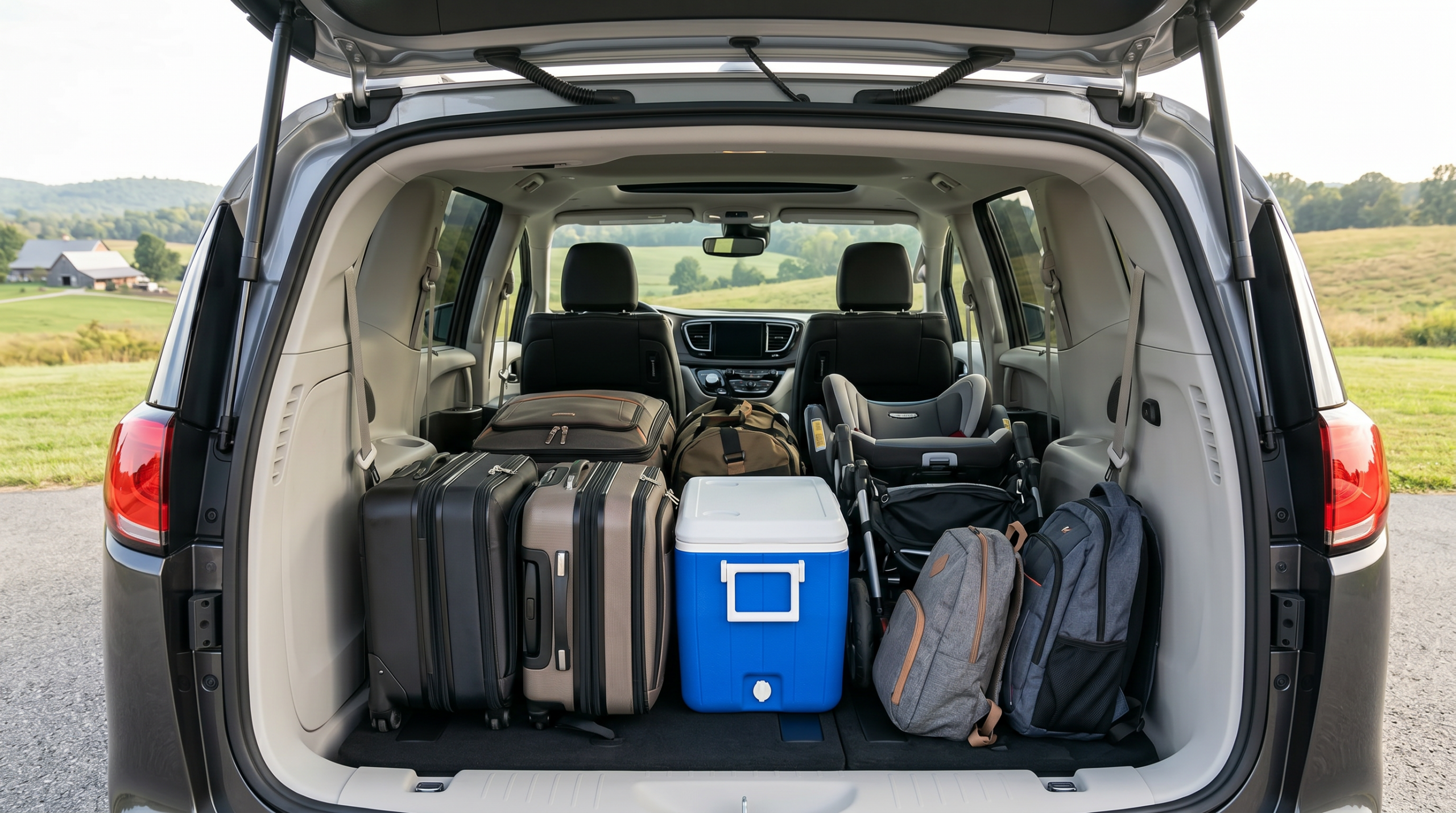
How much cargo space is there with seats up vs. folded?
Even with all three rows up, the deep well behind the third row holds plenty for everyday hauling — and the in-floor bins add covered storage on top of that. Fold the 3rd-row Stow ‘n Go bench flat and you open up roughly 87 cubic feet; drop the 2nd-row seats too and you get about 140 cubic feet of flat, usable floor.
The thing that sets the Pacifica apart from rivals here is that you don’t have to wrestle heavy seats out to the curb to get that space — they tuck away and the floor is genuinely flat. For a family heading out for a week, that means the cooler, the bikes, the bags, and the gear all fit, and you’re not storing seats in the garage while you’re gone.
From Beadle’s Chrysler Center
The question we hear most when families load up is “will it all fit if I keep the kids back there?” Almost always, yes — the well behind the third row and the floor bins handle a surprising amount with every seat occupied. The big folding numbers are for when you’re hauling, not hauling the whole family.
Is the Pacifica comfortable for long family road trips?
Yes — between three-zone automatic climate, heated front seats, and a quiet, composed ride, the 2027 Pacifica is built for long miles with kids aboard. The 3.6L V6 makes 287 horsepower and 262 lb-ft through a smooth 9-speed automatic, so it has the muscle to merge, climb, and pass loaded without straining.
For families who want the most relaxed second row, the Pinnacle swaps Stow ‘n Go for plush captain’s chairs and the Ultra Console — a trade of folding flexibility for lounge-level comfort. Either way, remote start is standard so the cabin is already comfortable before everyone climbs in, and the available all-wheel drive (about $3,000 on Select, Limited, and Pinnacle) keeps you confident when the weather turns on a long drive.
Stow ‘n Go vs. captain’s chairs: which fits your family?
| Consideration | 2nd-Row Stow ‘n Go (LX/Select/Limited) | Captain’s Chairs + Ultra Console (Pinnacle) |
|---|---|---|
| Folding flexibility | Best — seats fold flat into the floor | Seats don’t fold into floor |
| Cargo when folded | About 140 cu ft of flat floor | Less — captain’s chairs stay in place |
| Second-row comfort | Comfortable for everyday use | Plushest — lounge-level seating |
| In-floor storage bins | Yes — covered, lockable | No 2nd-row bins; Ultra Console storage |
Worth it if: you regularly switch between hauling kids and hauling cargo — 2nd-row Stow ‘n Go on the LX, Select, or Limited gives you the flat floor without removing seats, and the Pacifica is the only minivan that pairs available AWD with 2nd-row Stow ‘n Go.
Skip it if: you almost never fold the second row and want the most comfortable seats — the Pinnacle’s captain’s chairs and Ultra Console are the more relaxing choice.
How to fold the Pacifica’s Stow ‘n Go seats flat
Going from full seating to a flat cargo floor takes about a minute once you know the steps. Here’s the order we’d tackle it.
- Empty the in-floor bins: the 2nd-row seats fold into those storage wells, so clear them first.
- Slide the front seats forward: this gives the second-row seatback room to tumble into the floor.
- Open the bin lid and release the seat: pull the release strap, fold the headrest, and let the seat tumble down into the well.
- Fold the 3rd-row Stow ‘n Go bench: standard on every trim — release it and let the 60/40 bench drop into its own floor well behind it.
- Confirm the floor is flat: with both rows stowed you have about 140 cubic feet of flat load floor, ready for the road trip.
Key Takeaways
- The 2027 Pacifica seats 7 standard, with 8-passenger seating available on the Select.
- 3rd-row Stow ‘n Go is standard on all trims; 2nd-row Stow ‘n Go is on the LX, Select, and Limited, while the Pinnacle uses captain’s chairs and the Ultra Console.
- Fold the 3rd row flat for about 87 cubic feet, or both rows for roughly 140 cubic feet of flat floor — without removing seats.
- It’s the only minivan that pairs available all-wheel drive with 2nd-row Stow ‘n Go, and the 287-hp V6 makes long family road trips comfortable and confident.
Frequently Asked Questions
How many car seats fit in a 2027 Chrysler Pacifica?
Most families can fit three child seats across the second and third rows using the available LATCH anchors. The Pacifica seats 7 standard, and the Select offers 8-passenger seating for a center spot in the second row when you need it.
Which trims have 2nd-row Stow ‘n Go?
Second-row Stow ‘n Go is available on the LX, Select, and Limited. The Pinnacle uses captain’s chairs with the Ultra Console instead, while the 3rd-row Stow ‘n Go bench is standard on every trim.
How much cargo space does the Pacifica have?
Fold the 3rd-row Stow ‘n Go bench flat for roughly 87 cubic feet, or fold the second row too (LX, Select, Limited) for about 140 cubic feet of flat load floor. With seats up, the deep well behind the third row plus the in-floor bins still hold plenty for everyday hauling.
Is the Pacifica good for long family road trips?
Yes. Three-zone automatic climate, heated front seats, standard remote start, and a quiet ride make long miles comfortable, and the 287-hp 3.6L V6 with a 9-speed automatic has the power to merge and pass loaded. The available AWD adds confidence when the weather turns on the highway.
My Take on Stow ‘n Go and Family Space
When families come in worried about whether a minivan can really do it all, I usually just walk them to the Pacifica and start folding seats. Watching a second-row seat disappear into the floor in under a minute tends to answer the question faster than any spec sheet — that flat floor is the whole point.
My honest take: if your life swings back and forth between hauling kids and hauling cargo, the 2nd-row Stow ‘n Go on the LX, Select, or Limited is the one that makes a Pacifica feel limitless. If you mostly carry passengers and want the comfiest second row, the Pinnacle’s captain’s chairs are worth the step up. Either way, three car seats and a road trip’s worth of gear are not a problem.
As your local South Dakota Chrysler dealer — and a convenient North Dakota Chrysler dealer for families just across the border — we’re glad to help. If you want the full picture on trims, towing, and tech, take a look at our complete 2027 Chrysler Pacifica guide. And if you’re anywhere near Bowdle, stop by Beadle’s Chrysler Center — we’ll fold the seats with you and figure out what actually fits your family.
Keep Researching the 2027 Pacifica
Start with the full 2027 Chrysler Pacifica overview for trims, specs, and pricing. Then dig into related questions:
· FamCAM, hands-free doors & built-in vacuum
· Comfort & premium appointments
· Which trim is right for your family
Quick Answers
How many does it seat? 7 standard; 8 available on the Select.
How many car seats fit? Most families fit three across the rear rows.
Is 3rd-row Stow ‘n Go standard? Yes — on every trim.
Which trims have 2nd-row Stow ‘n Go? LX, Select, and Limited.
What does the Pinnacle use? Captain’s chairs + the Ultra Console.
Cargo with 3rd row folded? About 87 cubic feet.
Cargo with both rows folded? About 140 cubic feet of flat floor.
Can I get AWD with Stow ‘n Go? Yes — the only minivan that pairs them.
Where can I see one near me? Beadle’s Chrysler Center, Bowdle, SD.
About the Author
Lexy Tabbert — Beadle’s Chrysler Center, Bowdle, SD
Lexy Tabbert is the Director of Sales and Marketing at Beadle’s Chrysler Center in Bowdle, South Dakota. She covers Ram, Jeep, Dodge, and Chrysler vehicles — helping families, ranchers, and ag operators across the region find the right truck and configuration for their needs. Learn more about Lexy.
Connect with us


