




Quick Answer
Yes — with available all-wheel drive on the Select, Limited, and Pinnacle, the 2027 Chrysler Pacifica handles snow and gravel confidently for South Dakota families. Its AWD sends power to the wheels with grip and re-engages automatically in cold or slick conditions; the limit is ground clearance (about 5.4 inches), not traction.
If you’re shopping a minivan in the high plains, the first real question isn’t cup holders — it’s whether it’ll get the kids to school down a snowed-in gravel road in January. It’s a fair worry, and it’s the one we hear most from families around Bowdle once the forecast turns.
This guide covers exactly how the 2027 Pacifica’s available all-wheel drive works, how it behaves on snow and gravel, where its limits actually are, and the one upgrade that makes the biggest difference in a South Dakota winter.
On This Page
Does the 2027 Pacifica come with all-wheel drive?
Yes. All-wheel drive is available on the 2027 Pacifica Select, Limited, and Pinnacle for about $3,000 over the front-wheel-drive version. The one catch worth knowing up front: the entry-level LX is front-wheel drive only, so if AWD is a must-have, your shopping starts at the Select.
That makes the Pacifica one of the few minivans you can even buy with all-wheel drive — and the AWD versions add a rear sway bar and a touch more ground clearance over the front-drive models. For a lot of plains families, that availability alone is what puts the Pacifica on the list ahead of a front-drive-only competitor.
How does the Pacifica’s AWD handle snow and gravel?
The 2027 Pacifica uses an intelligent all-wheel-drive system that routes power to the wheels with the most grip and can send torque to the rear when the fronts start to slip. It engages on its own — you don’t push a button — when temperatures drop, the road gets rough, or you switch the wipers on.
Why it saves fuel, too
When grip is fine, the system fully disconnects the rear driveline so you’re not dragging it around on dry summer pavement. You get the traction when you need it and the efficiency when you don’t.
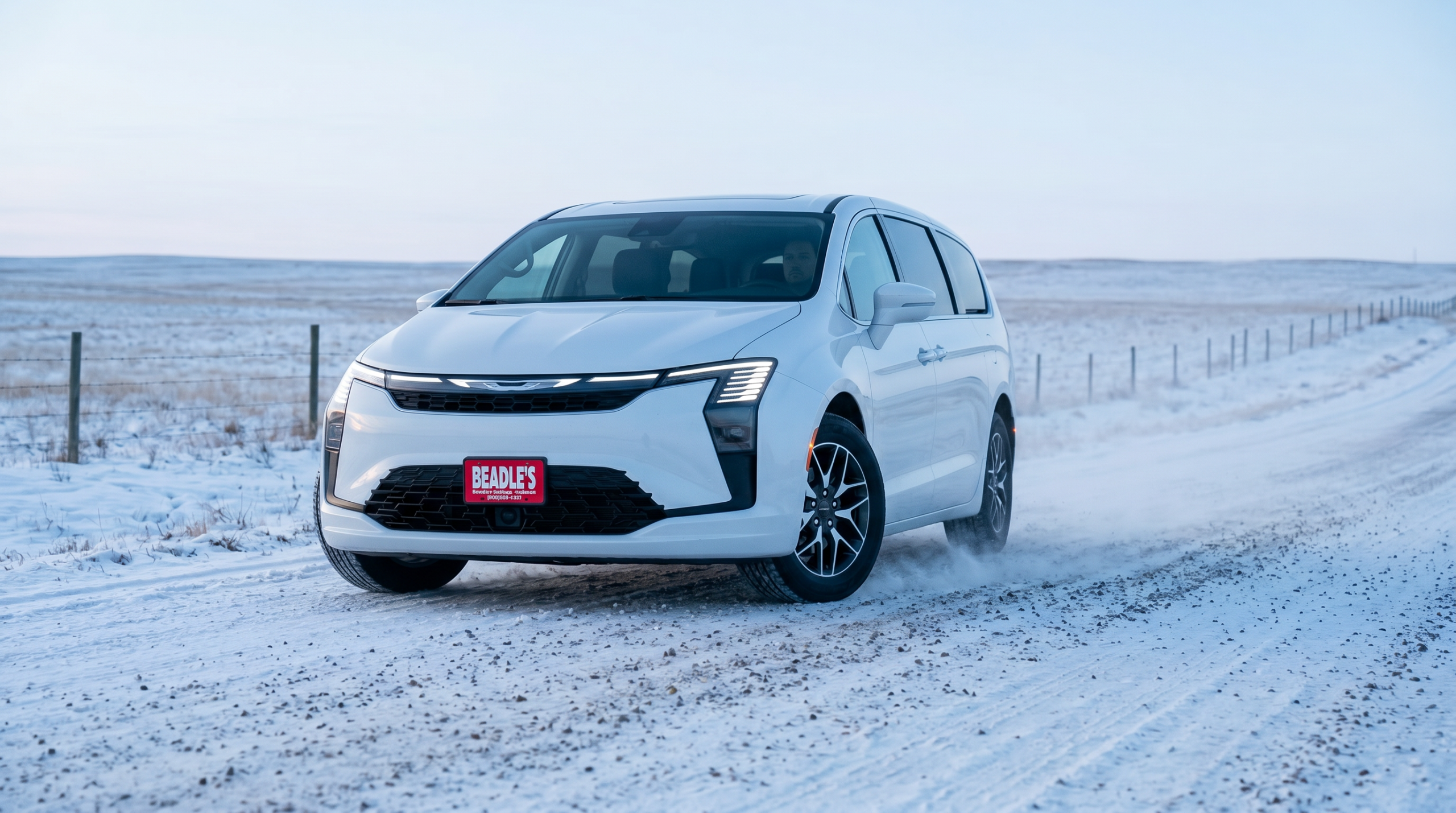
On packed snow, plowed gravel, and icy pavement, that translates into the Pacifica pulling away cleanly and tracking straight instead of spinning a front tire and washing wide. It behaves like a capable all-weather crossover — which, for getting around a Dakota county in winter, is exactly what most families need.
Is an AWD minivan really enough for a South Dakota winter?
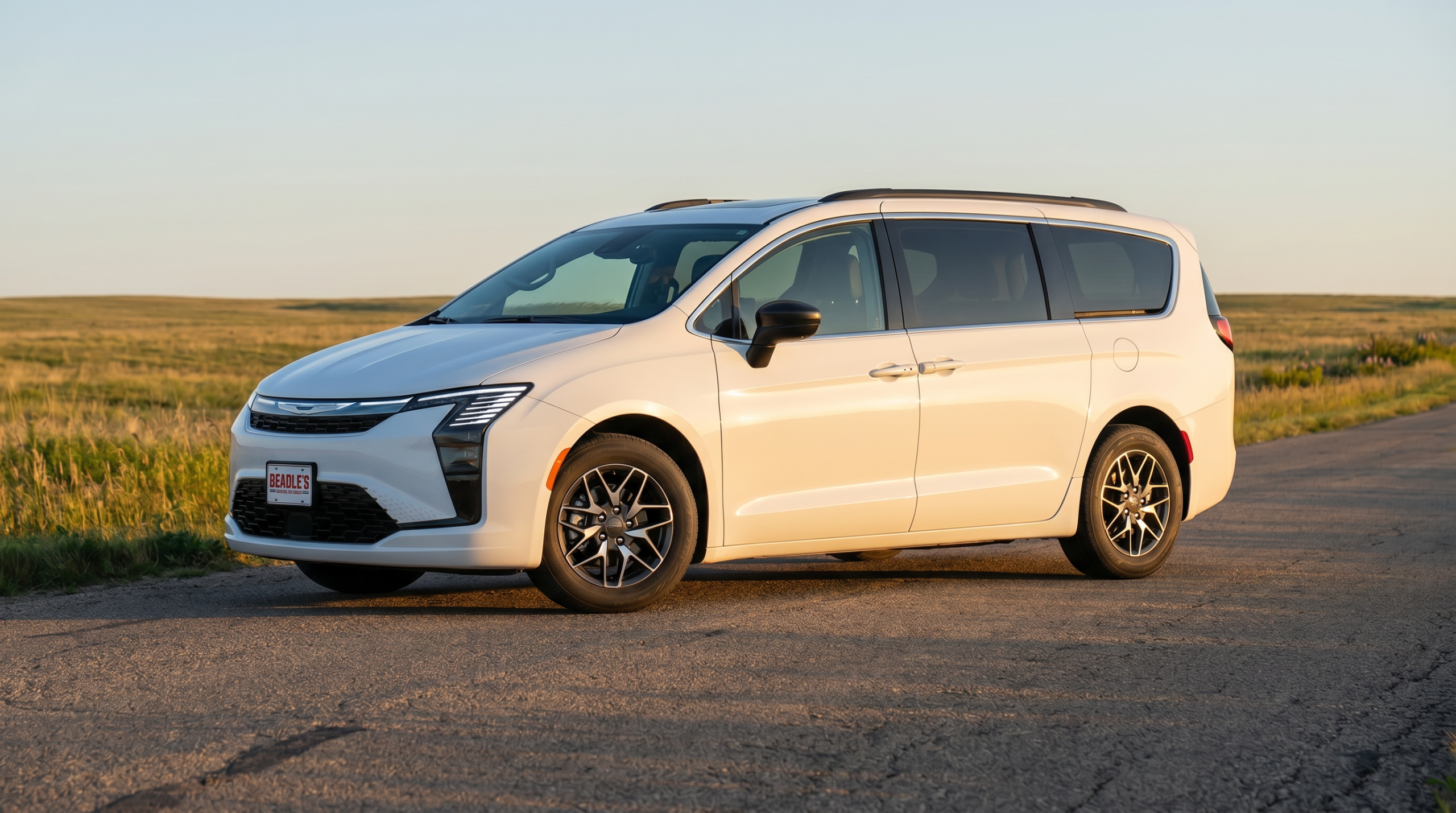
For the vast majority of winter driving out here — commuting, the school run, getting to work on plowed gravel — yes. Where you have to be honest is ground clearance: an AWD Pacifica sits about 5.4 inches off the ground, so it drives like a capable crossover, not a lifted truck.
Translation: traction is rarely the thing that stops a Pacifica in the snow — clearance is. On packed and plowed surfaces it’s confident and sure-footed. In a foot of unplowed drift across a minimum-maintenance road, clearance becomes the limit, just as it would for most crossovers. Knowing that line ahead of time is what keeps you from getting stuck.
From Beadle’s Chrysler Center
The most common conversation we have with winter-minded families is “do I really need AWD or am I fine with front-wheel drive?” Our honest answer: if you regularly drive unplowed gravel before the county gets to it, the AWD is worth it. If you’re mostly on town streets and plowed roads, front-wheel drive with good winter tires gets most people through.
What tires should you run for SD winters?
Tires matter as much as the drivetrain. A set of dedicated winter tires — or quality all-weather tires rated with the three-peak mountain snowflake symbol — will do more for cold-weather grip than almost any other single change, on both FWD and AWD Pacificas.
All-wheel drive helps you get moving; tires are what help you turn and stop on ice. Pair AWD with proper winter rubber and a Pacifica is genuinely composed in the cold. Our service team in Bowdle can mount and store a winter set so the swap each fall and spring is a quick stop, not a project.
AWD vs. FWD with winter tires: which makes sense?
| Consideration | AWD Pacifica | FWD + winter tires |
|---|---|---|
| Getting moving in deep snow | Stronger — power to all four wheels | Good on plowed surfaces |
| Stopping & cornering on ice | Depends on tires | Strong with proper winter tires |
| Upfront cost | About $3,000 (Select and up) | Lower — tire set only |
| Fuel economy | About 17/25 mpg | About 19/28 mpg |
Worth it if: you regularly drive unplowed gravel or rural roads before they’re cleared, or you just want the extra confidence.
Skip it if: you mostly stick to town and plowed routes — a front-wheel-drive Pacifica on good winter tires will handle that well and save you fuel.
How to set up your Pacifica for South Dakota winter driving
A little setup in the fall goes a long way once the snow flies. Here’s the order we’d tackle it.
- Choose the drivetrain honestly: if you drive unplowed gravel, step up to a Select, Limited, or Pinnacle with AWD; if not, front-wheel drive is fine.
- Fit winter or three-peak all-weather tires: this is the single biggest grip upgrade, on any drivetrain.
- Set up remote start: standard on every Pacifica — warm the cabin and start clearing glass before you walk out.
- Keep clearance in mind: avoid plowing into deep unbroken drifts; let the county clear minimum-maintenance roads first.
- Book a fall service check: battery, wipers, washer fluid, and tire mounting in one Bowdle stop.
Key Takeaways
- AWD is available on the 2027 Pacifica Select, Limited, and Pinnacle for about $3,000 — but not on the LX.
- The system is automatic and disconnects to save fuel, so you get traction when you need it and efficiency when you don’t.
- Traction is rarely the limit in a Dakota winter — ground clearance (about 5.4 inches) is, so it drives like a capable crossover.
- Winter or three-peak all-weather tires matter as much as the drivetrain for stopping and cornering on ice.
Frequently Asked Questions
Can I get all-wheel drive on the base Pacifica LX?
No. The LX is front-wheel drive only. All-wheel drive is available starting on the Select, and also on the Limited and Pinnacle, for about $3,000 over the front-drive price.
Do I need to switch the AWD on manually?
No. The Pacifica’s all-wheel drive is automatic. It engages on its own in cold temperatures, on rough or slippery surfaces, and when you turn the wipers on, then disconnects to save fuel when it isn’t needed.
Is a front-wheel-drive Pacifica okay for winter?
For town streets and plowed roads, a front-wheel-drive Pacifica on good winter tires handles South Dakota winters well. If you regularly drive unplowed gravel before it’s cleared, the available AWD is worth the upgrade.
How much does AWD affect the Pacifica’s fuel economy?
An AWD Pacifica is EPA-estimated around 17 mpg city and 25 mpg highway, versus about 19/28 for front-wheel drive. The disconnecting system helps keep that gap modest by shutting off the rear driveline when it isn’t needed.
My Take on the AWD Pacifica in Winter
When a family tells me they’re nervous about a minivan in winter, what they’re really picturing is one specific morning — kids buckled in, snow coming down, a gravel road between them and the highway. I’ve had that conversation a lot, and the AWD Pacifica is the answer that lets people stop worrying about it.
My honest recommendation: if you live off a gravel road or get out ahead of the plow, get the AWD and put a real set of winter tires on it — that combination is hard to beat for a family vehicle out here. If you’re mostly in town, don’t feel you have to spend up; a front-drive Pacifica on good tires will take care of you.
As your local South Dakota Chrysler dealer — and a convenient North Dakota Chrysler dealer for families just across the border — we’re glad to help. If you want the full picture on trims, towing, and tech, take a look at our complete 2027 Chrysler Pacifica guide. And if you’re anywhere near Bowdle, stop by Beadle’s Chrysler Center — we’ll show you the AWD setup in person and talk through what actually fits your winter.
Keep Researching the 2027 Pacifica
Start with the full 2027 Chrysler Pacifica overview for trims, specs, and pricing. Then dig into related questions:
· Which Pacifica trim is right for your family
· What the Pacifica can tow
· Pacifica vs. Sienna, Odyssey & Carnival
Quick Answers
Which trims offer AWD? Select, Limited, and Pinnacle.
Does the LX offer AWD? No — LX is front-wheel drive only.
How much is AWD? About $3,000 over front-wheel drive.
Is the AWD automatic? Yes — it engages and disconnects on its own.
AWD fuel economy? About 17 mpg city / 25 mpg highway (EPA est.).
Ground clearance with AWD? About 5.4 inches.
Best winter upgrade? Winter or three-peak all-weather tires.
Is FWD okay for winter? Yes, on plowed roads with winter tires.
Where can I see one near me? Beadle’s Chrysler Center, Bowdle, SD.
About the Author
Lexy Tabbert — Beadle’s Chrysler Center, Bowdle, SD
Lexy Tabbert is the Director of Sales and Marketing at Beadle’s Chrysler Center in Bowdle, South Dakota. She covers Ram, Jeep, Dodge, and Chrysler vehicles — helping families, ranchers, and ag operators across the region find the right truck and configuration for their needs. Learn more about Lexy.
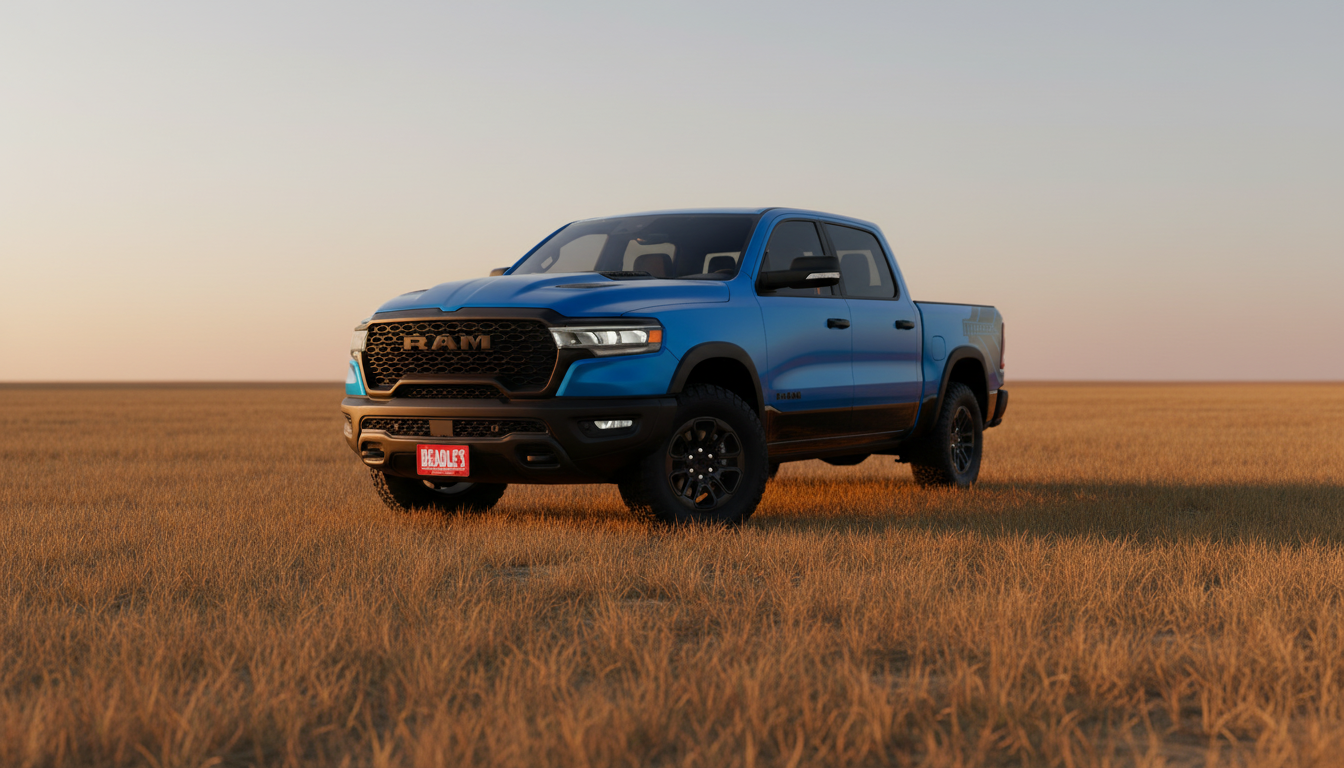
There are three ways a new Ram ends up in your driveway from Beadle’s Chrysler Center: it’s already on our lot when you walk in, it’s coming in on factory allocation in the next few weeks, or you place a custom order and we build it from scratch. Each path makes sense for a different buyer, and knowing which one fits your situation can save you a month of shopping and a lot of compromise.
This guide breaks down all three sourcing paths — what’s actually different about each one, when to choose which, and how Beadle’s allocates inventory across the three so the right truck shows up at the right time for the right customer.
On This Page
- The Three Ways Beadle’s Sources Your New Ram
- Lot Stock: What’s on the Ground Today
- Allocation: What’s Coming in the Next 30 to 90 Days
- Custom Order: A Truck Built to Your Spec
- How Beadle’s Decides What to Stock vs. Order
- Quick Reference: Which Sourcing Path Fits Your Plan?
- How to Pick the Right Sourcing Path
- Frequently Asked Questions
What Are the Three Ways Beadle’s Sources Your New Ram?
Lot stock is the simplest: the truck is physically on our lot in Bowdle right now, you can drive it today, and you take delivery this week. Allocation is the middle path: the truck is built and shipping or scheduled for production, with a known arrival window, and you reserve it before it lands. Custom order is the patient path: we build the truck to your exact spec through the Stellantis configuration system, and you wait roughly 12 weeks for it to come together.
Most metro dealers lean heavily on lot stock because their customer base wants same-week delivery on common configurations. Beadle’s mixes all three because our customer base is split between “I need it now” lot-stock buyers and “I want exactly this” custom-order buyers, with allocation filling the middle of the schedule.
When Does Lot Stock Make the Most Sense?
Lot stock is the right answer when you need a truck this week, you’re flexible on configuration, and what’s on our lot already lines up with your spec. Most popular configurations — Ram 1500 Big Horn or Laramie crew cabs in common colors, Ram 2500 crew cabs with diesel and tow packages, Ram 3500 dually configurations — show up on our lot regularly because we know what our customers buy.
If you walk in with a list of must-haves and we can match it to a truck on the ground, lot stock saves you 4 to 12 weeks compared to the other two paths. Pricing and incentives are applied at purchase, so what you see on the window sticker is what you sign. Trade-in evaluation happens the same day. You drive home in the truck.
Where lot stock falls short is when you need a specific configuration that we don’t currently stock. We can sometimes find it through a dealer trade — a swap with another Stellantis dealer who has your exact build — but that adds days or weeks and isn’t always possible. If the configuration is unusual or the timing’s tight, allocation or custom order is usually the better play.
How Does Factory Allocation Work?
Stellantis allocates new Ram production to dealers based on sales history, market demand, and a complex formula we don’t fully control. We see our incoming allocation in 30-, 60-, and 90-day windows — meaning we know which trucks are scheduled for production and when they’ll land at our lot.
If a customer comes in looking for a configuration that’s not on the lot today but matches an allocation truck coming in 4 to 6 weeks, we can reserve that allocation truck for you. You sign a reservation, lock in pricing at allocation time, and the truck is held for you when it arrives. Pricing on allocation reservations is locked at the date we assign the truck to you, not delivery.
A Note on Allocation Visibility
Allocation visibility goes out about 90 days, so we can usually tell you what’s likely coming. The closer you are to your decision, the more confidently we can match you to a specific incoming truck. If you’re 2 weeks away from a buying decision, allocation is often a stronger play than custom order.
Allocation is best when your spec is common enough that one is already in production for our region — most Ram 1500 configurations, common 2500/3500 builds — but specific enough that we don’t have it on the ground today. It’s a middle path between “settle for what’s here” and “wait 12 weeks for custom.”
Best for / Not ideal for
Best for: buyers with a 4- to 12-week runway whose spec is common enough to be in Stellantis production for our region. Not ideal for: buyers needing a truck this week, or buyers with an unusual spec that production likely won’t pick up — custom order is the cleaner path. Verify what’s actually coming on Stellantis allocation by calling 605-460-6254 with your exact spec.
When Is Custom Order the Right Path?
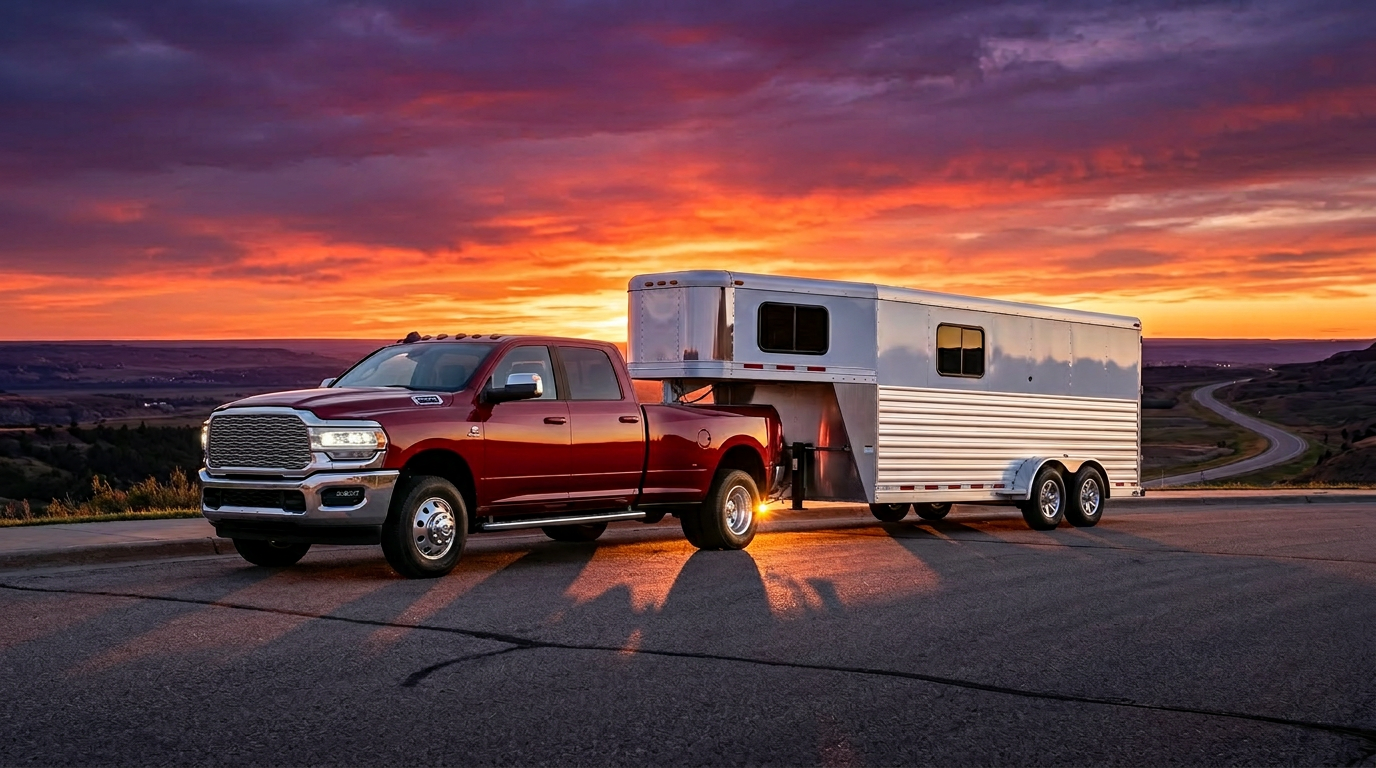
Custom order is the right path when you’ve spec’d out exactly what you want, that spec doesn’t appear in lot stock or allocation, and you’re willing to wait roughly 12 weeks to get it built from scratch. Most custom orders we write are HD configurations with specific package combinations, unusual color and trim pairings, or 1500 builds with options that don’t typically come through allocation.
The order itself is a 60- to 90-minute appointment to build the configuration in the Stellantis system, lock in MSRP, and submit. From there, we send you status updates as the truck moves through order accepted, scheduled, in production, shipped, and ready for pickup. Pricing is locked at MSRP at order time; manufacturer rebates and incentives apply based on what’s available at delivery.
For the full custom-order workflow — including what to decide before you call us, the build window timeline, and what to expect on pickup day — read our complete guide to custom-ordering a new Ram from Beadle’s.
How Does Beadle’s Decide What to Stock vs. Order?
Our lot mix is built around what our customers actually buy, not a generic playbook. The configurations we stock most often are the ones that move quickly enough to justify keeping them on the ground: HD diesel crew cabs with tow packages, Ram 1500 Big Horn and Laramie crew cabs in popular colors, dually 3500s for ag and recreational tow buyers, and a steady rotation of 2500s in working configurations.
For trims and options that don’t move as fast — Tradesman work specs, special editions, low-volume color and option combinations — we lean on allocation and custom order rather than tying up lot inventory in a configuration that takes 90 days to sell.
What most buyers overlook about sourcing
The biggest mistake first-time Ram buyers make is assuming lot stock is always the best deal. For common configurations it usually is, because incentives often hit lot stock harder than custom orders. But for an unusual spec, fighting to find a lot truck that “almost” matches your needs typically costs more in compromises than the 4 to 12 weeks of waiting for allocation or custom would have. The right question isn’t “what’s in stock?” — it’s “which path fits my actual spec and timeline?”
Which Sourcing Path Fits Your Plan?
| Consideration | Lot Stock | Allocation | Custom Order |
|---|---|---|---|
| Time to truck | Same week | 4 to 12 weeks | ~12 weeks |
| Configuration match | What’s here | Common builds in production | Exactly your spec |
| Price lock timing | At purchase | At allocation reservation | At order submission |
| Incentive timing | At purchase | At delivery | At delivery |
| Best fit | Common configs, tight timeline | Common spec, 4-12 week runway | Specific spec, patient buyer |
Best for lot stock: buyers who need a truck this week and don’t mind picking from what’s here.
Best for allocation: buyers with a 4- to 12-week runway who want a common configuration without compromise.
Best for custom: buyers who know exactly what they want and won’t settle for “close enough.”
How to Pick the Right Sourcing Path for Your Ram
Picking the right sourcing path is mostly about answering three questions honestly. Here’s the order to work through them.
- Define your spec: Model, trim, cab, bed, engine, drivetrain, color, packages. The more specific, the easier each subsequent step gets.
- Set your timeline: This week, this month, in 4 to 6 weeks, in 3 months. Be honest with yourself — and with us — about when you actually need the truck.
- Call us: 605-460-6254. Tell us your spec and your timeline and we’ll match you to the right path. If we have it on the lot, we’ll tell you. If a 6-week allocation truck matches, we’ll tell you. If only custom works, we’ll tell you that too.
- Walk through the path: Lot stock means a same-day appointment. Allocation means a reservation paperwork sit-down. Custom means a 60-90 minute order appointment.
- Track the truck (if applicable): For allocation and custom, we send updates as your truck moves through the build and shipping stages. For lot stock, we just hand you the keys.
Key Takeaways
- Beadle’s sources new Rams three ways: lot stock (same-week), factory allocation (4 to 12 weeks), and custom order (~12 weeks).
- Lot stock is best for common configurations and tight timelines; allocation is best when your spec is common but not on the ground today; custom is best for specific builds you won’t compromise on.
- Pricing locks at different times for each path: lot stock at purchase, allocation at reservation, custom at order submission. Incentives apply at delivery for allocation and custom.
- Our lot mix leans heavily on configurations our customers actually buy: HD diesel crew cabs, popular Ram 1500 trims, dually 3500s, working 2500s.
Frequently Asked Questions
What’s the difference between lot stock, allocation, and custom order?
Lot stock is on the ground at Beadle’s right now and you can drive it home this week. Allocation is a truck Stellantis is building or shipping for our region — you reserve it 4 to 12 weeks before delivery. Custom order is a truck we build to your exact spec from scratch, with a roughly 12-week timeline from order to pickup.
How far ahead can Beadle’s see incoming Ram allocation?
We have visibility into Stellantis allocation about 90 days out. The closer the truck is to delivery, the more confidently we can match you to a specific incoming unit. Call us with your spec and we’ll tell you what’s coming and when.
Can I reserve an allocation truck before it arrives?
Yes. If we have an allocation truck coming that matches your spec, we can reserve it for you with a paperwork sit-down. Pricing locks at allocation reservation, the truck is held for you when it arrives, and you take delivery the day it lands at our lot.
Is lot stock always the best deal?
Not always. Lot stock often gets the strongest current incentives, which makes it a great deal for common configurations. But if your spec doesn’t match anything on the lot, fighting to find a “close enough” truck typically costs more in compromise than waiting for allocation or custom would. Match the path to your spec, not the other way around.
Can I do a dealer trade if Beadle’s doesn’t have my spec on the lot?
Sometimes. Dealer trades work when another Stellantis dealer has your exact spec and is willing to swap. They add days or weeks to the timeline and aren’t always possible. We’re happy to look — but for unusual specs, allocation or custom is usually the cleaner path.
Do incentives differ between sourcing paths?
Manufacturer rebates and incentives are applied at the time of delivery, regardless of sourcing path. For lot stock, that’s the day you sign. For allocation and custom, that’s the day your truck arrives at our lot. We track every stackable rebate you qualify for and apply them at delivery.
My Take on Choosing the Right Sourcing Path
The single most useful conversation I have with new Ram buyers is the sourcing-path conversation — usually 10 minutes on the phone, sometimes less. We talk through your spec, your timeline, and your appetite for waiting versus your willingness to compromise. By the end, you know whether you’re a lot-stock buyer, an allocation buyer, or a custom-order buyer, and we both know what the next step looks like.
For ag operators who already know their spec — Cummins crew cab with a specific tow package — we usually find allocation works best. The build is common enough to be in production for our region but specific enough that we don’t always have it on the lot. For families shopping for a 1500, lot stock often wins because the popular trims rotate through quickly. For unusual specs and patient buyers, custom is the cleanest answer.
If you’d like the broader picture of buying a new Ram from Beadle’s — including custom orders in detail, what’s currently in stock, and how cross-state buying works — read our complete guide to new Ram trucks for sale in South Dakota. And if you’re ready for the sourcing conversation, give us a jingle at 605-460-6254.
About the Author
Lexy Tabbert — Beadle’s Chrysler Center, Bowdle, SD
Lexy Tabbert is the Director of Sales and Marketing at Beadle’s Chrysler Center in Bowdle, South Dakota. She covers Ram, Jeep, Dodge, and Chrysler vehicles — helping families, ranchers, and ag operators across the region find the right truck and configuration for their needs. Learn more about Lexy.
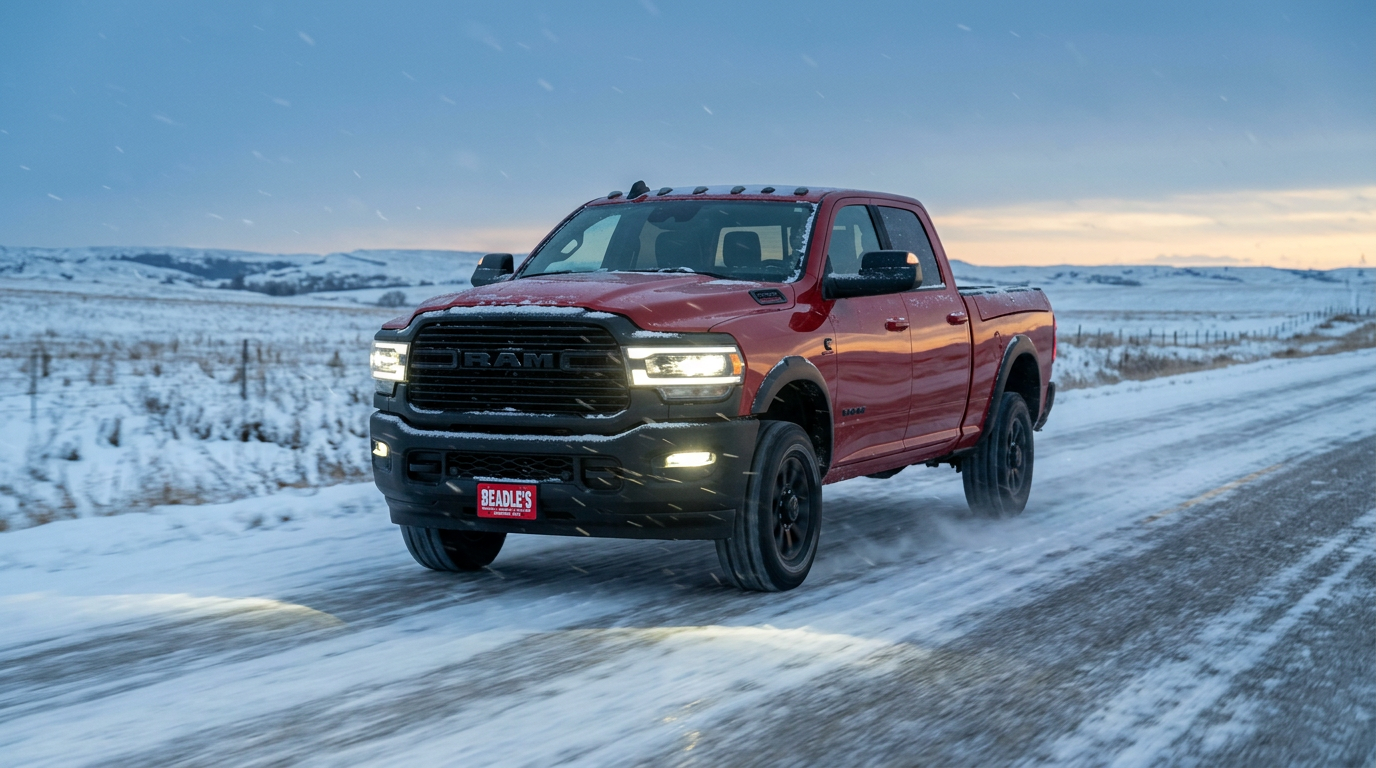
A new Ram delivered in October isn’t the same vehicle the day after it arrived from the factory as the day you drive it home from Beadle’s. Between those two days, our service bay puts every truck through a cold-weather prep checklist designed for South Dakota winter — block heater hookups verified, fluids checked at our regional temperature norms, batteries tested for sub-zero starts, and 4WD systems cycled on the lot before you ever turn the key.
This guide walks through what Beadle’s actually does to every new Ram before delivery in cold-weather months — what’s standard pre-delivery work, what we add for SD conditions, and the small handful of things you can check yourself in the first week to make sure your truck is winter-ready when the temperature drops.
On This Page
- The Beadle’s Cold-Weather Pre-Delivery Routine
- Block Heater and Cold-Start Systems
- Cold-Weather Fluids and Battery Check
- 4WD/AWD System Verification on the Lot
- Tire Pressure for South Dakota Cold Snaps
- The Cold-Weather Feature Orientation at Pickup
- Quick Reference: What’s Done For You vs. What to Check
- How to Verify Your New Ram Is Winter-Ready
- Frequently Asked Questions
What Does Beadle’s Do to Every New Ram Before Delivery in Winter?
Every new Ram that comes off the truck onto our lot goes through pre-delivery inspection (PDI) before a customer takes it home. In cold-weather months — typically late October through early April in our part of South Dakota — that PDI includes a regional cold-weather layer on top of the standard Stellantis-required checks.
The cold-weather work is the result of decades of selling Rams in a state where -20°F overnight isn’t unusual and a stuck block heater plug or a weak battery can ruin a calving morning. Most of it is invisible to the customer — the truck just starts when you turn the key — but it’s the difference between “it ran fine in the showroom” and “it runs fine at 5:00 a.m. with a 25 mph north wind.”
How Does Beadle’s Verify the Block Heater System?
Most new Rams sold in our region come with a block heater factory-installed (and on diesel HDs it’s standard equipment). We verify three things before delivery: the cord is in the engine bay where it’s supposed to be (not stuck behind a dust cap), the cord routes cleanly to a usable plug-in spot, and the heater itself draws current when plugged in.
If the cord is missing or the heater doesn’t draw, we fix it before you take delivery. We’ve seen factory cords get tucked away during transit and the customer not find them for two months — by which point a -10°F cold start has already happened.
For Cummins diesel HDs especially, we walk the cord to a customer-accessible spot and tag it with a small flag so it’s not buried under the front grille on day one.
Best for / Less critical for
Best for: SD, ND, MT, and northern MN buyers where overnight lows below 0°F happen most winters. Less critical for: buyers in milder microclimates or southern states — the heater still helps, but the cold-start risk is lower so the verification matters less.
What Cold-Weather Fluid and Battery Checks Are Done?
Coolant mix is verified to the cold-rated ratio for our climate, washer fluid is replaced with the cold-temperature blend (the factory often ships with mild-climate washer fluid), and on diesel trucks the DEF system is verified along with the fuel filter status.
The battery gets a load test, not just a voltage read. A new battery from the factory can show 12.6V on a multimeter and still fail at -15°F if the cold-cranking amps are under spec. If the battery doesn’t load-test clean, we replace it before delivery — every time, regardless of the calendar.
Engine oil is checked at the level marked by Stellantis for our region’s operating temperatures. For diesels we verify the fuel filter is clean and that the truck has cold-weather diesel (not summer blend) in the tank if the dealer next to the factory shipped it on summer fuel.
Does Beadle’s Test the 4WD System Before Delivery?
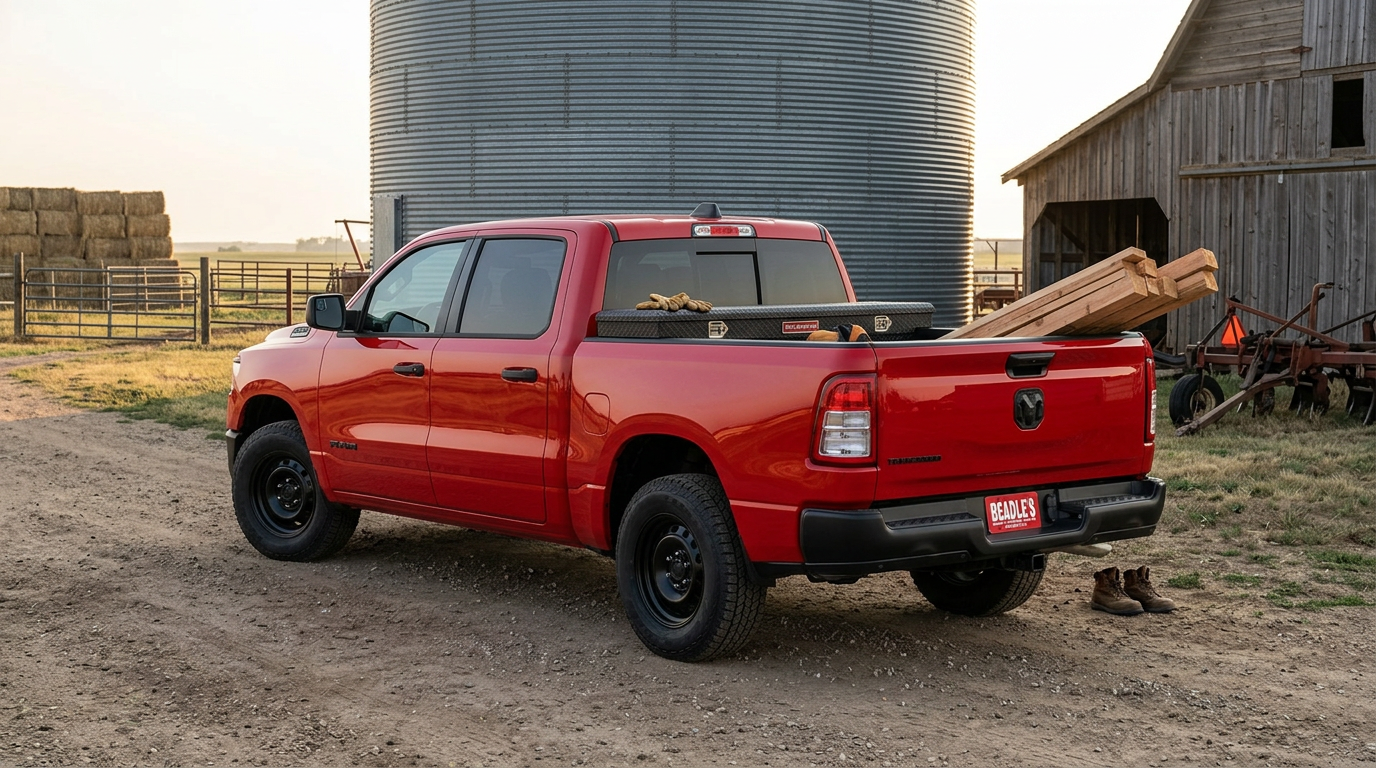
Yes — every 4WD/4×4 Ram on our lot gets the transfer case cycled through 2H, 4H, 4L, and Auto modes (where applicable) on the lot before delivery. We listen for the engagement, watch for the dash indicator, and confirm the front axle locks and unlocks as it should. A factory-fresh 4WD system can be electrically right but mechanically stuck if a truck has been sitting since assembly without being cycled.
For Power Wagon and Rebel buyers, we cycle the locking differentials and the disconnecting front sway bar through their full operating range too. If anything feels off, the truck doesn’t go to delivery — we get the repair done first.
How Does Beadle’s Set Tire Pressure for South Dakota Winter?
Tire pressure changes by about 1 PSI for every 10°F change in temperature. A truck shipped from a 70°F factory and delivered into a 10°F cold snap can show a TPMS warning the first morning out — even though nothing is actually wrong with the tire.
We set tire pressure to the manufacturer-recommended level for the loaded condition you’ll be driving (which we ask about during the pickup walk-around). For most customers that’s the door-jamb spec, adjusted for the ambient temperature on delivery day.
A Practical Note on Winter TPMS
If your TPMS light comes on the first cold morning after pickup, it’s almost always temperature-related, not a leak. Check pressure at the door-jamb spec on a cold tire (before driving) and add air if needed. If the warning persists after re-inflation, bring it back to us.
What Cold-Weather Features Get Walked Through at Pickup?
If your truck has remote start, heated seats, heated steering wheel, heated mirrors, defrost cycles, or auxiliary cab heat (on the diesels), we walk through how to use each one before you leave the lot. UConnect’s settings menu has options buried two and three menus deep — figuring them out at -15°F in your driveway isn’t fun.
For Power Wagon and Rebel, we walk through the off-road cold-weather differences too: where the heated grip warmers are routed, how the locking diff behaves below freezing, and what the driver-selectable terrain modes do to throttle and traction settings in icy conditions.
What most cold-weather buyers overlook
The cold-weather feature most often missed at pickup is the remote-start runtime setting. The factory default is usually 10 minutes — fine for southern-state weather, sometimes too short for SD mornings when you want the cabin warm and the windshield clear. We can set it to the longer runtime in UConnect during your pickup walk-around if you ask.
Quick Reference: What’s Done for You vs. What to Check
| Item | Beadle’s Handles It | You Should Check |
|---|---|---|
| Block heater function | Yes — verified before delivery | Plug it in the night of your first hard freeze |
| Battery cold-cranking | Load tested at PDI | Note any slow-crank symptoms early |
| Coolant mix | Verified for cold-rated ratio | No action needed |
| Washer fluid blend | Replaced with cold-temp blend | Top off as needed |
| 4WD engagement | Cycled on the lot | Engage briefly during your first cold week |
| Tire pressure | Set at delivery for current temp | Re-check on the first hard cold snap |
| Remote-start runtime | Set to your preference at pickup | Adjust through UConnect anytime |
Best for: any new Ram buyer in the SD/ND/MT region taking delivery between October and April.
Not strictly needed for: trucks delivered between May and September, when most cold-weather work isn’t seasonally relevant — though we still verify the systems for the next winter.
How to Verify Your New Ram Is Winter-Ready in the First Week
Most of the cold-weather prep happens at our shop, but six quick checks in your first week confirm everything is dialed in for your specific use case and home temperatures.
- Locate the block heater cord: It should be tagged or visible in the engine bay. If you can’t find it, call us at 605-460-6254.
- Plug in before the first hard freeze: A 4-hour pre-warm before a cold start is enough on most modern Rams; longer doesn’t hurt.
- Verify remote start works: Test from inside before the first sub-zero morning. Confirm runtime is set to your preference.
- Cycle 4WD or Auto mode briefly: Engage and disengage on a clear road to confirm the system is awake.
- Check tire pressure on a cold tire: First thing in the morning, before driving. Compare to the door-jamb spec.
- Test heated seats and steering wheel: Run them up to high once to confirm operation. Verify defrost works on the windshield and rear glass.
Key Takeaways
- Beadle’s pre-delivery inspection includes a regional cold-weather layer on top of standard Stellantis-required checks for trucks delivered between October and April.
- Block heater function, cold-rated coolant, cold-temp washer fluid, and battery load test are all verified before customer pickup — not assumed.
- 4WD/4×4 systems are cycled on our lot before delivery; locking diffs and disconnecting sway bars on Power Wagon and Rebel get the same treatment.
- Tire pressure is set at delivery for the current temperature; expect a TPMS warning on your first hard cold snap that’s almost always temperature, not a leak.
Frequently Asked Questions
Does my new Ram come with a block heater?
Most new Rams sold in the Northern Plains region come with a block heater factory-installed; on Cummins diesel HDs it’s standard equipment. We verify the cord is present and the heater draws current at our pre-delivery inspection. Confirm with your salesperson during the order or build conversation if you want it called out specifically.
How long should I plug in the block heater before a cold start?
A 4-hour pre-warm is enough for most modern Rams in temperatures down to about -20°F. Below that, longer is better — overnight on a thermostatic timer is a clean solution if you have one available. Plugging in indefinitely doesn’t damage the truck.
Why does my TPMS light come on after the first cold morning?
Tire pressure drops about 1 PSI for every 10°F temperature drop. A truck delivered at 30°F and parked overnight at -10°F can drop 4 PSI through no fault of the tire. Check pressure on a cold tire (before driving) and re-inflate to the door-jamb spec. The light usually clears after a short drive.
Does Beadle’s swap the washer fluid for cold weather?
Yes. Factory washer fluid is often a mild-climate blend that can freeze in our temperatures. We replace it with cold-temp blend during PDI for trucks delivered in the cold-weather window. Top-offs are on you for the rest of winter.
Can I adjust remote-start runtime myself?
Yes — UConnect’s settings menu has remote-start runtime adjustment buried a couple of menus deep. We can set it for you during the pickup walk-around if you tell us your preference. Default is usually 10 minutes; longer is available for cold mornings.
If my truck doesn’t start in the cold, what should I do first?
If your truck is under warranty and won’t crank or starts roughly in cold weather, call our service department at 605-460-6277. Don’t repeatedly attempt cold starts that drain the battery. We’d rather diagnose and fix it under warranty than have you fight it through a winter morning.
My Take on Cold-Weather Prep at Beadle’s
In a state where -20°F mornings happen every winter and a no-start day can mean missed cattle work or a kid stuck at school, the cold-weather prep on a new truck isn’t a sales feature — it’s just doing the job right. Our service team has been refining this checklist for decades because the customers who buy trucks here actually use them, often hard, in conditions the factory PDI checklist doesn’t fully account for.
Most of what we do happens before a customer ever sees the truck — block heater verification, battery load test, coolant ratio check, washer fluid swap, 4WD cycle. The customer-visible piece is the pickup walk-through, where we slow down and make sure you actually know how to use the cold-weather features your truck has. Take that 15 minutes seriously. It’s the difference between figuring out remote start in your driveway at 5:00 a.m. and having it ready to go.
If you’d like to see the full picture of buying a new Ram from Beadle’s — including custom orders, allocation, and what’s on the lot — read our complete guide to new Ram trucks for sale in South Dakota. And if you’re picking up a truck this fall and want to confirm what we’re prepping, give us a jingle at 605-460-6254.
About the Author
Lexy Tabbert — Beadle’s Chrysler Center, Bowdle, SD
Lexy Tabbert is the Director of Sales and Marketing at Beadle’s Chrysler Center in Bowdle, South Dakota. She covers Ram, Jeep, Dodge, and Chrysler vehicles — helping families, ranchers, and ag operators across the region find the right truck and configuration for their needs. Learn more about Lexy.
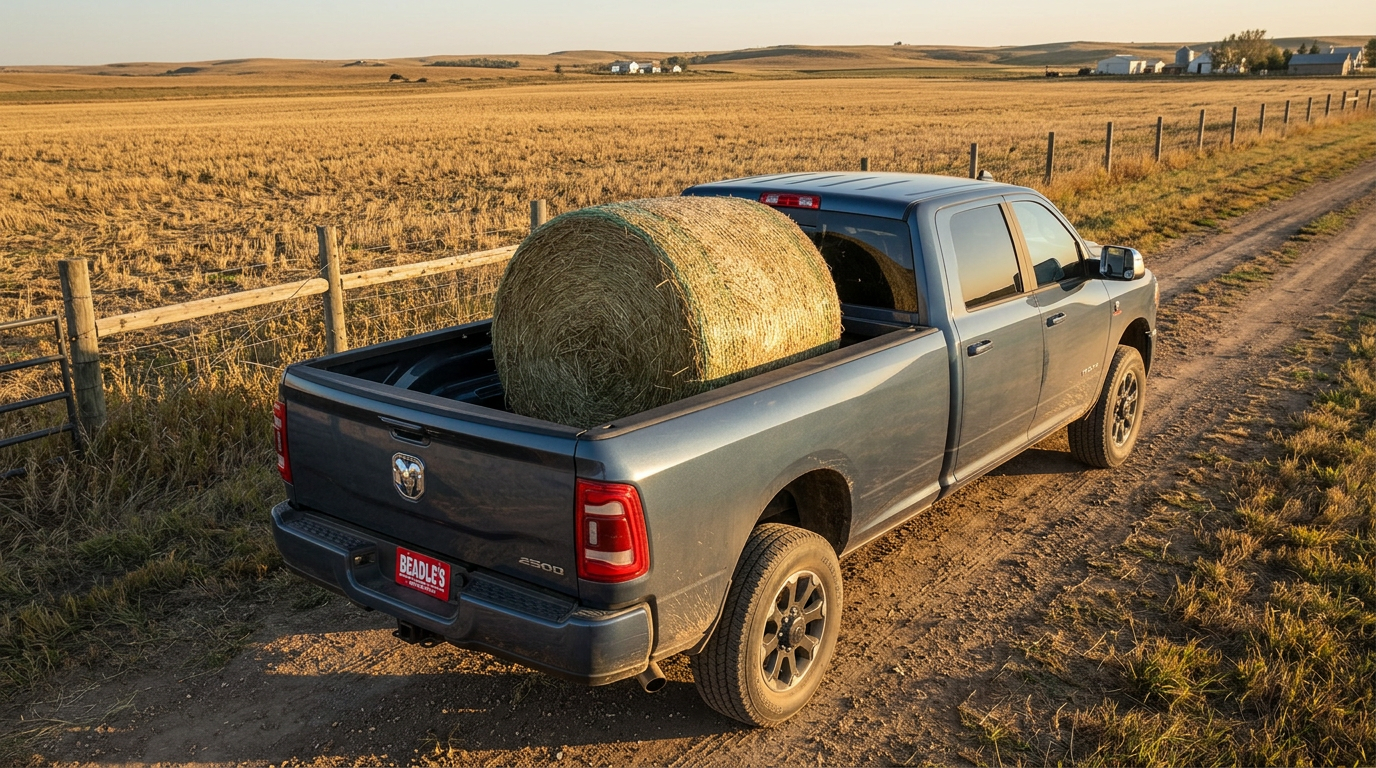
Drive to Bowdle from Fargo and you’ll pass several Ram dealers along the way. Drive in from Bismarck and there are dealers in your own metro selling the same trucks Beadle’s does. So why do ranchers, ag operators, and truck-buying families across the Northern Plains keep choosing the long drive to Beadle’s Chrysler Center over the closer option?
After 50+ years of family-owned business in Bowdle, the answer is more practical than sentimental. This guide unpacks what cross-border buyers actually mean when they say “Beadle’s was worth the drive” — what’s different about the inventory, the buying experience, the service after the sale, and the way Beadle’s handles cross-state paperwork that closer dealers either don’t or won’t.
On This Page
- The Pattern: Driving Past Closer Dealers
- Why the Inventory Mix Looks Different at Beadle’s
- What “Small-Town Buying Experience” Actually Means
- The Service Bay Most Customers Don’t Talk About Until They Need It
- How Beadle’s Handles Cross-State Paperwork
- When the Drive Is Worth It (and When It Isn’t)
- How to Decide If Beadle’s Is Right for Your Situation
- Frequently Asked Questions
Why Do Northern Plains Ranchers Drive Past Closer Dealers to Buy from Beadle’s?
The pattern shows up most clearly in our Fargo customers. Fargo is a 5-hour drive from Bowdle, and there are a dozen Ram dealers in the Fargo metro alone. The Fargo customers who make the trip aren’t doing it because they couldn’t find a Ram closer — they’re doing it because they couldn’t find the right Ram, the right deal, or the right buying experience closer.
The same story plays out from Bismarck (~2.5 hours), Mandan (~2.5 hours), Jamestown (~2.5 hours), and the eastern Montana side. Most of these buyers came to us once because someone they trust told them to, and they came back because the experience held up.
Three things drive the pattern more than anything else: a different inventory mix on a small-town northern-plains lot, a different buying culture (small-town directness, no high-pressure tactics), and a service relationship that treats the truck as the start of the relationship rather than the end of the transaction.
What’s Different About Beadle’s Ram Inventory?
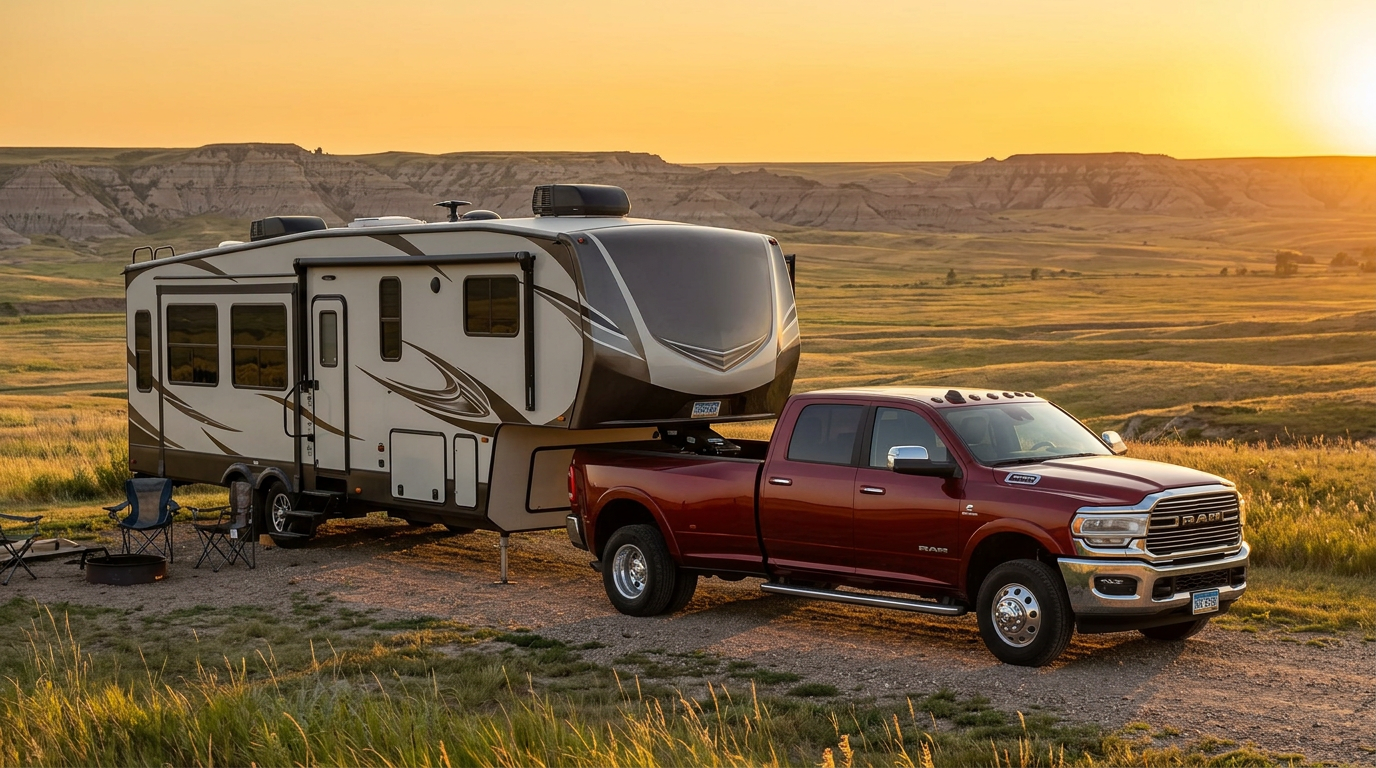
A small-town northern-plains Ram dealer stocks differently than a metro dealer. Our lot leans heavier on heavy-duty: more 2500s and 3500s, more Cummins-diesel crew cabs, more crew cabs with serious tow packages, more dually configurations. That’s because that’s what most of our customers actually buy — ranchers, farmers, ag operators, oil-and-gas tradesmen, and HD-towing recreational families.
Metro dealers tend to allocate heavier toward 1500s with comfort packages because that’s what their commuter and family-fleet markets buy. Both lots are right for their markets. The difference is what you find when you walk in: at Beadle’s, the truck you came looking for is more likely already on the lot or already inbound.
For working-ag buyers especially, the time saved by walking onto a lot that already stocks the configuration you need — instead of waiting on a trade or a dealer search — is often a bigger factor than the drive distance.
Best for / Not ideal for
Best for: buyers shopping for HD diesel, dually, or specific tow-package builds that don’t always show up on a metro lot. Not ideal for: buyers who want a stripped-down 1500 work truck commodity-priced and on the lot today — those configurations are usually quicker-turn at metro stores. Verify your specific configuration is in stock by calling 605-460-6254 before you make the drive.
What Does the “Small-Town Buying Experience” Actually Mean?
“Small-town” is one of those phrases that’s overused in marketing copy. Here’s what it actually looks like in practice at Beadle’s: the same person who answered your first phone call is the person you’ll sit down with on the lot. The trade walk-around isn’t handed off to a separate manager. The number you’re quoted is the number you pay. The pickup-day appointment doesn’t include a four-hour upsell loop.
“Give us a jingle and we’ll make a plan” isn’t a slogan we put on a sign. It’s how we run the calendar. We don’t have a dozen deal-flow specialists each working a different segment of your purchase. We have salespeople and service writers who know the inventory, know the customers, and know each other’s pricing.
That’s the part Fargo and Bismarck customers most often mention when they explain the drive. Not the drive itself — the absence of high-pressure tactics, surprise fees, or a 90-minute closing-table dance once they’ve decided.
What’s the Service Relationship Like After You Buy from Beadle’s?
A good number of Beadle’s customers tell us the service relationship is what kept them coming back, even more than the original purchase. Our service department does Mopar oil changes, recall work, warranty repairs, and HD diesel work in-house in Bowdle. For routine maintenance between Bowdle visits, most cross-border buyers use a local Mopar service in their home town and bring the truck back to us for major work or warranty items.
When you call our service department, you’re talking to the same writers who’ve been here for years. They remember who you are, what you bought, and what you’ve had done. That’s a small thing on paper and a real thing in practice — when something goes sideways at 6:00 a.m. on a branding morning, the difference between “let me look up your VIN” and “what’s going on with the 3500 you got from us last spring” is most of the experience.
What most cross-border buyers overlook
The piece that surprises most first-time Beadle’s buyers isn’t the buying experience — it’s how much easier the service relationship is over the long run when the dealer who sold you the truck is the same dealer who handles its warranty work. Customers who switch to us from a metro dealer tell us the difference shows up the first time they need a recall handled or a warranty claim escalated.
How Does Beadle’s Handle Cross-State Buyers Differently?
Closer-to-the-border ND, MT, MN, and IA buyers pick us because we treat cross-state purchases as routine, not as a special case. Beadle’s does not collect sales tax from out-of-state buyers — you pay your motor vehicle excise tax to your home state’s DMV when you register. Title work is paperwork we handle on our side and submit to South Dakota; you transfer in your home state at registration.
For trades, we handle title transfer paperwork between states ourselves. For financing, we work with a wide range of in-state and cross-border lenders, including most major ND banks and credit unions. Cross-state delivery is offered case by case, mostly at our expense for the right deal.
Most metro dealers in border markets handle cross-state purchases too, but they don’t structure their process around it the way we do. The smaller the dealer’s cross-state customer base, the more “special case” each one becomes. Ours is normal Tuesday paperwork.
When Is the Drive to Beadle’s Worth It?
| Buyer Situation | Beadle’s Worth the Drive? |
|---|---|
| HD diesel build, working ag | Yes — our inventory mix favors this |
| Cross-state buyer (ND, MT, MN, IA) | Yes — tax handling and routine cross-border process |
| Specific custom order spec | Yes — order through us, pickup in Bowdle |
| Looking for the buying experience | Yes — small-town, no-pressure, family-owned |
| Need a truck this week | Maybe — call us first to confirm we have your config in stock |
| All warranty service must be local | Less ideal — plan around major-work trips to Bowdle |
Best for: buyers who already know what they want, value a small-town experience, and don’t mind planning major service trips.
Not ideal for: buyers who need same-week walk-in inventory in a specific configuration without calling ahead, or buyers who want all warranty work handled in their home metro.
How to Decide If Beadle’s Is Right for Your Situation
A 30-minute phone call usually settles whether the drive to Bowdle is worth it for you. Here’s how to make that call productive.
- List your spec: Model, trim, cab, bed, engine, drivetrain, color, packages. The more specific you are, the faster we can tell you what we have or what we can get.
- Set your timeline: Need it this week, this month, in 3 months, or by branding season? That tells us whether you’re a lot-stock buyer, an allocation buyer, or a custom-order buyer.
- Decide your trade and finance plan: Have a trade with a payoff? Pre-qualified with a lender? Cash? Each one changes the conversation.
- Call us: 605-460-6254 reaches our sales team. Tell us your spec, your timeline, your trade, and your plan. We’ll give you a straight answer about whether we’re the right fit.
- If we’re the right fit: We’ll book your appointment, give you a pre-trip ballpark, and confirm what to bring. If we’re not the right fit, we’ll tell you that too.
Key Takeaways
- Northern Plains buyers drive to Beadle’s mainly for inventory mix, small-town buying experience, service relationship, and cross-state paperwork handling.
- The lot leans heavier on HD diesel, dually, and crew-cab tow-package builds than most metro dealers — that’s our customer base.
- The same person you call first is the person you sit down with — no deal-flow handoffs.
- Cross-state purchases are routine, not a special case — tax, title, plates, and lender payoffs are all part of normal weekly paperwork.
Frequently Asked Questions
How long has Beadle’s been in business?
Beadle’s Chrysler Center has been family-owned in Bowdle, South Dakota since 1975 — over 50 years of selling and servicing Ram, Jeep, Dodge, and Chrysler vehicles for customers across the Northern Plains.
Why do Fargo customers drive 5 hours to Beadle’s?
Fargo customers tell us the drive is worth it because the inventory mix is different on a northern-plains lot, the buying experience is direct and unpressured, and the service relationship is more personal. Most Fargo buyers came to us first because someone they trust pointed them our direction, and they came back because the experience matched what they were promised.
What kind of inventory does Beadle’s typically stock?
Our lot leans heavier on HD trucks (Ram 2500 and 3500), Cummins-diesel crew cabs, and trucks built for serious towing and ag work. We also stock Ram 1500s with comfort and tow packages, and Jeep, Dodge, and Chrysler vehicles. The mix reflects what our customers actually buy: mostly working-ag and recreational tow buyers across the Northern Plains.
Does Beadle’s service trucks bought somewhere else?
Yes. Our certified service department works on Ram, Jeep, Dodge, and Chrysler vehicles regardless of where they were purchased — including warranty work, recalls, scheduled maintenance, and Mopar parts. Cross-border customers often use a local Mopar service for routine maintenance and bring the truck back to us for major work.
Is Beadle’s only for ranchers and ag operators?
No. We sell to families, recreational tow buyers, oil-and-gas tradesmen, government and fleet customers, and first-time truck buyers as well. The HD-heavy inventory reflects what our customer base buys most often, but a meaningful share of our 1500 sales are family and daily-driver buyers.
How is the buying experience different from a metro dealer?
The biggest practical differences customers mention: no deal-flow handoff between salespeople, no high-pressure closing tactics, no surprise fees, and no four-hour delivery loop. The same person you call first is the person you finalize paperwork with at pickup. That’s the small-town experience our customers come back for.
My Take on Why Customers Drive Past Closer Dealers
The thing I hear most often from a new Fargo or Bismarck customer is some version of “my neighbor told me to come here.” That’s the only way a small-town dealer in Bowdle ends up with a regular flow of customers from cities five hours away. The reputation has to hold up, deal after deal, year after year, or that pipeline dries up fast.
For our customers, “worth the drive” usually comes down to one of three things: they couldn’t find the configuration they wanted closer; they got tired of the sales process at metro dealers; or they wanted a service relationship that would still be there when something went sideways years after the purchase. We try to deliver on all three.
If you’d like the broader picture of buying a new Ram from Beadle’s — including custom orders, allocation, and what’s on the lot today — read our complete guide to new Ram trucks for sale in South Dakota. If you’re already thinking about the drive and want to compare notes, give us a jingle at 605-460-6254 and we’ll be straight with you about whether the trip is worth it for your situation.
About the Author
Lexy Tabbert — Beadle’s Chrysler Center, Bowdle, SD
Lexy Tabbert is the Director of Sales and Marketing at Beadle’s Chrysler Center in Bowdle, South Dakota. She covers Ram, Jeep, Dodge, and Chrysler vehicles — helping families, ranchers, and ag operators across the region find the right truck and configuration for their needs. Learn more about Lexy.
If the Ram you actually want isn’t sitting on a lot anywhere within driving distance — wrong color, wrong cab, wrong trim, missing the option you need — custom ordering through Beadle’s Chrysler Center is the cleanest way to end up with the truck you actually pictured. Roughly 12 weeks from order placement to your keys in Bowdle, no settling for “close enough.”
This guide walks through the whole Beadle’s custom order process: the decisions to nail down before you call us, how the order itself works, what’s locked in versus what can shift during the build, and what to expect on pickup day at our lot in Bowdle.
On This Page
- When Custom Order Is the Right Call
- What to Decide Before You Call Us
- The Custom Order Process at Beadle’s
- The 12-Week Build Window
- How Pricing Works on a Custom Order
- Pickup Day at Beadle’s
- Custom Order vs. Lot Stock: Which Fits Your Plan?
- How to Place a Custom Order with Beadle’s
- Frequently Asked Questions
When Is Custom Ordering the Right Call?
Custom order makes sense when you’ve already decided exactly what you want and you can’t find that combination on a lot — wrong cab length, wrong bed, wrong drivetrain, missing a tow package, missing a specific paint code, or you just don’t want to compromise on the build.
If you’re flexible on configuration and just need a Ram on the next 30 days, lot stock is faster. If you want a specific build and you’re willing to wait, custom is the cleaner answer than chasing trades or waiting for the perfect allocation truck to land.
Best for / Not ideal for
Best for: buyers who already know their exact spec, won’t compromise on color or options, and have 12 weeks of runway. Not ideal for: buyers on a tight deadline, buyers who haven’t decided between trims yet, or buyers who’d rather see and test the truck before committing.
What Should You Decide Before You Call Us?
A custom order conversation goes faster — and ends in a tighter build — when you’ve already nailed down the major decisions on your end. Here’s what we’ll need to know on the first call.
| Decision | What to Bring |
|---|---|
| Model and trim | 1500 vs 2500 vs 3500, and the trim level you want (we’ll point you to the model hubs if you’re still deciding) |
| Cab and bed | Crew Cab, Quad Cab, or Regular Cab; 5’7″ or 6’4″ bed length |
| Engine | Gas, EcoDiesel, Cummins (HD), or Hurricane I-6 — verify availability for your trim |
| Drivetrain | 4×2 or 4×4 (most SD orders are 4×4) |
| Color | Exterior color and interior trim (look at OEM color cards or pick a color you’ve seen on the lot) |
| Option packages | Tow package, off-road group, level 2 equipment, sound system upgrades — we’ll walk through what’s on your trim |
| Trade and finance plans | Whether you’re trading, financing, or paying cash — affects how we structure the order paperwork |
If you have a specific window sticker from a similar truck you’ve seen — at our store or someone else’s — bring the photo. Working from a real-world reference build is faster than building from scratch through the option list.
How Does the Custom Order Process Work at Beadle’s?
Once you’ve decided what you want, the order itself is a single sit-down — usually about 60 to 90 minutes start to finish — to walk through the option list, lock in the build code, run the numbers, and finalize paperwork.
We pull up the Stellantis configuration system for your model year, build the exact spec, generate a written quote with MSRP and current incentive availability, and walk you through what’s locked once we submit and what can flex during the build window.
After you sign and the order is submitted to Stellantis, you get a build sequence number and an estimated delivery window. From there, we send you updates as your truck moves through the build stages — order accepted, scheduled for production, in production, shipped, in transit, and ready for pickup at our lot.
How Long Does a Custom Ram Order Take?
Most Beadle’s custom Ram orders arrive in roughly 12 weeks from the day we submit the build to the day you pick up the keys in Bowdle. That’s faster than the industry average for a full custom truck, and it’s the timeline we plan all our customer expectations around.
Why 12 Weeks Is Our Standard
The build window can vary by trim, engine, and Stellantis production schedule. HD diesel builds and limited-production trims sometimes run longer; common 1500 builds sometimes run shorter. We give you a realistic estimate at order time and update you if anything shifts during the build.
If you have a hard deadline — branding season, hunting trip, lease rollover — tell us at order time. We can tell you whether your spec is realistic for that window or whether you should look at allocation or lot stock instead.
How Does Pricing Work on a Custom Order?
When you place the order, we lock the MSRP at the price published by Stellantis on the day you sign. The price on your order paperwork is the price you pay at pickup — even if Stellantis raises prices on that model during your build window.
Manufacturer rebates and incentives, on the other hand, are applied based on what’s available at the time of delivery — not at order time. That usually works in your favor, since incentive programs tend to grow as the model year progresses, but it can occasionally work against you if a strong rebate ends before your truck arrives.
We track all of that for you and apply every stackable rebate you qualify for at delivery. If you want the most current pricing window for your specific build before you commit, call us at 605-460-6254 and we’ll walk through the math.
What Should You Expect on Pickup Day?
When your truck arrives at our lot in Bowdle, our service bay completes a pre-delivery inspection — full fluid check, tire pressure set, infotainment configured, cold-weather prep handled if it’s the season, and a final wash and detail. We don’t put a custom order in your hands until it’s ready to drive home.
Plan on 60 to 90 minutes at the dealership for paperwork, the walk-around, the feature orientation, and any final questions. We’ll set up the infotainment with your phone, walk you through the towing systems if you ordered a tow package, and make sure the cold-weather features (block heater, remote start, heated seats) are all working before you leave.
What most custom-order buyers overlook
The pickup-day step buyers most often skip is the infotainment walk-through. UConnect, the towing camera setup, and the trailer brake controller all benefit from 10 minutes of hands-on with someone who knows the system. Take that time on pickup day instead of figuring it out in your driveway later.
Custom Order vs. Lot Stock: Which Fits Your Plan?
| Consideration | Custom Order | Lot Stock |
|---|---|---|
| Time to truck | ~12 weeks | Same day |
| Configuration match | Exactly what you want | What’s on the lot |
| Pricing lock | MSRP locked at order | Today’s MSRP and incentives |
| Incentive timing | Applied at delivery | Applied at purchase |
| Trade-in flexibility | Trade evaluated at pickup | Trade evaluated at purchase |
Custom is worth it if: You know exactly what you want, the configuration isn’t on a lot, you have 12 weeks of runway, and you’d rather wait than compromise on the build.
Lot stock is the better call if: You need a truck this month, you’re flexible on color and trim, or you found a unit on our lot that already lines up with your spec.
How to Place a Custom Order with Beadle’s Chrysler Center
A custom order is mostly a one-day decision once you’ve done the prep work. Here’s the path from “I want to order one” to “the truck is on the way.”
- Lock your spec: Decide model, trim, cab, bed, engine, drivetrain, color, and packages before you call. Use the model hubs and OEM color cards as references.
- Call us: Reach Beadle’s Chrysler Center at 605-460-6254 to schedule the order appointment. We’ll confirm what’s possible on your trim and book the time.
- Bring your trade and finance documents: Title or lender payoff info if you’re trading; pre-qualification or lender choice if you’re financing.
- Sit down with us: 60 to 90 minutes to build the order in the system, run the numbers, and sign the paperwork.
- Get your build sequence number: After submission, we give you the order number and the estimated delivery window so you can track progress.
- Watch the build: We send updates as the truck moves through order accepted, scheduled, in production, shipped, and ready for pickup.
- Pickup day in Bowdle: 60 to 90 minutes for paperwork and walk-around, and you drive home in the truck you ordered.
Key Takeaways
- Custom Ram orders at Beadle’s typically arrive in 12 weeks from order submission to keys in your hand in Bowdle.
- MSRP is locked at order time; manufacturer rebates and incentives are applied based on what’s available at delivery.
- The order itself is a 60- to 90-minute appointment once you’ve decided model, trim, cab, bed, engine, drivetrain, color, and packages.
- Pickup day includes a service-bay pre-delivery inspection and a feature orientation — plan 60 to 90 minutes in Bowdle for the walk-around.
Frequently Asked Questions
How long does a custom Ram order take to arrive at Beadle’s?
Most custom Ram orders take roughly 12 weeks from the day we submit the build to Stellantis to the day you pick up the keys in Bowdle. HD diesel and limited-production builds sometimes run longer; common 1500 builds sometimes run shorter. We give you a realistic estimate at order time.
Is the price locked when I place a custom Ram order?
MSRP is locked at order time, so the published Stellantis price the day you sign is the price you pay — even if Ram raises prices during your build window. Manufacturer rebates and incentives are applied based on what’s available at delivery, not order time.
What deposit do I need to place a Ram custom order?
Deposit terms depend on the build and your finance plan. Call us at 605-460-6254 and we’ll walk through what your specific order requires before you commit.
Can I cancel or change my custom order after it’s submitted?
Once an order is submitted to Stellantis, change windows narrow as the build progresses. Most options can be adjusted before the truck is scheduled for production but not after. If you need to cancel, talk to us as early as possible — we’ll work through what’s possible based on the build stage.
Can I custom-order a Ram from out of state at Beadle’s?
Yes. North Dakota, Montana, Minnesota, and Iowa buyers custom-order Rams from us regularly. The order conversation can happen by phone or in person, and pickup happens at our lot in Bowdle. Same paperwork process as in-state buyers, plus the cross-state title and registration handling.
When does my trade get evaluated on a custom order?
Trade is evaluated at pickup, not at order time, since trade values shift over a 12-week window. We can give you a non-binding ballpark at order time so you can plan, but the firm trade number lands when your custom truck arrives in Bowdle.
My Take on Custom-Ordering a Ram from Beadle’s
The custom-order buyers I sit down with at Beadle’s are usually the customers who already know exactly what they want and have stopped trying to find it on used lots, on dealer trade lists, or on a competitor’s allocation sheet. Once you’ve decided not to compromise, the math gets easy — wait 12 weeks, get the truck you actually pictured.
For ranchers and ag operators, the most common custom orders we write are HD crew cabs with diesel and a tow package — the configurations you don’t always find on regional lots. For families, it’s a 1500 with a specific trim, color, and tow package combination they didn’t see anywhere on a Saturday drive. Both groups walk in with their spec ready and walk out with a build sequence number 90 minutes later.
If you want the broader picture of how new Ram buying works at Beadle’s — including allocation, lot stock, and how we source trucks for our lot — read our complete guide to new Ram trucks for sale in South Dakota. And if you’ve already locked your spec and want to start the order, give us a jingle at 605-460-6254 and we’ll book your appointment.
About the Author
Lexy Tabbert — Beadle’s Chrysler Center, Bowdle, SD
Lexy Tabbert is the Director of Sales and Marketing at Beadle’s Chrysler Center in Bowdle, South Dakota. She covers Ram, Jeep, Dodge, and Chrysler vehicles — helping families, ranchers, and ag operators across the region find the right truck and configuration for their needs. Learn more about Lexy.
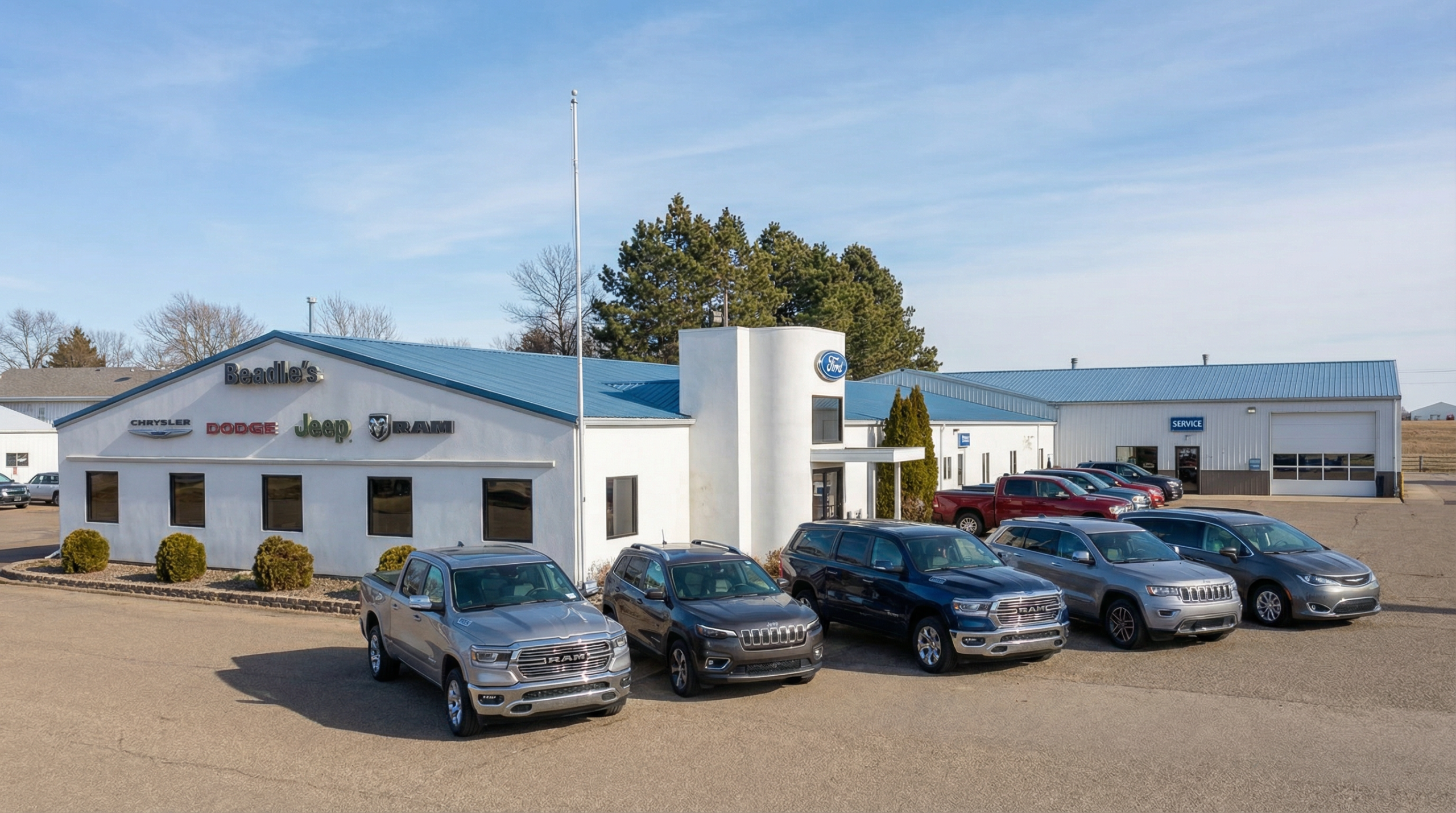
If you live in Bismarck or Mandan and you’ve started shopping for a new or used Ram, the first practical question is the same one every cross-border buyer asks: where’s the closest Ram dealer that’s actually worth the drive? Bismarck has Ram dealers of its own, but a steady stream of capital-city buyers, ranchers from the Mandan side, and lake-country families still point south on US-83 and pull into Beadle’s Chrysler Center in Bowdle, South Dakota.
This guide walks through the exact drive (2 hours 24 minutes via US-83 South to US-12 East), why Bismarck-area buyers keep making the trip, what changes when a North Dakota resident buys at a South Dakota dealer, and what to expect once you walk onto our lot in Bowdle.
On This Page
- How Far Is Beadle’s from Bismarck, ND?
- The US-83 + US-12 Route from Bismarck and Mandan
- Who’s Driving from Bismarck to Beadle’s?
- What ND Buyers Need to Know About Buying in SD
- How Beadle’s Handles a North Dakota Trade-In
- Quick Comparison: Bismarck Dealer vs. the Drive to Bowdle
- How to Plan the Drive from Bismarck to Beadle’s
- Frequently Asked Questions
How Far Is Beadle’s Chrysler Center from Bismarck, ND?
Beadle’s Chrysler Center sits 155 miles south of Bismarck on US-83, and the typical drive from downtown Bismarck to our lot at 5023 Fourth Avenue in Bowdle runs 2 hours 24 minutes in good weather. Mandan adds 5 to 10 minutes on the clock since you’re starting on the west bank of the Missouri, but the route is the same once you cross back over the river.
For Bismarck-area buyers used to comparing drive times to other regional Ram dealers, that 2:24 puts Beadle’s inside the radius most ND truck shoppers consider worth a half-day trip. We see Bismarck-plate trucks in our delivery lot most weeks, and the steady pattern is what made this guide worth writing in the first place.
What’s the Best Route from Bismarck and Mandan to Bowdle?
From either Bismarck or Mandan, the cleanest route is US-83 South all the way to the South Dakota line, continuing on US-83 to Selby, then turning east onto US-12 for the final stretch into Bowdle. It’s two-lane highway most of the way, no major detours, and one of the most predictable rural drives in either state.
| Leg | Route | Approximate Time |
|---|---|---|
| Bismarck to Linton, ND | US-83 South | ~1 hour |
| Linton to ND/SD state line | US-83 South | ~25 minutes |
| State line to Selby, SD | US-83 South | ~40 minutes |
| Selby to Bowdle, SD | US-12 East | ~20 minutes |
Cell coverage is solid for most of the drive but thins out in the rural stretches between Linton and Selby, so download your route ahead of time. Fuel stops in Linton, Herreid, and Selby are reliable; if you’re driving down for a same-day pickup, plan a fuel and coffee stop in Selby before the last twenty minutes east on US-12.
Who’s Driving from Bismarck to Beadle’s?
The Bismarck-area buyers we see most often fall into two groups: working ag operators from the Mandan and southern-Burleigh-County side, and family or recreational buyers driving down for a Ram 1500 with the right tow package for Lake Oahe weekends and late-season pheasant hunts.
The ag side is mostly Ram 2500 and 3500 buyers — Cummins-diesel crew cabs, gooseneck-rated builds, dually configurations for fifth-wheel livestock trailers. These customers know exactly what they need spec’d out, and they’re shopping for the right inventory and the right deal more than the closest dealer.
The family and recreational side leans heavier into the Ram 1500 — Big Horn and Laramie crew cabs, often with a tow package spec’d for a fifth-wheel camper or a covered trailer. For these buyers, the drive south on US-83 is part of the calculation: they cross the Missouri at Bismarck-Mandan, head down through the same country they hunt and fish, and pick up a truck that’s already broken in to the kind of road they actually drive.
Best for / Not ideal for
Best for: Bismarck-area buyers who already know roughly what they want and are shopping for the right inventory and the right deal. Not ideal for: shoppers who want to test drive five different models on the same afternoon — that’s a same-day, local-dealer use case.
What Do North Dakota Buyers Need to Know About Buying in South Dakota?
The biggest practical thing to know is that Beadle’s does not collect any sales tax from out-of-state buyers. As a North Dakota resident buying in South Dakota, you’ll pay your motor vehicle excise tax to the North Dakota Department of Transportation when you register the truck at home — not at the dealership in Bowdle.
North Dakota Motor Vehicle Excise Tax
North Dakota’s motor vehicle excise tax is 5% of the purchase price, paid at registration through the ND DOT. The dealership documents the purchase price on a bill of sale; you pay the tax at the ND DMV, not at Beadle’s. Verify current rates with ND DOT before purchase.
For plates, we provide a 30-day South Dakota temporary permit when you drive the truck home so you’re legal on the drive while you finish registration in North Dakota. Title work is paperwork we handle on our side and submit to South Dakota; you’ll then transfer the title in North Dakota when you register.
Insurance is the one thing to handle before you drive off the lot. Call your ND insurance agent and add the new truck to your policy before pickup — most ND insurers will bind coverage same-day with the VIN. We’ll wait while you make the call if you forget.
What most cross-border buyers overlook
The most common slip-up isn’t the tax math or the title work — it’s forgetting to call insurance before pickup day. Buyers who haven’t bound coverage on the new VIN can’t legally drive the truck off our lot. Five minutes on the phone with your ND agent the day before you drive down saves the only situation where we’d have to delay your departure.
How Does Beadle’s Handle a North Dakota Trade-In?
Cross-state trade-ins are routine for us. Bring your North Dakota title (or, if you still owe on it, your ND lender’s payoff information), the keys, and the truck itself for the walk-around. We handle the title transfer paperwork between the two states on our end, including the lien payoff if there’s still a balance with your North Dakota lender.
If you’d rather get a number before driving down, send us photos and odometer information ahead of time. We’ll give you a written trade range so you don’t burn a Saturday driving 155 miles south to find out the number is off from what you expected.
For trades that are still under finance, we work with most ND banks and credit unions directly on the payoff so the day-of paperwork stays clean and the only lien transfer happens on our title work.
Bismarck Dealer or the Drive to Bowdle: Which Choice Fits Your Plan?
| Consideration | Local Bismarck Ram Dealer | Drive to Beadle’s in Bowdle |
|---|---|---|
| Travel time | Local; same-day with no plan | 2 hr 24 min each way |
| Sales tax at purchase | 5% ND tax collected by dealer | $0 collected; pay at ND registration |
| Inventory mix | Bismarck-spec lot allocation | Northern-plains-spec lot (HD heavy) |
| Service after the sale | Local for routine service | Plan trips for major work, or use a local Mopar service for routine |
| Buying experience | Different at each store | Small-town, family-owned since 1975 |
Worth the drive if: You want a specific HD configuration that’s easier to find on a northern-plains lot, you’d rather settle the tax with the ND DMV than the dealer, or you’re shopping for the buying experience as much as the truck.
Stay in Bismarck if: You need a same-day decision with no travel, or you depend on the same store handling all your warranty service in-house.
How to Plan the Drive from Bismarck to Beadle’s Chrysler Center
A successful Bismarck-to-Bowdle truck pickup is mostly about preparation — confirming the truck is ready, calling your ND insurance, and timing the drive so you’re not pushing through the back half of US-83 in the dark.
- Confirm the truck: Call us at 605-460-6254 the day before to verify the specific Ram you’re coming for is detailed, fueled, and ready for delivery.
- Call your insurance: Add the new VIN to your ND auto policy before you leave home. Most ND agents can bind coverage by phone in under ten minutes.
- Pack your trade documents: Bring your ND title (or lender payoff info), valid driver’s license, and proof of ND insurance. Photo of your odometer if you sent us a trade quote ahead.
- Plan your fuel stops: Bismarck or Mandan to start, top off in Linton or Herreid mid-route, last fuel and coffee in Selby before turning east on US-12.
- Time your departure: Leave Bismarck by 8:00 a.m. for a comfortable mid-morning arrival in Bowdle. Plan for paperwork, walk-around, and detail review to take 60 to 90 minutes once you’re here.
- Drive home with your temporary permit: We send you off with a 30-day South Dakota temporary permit so you’re legal on the drive home and through the registration window at the ND DMV. Aim to be back across the state line by sundown.
Key Takeaways
- Beadle’s Chrysler Center is 2 hours 24 minutes from Bismarck via US-83 South to US-12 East — 155 miles of two-lane highway with reliable fuel stops.
- Beadle’s collects no sales tax from North Dakota buyers; ND residents pay the 5% motor vehicle excise tax at the ND DMV when they register the truck at home.
- The dominant Bismarck cohorts at Beadle’s are working-ag HD buyers (Ram 2500/3500 with diesel and tow packages) and family or recreational Ram 1500 buyers.
- Cross-state trade-ins, ND lender payoffs, and South Dakota temporary permits for the drive home are routine — the paperwork is what we do every week, not a special process.
Frequently Asked Questions
How long is the drive from Bismarck to Beadle’s Chrysler Center?
The drive from Bismarck, ND to Beadle’s Chrysler Center at 5023 Fourth Avenue in Bowdle, SD is 2 hours 24 minutes in good weather, covering 155 miles via US-83 South to US-12 East. Mandan adds 5 to 10 minutes since you start on the west bank of the Missouri.
Do I pay South Dakota or North Dakota sales tax when buying a Ram at Beadle’s?
As a North Dakota resident, you pay North Dakota’s 5% motor vehicle excise tax to the ND DOT when you register the truck at home — not to Beadle’s at purchase. We collect no sales tax from out-of-state buyers. Verify current ND rates with ND DOT before purchase.
Can Beadle’s deliver a Ram to Bismarck?
We arrange delivery case by case for Bismarck-area customers, usually at our expense for the right deal. Call us at 605-460-6254 and we’ll work out the logistics. Same-day delivery isn’t usually possible, but a scheduled delivery a few days out is realistic.
Will my North Dakota insurance cover me to drive a Ram home from Bowdle?
Yes, once you’ve added the new VIN to your ND policy. Call your insurance agent before you leave Bismarck or Mandan to bind coverage on the new truck. We’ll wait while you confirm if you forget. We also send you home with a 30-day South Dakota temporary permit so you’re legal on the drive while you complete ND registration.
Can I trade in a North Dakota–titled truck at Beadle’s?
Yes. Bring your ND title (or your lender’s payoff information if you still owe on it), the keys, and the truck. We handle title transfer paperwork between the two states and work with most ND lenders directly on the payoff. For pre-trip trade quotes, send us photos and odometer information ahead of time and we’ll give you a written range.
Why drive 2 and a half hours to Beadle’s when Bismarck has Ram dealers?
Most Bismarck-area customers tell us it comes down to three things: a different inventory mix on a northern-plains lot (heavier on HD diesel and crew cab tow-package builds), the small-town buying experience that’s been our way since 1975, and the cleaner tax-handling for ND buyers. The drive is part of why people pick us, not in spite of it.
My Take on the Bismarck Drive
Most of the Bismarck-area customers I sit down with at Beadle’s didn’t end up here by accident. They asked someone they trust where to buy a Ram, the answer was Bowdle, and they planned the drive. By the time they walk in, they already know they’re not just shopping for the closest dealer — they’re shopping for the one that fits how they want to buy.
If you’re an ag operator in the Mandan area, the inventory we keep on the lot leans more toward what you’re already looking for: Cummins-diesel HDs, gooseneck-rated builds, dually configurations. If you’re a Bismarck family shopping for a 1500 to pull a fifth-wheel out to Lake Oahe, the Big Horn and Laramie crew cabs are usually well represented in stock. Either way, the way to know if it’s worth the trip is to call ahead, tell us what you’re looking for, and we’ll be honest about whether we have it on the lot, can find it through allocation, or should be straight with you that another dealer is your better bet today.
If you’d like the full breakdown of how cross-border buying works for North Dakota residents — including drive times from other ND cities, ND-specific financing, and what changes when you cross state lines — read our complete out-of-state Ram buying guide. And if you’re already on US-83 with the truck picked out, give us a jingle at 605-460-6254 and we’ll have the keys ready when you pull in.
About the Author
Lexy Tabbert — Beadle’s Chrysler Center, Bowdle, SD
Lexy Tabbert is the Director of Sales and Marketing at Beadle’s Chrysler Center in Bowdle, South Dakota. She covers Ram, Jeep, Dodge, and Chrysler vehicles — helping families, ranchers, and ag operators across the region find the right truck and configuration for their needs. Learn more about Lexy.
Best New Ram Trim for Ranch Work in South Dakota
If you ranch in South Dakota and you’re shopping for a new Ram, you already know the brochure answer is useless. The right trim is the one matched to your actual loads, your actual mileage, and the way you actually spend your week — not the one a national ad campaign decided to push this quarter.
This guide walks through what working ranchers actually order at Beadle’s Chrysler Center: which Ram and which trim for which job, what the 2500 versus 3500 decision really comes down to, and the package decision most ranchers wish they hadn’t skipped. Verified 2026 specs throughout, with the configurations our customers ask for most often called out plainly.
On This Page
- Match the Truck to the Job, Not the Brochure
- The Ram 1500 Pick: Big Horn or Laramie with the Hurricane I-6
- The Ram 2500 Pick: Big Horn or Laramie 4×4 with the 6.7L Cummins
- When You Actually Need a 3500 Instead of a 2500
- 1500 vs. 2500 vs. 3500: Which Truck for Which Job?
- Power Wagon and Rebel: When Off-Road Spec Earns Its Keep
- The Package Decision Most Ranchers Regret Skipping
- How to Spec the Right Ram for Your Operation
Match the Truck to the Job, Not the Brochure
A ranch truck has to do four things well in South Dakota: pull what you actually pull, run the highway miles between operations without punishing your back, start in January at minus-fifteen, and last long enough to pay for itself. Most brochures answer the first question and assume the rest.
Out here on the high plains, that means an honest conversation about gooseneck weight, diesel power, four-wheel drive, and the upgraded tires that earn their keep on gravel and pasture. We ask a lot of questions before we spec a truck because the answers shift the order in real ways — and the right Ram for a cow-calf operation isn’t the same as the right Ram for a custom-harvest crew running between counties.
The Ram 1500 Pick: Big Horn or Laramie with the Hurricane I-6
For ranchers whose daily haul is a single-axle livestock trailer, a flatbed of fence supplies, or a tandem-axle utility, the Ram 1500 Big Horn or Laramie 4×4 with the 3.0L Hurricane twin-turbo I-6 is the most-ordered build at Beadle’s. The Hurricane Standard Output makes 420 horsepower and 469 lb-ft of torque; the High Output version steps up to 540 horsepower and 521 lb-ft.
Properly equipped, a 1500 Crew Cab 4×4 with the Hurricane HO and the right axle ratio tows up to 11,550 pounds — enough for a fully-loaded gooseneck stock trailer with a small cut of cattle, most fifth-wheel campers, or a tandem-axle equipment trailer. The 5.7L HEMI V8 with eTorque returns for 2026 as an available option on Big Horn through Limited Longhorn for buyers who prefer the traditional V8.
When the 1500 Stops Being the Right Truck
If you’re regularly pulling more than about 12,000 pounds, hauling a fifth-wheel camper over 30 feet, or running a gooseneck full of bred heifers across two counties — the 1500 has reached its honest ceiling. Step up to the 2500. Owning the right tool for the job costs less than wearing out the wrong one.
The Ram 2500 Pick: Big Horn or Laramie 4×4 with the 6.7L Cummins
The most-ordered Ram 2500 build at Beadle’s is a Big Horn or Laramie Crew Cab 4×4 with the 6.7L Cummins I-6 High-Output Turbo Diesel. The Cummins HO makes 430 horsepower and 1,075 lb-ft of torque — the highest standard diesel torque rating in the heavy-duty pickup segment for 2026 — paired with the TorqueFlite HD 8-speed automatic transmission.
For working ranchers, the Cummins is the right answer when you tow heavy regularly, want maximum payload headroom, or plan to keep the truck for 200,000-plus miles. The 6.4L HEMI V8 (405 horsepower, 429 lb-ft) is the lower-cost gas alternative and a legitimate choice for occasional towing — but the Cummins is what our customers ask for when the truck is a working vehicle.
| Ram 2500 Crew Cab 4×4 | 6.7L Cummins (3.42 axle) | 6.4L HEMI (4.10 axle) |
|---|---|---|
| Horsepower | 430 hp | 405 hp |
| Torque | 1,075 lb-ft | 429 lb-ft |
| Max Trailer Weight | 19,930 lb (gooseneck, 11,040 GVWR) | 17,330 lb (8′ bed, 11,040 GVWR) |
| Powertrain Warranty | 5-year / 100,000-mile | 5-year / 60,000-mile |
Figures from the 2026 Ram Heavy Duty Payload & Towing Weight Capacities chart. A fifth-wheel or gooseneck hitch is required for any Ram 2500 trailer over 20,000 pounds. Always confirm the Gross Combined Weight Rating against your specific build before pulling a trailer.
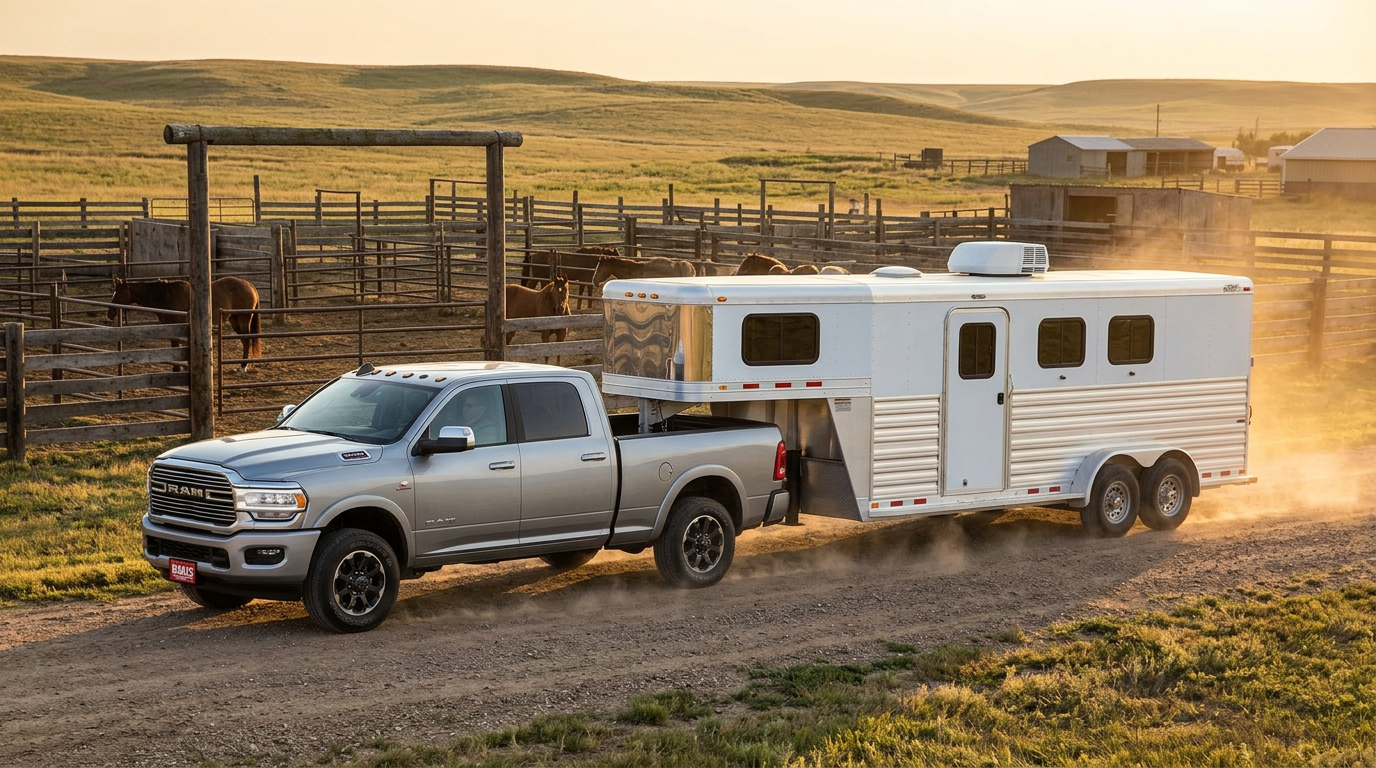
When You Actually Need a 3500 Instead of a 2500
The honest answer is simpler than most buyers expect: you need a 3500 when your gooseneck or fifth-wheel weight, plus your in-bed hitch load, exceeds what a 2500 can legally and safely handle — or when you regularly run at the upper end of the 2500’s capacity and want headroom instead of stress.
A Ram 3500 SRW (single rear wheel) Crew Cab 4×4 with the Cummins HO and a 12,300-pound GVWR option will pull up to 25,180 pounds gooseneck. Step to the dually (DRW) and the same Crew Cab 4×4 Cummins with the 14,000-pound GVWR will pull up to 36,610 pounds gooseneck when properly equipped — the territory of large fifth-wheel toy haulers, big stock trailers, and equipment haulers running tractors or skid steers.
SRW vs. Dually in One Sentence
SRW gets you most of the 3500’s capability with a narrower track, easier daily-driver footprint, and lower tire-replacement costs. Dually gets you the headroom for serious gooseneck weight and the stability advantage on long fifth-wheel runs — at the cost of a wider truck and four extra rear tires to maintain.
For ranchers who tow a 30-foot loaded gooseneck regularly, a 3500 SRW Cummins is usually the right answer. For ranchers running 35-foot fifth-wheel toy haulers or hauling tractors on equipment trailers, the dually starts earning its keep.
1500 vs. 2500 vs. 3500: Which Truck for Which Job?
| If your ranch work is… | The right Ram |
|---|---|
| Daily driver, occasional small trailer (under 12,000 lb) | Ram 1500 Big Horn / Laramie 4×4 Hurricane |
| Cow-calf operation, single-axle stock trailer, regular hay hauling | Ram 2500 Big Horn / Laramie 4×4 Cummins |
| Larger gooseneck loads, fifth-wheel camper, frequent heavy haul | Ram 3500 SRW Crew Cab Cummins |
| Big fifth-wheel toy hauler, equipment trailer, max weight regularly | Ram 3500 DRW Crew Cab Cummins |
| Pasture access, rough section-line roads, off-road duty | Ram 1500 Rebel or Ram 2500 Power Wagon |
Worth it if: your operation has a real, repeating use case for the truck listed.
Skip it if: you’re spec’ing for a once-a-year haul that you could rent a trailer or hire a hot-shot for instead.
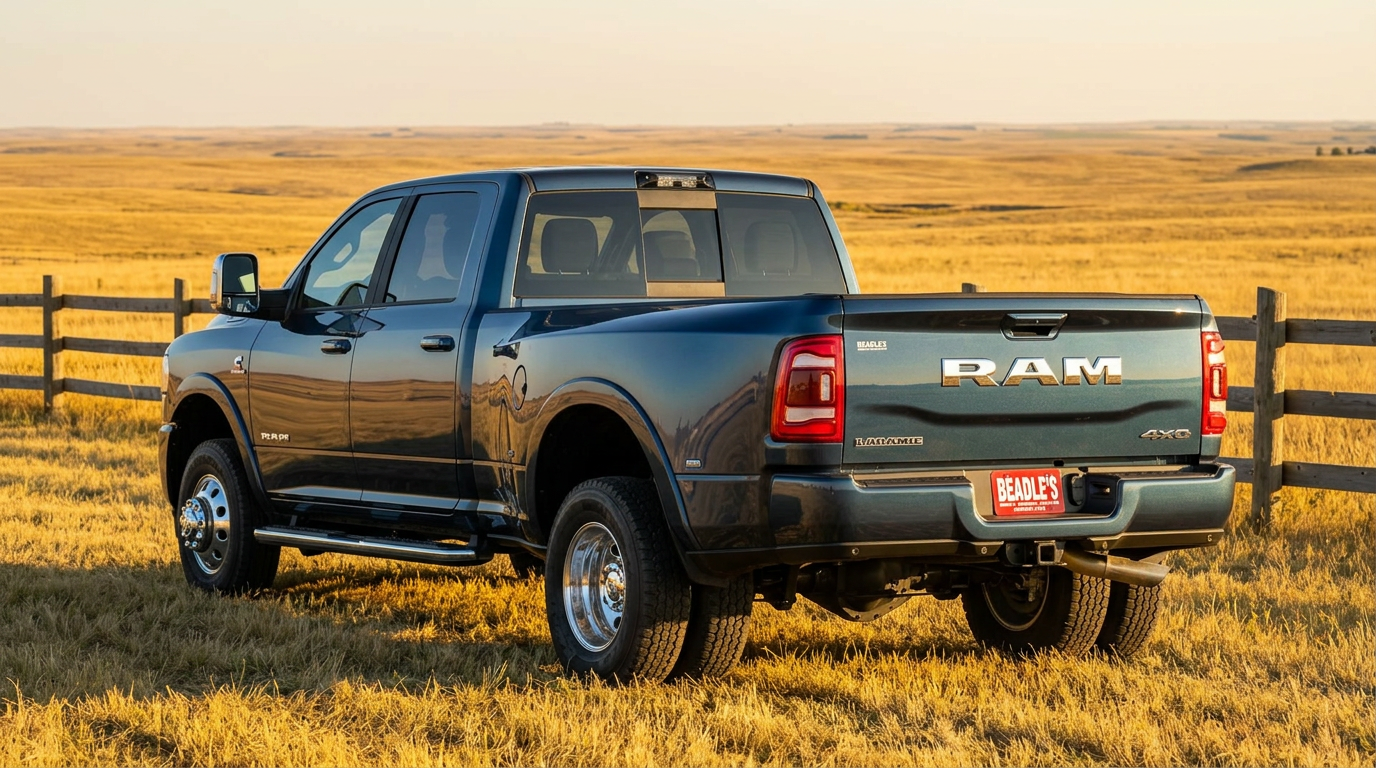
Power Wagon and Rebel: When Off-Road Spec Earns Its Keep
The Ram 2500 Power Wagon and Ram 1500 Rebel are the factory off-road builds in the lineup. The Power Wagon is the serious tool: 4×4 only, a 6.4L HEMI V8, electronic locking front and rear differentials, electronic front sway-bar disconnect, 33-inch all-terrain tires, and an integrated 12,000-pound winch. It comes with an 8,565-pound GVWR and tows up to 10,530 pounds — the lowest payload and tow rating of any 2500 because the off-road hardware uses up the capacity budget.
The Rebel is the 1500’s off-road-flavored trim: Bilstein shocks, all-terrain tires, skid plates, an electronic-locking rear axle, and a higher ride height than the standard 1500. It keeps most of the 1500’s daily-driver comfort while adding meaningful capability on rough section-line roads and pasture two-tracks.
Honest Take
Most ranchers don’t need a Power Wagon. Some do — and when you do, nothing else in the lineup substitutes. If your daily includes pasture roads, washouts after spring runoff, or trails that wash out the average half-ton, the Power Wagon earns the price tag. If your “off-road” is mostly a gravel two-track between sections, a Rebel or a properly-equipped Big Horn 4×4 covers the use case for less money.
The Package Decision Most Ranchers Regret Skipping
This is the part of the order conversation where we slow down. The packages get cut to save money up front, and within a year or two we hear the same line back: “I should have gotten that.” Here’s what’s actually inside the packages worth keeping — and why we’d rather walk you through them than have you skip them.
Ask us about each one. Some of the technology Stellantis has put into the 2026 Ram is genuinely useful, and some of it ranchers don’t realize they want until they have it. We’d rather you understand what you’re choosing than save a few hundred dollars on something you’ll regret.
Trailer Tow Max Package
Required to reach the maximum tow ratings on Ram 1500 (and unlocks the highest GVWR options on HD). Includes upgraded cooling, integrated trailer brake control, the right axle ratio, and the heavy-duty engine cooling that long uphill pulls actually need. If you’re going to tow at the limit, skipping this is the wrong place to save money.
Fifth-Wheel / Gooseneck Tow Prep Group (HD)
Factory-installed mounts in the bed, an additional 7-pin wiring harness, a 12-pin connector, and provisions for an auxiliary Mopar camera. Order it from the factory and the warranty zone is intact; install it aftermarket and you’re cutting into the bed yourself. Almost every HD buyer eventually wishes they’d ordered this from day one.
Blind Spot Monitoring with Trailer Coverage
Standard blind-spot monitoring covers the truck. The trailer-coverage upgrade extends the detection zone the full length of your trailer — so a 30-foot gooseneck doesn’t hide a passing vehicle when you change lanes on Highway 12 or Interstate 90. The package most overlooked, the one most regretted by long-haul tow customers.
360-Degree Surround View Camera + Trailer Reverse Guidance
Five cameras give you a composite overhead view, both sides of the trailer onscreen, and a cargo-bed view for hooking up gooseneck single-handed. Trailer Reverse Steering Control turns your wheel input into trailer direction — the most useful piece of new tow tech in the segment. Worth a real conversation before you order.
Snowplow Prep Group (HD)
If there’s any chance you’ll mount a plow — for the place, for hire, or for the road into the homeplace — order this from the factory. It includes the upgraded alternator, frame reinforcement provisions, and the front-axle weight rating headroom that an aftermarket plow needs. Adding it later is a different conversation entirely.
Adaptive Cruise Control & Forward Collision Warning Plus
Standard on 2026 Ram HD, but worth understanding before you assume it’s something else. Adaptive cruise holds your distance behind a slower vehicle automatically — on a long Highway 12 run pulling a trailer, that’s the difference between arriving rested and arriving worn out. Ask us to demo it on your test drive.
How to Spec the Right Ram for Your Operation
Before you call us or stop in, walk through these five steps. We’ll do the same with you on the lot — but going in with answers shortens the conversation and gets you the right truck faster.
- Weigh your worst-case load: total trailer weight plus what’s on it, fully loaded. Add a 10 percent margin for fudge factor and weather.
- Pick the truck class first: 1500 if your worst-case is under 11,000 pounds, 2500 if you’re between 11,000 and 19,000, 3500 SRW for 20,000 to 25,000, 3500 DRW for anything bigger.
- Choose engine by use, not preference: Hurricane I-6 in the 1500 for daily-plus-trailer, Cummins in the 2500/3500 if you tow heavy regularly or want 200,000-mile longevity.
- Land on a trim: Big Horn for working ranchers who want capability without the chrome, Laramie for the same buyer who also wants leather and the bigger touchscreen, Rebel or Power Wagon if your work includes real off-road.
- Build the package list: Trailer Tow Max if you’re towing at the limit, Tow Prep Group if you run gooseneck or fifth-wheel, Blind Spot with trailer coverage if you run highway, surround camera if you hook up alone, Snowplow Prep if there’s any chance.
Key Takeaways
- The most-ordered Ram 1500 ranch build at Beadle’s is a Big Horn or Laramie 4×4 with the 3.0L Hurricane I-6.
- The most-ordered Ram 2500/3500 ranch build is a Big Horn or Laramie Crew Cab 4×4 with the 6.7L Cummins High-Output diesel (430 hp / 1,075 lb-ft).
- Step from a 2500 to a 3500 SRW when your gooseneck regularly exceeds 19,000 pounds; step to dually (DRW) for fifth-wheel weight above 25,000 pounds.
- The package decisions ranchers most often regret skipping are Trailer Tow Max, Fifth-Wheel/Gooseneck Tow Prep, Blind Spot with trailer coverage, and Snowplow Prep on HD.
- Ask before you skip: ordering tow and tech packages from the factory is dramatically simpler than adding them aftermarket.
Frequently Asked Questions
Is the Hurricane I-6 enough engine for ranch work in a Ram 1500?
For ranchers whose worst-case haul stays under about 11,000 pounds, yes. The Hurricane Standard Output (420 hp / 469 lb-ft) handles a single-axle stock trailer, a tandem-axle utility, or a small fifth-wheel without strain. The High Output version (540 hp / 521 lb-ft) opens up the maximum 11,550-pound tow rating when paired with the right axle ratio and Trailer Tow Max Package.
Should I order a 2500 or a 3500 for towing a 30-foot loaded gooseneck?
A 30-foot loaded gooseneck typically runs 18,000 to 22,000 pounds depending on what’s on it. That’s at the upper edge of a Ram 2500’s capability and squarely in 3500 territory. We usually recommend a 3500 SRW Crew Cab 4×4 with the Cummins for that use case — the headroom matters when you’re loaded heavy on a windy SD highway.
What’s the difference between SRW and dually, and which one do I actually need?
SRW (single rear wheel) is one tire on each side of the rear axle. Dually (DRW) is two tires on each side, giving you a wider rear track and significantly more rear-axle weight capacity. You need the dually when your fifth-wheel pin weight or gooseneck hitch weight exceeds what an SRW can carry — usually loaded fifth-wheels over about 16,000 pounds total or goosenecks over 25,000 pounds total.
Is the Power Wagon overkill for ranching, or is it the right tool?
For most cow-calf and small-grain operations, yes — the Power Wagon is more than the day-to-day requires, and you give up payload and towing capacity to get the off-road hardware. For ranches with rough section-line roads, washout-prone pasture access, or steep approach angles where a regular 2500 gets stuck, the Power Wagon is the only factory truck that does the job. Talk to us about your worst access scenario before you decide.
What’s the most-skipped package that ranchers later wish they’d ordered?
Two things tie: Blind Spot Monitoring with trailer coverage and the Fifth-Wheel/Gooseneck Tow Prep Group. The blind spot upgrade extends detection along your trailer length, which makes long highway tows safer. The tow prep group puts the factory mounts and wiring in your bed before delivery — aftermarket installs are doable but invasive. We’d rather walk you through both than see you wish you’d added them.
What axle ratio should I order on a 2500 Cummins for gooseneck towing in SD?
The Cummins HO is paired with a 3.42 axle ratio across the Ram 2500/3500 lineup, and that ratio is calibrated for the diesel’s torque curve. You don’t pick a different ratio with the Cummins — you pick the GVWR option that matches your loaded weight. For maximum gooseneck capability on a 2500 Cummins, that’s the 11,040-pound GVWR with the right Tow Prep build.
Why do most Beadle’s ranch customers go diesel instead of the gas HEMI on HD?
Two reasons: torque under load and longevity. The 6.7L Cummins makes 1,075 lb-ft compared to the 6.4L HEMI’s 429 lb-ft — meaningful when you’re pulling a loaded gooseneck up a long South Dakota grade. And the Cummins routinely runs 250,000 to 400,000 miles in working ranch service. The HEMI is a real option for occasional towing and a lower up-front cost; the Cummins is what our regular-haul customers ask for.
My Take on Picking the Right Ram for Ranch Work
After enough years at Beadle’s Chrysler Center, the conversations start sounding similar. A rancher comes in with a worst-case load in mind and a budget that has to make sense, and the job is matching the right truck to the way the operation actually runs — not the way a brochure imagines it. The most useful thing I can do is ask questions until we both know what you actually need.
My recommendation, every time: order the tow and tech packages from the factory. Buyers cut them to save money and we hear about it later. The technology in the 2026 Ram is genuinely useful, especially for long highway tows and gooseneck work, and you don’t have to understand every package on day one to be willing to ask about them. We’d rather walk you through what’s inside than have you skip something you’d want.
If you’d like the full picture of what we stock and order at Beadle’s, here’s the complete new Ram trucks guide for South Dakota buyers. And if you’re anywhere in our service area — SD, ND, MT, MN, or IA — give us a jingle and we’ll make a plan that fits your operation.
About the Author
Lexy Tabbert — Beadle’s Chrysler Center, Bowdle, SD
Lexy Tabbert is the Director of Sales and Marketing at Beadle’s Chrysler Center in Bowdle, South Dakota. She covers Ram, Jeep, Dodge, and Chrysler vehicles — helping families, ranchers, and ag operators across the region find the right truck and configuration for their needs. Learn more about Lexy.
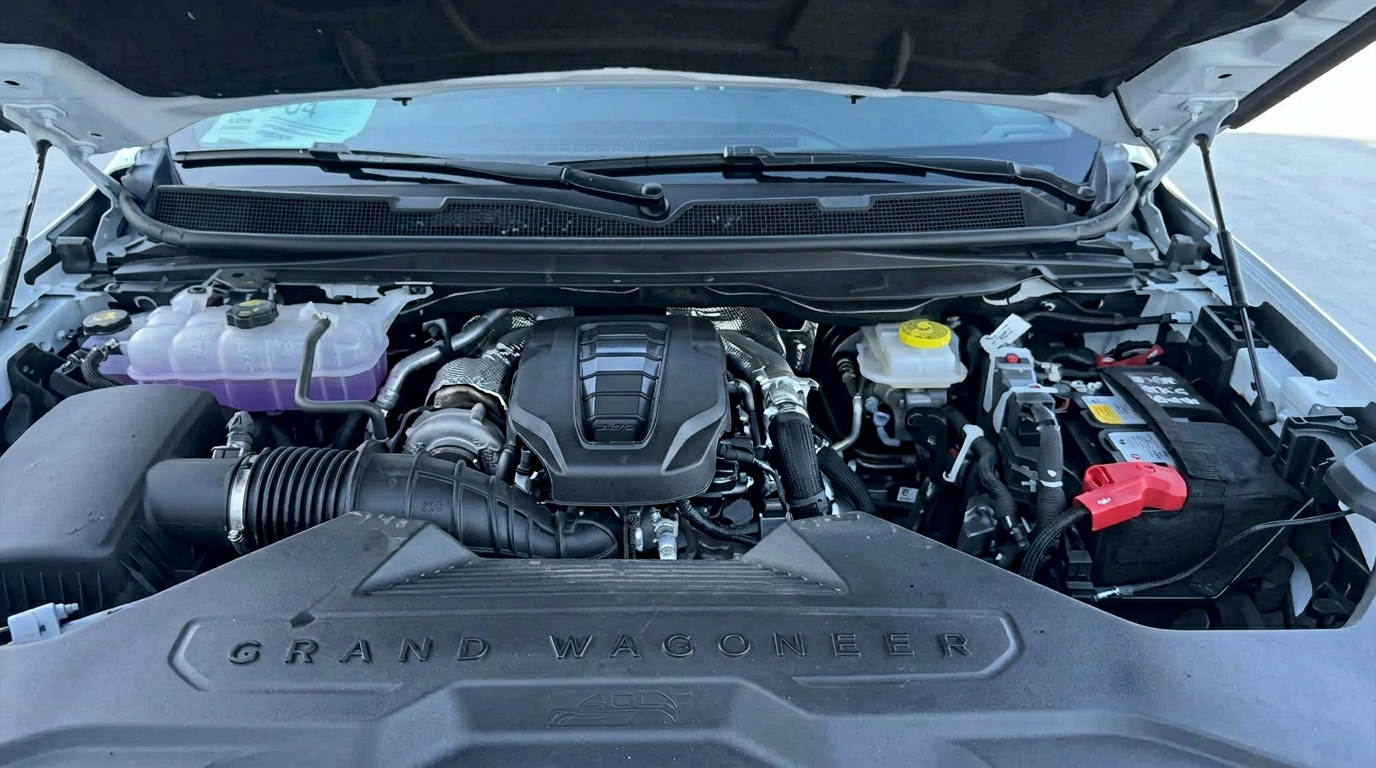
The 2026 Jeep Grand Wagoneer L runs a different engine than the 2025 model — and unless you’re tracking model-year changes closely, the swap is easy to miss. Jeep moved from the Hurricane Twin Turbo High Output (HO) in 2025 to the Hurricane Twin Turbo Standard Output (SO) for 2026. Same 3.0L inline-six twin-turbo architecture, different tune. The SO produces 420 hp and 468 lb-ft of torque per Jeep’s capability page, paired with a new in-house 8-speed automatic transmission.
This guide explains why Jeep made the swap, what 420 hp actually feels like in a full-size luxury family SUV, the real-world fuel economy story, what to think about for reliability on a relatively new engine family, and the range-extender hybrid Jeep has signaled is coming later in 2026.
On This Page
- What engine does the 2026 Grand Wagoneer L have?
- Why did Jeep swap from the 2025 Hurricane HO to the new SO?
- What does 420 hp actually feel like in this vehicle?
- What’s the real-world fuel economy and driving range?
- How reliable is the new Hurricane SO engine?
- When is the range-extender hybrid coming?
- Quick reference: 2025 HO vs 2026 SO
- How to maximize fuel economy on long South Dakota drives
- Key takeaways
- Frequently asked questions
What engine does the 2026 Grand Wagoneer L have?
Every 2026 Grand Wagoneer L — the 4×2, 4×4, Limited, and Summit — runs the same powertrain: the 3.0L Hurricane Twin Turbo Standard Output inline-six paired with an 8-speed automatic transmission and Engine Stop-Start technology. There is no V-8 option, no diesel option, and no hybrid in the 2026 lineup at launch. That changes later in 2026 when the range-extender hybrid arrives — but for the entire current lineup, it’s one engine across all four trims.
Per Jeep’s capability page, the Hurricane Twin Turbo SO produces 420 horsepower and 468 lb-ft of torque. Those are the OEM-direct figures. The 8-speed automatic is a new in-house Stellantis transmission for 2026 — Jeep moved away from the ZF-sourced 8-speed used in the 2025 model. Engine Stop-Start is standard, as is the Heavy Duty Engine Cooling on every trim — both relevant for a vehicle that may spend time idling at boat ramps or pulling steady highway loads in summer heat.
Why did Jeep swap from the 2025 Hurricane HO to the new SO?
This is the part of the 2026 story that competing reviews tend to gloss over. The 2025 Grand Wagoneer L ran the Hurricane Twin Turbo High Output (HO) — same 3.0L inline-six architecture, but tuned for higher peak figures (in the neighborhood of 510 hp on competing publications). The 2026 model uses the Standard Output (SO) tune at 420 hp and 468 lb-ft. That’s a real reduction in peak horsepower.
The reason: the 2026 Grand Wagoneer L is positioned at a substantially lower starting price than the 2025 model — high $60s for the base 4×4 versus mid $90s for the 2025 entry trim. To hit that price point, Jeep made several decontenting choices, and the engine tune is one of them. The HO became reserved for higher-output applications elsewhere in the Stellantis lineup; the SO became the standard powertrain for the more accessible Grand Wagoneer L lineup.
Whether the change matters depends on what you actually need from the vehicle. For a buyer using the Grand Wagoneer L the way most buyers do — family transport, recreational towing, long highway drives — 420 hp is genuinely sufficient. For a buyer who specifically wanted the 510-hp tune for a specific reason, the 2025 model may still be available used, and that’s a fair conversation to have. The full 2025-vs-2026 change list is covered in our what changed for 2026 guide.
What does 420 hp actually feel like in this vehicle?
The Hurricane SO doesn’t feel like a sports-car engine in a luxury SUV — and it shouldn’t. What it does feel like: smooth, effortless, and torque-rich at the speeds you actually drive. The 468 lb-ft of torque is the more important number for daily use; that’s what gets the truck moving from a stop, climbs a Black Hills grade with a trailer, and merges onto I-90 at full freeway speed without the engine having to work hard.
Compared to a naturally aspirated V-8 — say a 6.2L from a Tahoe High Country — the Hurricane SO trades a rumbly soundtrack for a more refined, quieter delivery and stronger low-end response. There’s no induction roar through the cabin. The twin turbos build boost smoothly and the engine feels relaxed in the rev range you spend most of your time in.
For context: the Grand Wagoneer L 4×4 has a curb weight in the 6,200-pound range. 420 hp moving that much vehicle is roughly the same power-to-weight ratio as many full-size SUVs in this segment. Acceleration won’t impress anyone with a stopwatch, but it’s never an issue in real driving. The truck pulls confidently up a grade, gets out of its own way merging, and never feels labored.
What’s the real-world fuel economy and driving range?
EPA-rated at 16 city, 22 highway, 18 combined per the window sticker on the in-stock 4×4 we have on the lot. Those are reasonable numbers for a 6,500-pound luxury 3-row SUV with a turbocharged engine. The same EPA estimate puts annual fuel cost at $2,750.
Real-world fuel economy varies with driving style, terrain, load, and weather — but for South Dakota highway driving at 70 mph on cruise control with a moderate load, 22 mpg is a fair expectation. In stop-and-go conditions or with the cabin loaded full of family and gear, expect closer to the 16 city number.
Where the Hurricane SO genuinely earns its keep is fuel-tank range. The 30.5-gallon tank gives you real distance between fill-ups: roughly 670 miles of highway range theoretical, around 550 miles combined. In practical terms, Bowdle to Minneapolis at 390 miles is comfortably one tank with margin. Long multi-state runs are achievable with a single fuel stop along the way. For families that drive long distances regularly, the range advantage matters more than 1–2 mpg either way.
How reliable is the new Hurricane SO engine?
Honest answer: the Hurricane Twin Turbo family is a relatively new engine for Stellantis — introduced in the Wagoneer family in 2023. Long-term reliability data isn’t yet available the way it is for, say, a 5.7L HEMI V-8 with two decades of fleet data. That doesn’t mean it’s unreliable; it means the data set is shorter.
What’s covered by warranty
Per the window sticker, every new Grand Wagoneer L includes a 5-year / 60,000-mile Powertrain Limited Warranty and a 3-year / 36,000-mile Basic Limited Warranty. The powertrain coverage protects the engine and transmission specifically — the part of the vehicle most relevant to the new-engine-family question.
For buyers who specifically want the longer reliability track record of an established engine — say, the 5.7L HEMI V-8 — the Grand Wagoneer L isn’t where you find it. That’s a Ram or Durango conversation. For buyers who are comfortable with a newer engine family from a major manufacturer with full powertrain warranty coverage, the Hurricane SO is a reasonable choice. As with any new engine generation, regular maintenance and following the recommended service intervals matter more than they do on a long-proven design.
When is the range-extender hybrid coming?
Jeep has signaled that a range-extender hybrid (REEV) Grand Wagoneer variant is coming later in 2026, borrowing technology from the Ram REV 1500 program. Reported figures point to a combined output substantially higher than the SO’s 420 hp, with electric-only range supplemented by an onboard generator running the Hurricane engine.
What we don’t have yet: an exact launch date, confirmed pricing, confirmed trim availability, or final EPA figures. That information will be released closer to the on-sale date, and as soon as Jeep confirms the details for our region we’ll update this content.
Practical advice for buyers asking about it: if the hybrid is the version you specifically want, it makes sense to wait. If you need a vehicle now and the gas Hurricane SO covers your needs, the current model is on the lot and the hybrid arriving later doesn’t make it less of a vehicle today. If you tow heavy or run long distances on remote highways, the gas powertrain may actually be the more practical choice long-term — range-extender hybrids favor city and short-trip use over interstate hauling.
Quick reference: 2025 Hurricane HO vs 2026 Hurricane SO
| Spec | 2025 Hurricane HO | 2026 Hurricane SO |
|---|---|---|
| Architecture | 3.0L I-6 twin-turbo | 3.0L I-6 twin-turbo |
| Horsepower (peak) | ~510 hp (per published reviews) | 420 hp (Jeep capability page) |
| Transmission | 8-speed auto (ZF-sourced) | 8-speed auto (Stellantis in-house) |
| Engine Stop-Start | Standard | Standard |
| 2025 trim availability | Series II / Series III only | All four 2026 trims |
Worth it if: you want the most accessible price point on a Grand Wagoneer L and 420 hp covers your needs — the 2026 SO is the right answer.
Skip it if: you specifically wanted the higher-output HO tune from 2025 — a used 2025 Series II or Series III may still be on the market and is a different conversation.
Want to feel the Hurricane SO yourself? Check what’s currently on the lot.
Search Grand Wagoneer L InventoryHow to maximize fuel economy on long South Dakota drives
A handful of small habits make the difference between hitting 22 mpg highway and falling well short of it on the Hurricane SO. None are unique to this engine, but the truck rewards drivers who use them.
- Set adaptive cruise around 70 mph on the interstate. Above 75 mph, fuel economy falls off quickly with an SUV-shaped vehicle pushing through air. The Active Driving Assist system holds speed steady and helps maintain consistent throttle.
- Use Auto mode for Selec-Terrain in normal driving. Snow, Mud, and Sport modes adjust shift mapping and traction in ways that hurt fuel economy. Save them for when you actually need them.
- Let Engine Stop-Start work. The standard ESS shuts the engine off at extended idles. It’s working as designed — disabling it costs measurable fuel over a year of stop-and-go.
- Avoid heavy roof loads when possible. The standard adjustable roof rail crossbars (with HD Tow) are useful, but anything tall on the roof costs significant fuel economy at highway speed. Use a hitch-mounted carrier when feasible.
- Check tire pressure monthly. Underinflated tires cost real fuel economy. The Tire Pressure Monitoring System catches major drops, but 2-3 psi low can still cost 1-2 mpg.
Key Takeaways
- Every 2026 Grand Wagoneer L runs the 3.0L Hurricane Twin Turbo SO inline-six — 420 hp and 468 lb-ft per Jeep’s capability page, paired with a new in-house 8-speed automatic.
- The 2026 engine is a tune-down from the 2025 Hurricane HO (~510 hp). The trade-off enables the substantially lower starting price for the lineup.
- EPA-rated at 16 city / 22 highway / 18 combined. The 30.5-gallon fuel tank gives roughly 670 miles of highway range and around 550 miles combined — Bowdle to Minneapolis is comfortably one tank.
- 5-year / 60,000-mile Powertrain Limited Warranty plus 3-year / 36,000-mile Basic Limited Warranty cover the engine and transmission specifically.
- The range-extender hybrid Grand Wagoneer is signaled for later in 2026. No firm launch date or pricing yet — wait if it’s specifically the version you want.
Frequently Asked Questions
What engine does the 2026 Jeep Grand Wagoneer L have?
Every 2026 Grand Wagoneer L trim runs the 3.0L Hurricane Twin Turbo Standard Output (SO) inline-six paired with an 8-speed automatic transmission and Engine Stop-Start. There is no V-8 or diesel option. A range-extender hybrid is signaled for later in 2026.
How much horsepower does the 2026 Grand Wagoneer L Hurricane Twin Turbo make?
420 horsepower and 468 lb-ft of torque per Jeep’s capability page. That’s the Standard Output (SO) tune, a step down from the 2025 model’s High Output (HO) tune. The lower output is part of how Jeep delivered the substantially lower starting price for the 2026 lineup.
What kind of fuel economy can I expect from the 2026 Grand Wagoneer L?
EPA rates the 2026 Grand Wagoneer L 4×4 at 16 city, 22 highway, 18 combined per the window sticker. The 30.5-gallon fuel tank gives roughly 670 miles of theoretical highway range and 540 miles combined. Real-world economy varies with driving style, load, weather, and terrain, but South Dakota interstate driving at 70 mph with cruise control should hit the highway figure.
Is the new Hurricane Twin Turbo SO engine reliable?
The Hurricane Twin Turbo family is a relatively new engine, introduced in the Wagoneer lineup in 2023. Long-term fleet reliability data isn’t as deep as it is for the 5.7L HEMI V-8 with two decades of history. The 5-year / 60,000-mile Powertrain Limited Warranty covers the engine and transmission specifically. Buyers who specifically want a long-proven engine family may prefer a Ram or Durango with the HEMI V-8.
When will the plug-in hybrid or range-extender Grand Wagoneer L be available?
Jeep has signaled the range-extender hybrid (REEV) Grand Wagoneer variant for later in 2026, borrowing technology from the Ram REV 1500 program. No firm launch date, pricing, or trim availability has been confirmed at the time of writing. As soon as Jeep releases details for our region, we’ll update this guide. If the hybrid is specifically the version you want, waiting may be the right call. If you need a vehicle now and the gas powertrain covers your needs, the current model is on the lot.
My Take on the New Hurricane SO
The engine question is one of the more common ones I get from buyers cross-shopping the Grand Wagoneer L against a Tahoe High Country or Expedition Platinum, and the honest answer is that 420 hp is enough power for what almost every buyer in this segment actually does with the vehicle. The HO-to-SO swap looks dramatic on a spec sheet — it’s a 90-hp drop on paper — but in real driving, the 468 lb-ft of torque is doing most of the work, and that figure is competitive with naturally aspirated V-8 alternatives in the segment.
My honest take for South Dakota families: the Hurricane SO is a smooth, quiet, torque-rich engine that fits the rest of the vehicle’s character. It’s not a muscle-car powerplant, and it doesn’t try to be. The 30.5-gallon tank and the long range between fill-ups are arguably more important to buyers driving 200 to 400 miles in a stretch than peak horsepower, and the Hurricane SO delivers there. For buyers who specifically want the higher-output 2025 HO tune, that’s a used-market conversation now — and one we’re happy to help with.
For the rest of the 2026 picture — refresh, capability, tech, colors, and safety — read our 2026 Jeep Grand Wagoneer L overview. If towing is part of why you’re cross-shopping the powertrain, our recreational towing guide covers how the Hurricane SO handles real loads. And if you want to feel the engine for yourself, come drive one — twenty minutes on the highway will tell you whether the SO tune fits the way you actually drive.
About the Author
Lexy Tabbert — Beadle’s Chrysler Center, Bowdle, SD
Lexy Tabbert is the Director of Sales and Marketing at Beadle’s Chrysler Center in Bowdle, South Dakota. She covers Ram, Jeep, Dodge, and Chrysler vehicles — helping families, ranchers, and ag operators across the region find the right truck and configuration for their needs. Learn more about Lexy.
Can the 2026 Jeep Grand Wagoneer L Tow Your Boat, Camper, or Trailer? A South Dakota Recreational Guide
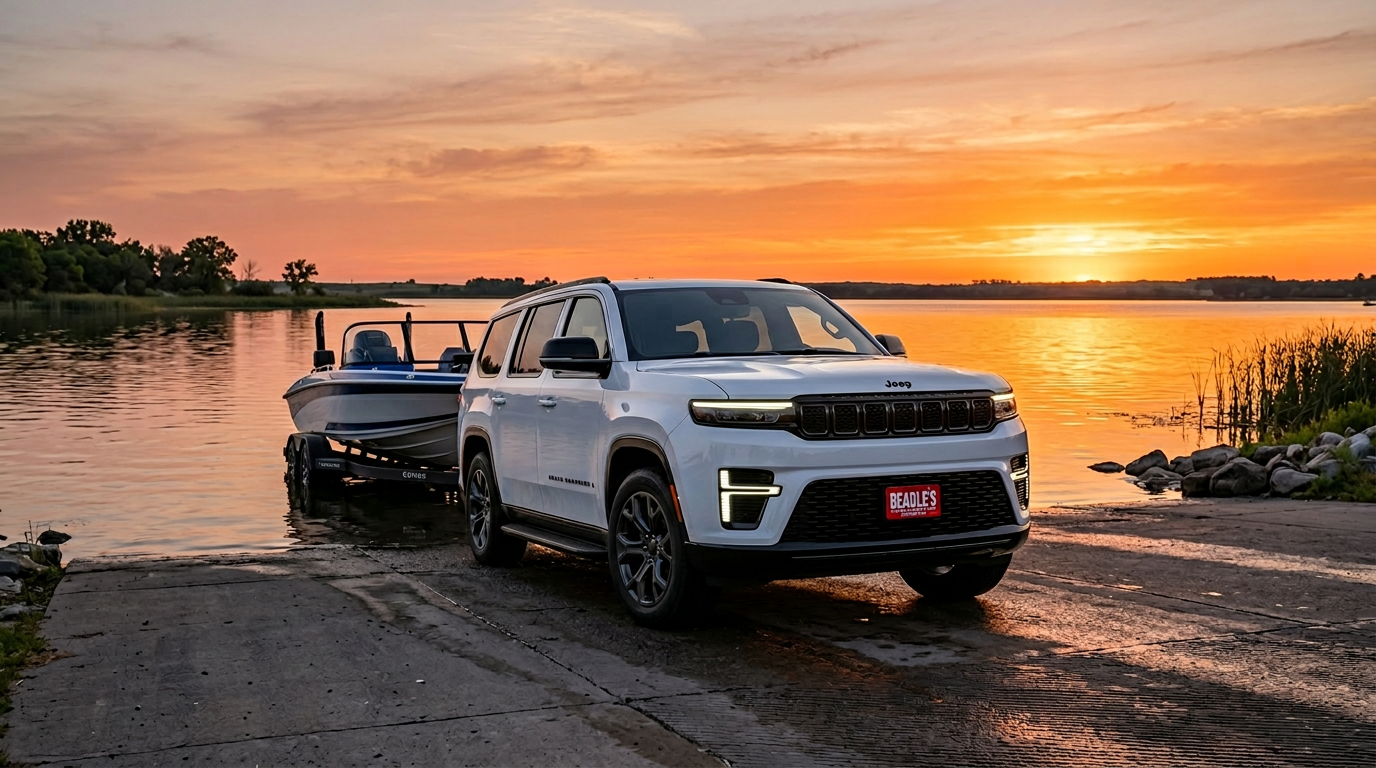
Most “how much can it tow” articles online are written for buyers shopping a half-ton pickup. The 2026 Jeep Grand Wagoneer L isn’t trying to compete with a Ram 2500 — it’s a luxury family SUV that happens to tow real recreational loads honestly. For South Dakota families, that means a 19-foot aluminum fishing boat to Lake Oahe, a small travel trailer to the Black Hills, a 2-horse bumper-pull for weekend rides, or a snowmobile trailer to the Hills in February.
This guide covers what the Grand Wagoneer L actually tows, when the HD Trailer Tow Package is worth ordering, and how the higher trims change the towing experience. We’ll skip the work-truck conversation — for cattle trailers, gooseneck hitches, or anything regularly above 10,000 pounds, you want a Ram 1500 or 2500 — and focus on the recreational scenarios that match this vehicle and this region.
On This Page
- How much can the 2026 Grand Wagoneer L actually tow?
- What does the HD Trailer Tow Package include — and which trims can get it?
- What can it tow in real South Dakota recreational scenarios?
- What towing tech comes with the HD Tow Package?
- How do Limited and Summit change the towing experience?
- Quick reference: common SD recreational tow loads
- How to set up the Grand Wagoneer L for safe recreational towing
- Key takeaways
- Frequently asked questions
How much can the 2026 Grand Wagoneer L actually tow?
Up to 10,000 pounds with the available HD Trailer Tow Package, per Jeep’s official capability page. Jeep markets that figure as “Best-in-Class Available Maximum Towing Capacity” for the full-size luxury SUV segment — and the headline number applies specifically to a properly equipped 4×4 with the HD Tow Package, not to every configuration on the lot.
The base configuration without the HD Tow Package still tows real recreational loads — the standard equipment includes a Class IV receiver hitch and 7-pin and 4-pin wiring harness on every 2026 trim, plus heavy-duty engine cooling. What changes with the HD Tow Package is the upgrade to a 3.92 rear axle ratio, the addition of the two-speed transfer case, an integrated trailer brake controller, blind-spot detection that accounts for the trailer, and the Selec-Speed Control crawl system. Those are the upgrades that unlock the 10,000-pound rating and make towing meaningfully easier — not just rated higher.
The HD Tow Package is available on the 4×4, Limited, and Summit trims. It is not available on the 4×2. Confirm the exact tow rating on the window sticker for the specific build you’re considering — manufacturer ratings vary by configuration, axle, and equipment level.
What does the HD Trailer Tow Package include — and which trims can get it?
The HD Trailer Tow Package is the single most important option for any Grand Wagoneer L buyer who plans to tow seriously. It bundles the upgrades that take towing from rated to genuinely easy.
What’s included in the HD Trailer Tow Package:
Available on
The HD Trailer Tow Package is available on the Grand Wagoneer L 4×4, Limited, and Summit. It is not offered on the 4×2 — that configuration uses the standard tow setup only. If towing is part of why you’re shopping this vehicle, the 4×4 is required, not optional.
What you get for the HD Tow upgrade isn’t just a higher rating — it’s the integrated brake controller (so you don’t have to install one aftermarket), the trailer-aware blind spot system (real safety on a long highway haul), and the Selec-Speed Control for steep boat ramps and uneven Black Hills approaches. For most recreational towers, those features are worth more than the rating bump.
What can it tow in real South Dakota recreational scenarios?
Tow numbers only matter when matched to the trailers buyers actually pull. Here’s how the Grand Wagoneer L handles common recreational loads in this region.
Lake Oahe fishing boat (16- to 22-foot aluminum)
A 16- to 22-foot aluminum fishing boat with a 90- to 250-hp outboard, kicker motor, full fuel, and the trailer typically loads at 3,500–5,500 pounds. That’s well within the Grand Wagoneer L’s rating on any 4×4 configuration with HD Tow. The Lake Oahe ramps at Whitlocks Bay and Indian Creek are steep enough that the Selec-Speed Control included with HD Tow makes a meaningful difference launching and recovering.
✓ Comfortably within rating with HD Tow
Black Hills travel trailer or pop-up camper (20- to 25-foot)
Most bumper-pull travel trailers in the 20- to 25-foot range load between 5,000 and 8,000 pounds. The Grand Wagoneer L 4×4 with HD Tow handles that range comfortably — the trailer brake controller and trailer-coverage blind spot are real assets on I-90 west and the climb out of Custer State Park. For a small pop-up camper at 1,500–3,000 pounds, you’re well below rating and the standard equipment is sufficient even without the HD Tow Package.
✓ Within rating with HD Tow; pop-ups handle on standard tow setup
Two-horse bumper-pull trailer for weekend riders
A two-horse straight-load bumper-pull with horses, hay, and tack typically runs 5,500–7,500 pounds loaded. Within rating on the 4×4 with HD Tow, with margin for tongue weight. A weight-distributing hitch is recommended at the upper end of this range. Heavier configurations — three-horse or four-horse with living quarters — start to push above 9,000 pounds and approach the maximum, so pay attention to your specific loaded weight. For gooseneck or fifth-wheel livestock setups, the Grand Wagoneer L is not the right vehicle; that’s pickup territory.
⚠ Within rating but verify loaded weight before towing heavier configurations
UTV, ATV, or snowmobile trailer
An open utility trailer carrying a single side-by-side or two snowmobiles typically loads at 2,500–4,500 pounds. Easy work for the Grand Wagoneer L. Enclosed cargo or toy haulers (12-foot to 16-foot) push to 4,000–6,500 pounds depending on contents — still comfortably within rating. The standard Class IV receiver hitch handles most of these configurations with a basic ball mount.
✓ Comfortably within rating on any 4×4 configuration
When the Grand Wagoneer L is the wrong tool
Heavy gooseneck livestock trailers, fifth-wheel campers, or anything that regularly exceeds 10,000 pounds are pickup-truck loads — a Ram 1500 with a tow package or a Ram 2500 HD is the right tool. The Grand Wagoneer L is not rated for gooseneck or fifth-wheel hitch use; the receiver hitch is bumper-pull only. Be honest about your real towing needs before buying — if you’re routinely at the upper limit of any vehicle’s rating, you’re in the wrong segment.
✗ Use a pickup for gooseneck, fifth-wheel, or regular 10,000+ lb loads
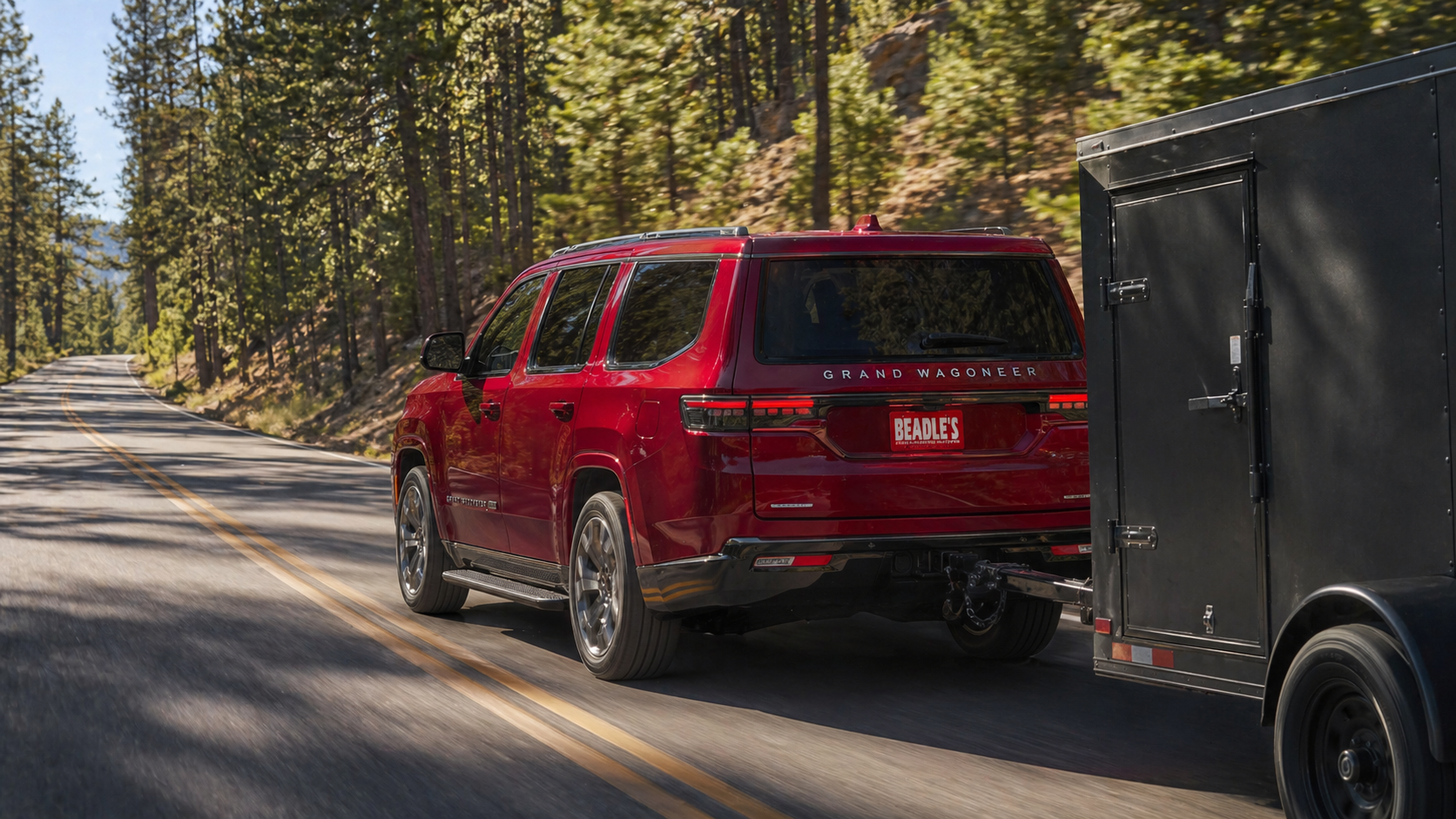
What towing tech comes with the HD Tow Package?
The HD Tow Package isn’t just a rating bump — it’s the bundle of features that makes towing meaningfully less stressful. A few are worth calling out specifically because they change the day-to-day experience.
Integrated Trailer Brake Controller
Built into the dashboard — no aftermarket installation, no wiring kit, no second guessing. Provides proportional braking output to the trailer’s electric brakes based on your braking input. Required for any trailer with electric brakes.
Blind Spot Detection with Trailer Coverage
The standard blind-spot system extends to cover the trailer length when one is connected. Real safety value on I-90 or US-12 when the trailer is long enough to obscure your rear sightlines.
Selec-Speed Control
Low-range crawl-style control for steep grades and demanding launch and recovery situations. Particularly useful at boat ramps, on steep Black Hills approaches, and any time you want controlled descent without riding the brake.
Trailer Light + Tire Pressure Monitoring
Confirms the trailer running lights are functioning before you pull out, and monitors tire pressure on the trailer once it’s connected. Both eliminate the most common “I should have checked that” moments in recreational towing.
How do Limited and Summit change the towing experience?
The HD Tow Package is available on every 4×4 trim — base 4×4, Limited, and Summit. Where the higher trims add value for towing specifically is in the suspension content.
The Quadra-Lift Air Suspension is standard on the Summit and available on the Limited via the Convenience Group I package or the Reserve QOP. Air suspension makes a meaningful difference under tow because it allows automatic load leveling — the rear of the vehicle stays at the right ride height when there’s tongue weight applied, which keeps the headlights aimed correctly, the trailer level, and the steering feel predictable. Buyers who tow heavy trailers regularly will notice the difference. Buyers who tow a small boat occasionally will get along fine on the standard rear load-leveling suspension.
Beyond suspension, the Limited and Summit don’t change the towing rating — same HD Tow Package contents, same hitch, same trailer brake controller. The decision between trims for a tow-focused buyer comes down to suspension content and overall comfort for the long highway miles between point A and point B. The deeper trim breakdown lives in our 2026 Grand Wagoneer L trim guide.
Looking for a Grand Wagoneer L set up for your tow load? See what’s currently on the lot.
Search Grand Wagoneer L InventoryQuick reference: common SD recreational tow loads
| Load | Typical loaded weight | GWL handles it? |
|---|---|---|
| Pop-up camper | 1,500–3,000 lbs | Easy on standard tow |
| UTV / snowmobile trailer | 2,500–4,500 lbs | Easy on standard tow |
| Lake Oahe fishing boat (16–22 ft) | 3,500–5,500 lbs | Comfortable; HD Tow recommended for ramps |
| Travel trailer (20–25 ft) | 5,000–8,000 lbs | Within rating with HD Tow |
| 2-horse bumper-pull | 5,500–7,500 lbs | Within rating with HD Tow + WD hitch |
| Heavy livestock / gooseneck | 10,000+ lbs | No — pickup territory |
Worth ordering HD Tow if: you tow a fishing boat to Oahe, a horse trailer, a travel trailer, or anything with electric trailer brakes. The integrated brake controller and trailer-coverage blind spot are worth the package on their own.
Skip HD Tow if: your only towing is an occasional pop-up camper or a small open utility trailer under 4,000 pounds. Standard tow equipment is sufficient.
How to set up the Grand Wagoneer L for safe recreational towing
A short checklist before any tow trip — the kind of thing experienced towers do automatically and new towers should make a habit.
- Verify the rating on your specific build. The window sticker shows the exact tow rating for your configuration. The 10,000-pound headline is the ceiling, not the default.
- Use a weight-distributing hitch above 5,000 pounds. Recommended for heavier loads to keep the front axle properly weighted and the steering predictable.
- Check tongue weight before pulling out. Aim for roughly 10–15% of the trailer’s total loaded weight. Too low causes sway; too high overloads the rear axle.
- Confirm trailer brake controller setup. The integrated controller (with HD Tow) needs initial calibration — give it a short test stop in a parking lot before highway driving.
- Verify trailer lights and tire pressure. The Trailer Light Monitoring and Trailer Tire Pressure Monitoring with HD Tow make this a minute-long check, not a guess.
- Switch to Tow/Haul mode for highway driving. The 8-speed automatic adjusts shift points and engine braking for towing. Use it any time you’re pulling a loaded trailer at speed.
- Reduce speed in crosswind. The L wheelbase helps, but a loaded trailer plus 30-mph plains crosswind on US-281 still asks for slower, more deliberate driving.
Key Takeaways
- Up to 10,000 pounds with the available HD Trailer Tow Package per Jeep’s capability page — Best-in-Class Available Maximum Towing for the segment, applied to a properly equipped 4×4.
- The HD Tow Package is available on the 4×4, Limited, and Summit — not on the 4×2. If towing matters, the 4×4 is required.
- Most South Dakota recreational loads — fishing boat to Oahe, pop-up or travel trailer to the Hills, 2-horse bumper-pull, UTV trailer — are comfortably within rating with HD Tow.
- The HD Tow Package’s real value beyond rating: integrated trailer brake controller, blind-spot with trailer coverage, Selec-Speed Control for boat ramps, and trailer light + tire pressure monitoring.
- Quadra-Lift Air Suspension (Summit standard, Limited via Convenience Group I or Reserve) adds automatic load leveling — meaningful if you tow heavy or tow regularly.
- The Grand Wagoneer L is not rated for gooseneck or fifth-wheel hitch use. For loads regularly above 10,000 pounds, a Ram 1500 or 2500 is the right vehicle.
Frequently Asked Questions
How much can the 2026 Jeep Grand Wagoneer L tow?
Up to 10,000 pounds with the available HD Trailer Tow Package on a properly equipped 4×4, Limited, or Summit, per Jeep’s capability page. The 4×2 is not eligible for HD Tow. Confirm the exact rating on the window sticker for your specific build before towing.
Can the Grand Wagoneer L pull a fishing boat to Lake Oahe?
Yes — comfortably. A 16- to 22-foot aluminum fishing boat with motor, fuel, and trailer typically loads at 3,500 to 5,500 pounds, well within the rating on any 4×4 configuration. The Selec-Speed Control included with the HD Tow Package is particularly useful at the steep ramps on Lake Oahe — Whitlocks Bay and Indian Creek included.
Can the Grand Wagoneer L tow a small travel trailer or pop-up camper?
Yes. Pop-up campers in the 1,500 to 3,000 pound range are easy work on the standard tow setup. Bumper-pull travel trailers in the 20- to 25-foot range typically load at 5,000 to 8,000 pounds and are within rating on the 4×4 with the HD Trailer Tow Package. For larger trailers approaching 10,000 pounds, verify your specific build’s rating and use a weight-distributing hitch.
Can the Grand Wagoneer L tow a horse trailer?
Yes — a two-horse bumper-pull loaded with horses, hay, and tack at 5,500 to 7,500 pounds is well within rating on the 4×4 with HD Tow. A weight-distributing hitch is recommended at the upper end. Three-horse and four-horse trailers approach the maximum rating, and gooseneck or fifth-wheel livestock trailers exceed it — those are pickup-truck loads. The Grand Wagoneer L is not rated for gooseneck or fifth-wheel hitch use.
Does the Grand Wagoneer L have a gooseneck or fifth-wheel hitch option?
No. The Grand Wagoneer L uses a Class IV bumper-pull receiver hitch only. Gooseneck and fifth-wheel hitches require a pickup truck bed, and the loads typical of those hitch types — heavy livestock, large fifth-wheel campers — exceed the Grand Wagoneer L’s rating regardless. For those use cases, a Ram 1500 or Ram 2500 is the right vehicle.
My Take on Towing with the Grand Wagoneer L
The recreational tow conversation is one I have a lot at Beadle’s Chrysler Center, and the answers are usually simpler than buyers expect. Most South Dakota families towing a fishing boat, a small camper, a UTV trailer, or a 2-horse bumper-pull are well within the Grand Wagoneer L’s range — and the HD Trailer Tow Package is a no-brainer order if any of those loads are in your future. The integrated brake controller and trailer-coverage blind spot are worth the package on their own, before you even talk about the rating bump to 10,000 pounds.
What I tell buyers honestly: this isn’t a work truck, and it shouldn’t try to be. If your real towing is a cattle trailer that runs 12,000 pounds or a fifth-wheel camper, that’s a different conversation — Ram 1500 or Ram 2500 territory. But for the recreational uses that actually match South Dakota families — Oahe fishing weekends, Black Hills camping trips, weekend horse rides, snowmobile hauls in February — the Grand Wagoneer L 4×4 with HD Tow is genuinely well-suited. Add the Limited or Summit if you want air suspension for heavier or more frequent tow duty, but the base 4×4 with HD Tow handles most of what we see come through the door.
For the rest of the 2026 picture — refresh, capability, tech, colors, and safety — read our 2026 Jeep Grand Wagoneer L overview. If you want to dig into year-round capability beyond towing, our South Dakota winter and gravel guide covers Selec-Terrain and 4×2-vs-4×4 in detail. And if your trip is taking shape, come see one of these in person — bring the trailer if you can. Test-towing in the lot tells you more in twenty minutes than a spec sheet does in a week.
About the Author
Lexy Tabbert — Beadle’s Chrysler Center, Bowdle, SD
Lexy Tabbert is the Director of Sales and Marketing at Beadle’s Chrysler Center in Bowdle, South Dakota. She covers Ram, Jeep, Dodge, and Chrysler vehicles — helping families, ranchers, and ag operators across the region find the right truck and configuration for their needs. Learn more about Lexy.
Most three-row SUVs have a third row that’s a marketing claim more than a functional space. Adults squeeze in for short hops, knees up against the seatbacks, and climb out gratefully. The 2026 Jeep Grand Wagoneer L is the rare full-size SUV where the third row actually works for adult passengers on a real drive — and that’s the entire reason to choose the L over the standard Grand Wagoneer in the first place.
This guide is for South Dakota families thinking about how the Grand Wagoneer L fits real life: adults riding to a wedding in Sioux Falls, hockey bags and tournament gear loaded for a weekend across the state, three car seats lined up for the kids’ age range, and the eight-hour round trip to Minneapolis for a medical appointment or a Twins game. Here’s what the L actually delivers, where it has limits, and which trim upgrades earn their keep for family use.
On This Page
- Why does the “L” wheelbase matter for family use?
- Is the third row actually usable for adults?
- How much cargo space does the Grand Wagoneer L have for family weekends?
- Can the Grand Wagoneer L fit three car seats?
- How comfortable is the Grand Wagoneer L on 4-plus-hour family road trips?
- Quick reference: which configuration fits which family
- How to pick the right Grand Wagoneer L configuration for family use
- Key takeaways
- Frequently asked questions
Why does the “L” wheelbase matter for family use?
The Grand Wagoneer L is the long-wheelbase version of the Grand Wagoneer. The wheelbase grows from 123 inches to 130 inches, and overall body length stretches by roughly 12 inches. Every bit of that extra length goes into the back of the cabin — third-row legroom and cargo behind the third row. Up front, the driver and passenger seat positions are essentially the same.
That’s the whole bet on the L. If you’re a household where the third row is occasional — kids only, short hops to school events — the standard Grand Wagoneer is fine and saves you a few thousand dollars. If you’re a household where the third row gets adults regularly, or where you load tournament gear behind it, the L is the version of this SUV that solves the actual problem. Same powertrain, same tech, same trim choices. More room where families need it.
For South Dakota distances — the four-hour drive to Sioux Falls, the six-hour drive to Minneapolis, the four-and-a-half-hour drive to Rapid City — back-row legroom isn’t a luxury. It’s the difference between a parent volunteering to ride back there and an actual road trip nobody dreads.
Is the third row actually usable for adults?
Yes — and this is the section where the Grand Wagoneer L genuinely separates itself from competitors. With the second-row captain’s chairs slid forward modestly, an average-height adult can sit in the third row with knees clear of the seatback and head clear of the headliner. Two adults across the third row work for a wedding drive to Sioux Falls or an in-laws weekend.
What makes the third row livable, not just legal, is that the second-row captain’s chairs include power tilt and slide as standard equipment. Passengers in row two can adjust their position to free up real legroom for row three without giving up much for themselves. The 60/40 third-row seat itself includes power recline, so once row-three passengers are in, they can ease the seatback back a few degrees and settle in.
What the third row is — and isn’t
It’s a real two-adult bench for a 2- to 4-hour drive. It is not a long-haul first-class space — over six hours, anyone in the third row will feel it more than the front-seat passengers. For a family that uses the third row a few times a week and on quarterly road trips, it’s fully functional. For a family where row-three passengers ride for eight hours weekly, plan to swap riders or accept the trade-off.
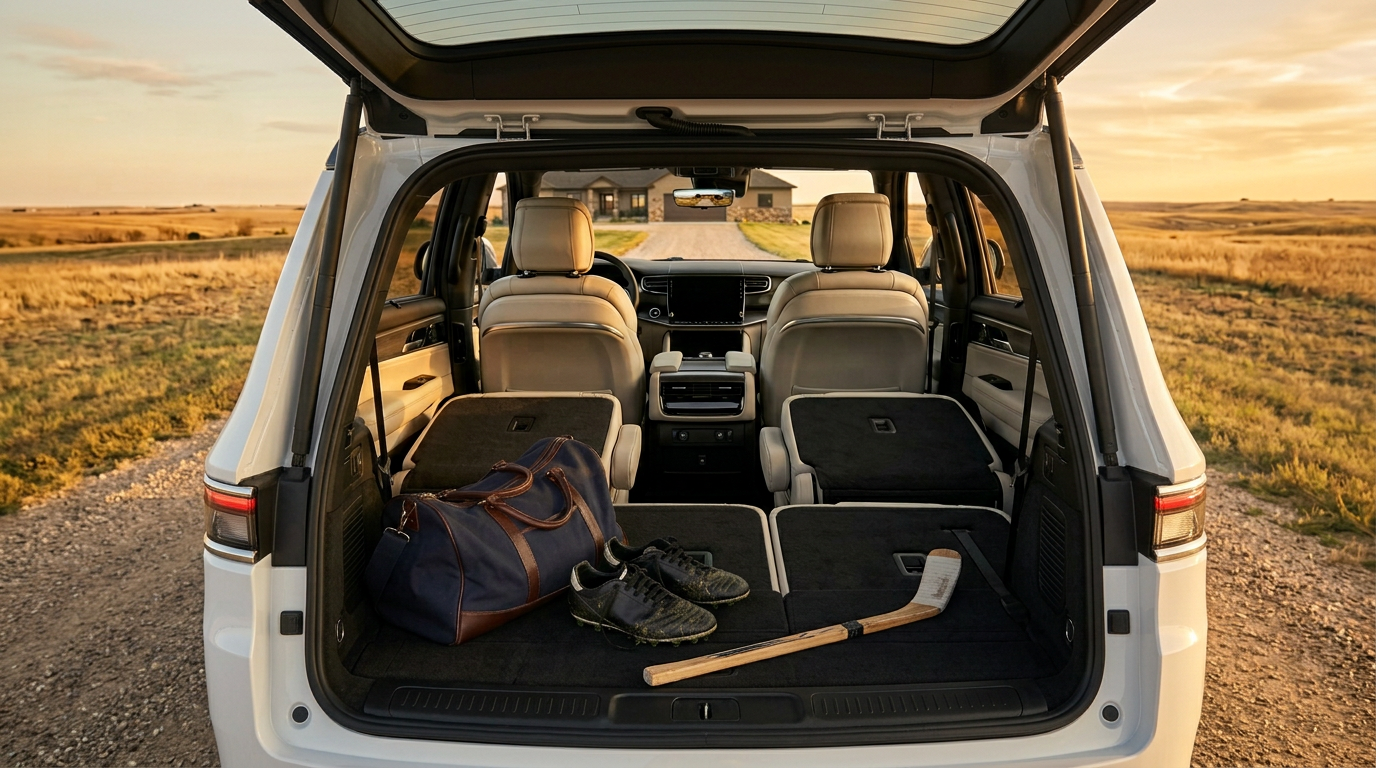
How much cargo space does the Grand Wagoneer L have for family weekends?
Cargo capacity changes a lot depending on what’s folded. Two scenarios cover most family use.
All three rows up — Sioux Falls tournament weekend: The L’s extra 12 inches of body length lives mostly behind the third row. With seven passengers riding, you still have meaningful cargo room — enough for a hockey bag or two, weekend duffels, and a cooler. It’s not unlimited, and a full tournament weekend with sticks, full pads, equipment bags for two players, plus everyone’s overnight bags will fill it. But it’s enough that you don’t need to choose between bringing all the gear and bringing all the people. That’s the entire pitch of the L.
Third row folded — camping or Black Hills weekend: Drop the 60/40 power-fold third row and you have a flat cargo floor that handles a serious load. A weekend in the Hills with a tent, sleeping bags for four, a cooler, camp chairs, fishing tackle, and a couple of bikes on the roof or hitch is well within range. The hands-free power liftgate is standard, which sounds like a luxury feature until you’re loading the back with kids in your hands and a foot-wave to open the gate is the only way you can do it.
Both rows folded — moving day or kids-to-college: Drop both the second-row captain’s chairs (forward) and the third row (flat) and the cabin opens into a long, wide cargo space. It’s not a pickup bed — there’s no open-air freedom and the floor isn’t level with a tailgate — but it handles a college dorm load, a small piece of furniture, or the inventory haul most families occasionally need.
Can the Grand Wagoneer L fit three car seats?
Three car seats is one of the more common questions families ask, and the answer depends on which row-two configuration you order.
Standard configuration — second-row captain’s chairs: The two captain’s chairs each have LATCH anchors and are excellent individual car-seat platforms. With the standard 7-passenger setup, a third car seat goes into the third row. Many families with three young children find this works well — two seated together up in row two for parental access, one in the back for the older child or a forward-facing convertible.
Optional 8-Passenger Seating Package: Replaces the captain’s chairs with a 40/20/40 power tip-and-slide bench. Three car seats across the second row is theoretically possible with this configuration if your specific seats are narrow enough — and modern car seats vary widely in width. Some narrow models (Diono Radian, Clek Foonf, certain Graco models) fit three across; others won’t. If three-across is the goal, bring your actual seats with you and we’ll fit them on a vehicle on the lot before you commit.
For most families with three car seats, the captain’s-chairs setup with a third in row three is the easier solution and keeps row-two access clean for the parent reaching in. The 8-passenger bench is better when you regularly carry seven or eight people and the car-seat phase is closer to ending.
The fastest way to know whether the third row and cargo work for your family is to sit in one and load it up. Stop in and see a Grand Wagoneer L in person.
Contact Beadle’s Chrysler CenterHow comfortable is the Grand Wagoneer L on 4-plus-hour family road trips?
Long-distance comfort is one of the Grand Wagoneer L’s strengths. The 130-inch wheelbase smooths out highway expansion joints and crosswind that bother shorter SUVs, the heated front seats are standard on every trim, and the Active Driving Assist Level 2 hands-free system is included on every 2026 trim — including the entry 4×4 — so the driver gets a real break on long interstate stretches.
For South Dakota families, the math on the 30.5-gallon fuel tank matters more than people realize. At 22 mpg highway, you have real range — Bowdle to Minneapolis at 390 miles is comfortably one tank with margin to spare. Bowdle to Denver at 600 miles is one stop. The 18 mpg combined EPA rating isn’t class-leading, but the long range between fuel stops is meaningful when you’re pushing through the corn belt with a full cabin.
Where the trim choice changes the road-trip experience: heated and ventilated front seats are standard on every 2026 trim, so the base 4×4 already covers that ground. The real upgrades come at Limited (heated second-row seats standard, real wood interior accents) and Summit (massage front seats, premium audio, suede headliner). Air suspension and the McIntosh audio show up through specific package content — Convenience Group I or the Reserve QOP on Limited, standard or via Reserve content on Summit. The base 4×4 is competent for a family road trip; the Limited makes the trip noticeably more comfortable for the second-row passengers, and the Summit makes it noticeably more comfortable for the driver.
The deeper trim breakdown lives in our 2026 Grand Wagoneer L trim guide — that walks through which package adds which feature and which trade-offs are worth the upcharge for family use specifically.
Quick reference: which configuration fits which family
| Family situation | Recommended configuration |
|---|---|
| 2-3 kids, occasional grandparents | Grand Wagoneer L 4×4 with captain’s chairs (standard) |
| 3 young kids in car seats | Grand Wagoneer L 4×4 with captain’s chairs — 2 in row 2, 1 in row 3 |
| Regularly carry 7-8 people (extended family / carpool) | Grand Wagoneer L 4×4 with 8-Passenger Seating Package |
| Long road trips with adult passengers in row 2 | Limited or Summit (heated 2nd-row seats standard) |
| Driver does most miles solo or with co-pilot | Summit (massage seats, ventilated front, premium audio) |
Worth it if: your household uses the third row weekly and your weekend cargo regularly fills the back. The L is the version of this SUV designed for that life.
Skip it if: third row is once-a-month and cargo behind a folded back row is plenty — the standard Grand Wagoneer saves money and parks more easily in tight spots.
How to pick the right Grand Wagoneer L configuration for family use
A simple decision flow that matches the questions families actually ask in our showroom.
- Confirm the L is the right body length for you. If row three rides empty most weeks, the standard Grand Wagoneer saves money. If row three fills regularly with people or cargo, the L pays for itself in usability.
- Sit in row three before you decide. Have an adult ride back there for the full test drive — both directions. Notice how it feels at speed on a highway, not just in the parking lot.
- Pick row-two seating based on your stage of life. Captain’s chairs are easier for car seats and parental access. The 8-passenger bench is better when you carry more passengers or the car-seat phase is winding down.
- Decide on the trim by who rides most. If it’s mostly family with adults in row two, Limited’s heated second row is meaningful. If it’s mostly the driver, Summit’s massage and ventilated front seats add up over a 4-hour interstate run.
- Bring your actual car seats to the test drive. Three-across only works with certain seat models in the 8-pass bench. Verify with the seats your family actually owns — not theoretically.
- Load it up before signing. Bring a hockey bag, two backpacks, a cooler, and whatever else lives in your current vehicle’s cargo area. Confirm the load actually fits before you commit.
Key Takeaways
- The “L” wheelbase adds 7 inches to the chassis and roughly 12 inches to overall body length, with all of it going to third-row legroom and cargo behind the third row.
- The third row is genuinely usable for adults on 2- to 4-hour drives. It is not a long-haul first-class space — over six hours, row-three passengers will feel it.
- Standard 7-passenger captain’s-chair setup is best for most families with three car seats. The 8-Passenger Seating Package adds a 40/20/40 bench for 3-across seating with narrow car seats.
- Heated second-row seats are standard on Limited and Summit, not on the entry 4×4. If row two carries adults on long road trips regularly, the trim upgrade earns its keep.
- Active Driving Assist Level 2 hands-free is standard on every 2026 trim, which makes long interstate drives meaningfully easier on the driver — no subscription required.
Frequently Asked Questions
Is the third row in the 2026 Grand Wagoneer L big enough for adults?
Yes — for 2- to 4-hour drives, the third row is genuinely usable for two average-height adults. The 7-inch longer wheelbase versus the standard Grand Wagoneer goes directly into third-row legroom, and the standard power-fold 60/40 third-row seat includes power recline. For drives longer than four hours or with taller adults, plan to swap riders periodically.
How much cargo space does the 2026 Grand Wagoneer L have with all three rows up?
Enough for a tournament weekend with hockey bags, weekend duffels for seven passengers, and a cooler. The L’s extra body length over the standard Grand Wagoneer goes mostly behind the third row, which is the difference between cargo for groceries and cargo for actual family weekends. With the third row folded down, the cargo floor expands significantly for camping or Black Hills weekends.
Can the 2026 Grand Wagoneer L fit three car seats?
Yes — with two configurations. The standard captain’s-chair setup fits two car seats in row two and one in row three, which works well for most families with three young kids. The optional 8-Passenger Seating Package adds a 40/20/40 power tip-and-slide bench in row two that can fit three car seats across if your specific seats are narrow enough. Bring your actual car seats to the dealership and we’ll verify the fit before you buy.
What’s the new Sea Salt and Black interior in the 2026 Grand Wagoneer L?
Sea Salt and Black is a new-for-2026 lighter two-tone interior color combination available across all four trims, paired with Capri leather. It’s a meaningful aesthetic update from the all-black interior that was the default in 2025. For families, the lighter palette feels less cave-like on long drives and tends to keep cabin temperatures more comfortable in South Dakota summers. The all-Global Black interior remains available if you prefer it.
Is the Grand Wagoneer L comfortable for long drives to Sioux Falls, Rapid City, or Minneapolis?
Yes. The 130-inch wheelbase is genuinely calmer on plains highway crosswind than a shorter SUV, the heated front seats are standard on every trim, and the Active Driving Assist Level 2 hands-free system is standard with no subscription — meaningful on a 4-hour interstate run. The 30.5-gallon fuel tank gives real range; Bowdle to Minneapolis is comfortably one tank with margin. Limited and Summit add heated second-row seats and additional comfort features that earn their keep on regular long drives.
My Take on the Grand Wagoneer L for South Dakota Families
The conversation I have most with families considering the Grand Wagoneer L starts the same way: someone has been driving a Suburban or a Tahoe XL for ten years, the kids are getting bigger, the gear is getting bigger, and the third row that used to be fine is now where the kids fight about who has to sit. They come in thinking they need to step up to a luxury 3-row, and they leave realizing the L solves the actual problem — third row that adults will ride in, cargo that doesn’t force them to choose between people and gear, and Active Driving Assist standard so the driver isn’t worn out by Sioux Falls.
My honest take: for most South Dakota families with kids who play sports, travel for medical appointments to Sioux Falls or Minneapolis, or do summer trips to the Hills, the Grand Wagoneer L 4×4 with the captain’s-chair setup is the configuration that fits real life. If row two carries adults on long drives regularly, the Limited’s heated second row makes those trips meaningfully better. If the driver does most miles, the Summit’s massage and ventilated front seats add up over the year. The 85th Anniversary Edition on the 4×4 is a strong appearance value if the McIntosh audio and three-panel sunroof matter to you and you don’t need air suspension.
For the rest of the 2026 picture — refresh, capability, tech, colors, and safety — read our 2026 Jeep Grand Wagoneer L overview. If you want to dig into how the trim choices map to your specific family use, our 2026 trim guide walks through every package and what it actually adds. And if you’re anywhere near Bowdle, bring the kids and the car seats and load it up. The L answers most family questions on the lot in about 20 minutes.
About the Author
Lexy Tabbert — Beadle’s Chrysler Center, Bowdle, SD
Lexy Tabbert is the Director of Sales and Marketing at Beadle’s Chrysler Center in Bowdle, South Dakota. She covers Ram, Jeep, Dodge, and Chrysler vehicles — helping families, ranchers, and ag operators across the region find the right truck and configuration for their needs. Learn more about Lexy.
Connect with us


