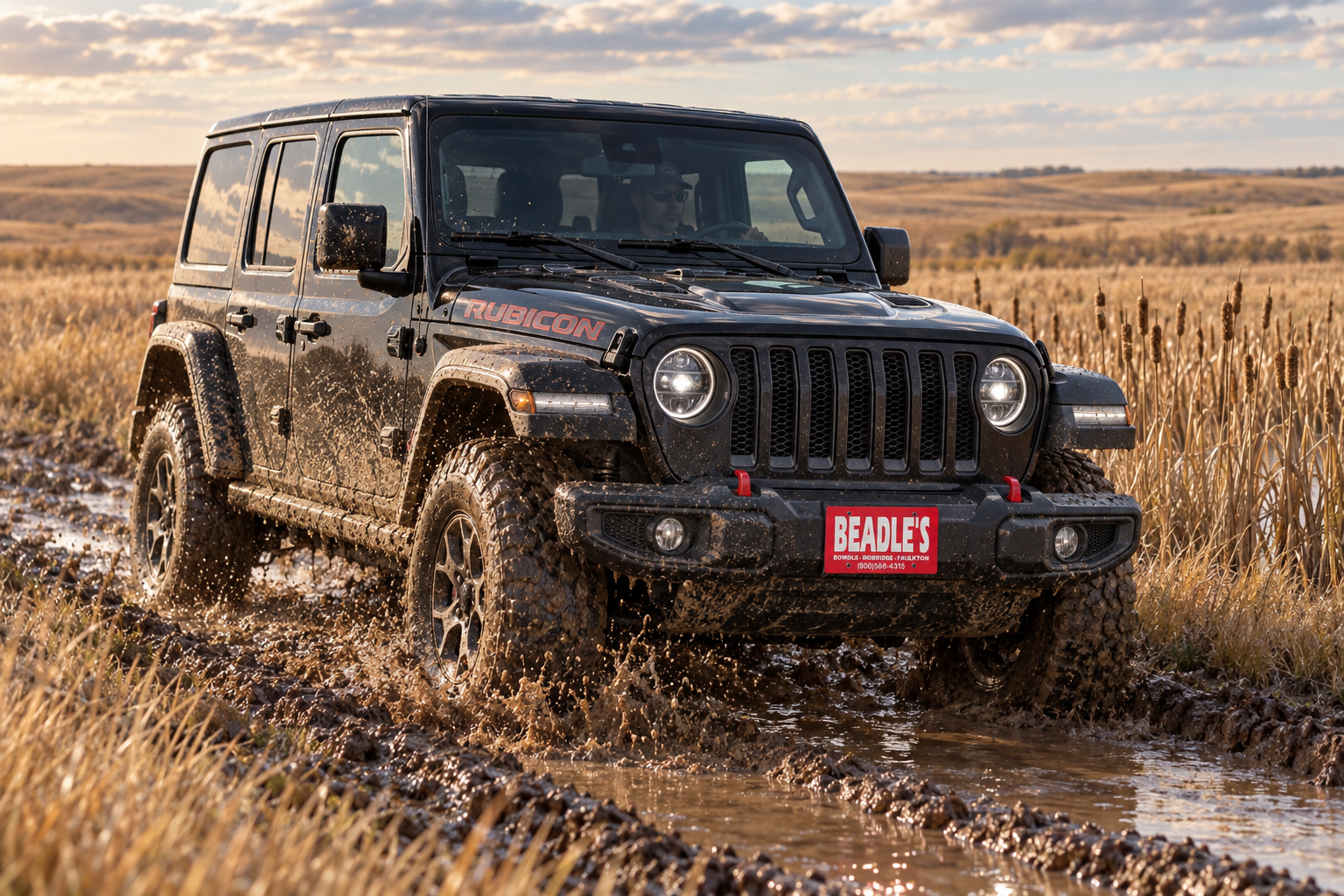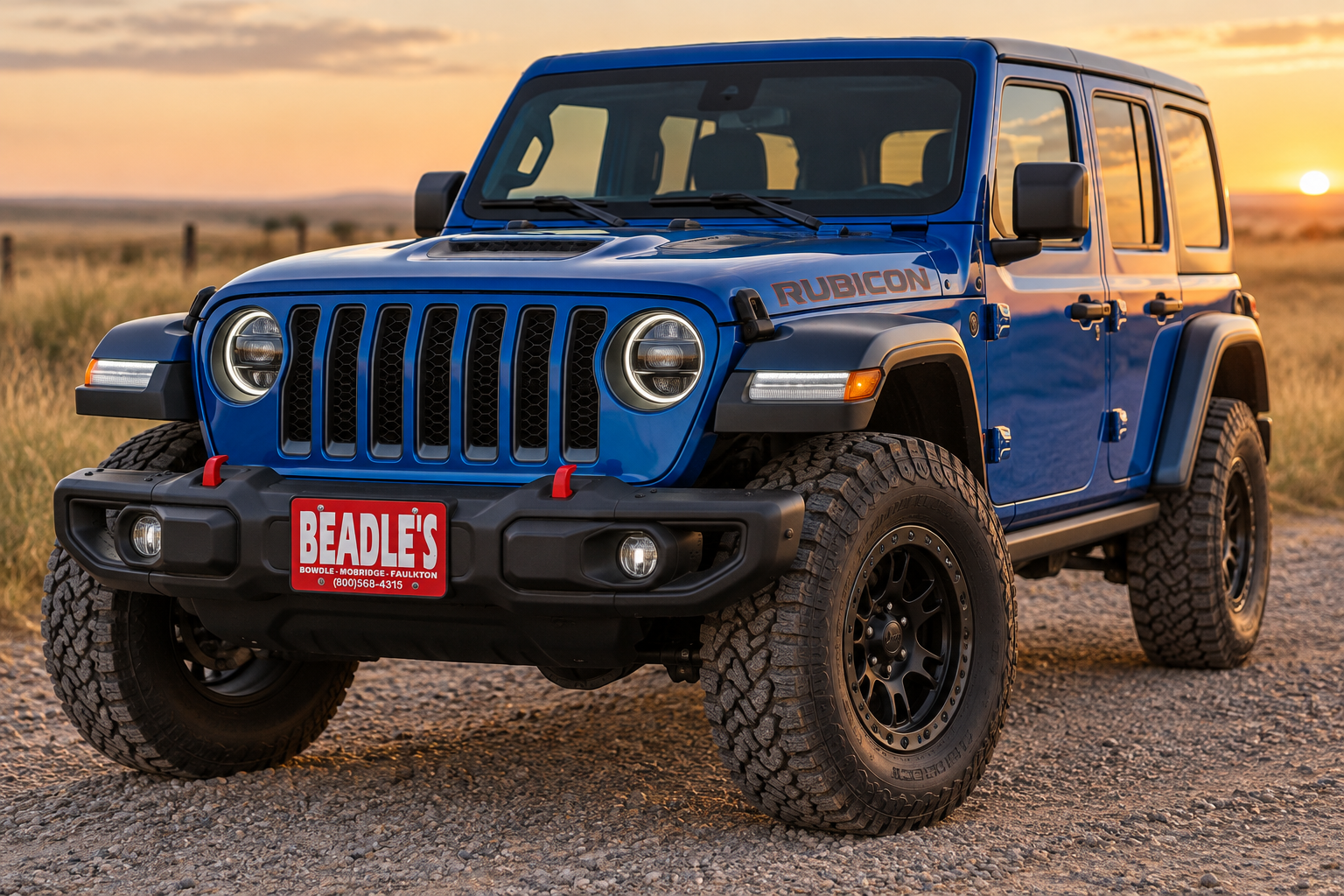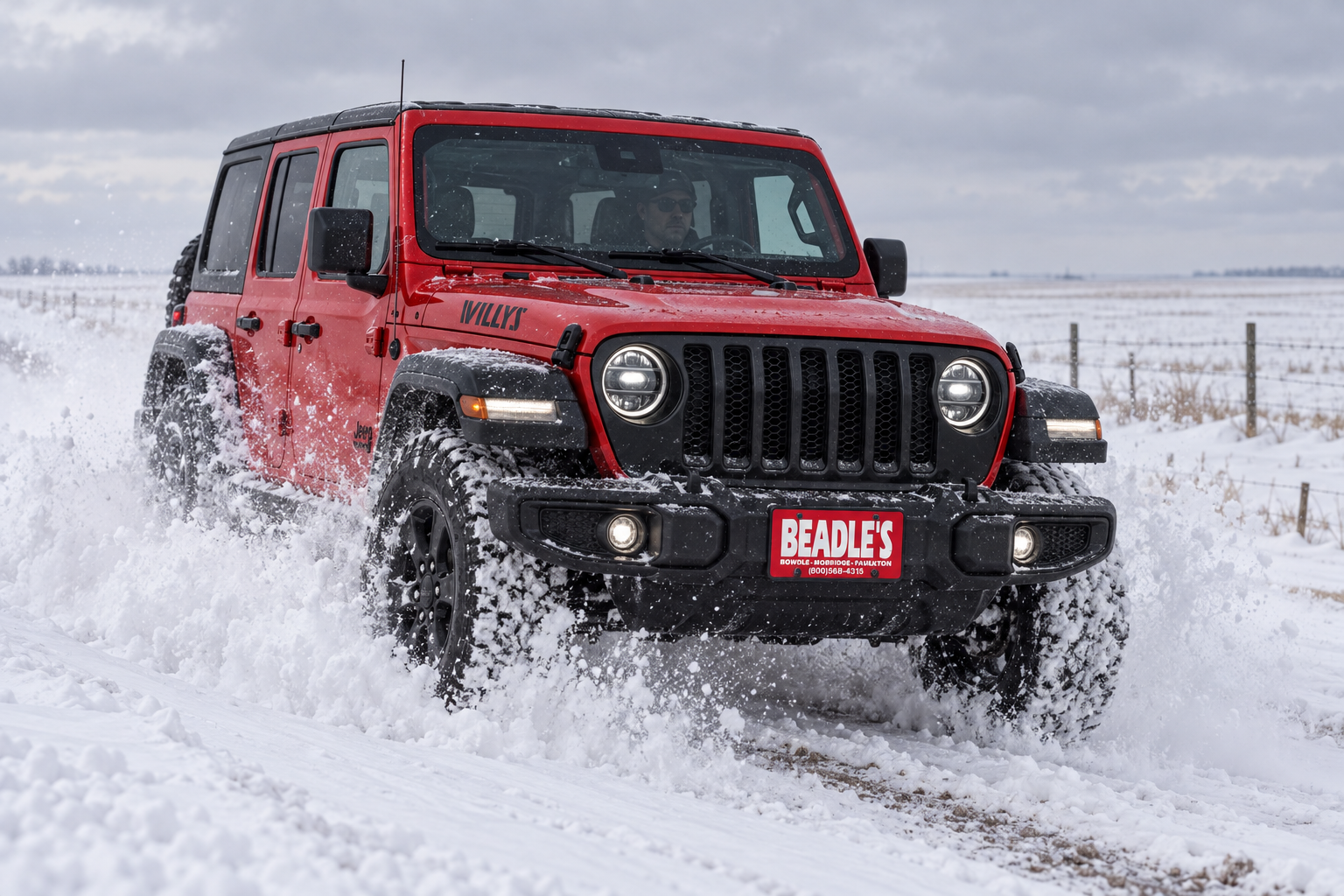





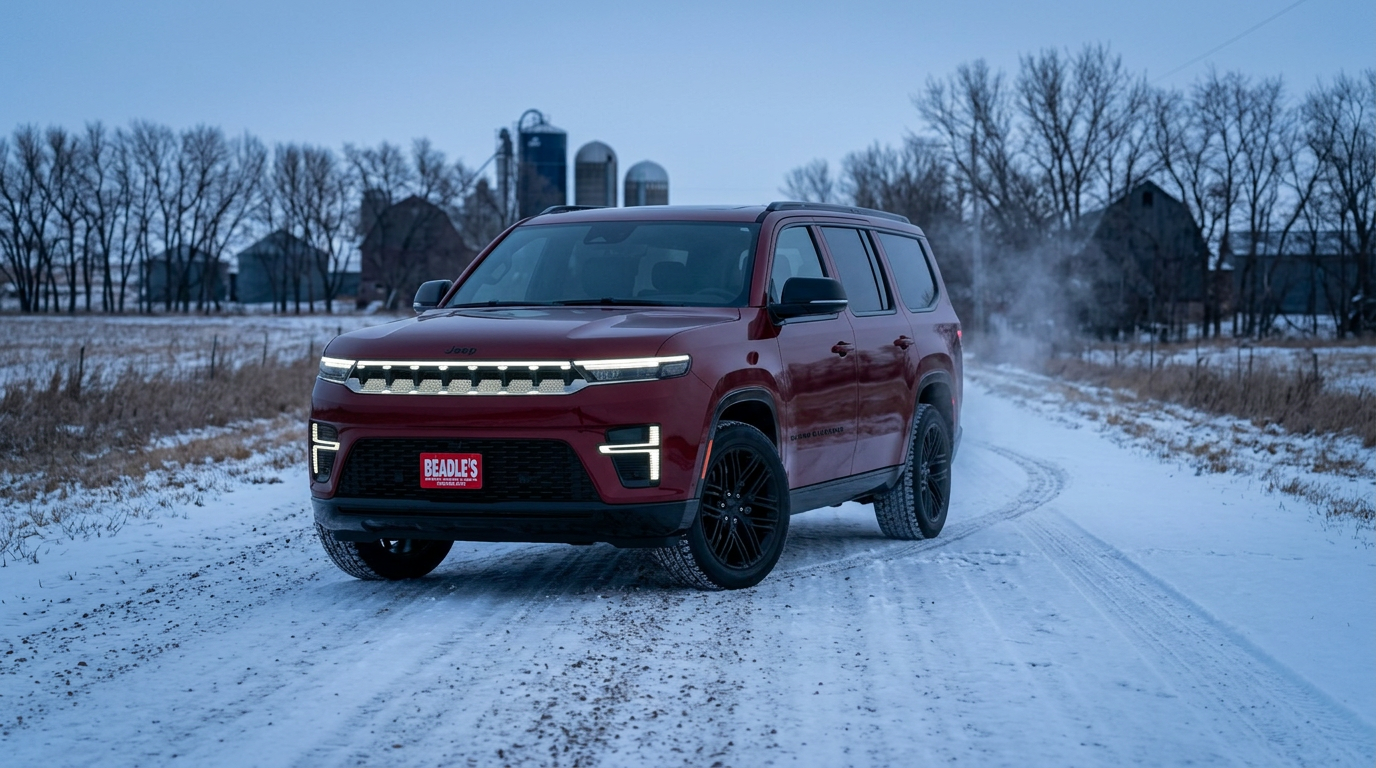
"Winter capable" means something specific in South Dakota that doesn't always show up in Jeep's marketing copy. It means cold starts at -15°F when the wind chill is doubled. It means a wet gravel road that turns into a washboard, then ice, then bare ground in the same five-mile stretch. It means crosswind on US-281 strong enough to push a shorter SUV around between Bowdle and Aberdeen. The 2026 Jeep Grand Wagoneer L handles all of that — but the configuration you choose actually matters, and there are a couple of common questions worth answering before you buy.
This guide covers what to expect from the Grand Wagoneer L on plains-state winter and gravel-road conditions. We'll walk through how the new Selec-Terrain system works (and how it's different from Jeep's old Quadra-Trac system), whether the 4x2 or 4x4 is the right choice for rural South Dakota, why the long-wheelbase body is more stable than you'd think on highway crosswinds, and the small handful of cold-weather considerations that actually move the needle.
On This Page
- What does winter capability actually mean on the South Dakota plains?
- How does Selec-Terrain work — and how is it different from Quadra-Trac?
- Should I get the Grand Wagoneer L 4x2 or 4x4 for rural South Dakota?
- Why does the long-wheelbase platform help on plains highway crosswinds?
- Quick decision: 4x2 vs 4x4 for plains buyers
- How to drive the Grand Wagoneer L safely in South Dakota winter conditions
- Key takeaways
- Frequently asked questions
What does winter capability actually mean on the South Dakota plains?
Most "winter SUV" coverage online is written for either Colorado mountain conditions or Northeast snowstorms. South Dakota plains winter is its own thing. The challenges are different, and the right capabilities are different.
What you actually deal with around Bowdle from late October through April: cold starts at -10° to -25°F with wind chill, plowed county roads with refrozen melt patches, gravel roads that go from dry to washboard to ice and back in the same morning, unplowed driveway approaches after a 6-inch snow, and crosswind on US-12, US-281, and I-90 that's strong enough to make a high-profile SUV feel busy in the lane.
The Grand Wagoneer L was built for this kind of all-condition daily driving — body-on-frame construction, heavy-duty engine cooling standard on every 2026 trim, full-time all-wheel drive available with a single-speed on-demand transfer case (or a two-speed with the HD Trailer Tow Package), and Hill-Start Assist on every trim. Where it stands out for plains use is the long-wheelbase chassis, which we'll get to in a minute. First, the Selec-Terrain question — because the 2026 lineup uses different terminology than older Wagoneer and Grand Cherokee owners are used to.
How does Selec-Terrain work — and how is it different from Jeep's old Quadra-Trac system?
For 2026, Jeep dropped the Quadra-Trac branding on the Grand Wagoneer L. The system that handles four-wheel-drive distribution and terrain modes is now called Selec-Terrain, and the transfer case is described straightforwardly as either a Single-Speed On-Demand Transfer Case (standard on 4x4 trims) or a Two-Speed On-Demand Transfer Case (included when you add the HD Trailer Tow Package).
In practice it works the same way — full-time all-wheel-drive that biases torque to the rear under normal driving and shifts power forward when sensors detect wheel slip. What changed is the dial and the marketing language. If you're trading in a 2024 or 2025 Wagoneer with Quadra-Trac, the actual driving experience is very similar; what's gone is the "Quadra-Trac I / II / Drive II" trim-by-trim distinction.
Drive Modes
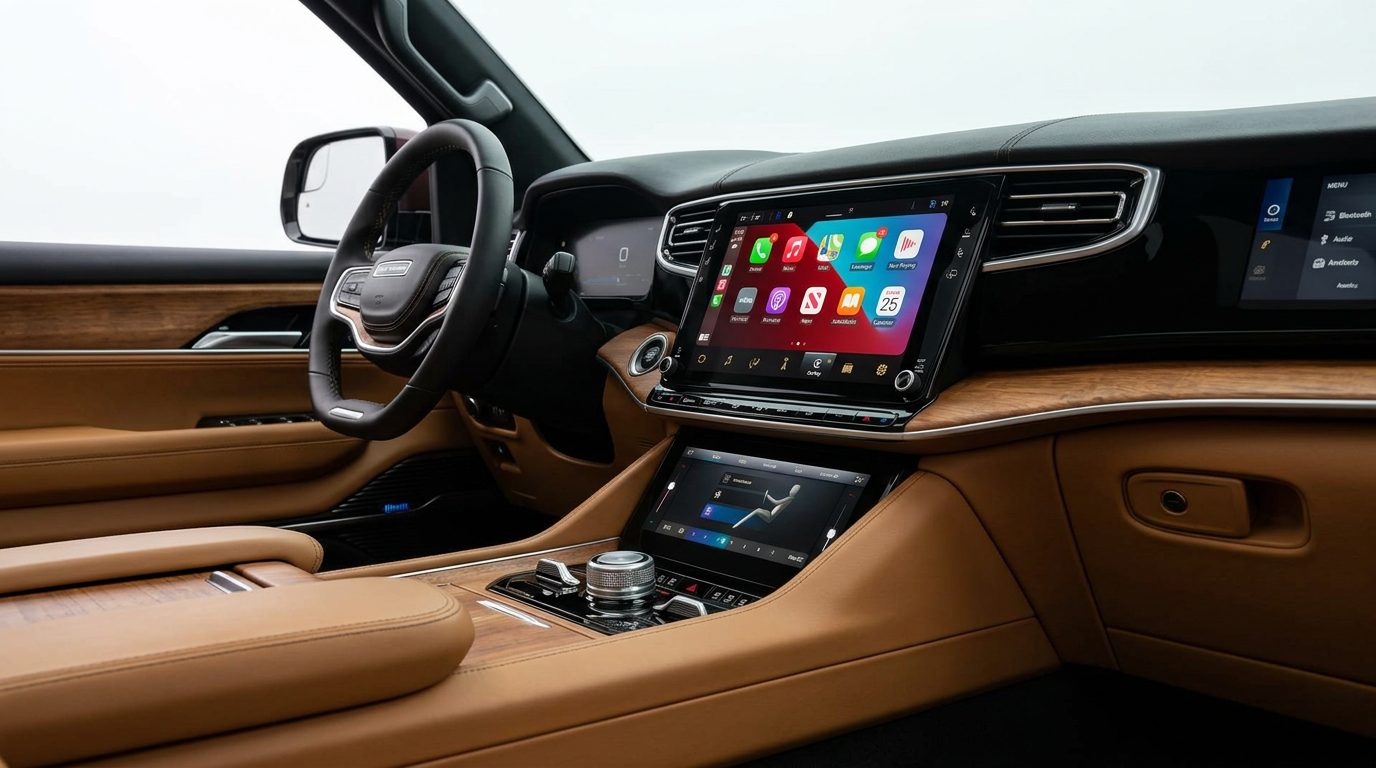
Selec-Terrain on the 4x4 trims includes drive modes covering Auto, Snow, Sand, Mud, and Sport. Auto is the default for plowed county roads, mixed surfaces, and most highway driving. Snow tightens throttle response and shift mapping for traction on packed and freshly plowed surfaces. Sand and Mud are aggressive-traction modes for soft surfaces. The HD Trailer Tow Package adds Selec-Speed Control and the two-speed transfer case for low-range applications (steep grades, heavy loads, or extreme conditions).
For 95% of South Dakota daily driving, you'll leave it in Auto and forget it's there. The system manages itself, and unless you're towing heavy or working a ranch driveway after a serious snow, you won't need to touch the dial. The Trac-Lok anti-spin rear differential and Conventional Front Axle with Disconnect are standard on every 4x4 trim — meaning the system can decouple the front axle when not needed for fuel efficiency, then re-engage when wheel slip is detected.
Should I get the Grand Wagoneer L 4x2 or 4x4 for rural South Dakota?
For Bowdle and the surrounding region, the answer is the 4x4 — and it isn't a close call. The 4x2 (rear-wheel drive) trim exists and saves you a few thousand dollars on the sticker, but it's the wrong configuration for anyone who actually drives a county gravel road in February or has a driveway approach that doesn't get plowed first thing.
There are two practical reasons. First, the 4x2 doesn't include the Selec-Terrain System — that's standard on 4x4 trims (4x4, Limited, and Summit) and not offered on the 4x2. Second, rear-wheel drive on a heavy three-row SUV is genuinely difficult on packed snow and ice; the rear axle gets light when the cabin is loaded, and traction drops fast when you need it most. The 4x2 is a fine choice for buyers who never see snow — Texas, Florida, Arizona — but South Dakota isn't that buyer.
The other piece nobody talks about enough is tires. The Grand Wagoneer L 4x4 ships with all-season tires that are perfectly adequate for plowed highway and dry gravel, but they're not winter tires. If you regularly drive unplowed gravel after a snow, or if your morning commute starts on ice before the county truck has been through, a dedicated set of winter tires (mounted on a separate set of wheels) makes a meaningful difference. We have customers who run all-seasons year-round and customers who swap to winters in November — both are valid; it depends on how often you encounter conditions where traction matters more than tread life.
One small but underrated cold-weather option: the engine block heater (NHK) is a $95 add-on and worth every dollar if you park outside and your overnight temperatures regularly drop below -10°F. The Hurricane Twin Turbo SO will start without it, but a block heater shortens warm-up time, reduces wear on cold starts, and is the kind of thing you only think about when you wish you'd bought it.
Why does the long-wheelbase platform help on plains highway crosswinds?
This one surprises people. A 130-inch wheelbase and a body that's nearly 19 feet long sounds like it would be cumbersome to drive, but it's actually the opposite on a plains highway with a 25-mph crosswind.
The physics: a longer wheelbase means the front and rear axles are farther apart, which damps the side-to-side motion when wind hits the side of the body. Shorter SUVs (the standard Tahoe at 121 inches, the Expedition at 122 inches) react more sharply to crosswind gusts because the wheelbase is shorter relative to the body height. The Grand Wagoneer L's extra 8 to 9 inches of wheelbase translates into a noticeably calmer ride on US-281 between Bowdle and Aberdeen, or on I-90 west of Mitchell, when the wind is pushing.
For long highway drives across South Dakota distances — Bowdle to Sioux Falls (3.5 hours), Bowdle to Rapid City (4.5 hours), or Bowdle to Minneapolis (6 hours) — the L wheelbase is a real comfort factor. It's not just about back-row legroom; it's about how the truck feels under you on a windy interstate at 70 mph with a full cabin.
Quick decision: 4x2 vs 4x4 for plains buyers
| Consideration | Grand Wagoneer L 4x2 | Grand Wagoneer L 4x4 |
|---|---|---|
| Selec-Terrain system | Not offered | Standard |
| Front Axle Disconnect | N/A (RWD) | Standard |
| Snow / ice traction | Limited (RWD) | Strong |
| Unplowed driveway approach | Difficult | Designed for it |
| Starting MSRP zone | Mid-to-high $60s | High $60s (4x4) |
Worth it if: you live in rural South Dakota, North Dakota, Minnesota, Montana, or anywhere with real winter — the 4x4 is the configuration this vehicle was designed around.
Skip it if: you live somewhere with no real winter and never see snow or unplowed roads, in which case the 4x2 saves money and still drives well.
How to drive the Grand Wagoneer L safely in South Dakota winter conditions
A handful of small habits make a big difference on plains winter roads. None of these are unique to the Grand Wagoneer L, but the truck rewards drivers who use them.
- Start the engine and let it warm up briefly. Two to three minutes is plenty — you don't need to idle for fifteen. The Hurricane Twin Turbo runs better once oil is warmed, and modern turbochargers benefit from a short idle before load.
- Use Snow mode on packed and freshly plowed surfaces. It tightens throttle response and shift points for traction. Switch back to Auto once you're on dry pavement.
- Brake early and gently on ice. The anti-lock and stability systems are excellent, but they work best when given time to react. Don't stab the brake.
- Slow down for crosswind on plains highways. The L wheelbase helps, but no SUV is immune to a 40-mph gust on I-90. Reduce speed to 60 mph or below when the wind is pushing.
- Keep at least a half tank of fuel through the winter. The 30.5-gallon tank gives you real range, and a full tank reduces condensation in the fuel system at extreme cold.
- Plug in the block heater overnight if temperatures drop below -10°F (assuming you ordered it). Cuts warm-up time and is gentler on the engine.
Key Takeaways
- The 4x4 is the right configuration for rural South Dakota — the 4x2 doesn't include the Selec-Terrain system and is not designed for snow, ice, or unplowed gravel.
- Selec-Terrain replaces the Quadra-Trac branding on the 2026 Grand Wagoneer L. The system is the same idea, with simpler naming. The HD Trailer Tow Package adds a two-speed transfer case for heavier conditions.
- The 130-inch wheelbase is a real comfort factor on plains highway crosswinds — calmer than shorter Tahoe and Expedition wheelbases on long, windy interstate drives.
- Optional engine block heater ($95, code NHK) is worth ordering if you park outside and temperatures regularly drop below -10°F. Cuts cold-start time and reduces engine wear.
- Dedicated winter tires on a separate set of wheels make a meaningful difference for buyers who regularly drive unplowed gravel after a snow.
Frequently Asked Questions
What's the difference between Selec-Terrain and Jeep's old Quadra-Trac system?
For the 2026 Grand Wagoneer L, Jeep retired the Quadra-Trac I / II / Drive II naming and rebranded the system as Selec-Terrain with a Single-Speed or Two-Speed On-Demand Transfer Case. The driving experience is the same idea — full-time all-wheel-drive that biases torque to the rear under normal conditions and shifts power forward when wheel slip is detected. The HD Trailer Tow Package adds the two-speed transfer case for low-range applications.
Should I get the Grand Wagoneer L 4x2 or 4x4 if I live in rural South Dakota?
The 4x4. It isn't close. The 4x2 doesn't include the Selec-Terrain system, and rear-wheel drive on a heavy three-row SUV is difficult on snow, ice, and unplowed gravel. The 4x2 is a valid choice for buyers in southern climates, but for South Dakota plains use the 4x4 is the configuration this vehicle was engineered around.
Does the 2026 Grand Wagoneer L have a low range or two-speed transfer case?
The 4x4 trims come standard with a Single-Speed On-Demand Transfer Case, which is sufficient for nearly all South Dakota driving conditions. The Two-Speed On-Demand Transfer Case with low range is included when you order the HD Trailer Tow Package. If you regularly tow heavy loads on steep grades or work conditions that genuinely benefit from low range, that's the order to make.
What tires come on the 2026 Grand Wagoneer L for South Dakota winter driving?
The 4x4 ships with all-season tires that handle plowed highway and dry gravel without issue. They're not dedicated winter tires. For buyers who regularly drive unplowed gravel after a snow or commute on ice before the plow has been through, a separate set of winter tires on dedicated wheels is worth the investment. Many of our customers run all-seasons year-round; others swap to winters in November and back in April. Both are valid choices.
Will the Hurricane Twin Turbo engine start reliably in extreme cold?
Yes. The 3.0L Hurricane Twin Turbo SO is designed to start in subzero temperatures, and Engine Stop-Start technology is standard. For buyers who park outside and routinely see overnight temperatures below -10°F, the optional engine block heater ($95, factory code NHK) shortens warm-up time and reduces wear on cold starts. It's not required, but it's the kind of small option that pays back over a 5- to 10-year ownership window in plains conditions.
The best way to feel how the L wheelbase handles plains driving is to drive one. Stop in or schedule a time that works for you.
Search Grand Wagoneer L InventoryMy Take on Driving the Grand Wagoneer L Through a Plains Winter
I have a lot of customers who buy a vehicle in spring and don't think about winter again until the first hard snow in November. The questions I get in late October every year are the same: which mode do I use, do I need new tires, will it start cold? The Grand Wagoneer L makes those answers easier than most SUVs at this price band — the system is forgiving, the platform is heavy enough to feel planted, and the standard equipment list covers the basics every plains family needs.
For families around Bowdle, Aberdeen, Pierre, or anywhere on the South Dakota plains, my real recommendation is straightforward: the 4x4 is the right configuration, the all-season tires are fine for most buyers but worth swapping if you commute on unplowed gravel, and the $95 block heater is the cheapest insurance you'll buy on the truck. Skip the 4x2 unless you're moving to Phoenix.
For the rest of the 2026 picture — refresh, capability, tech, colors, and safety — read our 2026 Jeep Grand Wagoneer L overview. If you want to think about how the L wheelbase changes towing as well as winter stability, our recreational towing guide covers boat, camper, and trailer scenarios for South Dakota recreation. And if Limited or Summit makes more sense for your use case than the base 4x4, our 2026 trim guide walks through what each tier adds. If you're nearby, come drive one. The L wheelbase has to be felt to be understood.
About the Author
Lexy Tabbert — Beadle's Chrysler Center, Bowdle, SD
Lexy Tabbert is the Director of Sales and Marketing at Beadle's Chrysler Center in Bowdle, South Dakota. She covers Ram, Jeep, Dodge, and Chrysler vehicles — helping families, ranchers, and ag operators across the region find the right truck and configuration for their needs. Learn more about Lexy.