




If you walked into this page already planning to buy a three-row SUV, that’s fair. Most families in central South Dakota come into the van conversation sideways — a friend mentioned it, they drove one at a rental counter, or a spouse suggested it after test-driving a three-row SUV for the third time and not quite being satisfied.
This isn’t a sales pitch. It’s an honest comparison. The Chrysler Pacifica is not the right vehicle for every family. But for many families who think they want a three-row SUV, the Pacifica does several important things better — and it’s worth knowing what those things are before you decide. The full specs for the Pacifica are in the 2026 Pacifica overview.
Why do families default to three-row SUVs over minivans?
The short answer is perception. Three-row SUVs have a truck-based or car-based ruggedness image that minivans have spent decades fighting against. Buyers who grew up riding in their parents’ Dodge Caravan have complicated feelings about the category.
The longer answer is that three-row SUVs are genuinely good vehicles with real advantages — ground clearance, optional off-road capability, and a visual presence that reads as “SUV” in a way that matters to some buyers. This guide doesn’t dismiss those preferences. It asks whether they outweigh the practical advantages the Pacifica delivers.
For most families whose primary vehicle job is hauling children, cargo, and gear across South Dakota — the functional comparison doesn’t favor the SUV as cleanly as the perception does.
Are sliding doors actually better than swing doors?
In everyday family use — yes, significantly. This comes up in almost every conversation I have with families comparing the Pacifica to a three-row SUV.
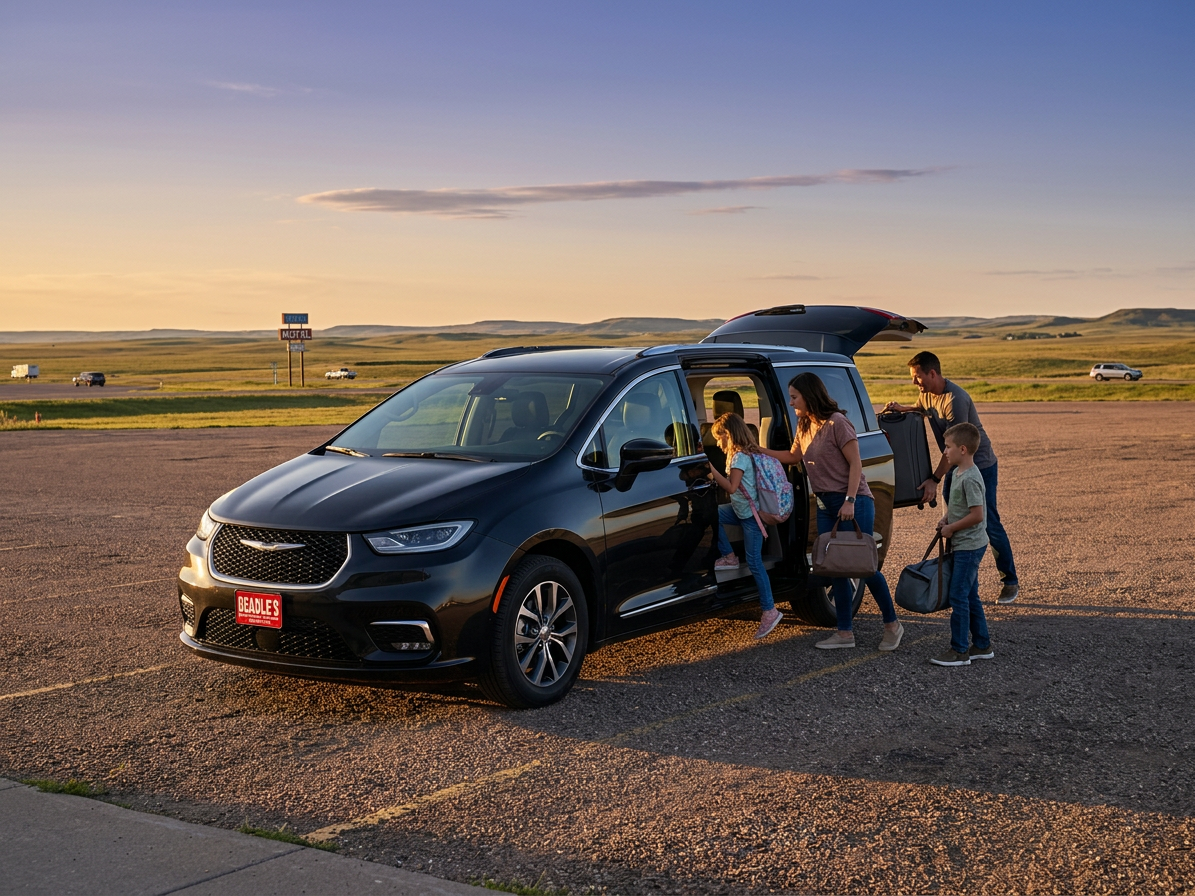
Sliding doors don’t swing into adjacent parking spaces — a real concern in any parking lot where spaces run tight. They don’t catch South Dakota crosswinds and bang into the vehicle next to you. They don’t require children to manage a door they could push too hard or not catch in time.
In winter specifically: a swing door opened in subzero temperatures with a sleeping toddler in your arms, in a parking lot where blowing snow has frozen the gap, in wind — that’s a different experience from sliding a door back along its track with one hand. South Dakota families who switch to a minivan almost universally cite winter door operation as something they didn’t expect to care about and then cared about immediately.
Power sliding doors on the Limited and Pinnacle add hands-free operation via a kick sensor under the rear bumper. On the Pinnacle and via the Theater Family Group on the Limited, hands-free sliding doors are included — useful when you’re carrying groceries or gear and can’t reach the handle.
How does Stow ‘N Go compare to SUV cargo solutions?
Stow ‘N Go is the single most practical cargo feature in the passenger vehicle segment. The third-row seats — and on gas trims, the second-row seats — fold completely flat into recesses in the floor. No seat removal. No storage problem. No trip to figure out where to put the seat you just took out.
On gas Pacifica trims, folding both middle and rear rows gives you a flat, uninterrupted cargo floor roughly 8 feet long. That’s truck-bed-level cargo utility inside a heated, enclosed cabin. Whether it’s hockey equipment, lumber from the hardware store, camping gear for six people, or fishing equipment for a Missouri River weekend — the floor loads flat and the van becomes a cargo van without removing a single seat from the vehicle.
Three-row SUVs handle cargo differently. The third row typically folds flat, but the second row doesn’t go into the floor — it either folds forward against the front seats or tumbles in place, creating an uneven floor. You get cargo space behind the second row, or cargo space with a compromised second row — not a flat floor across the full cabin.
This matters most for families who need full seating on some days and full cargo on others. In an SUV, that transition involves physically moving seats or wrestling with configurations. In the Pacifica, it involves lifting seat cushions and watching the seat disappear into the floor.
How does passenger comfort compare between the Pacifica and a three-row SUV?
Row by row, the Pacifica is the more comfortable vehicle for most passengers most of the time.
Row 1: Comparable — both offer heated seats, tech features, and comfortable front row environments. The Pacifica’s three-zone automatic climate control starts in the first row.
Row 2: The Pacifica has more usable floor space, easier entry via sliding door, and better interior width than most three-row SUVs. The second row is the “prime seating” for children who need car seats — the sliding door opening is wider, car seat installation is easier, and there’s no step-in height that requires lifting.
Row 3: This is where the Pacifica wins most clearly. The third row in a three-row SUV is typically cramped — designed for small children or short adults for short durations. The Pacifica’s third row is genuinely adult-usable for highway trips. There’s meaningful legroom, the floor is flat rather than elevated over the wheel wells, and access through the sliding door is easier than climbing over a folded second-row seat.
For families who regularly seat six or seven adults — cousins at Christmas, carpool duty, athletic team hauling — the Pacifica’s third row is the difference between a comfortable ride and a ride nobody wants to volunteer for.
How does the Pacifica compare on price to a similarly-equipped three-row SUV?
We’re not going to name specific competitors and quote their prices here — those change, and specific configurations vary too much to make direct comparison useful. But the honest general observation is this: a three-row SUV with comparable feature content — AWD, second-row captain’s chairs, leather, rear entertainment, safety tech — tends to carry a higher price than an equivalently equipped Pacifica.
The Pacifica gets you more usable passenger space, a better third row, and superior cargo flexibility for the same or less money than most comparable three-row SUVs at the same feature tier. For families who are value-focused and not committed to the SUV form factor for reasons of preference, the Pacifica is typically the better financial choice.
Where does the Pacifica fall short compared to a three-row SUV?
Being honest about this matters. The Pacifica is not the answer for every family.
- Ground clearance: The Pacifica is a lower-riding vehicle than most three-row SUVs. If you regularly drive unpaved roads with meaningful rutting, high-centering risk, or significant ground clearance requirements, an SUV platform handles it better.
- Off-road capability: The Pacifica offers no lifted suspension, no off-road tires, and no low-range transfer case. It’s not designed for trails or serious unimproved surfaces.
- Towing maximum: 3,600 lbs is best-in-class for minivans but lower than many three-row SUVs. If you regularly tow above that threshold — gooseneck trailers, large campers, heavy equipment — an SUV or truck platform is the right call.
- Perception: Some buyers just don’t want a minivan, and that’s a legitimate preference. There’s nothing wrong with choosing a vehicle partly based on how it makes you feel.
If those factors matter to your household, the SUV is probably the right choice. If they don’t — if your gravel roads are passable, your towing needs are under 3,600 lbs, and you’re open to being practical about what moves a family most efficiently — the comparison looks different.
Who should choose the Pacifica, and who should stick with the SUV?
Choose the Pacifica if: You regularly load and unload children in parking lots. Cargo flexibility between full-seating and flat-floor matters. You seat adults in the third row. Your daily driving is on paved or typical gravel South Dakota roads. You want AWD for winter without truck-level fuel costs. You’re open to a vehicle that does its job extremely well regardless of what segment it’s in.
Stick with the SUV if: You regularly navigate rough terrain with meaningful ground clearance needs. Your towing requirements exceed 3,600 lbs consistently. The form factor is genuinely important to you and not something you’ll get past. You have specific off-road use cases that require an SUV platform.
- Sliding doors win in parking lots, South Dakota winters, and child-loading situations — every day, not just occasionally
- Stow ‘N Go gives you a flat cargo floor without removing seats — no SUV in this class matches that flexibility
- The Pacifica’s third row is genuinely adult-usable for highway trips; most three-row SUV third rows are not
- The Pacifica is typically less expensive than comparably equipped three-row SUVs at the same feature tier
- The SUV wins on ground clearance, serious towing above 3,600 lbs, and off-road capability — be honest with yourself about whether you actually use those things
- AWD is available on Pacifica Select, Limited, and Pinnacle for winter-weather confidence
Common Questions
The honest take
I’ve watched families drive away in three-row SUVs who I think would have been happier in a Pacifica. I’ve also watched families make the right call choosing an SUV because their specific needs — regular off-road access, heavy towing, meaningful terrain — genuinely fit the SUV platform better.
If your primary vehicle job is moving your family around South Dakota efficiently and comfortably, the Pacifica does it better in most situations than any three-row SUV in its price range. If you want to see how it compares on paper, the 2026 Pacifica overview has the full spec picture. If you want to drive one, call us in Bowdle.

Lexy Tabbert is the Director of Sales and Marketing at Beadle’s Chrysler Center in Bowdle, South Dakota. She writes and oversees all vehicle content on this site with one goal: give South Dakota buyers accurate, useful information before they come in. Every spec and figure published here is verified against OEM sources before it goes live. When she’s not writing, she’s working with the team in Bowdle helping families find the right vehicle for the way they actually live and drive.


