




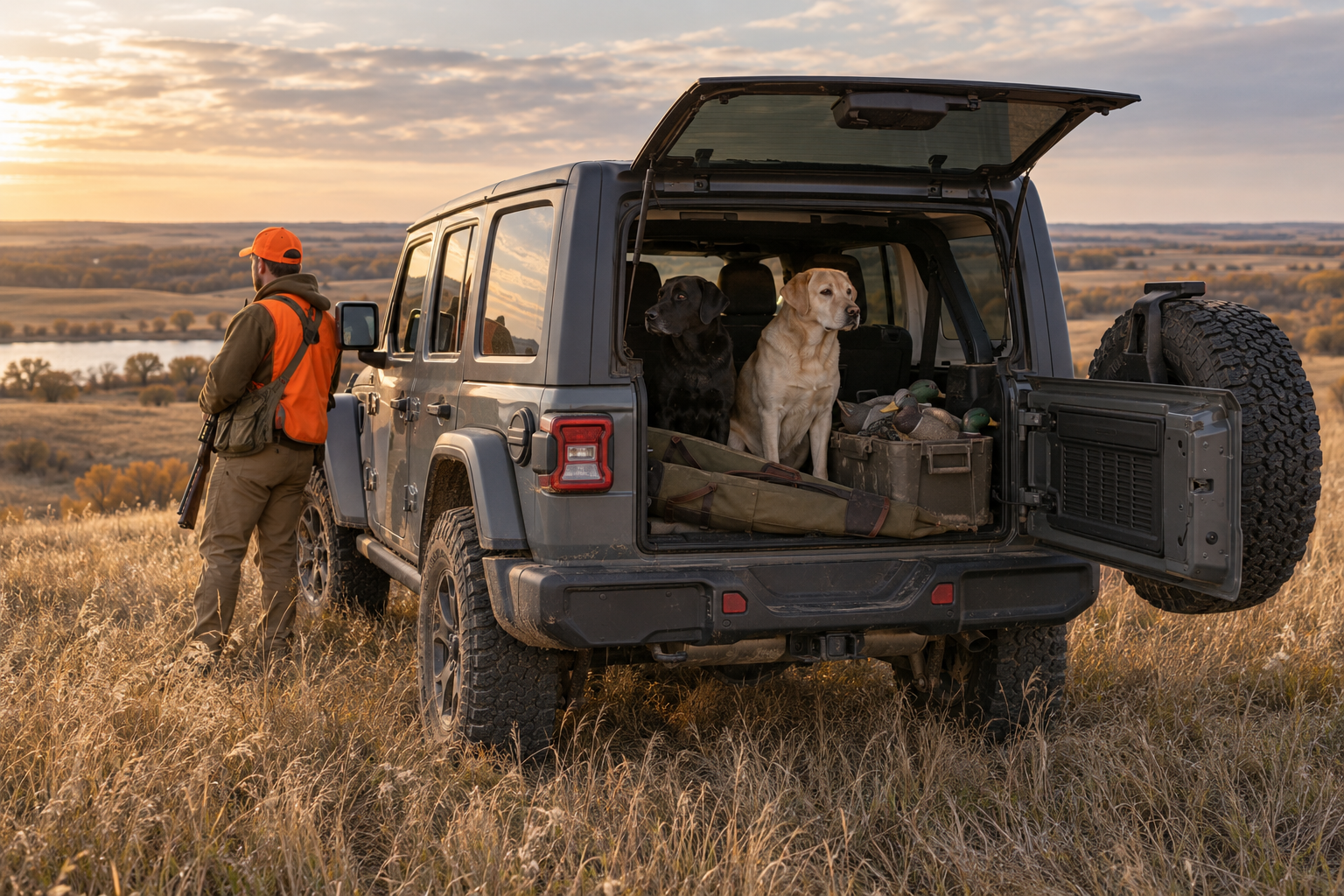
Around here, a Wrangler is rarely bought as a daily driver first. It is bought because there is a story behind it: two Labs, a couple of shotgun cases, a CRP field at the end of a section line on the third Saturday of October, and a boat ramp at Mobridge the rest of the year. The pickup already handles the work. The Jeep is the one that goes where the truck is too long and the side-by-side is not street legal, and it is supposed to be fun doing it.
So the honest question is whether the 2026 Wrangler actually earns that job. Short answer: yes, and better than most people expect, as long as you pick the right trim and tires and go in with clear eyes about cargo and wet dogs. This post covers the hunting side, the Lake Oahe side, which hardware matters for CRP and cattail sloughs, and how the doors and roof really come off and go back on between the September dove hunt and deer opener — from people who sell and service these in Bowdle.
Is the Wrangler a Good Pheasant-Hunting Rig?
Yes. Every 2026 Wrangler has real part-time or full-time 4x4 with a true low range, roughly 10 inches of ground clearance or more, a skid plate under the fuel tank, and a full-size spare on the tailgate — which is exactly the list you want when the "road" into a walk-in area is a pair of ruts through waist-high grass.
What makes it a good hunting rig is not any one feature; it is that the whole vehicle is short, tall, and built to be driven somewhere the county does not maintain. A 4-Door turns around in a field approach where a crew-cab pickup needs a three-point plan. It crosses a washed-out section-line ditch without dragging its belly. And the tailgate-mounted spare means the cargo floor stays flat for a kennel or a dog mat instead of hiding a jack under everything you packed.
Now the honest part, because the neighbor who has owned three of them would tell you. Cargo behind the second row of a 4-Door is real but it is not a pickup bed: two Labs and a couple of gun cases and a cooler fit; two big kennels, four hunters, and a week's worth of gear do not. A wet dog in a closed cabin smells like a wet dog in a closed cabin. And after a muddy morning in a slough bottom, the floor will need a hose and the seats will need a towel. None of that changes the answer. It just tells you to plan the cargo area before opener instead of the morning of.
Late-season hunting adds one more question: the top. A soft top is fine in October and gets loud and drafty by December. If your hunting runs into the cold months, our Wrangler winter guide covers the hardtop, heat, and traction question in full.
Which Trim and Tires for CRP, Cattail Sloughs, and Mud?
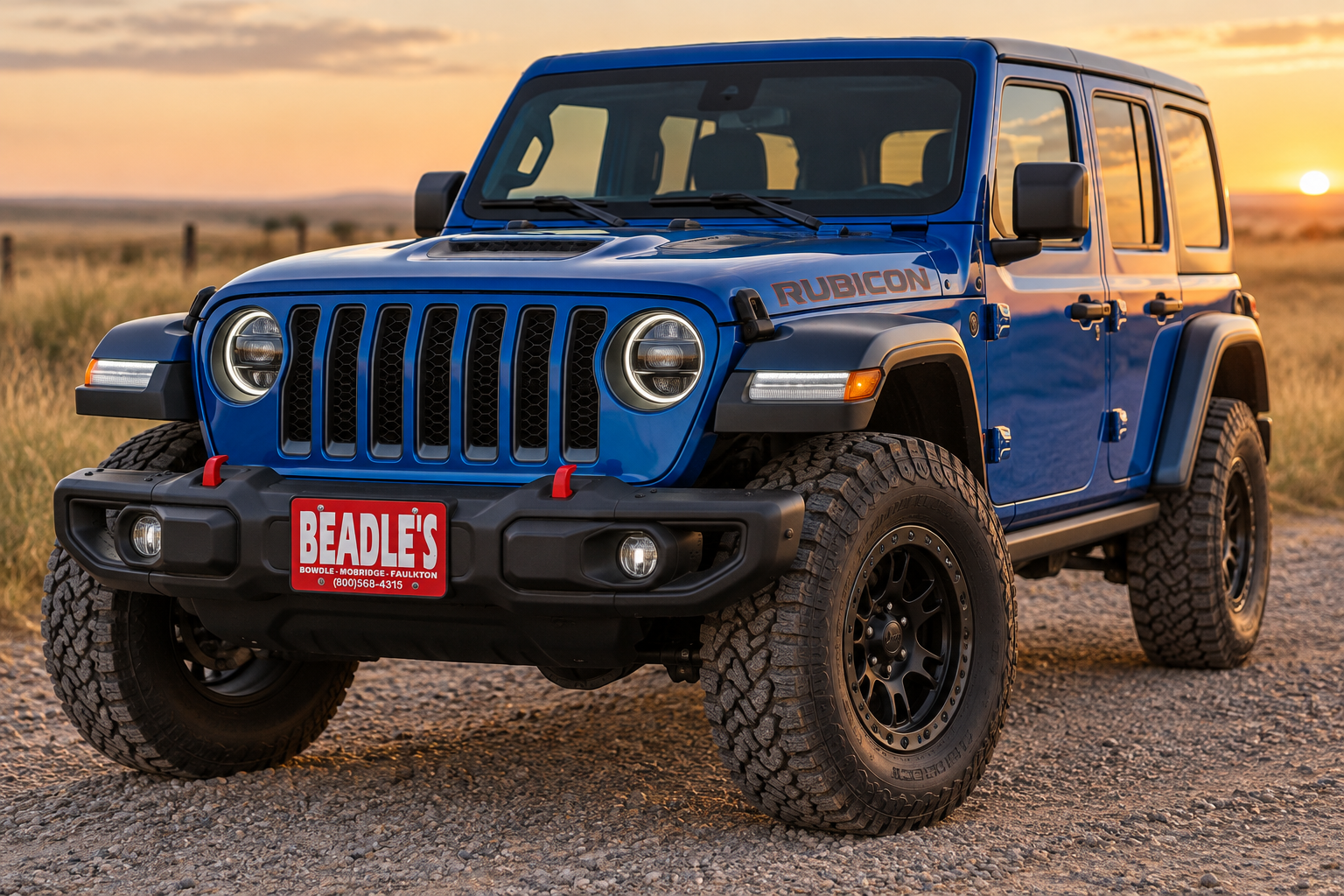
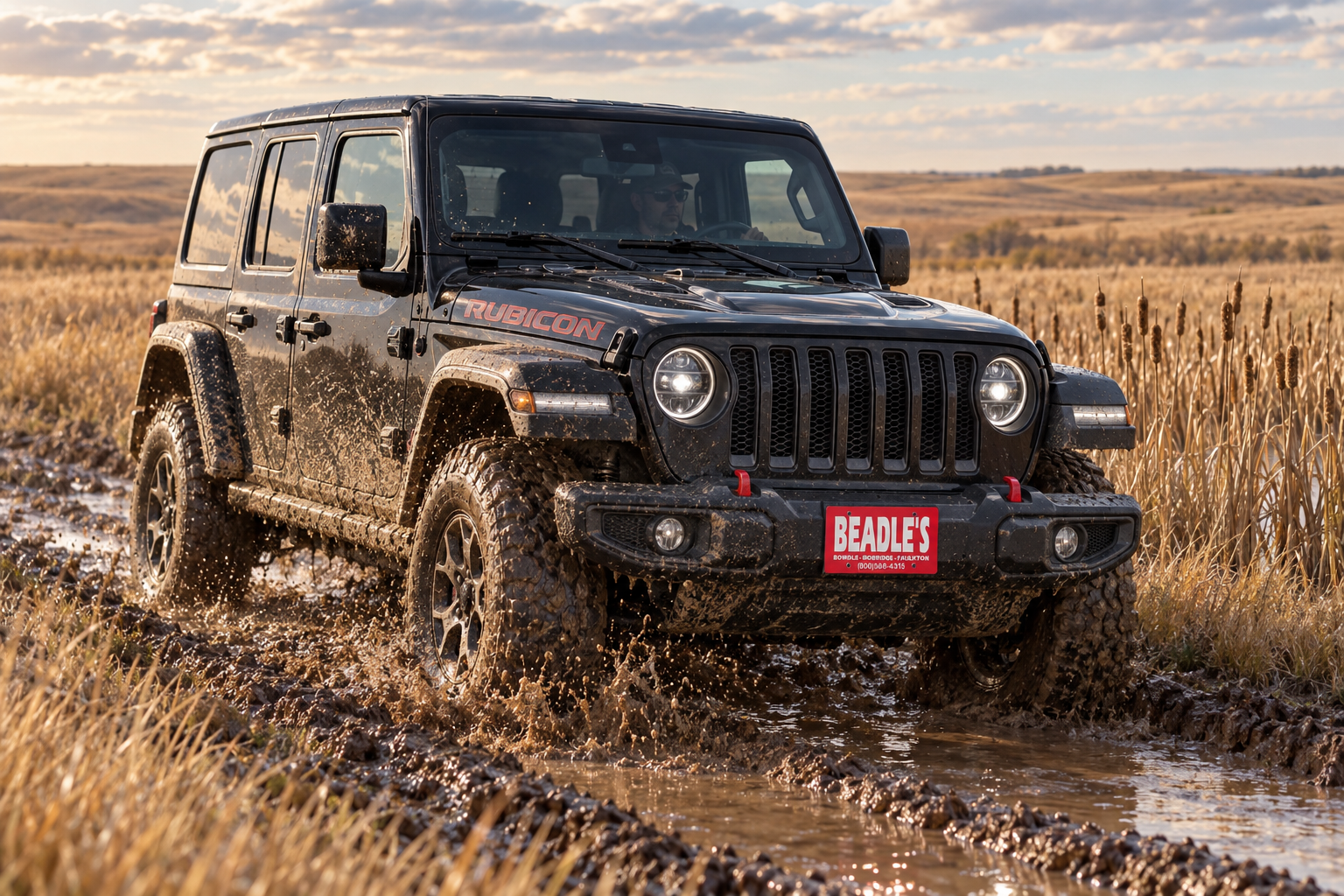
For most hunters around Bowdle, the Willys is the sweet spot: it adds all-terrain tires and a locking rear differential to the Sport's Command-Trac 4x4, which is the hardware that matters most on wet CRP edges and slough two-tracks. The Rubicon is the pick if you regularly push into the soft bottoms, because its 33-inch tires, front and rear lockers, sway-bar disconnect, and 4:1 low range are built for exactly that.
| Trim | 4x4 and Traction | Tires | Where It Fits for Hunting |
|---|---|---|---|
| Sport / Sport S | Command-Trac part-time, 2.72:1 low range | 245/75R17 all-season | Gravel, field approaches, dry CRP; plan on a tire upgrade for mud |
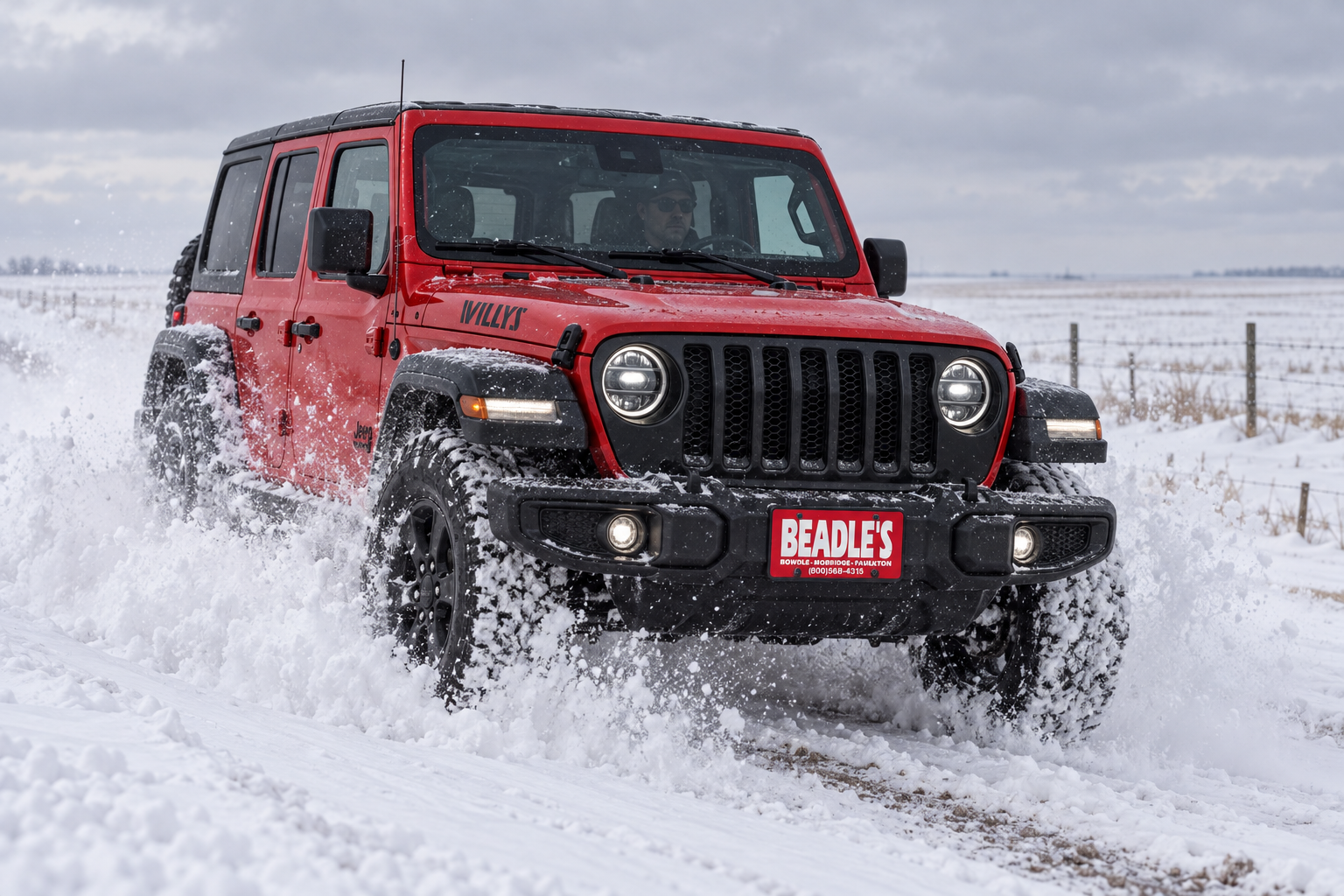
| Willys | Command-Trac, 2.72:1, locking rear differential | 245/75R17 all-terrain | The hunting value pick: slough edges, wet two-tracks, cattail margins |
| Sahara | Selec-Trac full-time, 2.72:1, can stay in 4-Auto | 255/70R18 all-season | The comfortable daily that still hunts; swap tires if you chase birds in the wet |
| Rubicon / Rubicon X | Rock-Trac, 4:1 low range, front and rear lockers, sway-bar disconnect | LT285/70R17 (33-inch) off-road; 35s available | Slough bottoms, river-bottom timber, anywhere you would otherwise turn around |
Ground clearance is roughly 10 inches on Sport and Sahara, about 10.8 inches on a Rubicon with the 33s, and about 12.9 inches with the 35-inch tire package. On a CRP two-track that last inch or two is the difference between the skid plate riding over the center hump and the center hump riding on the skid plate. Tires matter at least as much: the Sport's all-seasons are fine on gravel and dry stubble and will pack full of gumbo the first time you get greedy at a slough. The trim guide explains each trim's hardware as hardware if you want the full breakdown.
Sloughs are where you learn to stop
A cattail slough bottom in a wet fall is gumbo over water, and no locker fixes that once you are in it. Lockers and low range let you get out of the soft edge you eased into; they do not let you drive across the middle. Park on the firm ground, walk the last fifty yards, and keep a tow strap and a buddy with a truck in the plan. The Wrangler will get you closer than anything else you own — it just cannot repeal physics.
How Do the Doors and Roof Come Off, and Where Do You Put Them?
The two front roof panels — the Freedom panels on a hardtop — lift off in about a minute with no tools, the soft top folds back over the front seats, and the full metal doors come off their quick-release hinges in a few minutes each with a helper. The windshield folds too. The whole point is that a September dove hunt with the doors off and a November deer opener with everything buttoned up are the same Jeep.
On a hardtop, the two front panels are the ones you will actually take off on a regular basis: pop the latches, lift them out, and you have open sky over the front seats. The full three-piece hardtop can come off entirely, but that is a two-person job in the shop, not something you do in a field approach. On the standard Sunrider soft top (Sport, Sport S, Willys, and Rubicon), the front section flips back like a big sunroof in seconds, and the whole top folds down when you want it. The Dual Top Group gets you both, which is the setup a lot of hunters around here end up with: soft top for September through the early season, hardtop bolted on for the cold months.
The doors are simpler than people expect. Every trim has full metal doors on quick-release hinges: unplug the wiring connector, undo the check strap, lift straight up, and the door comes off. Having a second set of hands the first few times saves your paint and your back. Reinstalling is the same in reverse.
Storage is the part nobody thinks about until the doors are leaning against the lawn mower. Doors go on an old blanket along the shop wall, or on a simple hanging rack, hinge-side up so nothing bends. Roof panels stack flat somewhere dry; ask us about a padded storage bag for them. And put it all back on before the first real cold snap — a doors-off October morning is glorious and a doors-off November morning is a bad decision you only make once.
Will It Handle a Lake Oahe Boat Ramp and Shoreline Two-Track?
Yes, and the boat ramp is where a Wrangler makes its case better than almost anywhere. Every trim has a real low range for pulling a boat out on a slimy ramp, the short wheelbase makes backing a single-axle trailer straightforward, and the ground clearance and 4x4 handle the low-water shoreline two-tracks that show up when Oahe drops in late summer.
At the Mobridge-area ramps, the problem is never the pavement; it is the green slime below the waterline and the wet gravel above it when the lake is down. Shift into 4-Low before you back down, and the Jeep will walk a loaded boat trailer up the ramp at idle without spinning a tire. A Sahara's Selec-Trac adds a nice wrinkle for lake days: you can leave it in 4-Auto on the wet pavement around the ramp and parking lot without worrying about binding, then drop to low range for the pull.
Shoreline two-tracks are a different kind of driving. The ruts are usually dried mud that turns slick after a rain, there is always a washout you did not see last year, and the approach to a good bank-fishing spot often means a short, steep pitch over rocks. A Willys on its all-terrains handles most of it; a Rubicon on 33s handles all of it with the sway bar disconnected so the front axle can flex over the rough spots. Either way, the full-size spare on the tailgate means a sidewall cut from a sharp rock is an inconvenience instead of a phone call.
The one thing to be honest about is the trailer behind you. A properly equipped 4-Door is rated to tow 3,500 pounds and a 2-Door 2,000 pounds, which covers most 16-to-18-foot aluminum fishing boats on a single-axle trailer and does not cover a big walleye boat on a tandem. Our towing guide walks through the ratings, the tow package, and how to weigh your rig before you count on the Jeep for lake duty.
How to Set Up a Wrangler for Pheasant Opener
A little prep the week before opener keeps the Jeep from being the thing you are thinking about when the roosters get up. This is the list I would work through.
- Put the doors and roof back on if they came off for dove season, and check that the panels are latched tight. October mornings in a CRP field are cold enough without a draft.
- Set up the cargo area: a rubber mat or a kennel behind the second row, gun cases flat on top or along the side, cooler and vest bag where a wet dog cannot sit on them.
- Check the tires and the spare: proper pressure on all five, including the full-size spare on the tailgate, and look for any sidewall damage from the summer's shoreline trips.
- Pack the recovery kit: a tow strap, a shovel, and a pair of gloves live in the Jeep from opener through the end of deer season. The tow hooks are there for a reason.
- Use 4-High on the gravel in, 4-Low at the slough: part-time 4x4 on Sport, Willys, and Rubicon is for loose surfaces, not dry pavement. Shift to low range before the two-track gets soft, not after.
- Hose it out the same day: mud, feathers, and dog hair come out easily when they are fresh and stubbornly when they are a week old.
Willys or Rubicon for a Hunting and Lake Rig?
| Consideration | Willys | Rubicon |
|---|---|---|
| Lockers | Rear | Front and rear, plus sway-bar disconnect |
| Low range | 2.72:1 Command-Trac | 4:1 Rock-Trac |
| Tires | 245/75R17 all-terrain | 33-inch off-road (35s available) |
| Ground clearance (approx.) | About 10″ | About 10.8″ (about 12.9″ on 35s) |
| Boat ramp hitch | Add the tow group | Class II hitch standard |
Worth it (Rubicon) if: you hunt slough bottoms and river-bottom timber, you drive the shoreline two-tracks at low water, or you want the front locker and the 33s from day one instead of adding tires later.
Skip it (get the Willys) if: most of your hunting is walk-in CRP off a gravel approach and your lake days are ramp-to-ramp — the Willys' all-terrains and rear locker cover that, and the difference stays in your pocket.
Key Takeaways
- Every 2026 Wrangler has real 4x4 with a low range, about 10 inches or more of clearance, a fuel-tank skid plate, and a full-size spare on the tailgate — the right list for CRP and slough two-tracks.
- The Willys (all-terrains plus a rear locker) is the hunting value pick; the Rubicon (33s, front and rear lockers, sway-bar disconnect, 4:1 low range) is for the soft bottoms.
- Freedom panels lift off in about a minute with no tools; doors come off their quick-release hinges in a few minutes each. Store doors on a blanket or a rack and put everything back on before the cold.
- At a Lake Oahe ramp, shift to 4-Low before you back down; a 4-Door is rated for 3,500 pounds with the tow group.
- Lockers get you out of a slough edge, not across the middle. Park on firm ground and walk the last fifty yards.
Frequently Asked Questions
Will two Labs and my gear fit in the back of a 4-Door Wrangler?
Two dogs behind the second row with gun cases and a cooler is a normal load for a 4-Door, and the flat floor with the spare on the tailgate helps. Two large kennels plus four hunters and a week of gear is a pickup job. Bring your kennel to the lot and try it; that answers the question faster than any spec.
Do I need a Rubicon to hunt pheasants in South Dakota?
No. A Willys with its all-terrain tires and locking rear differential handles walk-in CRP, gravel approaches, and most slough edges. The Rubicon's front locker, 33-inch tires, sway-bar disconnect, and 4:1 low range earn their keep in soft slough bottoms and river-bottom timber.
How long does it take to get the doors off a Wrangler?
A few minutes per door once you have done it a couple of times: unplug the wiring connector, undo the check strap, and lift the door off its quick-release hinges. The front Freedom panels on a hardtop come off in about a minute with no tools. A helper makes both jobs easier on your paint.
Is a soft top okay for late-season hunting?
It works, but it is louder and draftier once the real cold sets in, and it does not hold heat like the hardtop. If your hunting runs through December, a hardtop or the Dual Top Group is the better setup, along with heated seats and a heated wheel where the trim offers them.
My Take on the Wrangler as a Hunting and Lake Rig
This is the Wrangler at its best. It is not the comfortable choice or the sensible choice, and nobody around here pretends it is; it is the vehicle that gets you to the far corner of the CRP before daylight and up the ramp at Mobridge with the boat behind it, and then does it again with the doors off in July. The hardware is real, and on our roads it earns its keep.
If I am helping a hunter who mostly walks public ground off a gravel approach, I point them at a 4-Door Willys and tell them to spend the savings on a good kennel and a set of winter tires. If they hunt the sloughs hard or run the shoreline two-tracks all summer, the Rubicon is worth it and I say so. Either way, I tell them to try the doors and the roof panels on the lot before they buy, because the first time the front panels come off in about a minute is usually the moment the decision gets made.
The full rundown on trims, engines, tops, towing, and winter is in our 2026 Jeep Wrangler guide. And if you are anywhere near Bowdle before opener, stop by Beadle's Chrysler Center, bring the dogs, and we will see how they fit.
About the Author
Lexy Tabbert — Beadle's Chrysler Center, Bowdle, SD
Lexy Tabbert is the Director of Sales and Marketing at Beadle's Chrysler Center in Bowdle, South Dakota. She covers Ram, Jeep, Dodge, and Chrysler vehicles — helping families, ranchers, and ag operators across the region find the right truck and configuration for their needs. Learn more about Lexy.