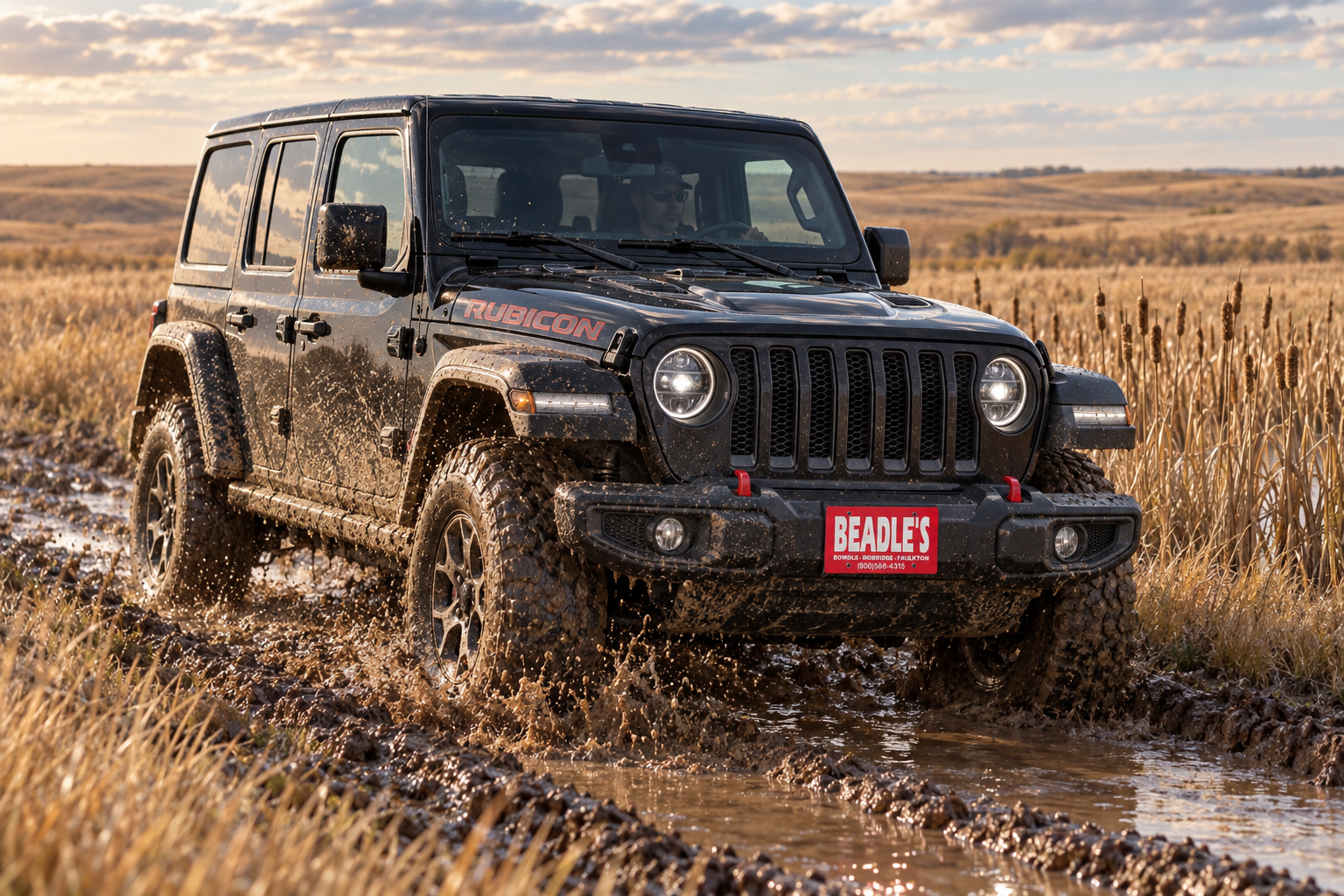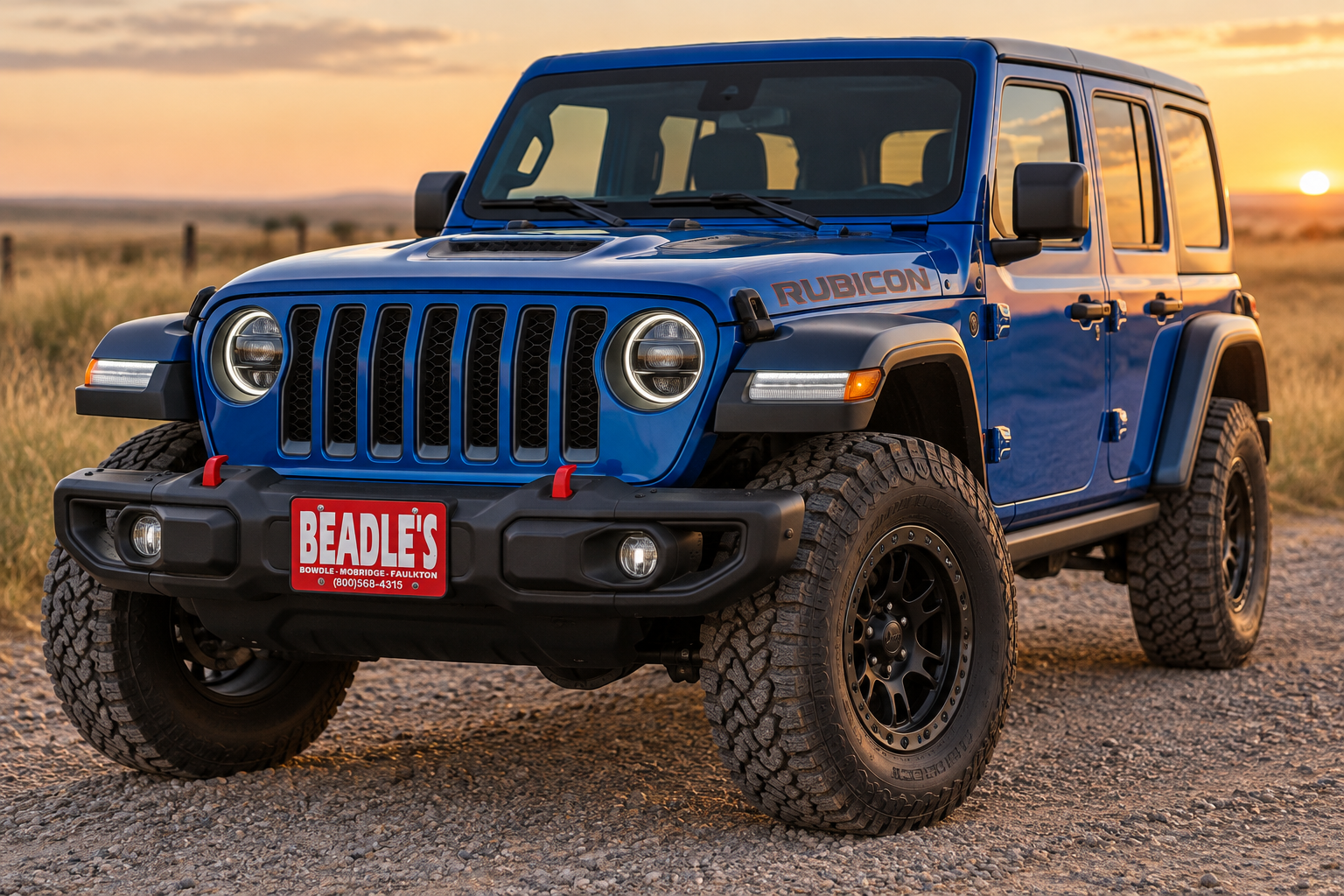





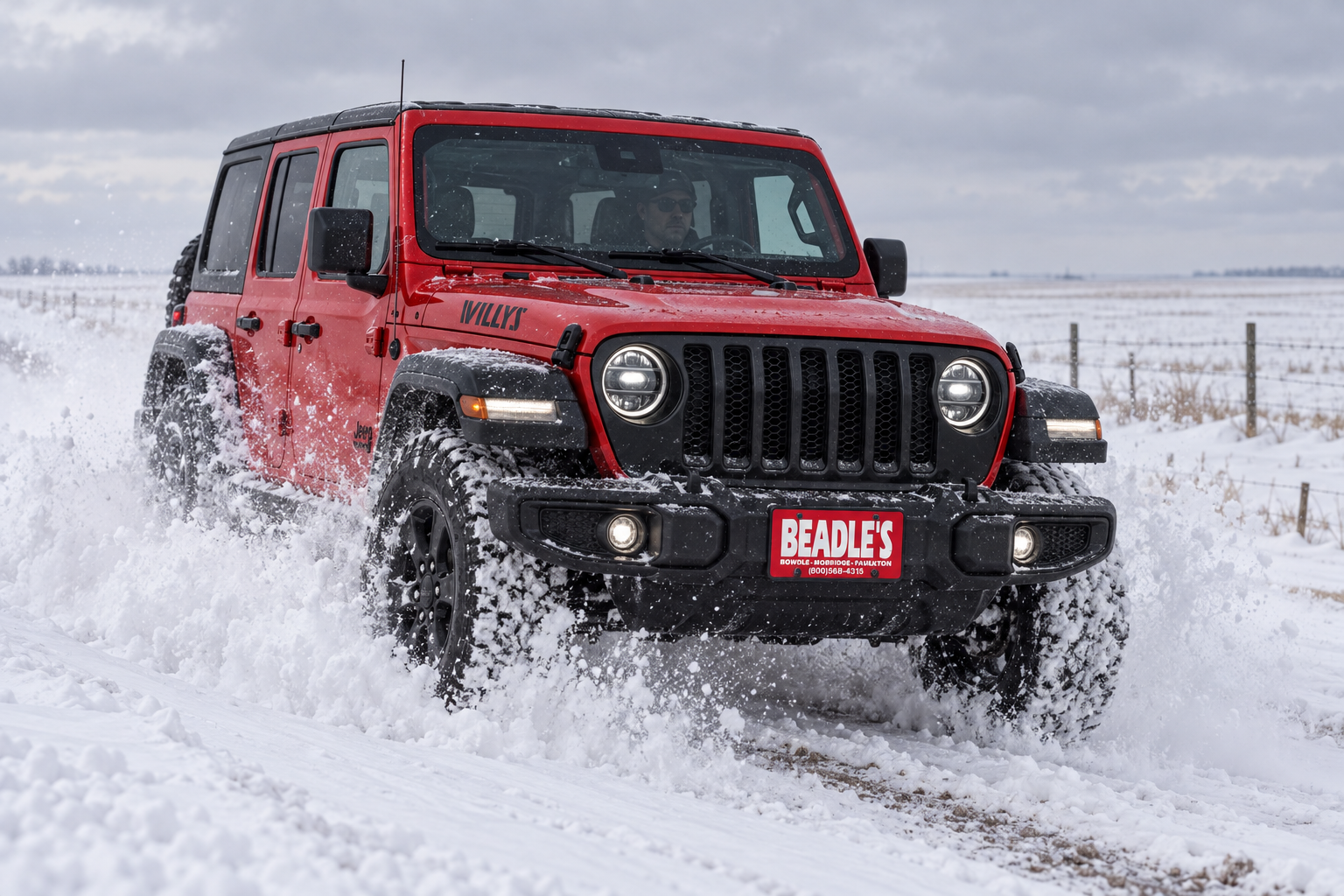
Every fall, right around pheasant opener, somebody in the showroom asks me some version of the same thing: I have always wanted a Wrangler, but is it a real winter vehicle out here, or is it a summer toy I park in December? They usually already own a Ram or an F-150. The Wrangler is going to be the second rig — the hunting rig, the lake rig, the one they finally get to buy — and they need to know it will start at 20 below and get them to Selby on an unplowed section line.
Short answer: yes, the Jeep Wrangler is a legitimately good winter vehicle, with two honest caveats about the top and the tires. I have owned three of them through central South Dakota winters, and this guide walks through what actually matters — soft top versus hardtop when it is 20 below, which trims get heated seats and remote start, which 4x4 system you want for a drifted township road, and what rubber comes on each trim — from people who plow out and drive them in Bowdle.
On This Page
Is the Wrangler a Real Winter Vehicle or a Summer Toy?
It is a real winter vehicle. Every Wrangler leaves the factory with a true 4x4 system that has a low range, solid axles at both ends, about 10 inches of ground clearance on a base Sport, a skid plate under the fuel tank, and a full-size spare bolted to the tailgate. That is more winter hardware than most of the crossovers in the church parking lot.
The reason it gets down an unplowed township road when a car will not comes down to three things. First, clearance: the ridge of packed snow between the tire tracks is what high-centers a car, and a Wrangler rides above it. Second, the transfer case: shifting into 4-High puts real drive to the front axle instead of asking a clutch pack to guess. Third, short overhangs: the nose does not stuff itself into a drift the way a long-hooded sedan does, so the Wrangler climbs over the drift instead of plowing into it. I have crossed drifts on the section line north of town in a Sport on all-season tires that turned my wife's car around a quarter mile back.
Now the honest part. The Wrangler is a short, tall, boxy vehicle on solid axles, and on a glare-ice highway with a 40-mile-an-hour crosswind it is not as planted as a Grand Cherokee or a crew cab. You feel the wind. It steers a little slower. It rewards a driver who slows down and leaves room. It is not a vehicle that makes winter disappear; it is a vehicle that will not leave you sitting at the end of the driveway. Both the 3.6L V6 and the 2.0L turbo start fine in the cold, and which one you want is its own conversation.
How Bad Is a Soft Top at 20 Below, and Should You Get the Hardtop?
A soft top at 20 below is livable but loud, and I would not pick it for a daily driver in this county. If the Wrangler is going to be driven every day from November to March, get the hardtop.
The black Sunrider soft top is standard on the Sport, Sport S, Willys, and Rubicon. In September it is wonderful — you fold the front section back for a dove hunt in a few seconds. In January it becomes the thing you notice. The fabric stiffens in the cold. Highway wind noise goes from a hum to a roar somewhere north of 60. You will scrape frost off the inside of the plastic windows on a cold morning, and the cabin takes longer to warm because you are heating a tent. It does seal — a properly latched soft top does not let snow in — but it does not insulate, and the drafts along the door tops are real.
The body-color three-piece Freedom hardtop is standard on the Sahara and the 392, and optional in black or body color on everything else. It is quieter, it holds heat, the rear glass defrosts like a normal vehicle, and the two front Freedom panels still lift off in about a minute with no tools when July comes. If you cannot decide, the Dual Top Group gets you both: hardtop from deer opener through lake season, soft top for summer. If you are asking about a power top, ask us what is currently available on the trim you want.
What the hardtop does not fix
The hardtop makes a Wrangler quieter and warmer; it does not make it a Grand Cherokee. The doors are still full metal doors on quick-release hinges with a rubber seal, and on a windy day at 20 below you will feel a whisper of air at the top of the door. Keep the seals clean and treated, latch the doors firmly, and it is a non-issue. Just know going in that "quiet" is relative.
Which Trims Get Heated Seats, a Heated Wheel, and Remote Start?
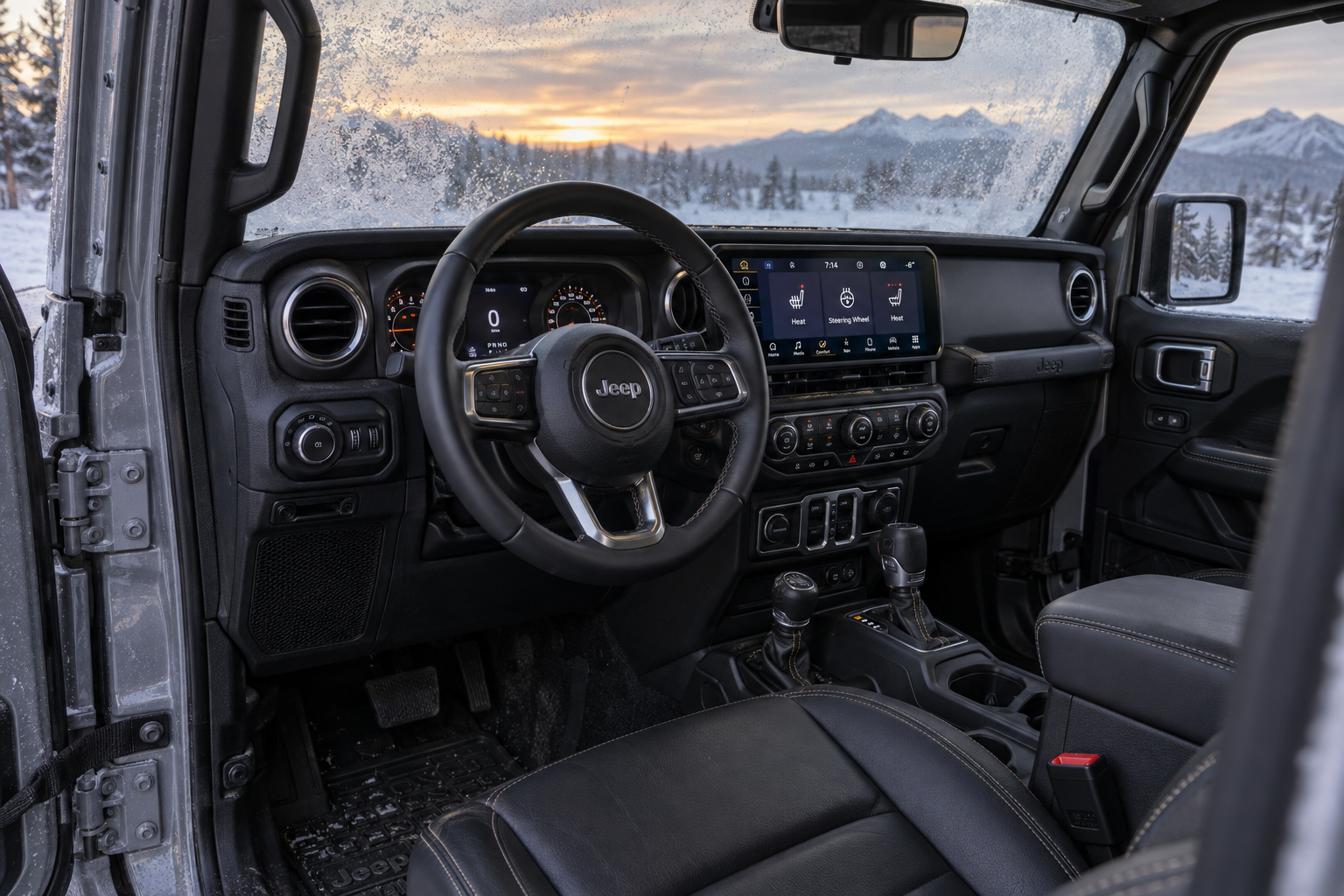
Heated front seats and a heated steering wheel are standard on the Sahara, Rubicon, and 392. On the Sport, Sport S, and Willys, you get them in the Convenience Group, which also adds automatic climate control and remote start.
| Trim | Heated Seats + Heated Wheel | Standard Top | Winter Note |
|---|---|---|---|
| Sport / Sport S / Willys | Convenience Group (adds auto climate + remote start) | Black Sunrider soft top | Add the Convenience Group and a hardtop for a daily driver |
| Sahara | Standard | Body-color Freedom hardtop | The most winter-ready trim as it sits |
| Rubicon / Rubicon X | Standard | Black Sunrider soft top (hardtop optional) | Spec the hardtop or the Dual Top Group |
| 392 | Standard | Body-color Freedom hardtop | 4-Door only; a lot of V8 for a winter commute |
If I am ordering a Sport-line Wrangler for somebody who is going to drive it every day in winter, I do not let them leave without the Convenience Group. Remote start at 6 a.m. with frost on the hood is the difference between a Wrangler you love and one you tolerate. On the Sahara and Rubicon, ask us how remote start is equipped on the specific unit you are looking at. Every trim gets the 12.3-inch Uconnect touchscreen with wireless Apple CarPlay and Android Auto, so the cold-morning tech is the same up and down the line, and every trim carries a 21.5-gallon tank — keep it above half when the wind chill drops.
Which 4x4 System and Tires Do You Need for Drifted Section Lines?
For drifted gravel around Bowdle, the Command-Trac part-time system on a Sport or Willys is genuinely enough. What changes your winter more than the transfer case is the tire: the Willys' all-terrains are the best stock winter setup for the money, and the Rubicon's lockers are for the days you are breaking your own trail.
| Trim | 4x4 System | Low Range | Stock Tire |
|---|---|---|---|
| Sport / Sport S | Command-Trac part-time | 2.72:1 | 245/75R17 all-season |
| Willys | Command-Trac part-time + locking rear differential | 2.72:1 | 245/75R17 all-terrain |
| Sahara | Selec-Trac full-time (4-Auto stays on) | 2.72:1 | 255/70R18 all-season |
| Rubicon / Rubicon X | Rock-Trac heavy-duty part-time, front and rear lockers | 4:1 | LT285/70R17 (33-inch) off-road |
Command-Trac is a part-time system: 2-High on dry pavement, 4-High when the road is covered, 4-Low when you are crawling through something. The one thing to remember is to shift back out of 4-High when you hit dry blacktop, because part-time 4x4 binds up on grip. The Sahara's Selec-Trac has a 4-Auto position that can stay engaged on pavement and sends drive to the front axle as it is needed, which is the setup I would put my wife in for a commute to Aberdeen that goes from black ice to dry pavement three times. Rock-Trac on the Rubicon adds a 4:1 low range, Dana 44-class heavy-duty axles, electronic lockers front and rear, and a sway-bar disconnect. Those are trail tools, but the rear locker in particular is a real help when one side of the Jeep is on ice in a ditch bank. Ground clearance runs about 10 inches on a Sport or Sahara, about 10.8 inches on a Rubicon with the 33s, and about 12.9 inches with the 35-inch package.
On tires: the all-season on a Sport or Sahara is a highway tire. It is fine on plowed pavement and packed snow, and it is honestly not great on ice or on washboard gravel with a skim of fresh snow. The Willys' all-terrain is a noticeable step up in loose snow and slush and is what I would want on a hunting rig. The Rubicon's 33-inch off-road tire floats over deep snow and mud better than anything else in the lineup, but a heavy-lugged tire is not a winter tire; it can be squirrelly on glare ice. The best winter setup on any trim is a dedicated set of winter tires on a second set of wheels, and because the full-size spare rides on the tailgate you can run a matched set of five. Our trim guide goes deeper on what each trim's hardware actually does on our roads.
How to Set Up a Wrangler for a 20-Below Morning
A Wrangler rewards a few habits that a normal SUV does not ask of you. Here is the routine I run from November through March.
- Start it remotely if you have the Convenience Group — ten minutes of idle gets the cabin and the glass ahead of you before you climb in.
- Check the top and doors: make sure the soft-top latches or the Freedom panels are fully seated and each door is firmly closed; a half-latched panel is where the cold air gets in.
- Shift into 4-High before you need it: engage the transfer case in the driveway on a snow-covered road, not halfway up an icy hill, and shift back to 2-High (or leave a Sahara in 4-Auto) when you reach dry pavement.
- Clear the windshield and the sensors: the upright glass ices fast; brush the front camera area and grille so the safety systems work.
- Air up the tires: pressure drops with the temperature, and a soft tire wanders on washboard and packed snow.
- Keep the tank above half and a blanket, a shovel, and a tow strap behind the seat — the front and rear tow hooks are there for a reason.
- Slow down and leave room: 4x4 helps you go; only good tires and distance help you stop.
Hardtop or Soft Top for a South Dakota Winter?
| Consideration | Sunrider Soft Top | Freedom Hardtop |
|---|---|---|
| Highway noise in the cold | Loud | Much quieter |
| Holding heat | Poor — cabin warms slowly | Good — defrosts like a normal vehicle |
| Frost inside the windows | Common on cold mornings | Rare |
| Summer open-air use | Folds back in seconds | Front panels off in about a minute |
| Standard on | Sport, Sport S, Willys, Rubicon | Sahara, 392 (optional elsewhere) |
Worth it if: the hardtop is worth it if the Wrangler is a year-round daily driver, somebody commutes in it, or it sits outside overnight from November to March.
Skip it if: it is a three-season hunting-and-lake rig that lives in the shed in January — keep the soft top, or get the Dual Top Group and have both.
Key Takeaways
- Every Wrangler has true 4x4 with a low range, solid axles, and about 10 inches of clearance on a Sport — it will get down an unplowed township road when a car will not.
- The soft top is livable at 20 below but loud and drafty; for a daily driver, get the hardtop or the Dual Top Group.
- Heated seats and a heated wheel are standard on Sahara, Rubicon, and 392, and come with remote start in the Convenience Group on the Sport line.
- Command-Trac on a Sport or Willys is enough for drifted gravel; the Willys' all-terrains are the best stock winter tire, and a dedicated winter tire beats every trim's stock rubber.
Frequently Asked Questions
Will a Jeep Wrangler soft top hold up in a South Dakota winter?
Yes, a properly latched Sunrider soft top seals against snow and holds up through the cold. What it does not do is insulate: expect more highway noise, slower warm-up, and frost inside the plastic windows on the coldest mornings. For a year-round daily driver, most of our winter buyers choose the Freedom hardtop or the Dual Top Group.
Can I leave a Wrangler in four-wheel drive all winter?
Only on a Sahara. Its Selec-Trac full-time system has a 4-Auto position that can stay engaged on dry pavement. The Command-Trac and Rock-Trac systems on the Sport, Willys, and Rubicon are part-time: use 4-High on snow and ice, and shift back to 2-High on dry blacktop so the driveline does not bind.
Which Wrangler trim is best for winter in South Dakota?
For a daily driver, the Sahara: it comes with the body-color hardtop, heated seats and steering wheel, and full-time Selec-Trac 4x4 that can stay engaged on pavement. For a hunting rig that also sees winter, the Willys with the Convenience Group and a hardtop is the value pick thanks to its all-terrain tires and locking rear differential.
Do I need a Rubicon to get through snow?
No. A Sport or Willys with Command-Trac handles drifted gravel and unplowed township roads well. The Rubicon's 4:1 Rock-Trac, front and rear lockers, and 33-inch tires give you more clearance and traction for breaking trail through deep snow, but its off-road tires are not a winter tire, and on glare ice a dedicated winter tire on any trim matters more.
My Take on the Wrangler in Winter
My first Wrangler was a soft top, and I drove it through two winters out here before I admitted the obvious and bought a hardtop for it. I have never gone back. The Wrangler itself was never the problem in winter — it went everywhere, it started every morning, and it pulled two neighbors out of the ditch on the Selby road. The problem was me pretending a tent was a roof in January.
So here is what I tell people on the lot. If this is going to be your daily driver, buy a Sahara or add the hardtop and the Convenience Group to a Sport-line Jeep, and put a set of winter tires on it. If it is a hunting-and-lake rig that also has to get you to town when the county has not been through yet, the Willys is the one — the all-terrains and the rear locker are the right hardware for drifted gravel, and the money you save over a Rubicon buys the hardtop and a lot of shells. And whichever you choose, understand that you are buying a short, tall, honest 4x4 that asks you to drive it like one.
If you want the full rundown on trims, 2-door versus 4-door, engines, and towing, our 2026 Jeep Wrangler guide covers all of it. And if you are anywhere near Bowdle, stop by Beadle's Chrysler Center — we will put you in a Sport, a Willys, and a Sahara on the same afternoon so you can feel the difference before the snow flies.
About the Author
Lexy Tabbert — Beadle's Chrysler Center, Bowdle, SD
Lexy Tabbert is the Director of Sales and Marketing at Beadle's Chrysler Center in Bowdle, South Dakota. She covers Ram, Jeep, Dodge, and Chrysler vehicles — helping families, ranchers, and ag operators across the region find the right truck and configuration for their needs. Learn more about Lexy.