




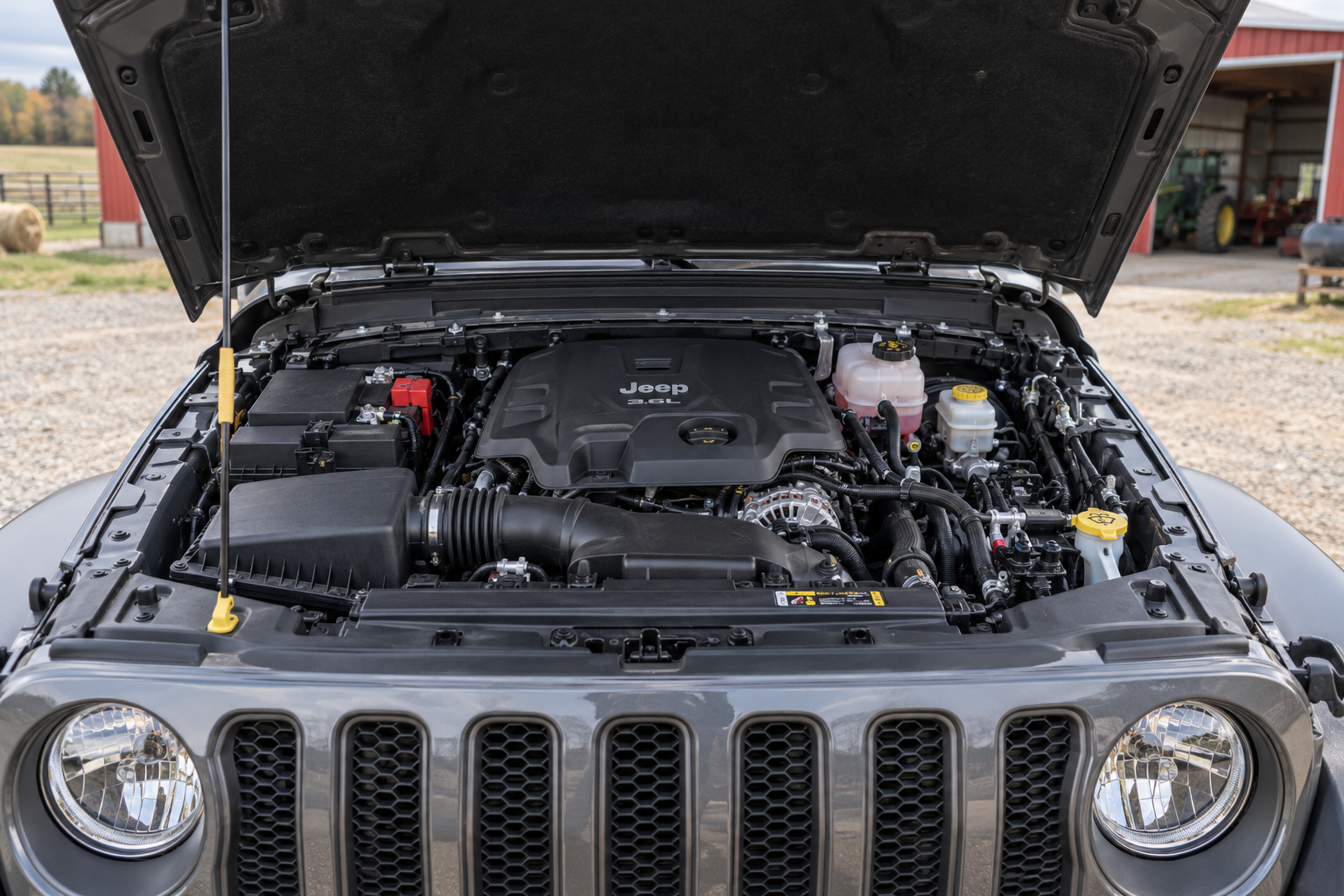
Every Wrangler conversation on our lot gets to the same fork about ten minutes in. The 4-door is settled, the trim is mostly settled, and then somebody leans on the fender and asks: the V6 or the turbo? Usually right behind it, from whoever learned to drive on a three-on-the-tree, comes the second question — can I still get a stick? Those are the two engine questions I hear most in Bowdle, and they deserve a straight answer instead of a brochure.
Short version: both engines are good, and the right one depends on how you will use the Jeep. The 3.6L Pentastar V6 is the known quantity, and it is the only Wrangler engine you can pair with the 6-speed manual. The 2.0L turbo four makes more torque, is a little easier on fuel, and comes only as an automatic. The 392 V8 is its own animal. Below is how I walk a neighbor through it — cold starts, gravel, the four-hour run to the Hills, and the manual question — using only the numbers I can stand behind.
Which Engine Is Better for Cold Starts and Gravel?
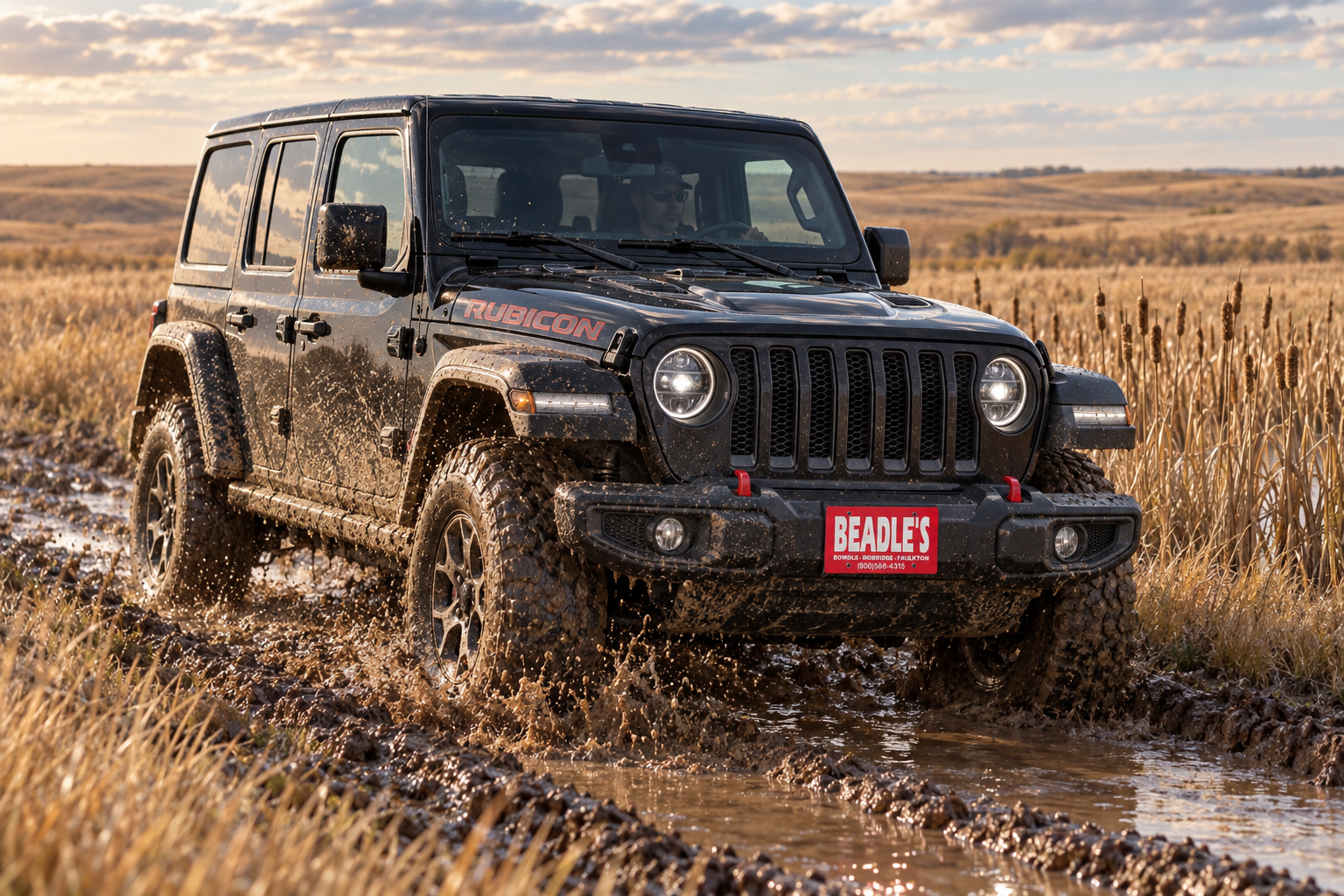
Both engines start and run fine on a twenty-below morning with a healthy battery, so cold starts are not the deciding factor. Gravel is where you feel a difference: the 2.0L turbo makes 295 lb-ft of torque against the V6's 260 lb-ft, and it delivers it lower in the rev range, which means less downshifting on a washboard section line or pulling out of a soft slough edge.
The 3.6L V6 is rated at 285 horsepower and 260 lb-ft. It likes to rev, and with the 8-speed automatic it finds the gear it wants without any fuss. With the 6-speed manual, you are the one finding the gear, and on gravel that is honestly part of the appeal for some folks. The 2.0L turbo four is rated at 270 horsepower and 295 lb-ft, always with the 8-speed automatic. On paper the V6 wins horsepower and the turbo wins torque; on a county road at 45 mph, torque is what you notice.
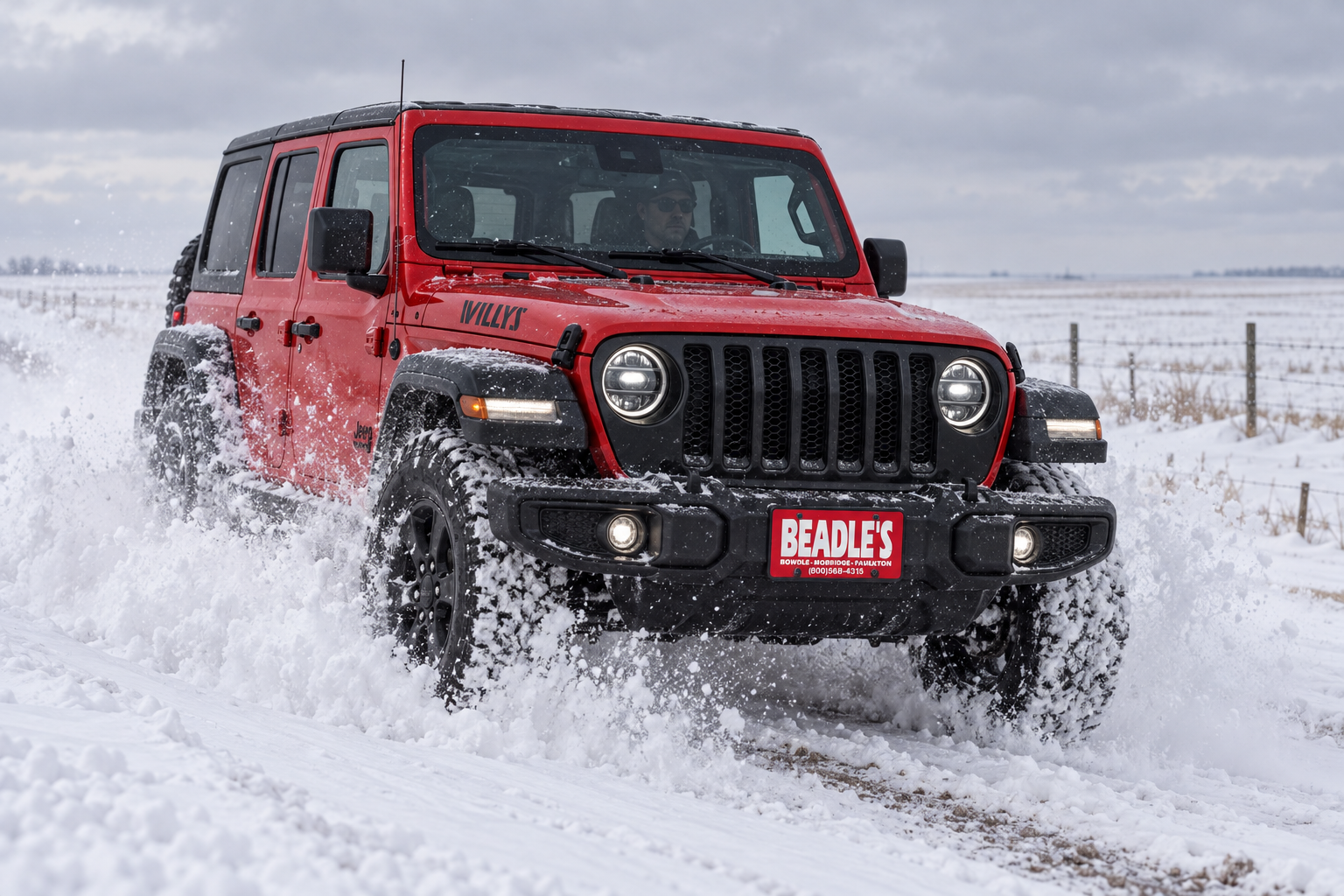
On the cold-weather side, both take a few miles to bring real heat, and if you have the heated seats and heated wheel (standard on Sahara, Rubicon, and 392, available on the Sport line in the Convenience Group with remote start), you will lean on them the first ten minutes of a January morning either way. Remote start plus heated seats matters more to your winter comfort than which engine is under the hood. Our Wrangler winter guide gets into the top, doors, and heat question in detail.
Torque is what you feel on gravel
Horsepower is what gets you to 70 on the highway. Torque is what gets a loaded Jeep moving from a stop on a soft shoulder, up a boat ramp, or through a drift without the transmission hunting. The 2.0L turbo's 295 lb-ft is the single biggest reason people who drive a lot of gravel end up liking it more than they expected to.
Which One Is Better for a Long Highway Run to the Hills?
The 2.0L turbo is a little easier on fuel, but the gap is smaller than the internet makes it sound. Both engines land somewhere in the low-20s on the highway by EPA estimate; the turbo edges into the low-to-mid 20s, and the 392 is in the mid-teens. On a four-hour run to the Black Hills, the shape of the Jeep and the tires under it will affect your mileage as much as the engine choice.
| Engine | Output | Transmission | Available On | Highway MPG (EPA est., approx.) |
|---|---|---|---|---|
| 3.6L Pentastar V6 | 285 hp / 260 lb-ft | 6-speed manual standard; 8-speed automatic optional | Sport, Sport S, Willys, Sahara, Rubicon, Rubicon X (2-Door and 4-Door) | Low 20s (automatic) |
| 2.0L turbo four | 270 hp / 295 lb-ft | 8-speed automatic only | Sport line, Sahara, Rubicon (2-Door and 4-Door) | Low-to-mid 20s |
| 6.4L V8 (392) | 470 hp / 470 lb-ft | 8-speed automatic only | 392 only (4-Door only) | Mid-teens |
Here is the honest part. A Wrangler is a box with a flat windshield, and a west wind between Faulkton and Pierre does not care which engine you bought. A Rubicon on 33-inch off-road tires will use more fuel than a Sport on its 245/75R17 all-seasons, and a soft top adds wind noise that makes the trip feel thirstier than it is. If you are chasing the best highway number, the turbo in a Sport S or Sahara on stock all-season tires is the combination. If you are running 33s and a soft top, the engine will not rescue your mileage; buy the one you like.
The good news for either engine is the 21.5-gallon fuel tank, which is enough range to make the Hills from Bowdle without planning the trip around a fuel stop. Where the turbo's advantage really shows up is the daily grind — the Aberdeen commute, the school-and-elevator loop — where a few tenths of a gallon a day add up over a year.
Can You Still Get a Wrangler With a Manual, and on Which Trims?
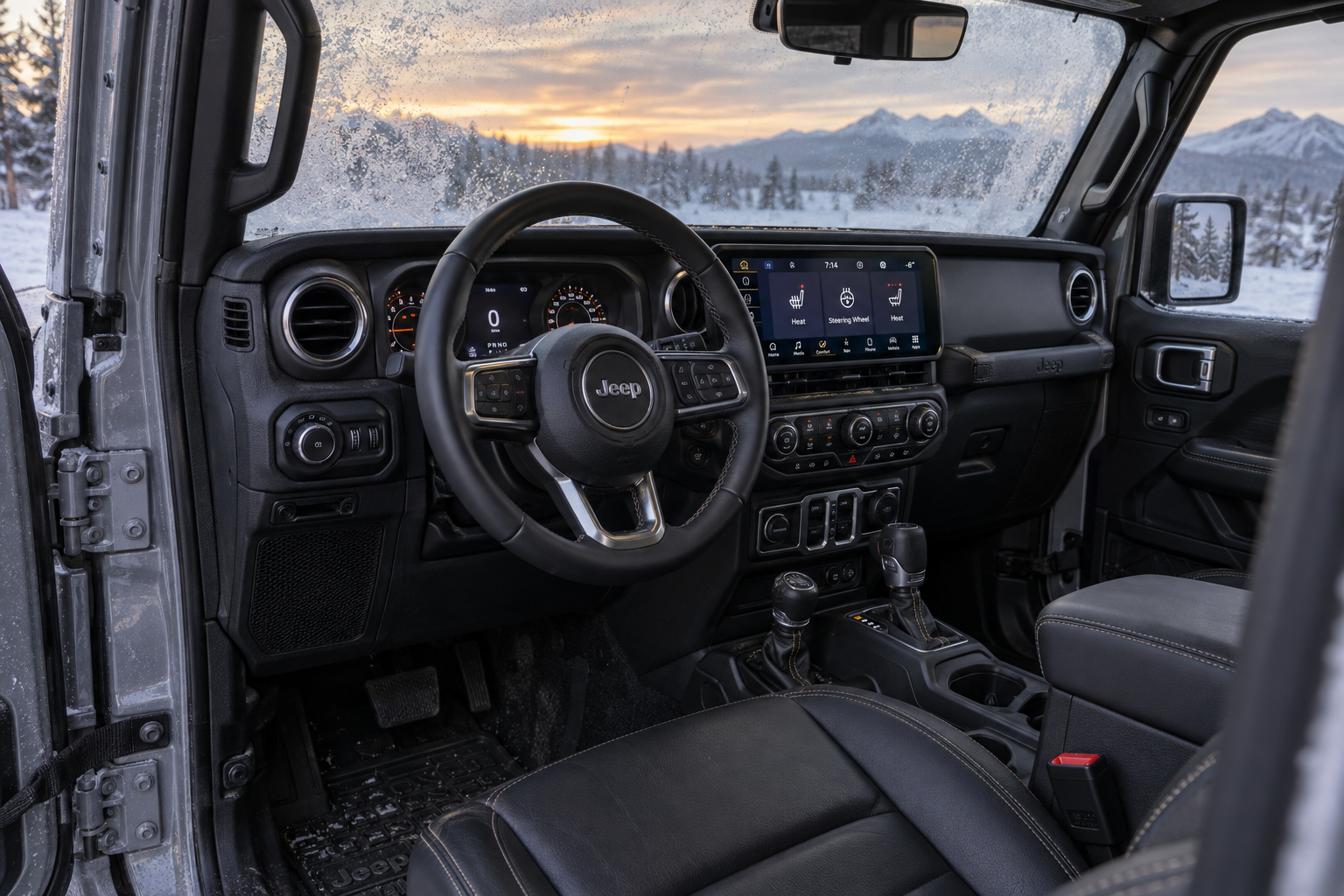
Yes. The 6-speed manual is the standard transmission with the 3.6L V6 on Sport, Sport S, Willys, Sahara, Rubicon, and Rubicon X, in both the 2-Door and the 4-Door. The 8-speed automatic is the extra-cost option on the V6. You cannot get a manual with the 2.0L turbo or the 392; those are automatic only.
That makes the Wrangler one of the last new vehicles you can buy around here with three pedals, and for a certain kind of buyer that is the whole reason to walk onto the lot. If that is you, I am not going to talk you out of it. A manual V6 Willys or Rubicon is a genuinely fun thing to drive down a section line, and the 4:1 low range on a Rubicon with a stick gives you a crawl gear you can feather with your foot.
The trade-offs are real, though, and I would rather you hear them from me than discover them in February. In a drift, on a slick boat ramp, or creeping up to a cattle guard on ice, the automatic is simply easier — a steady, gentle throttle with no clutch to manage. If your spouse or your teenager will drive the Jeep, the automatic is the one they will actually want. The manual is the right call when you want it; it is rarely the right call when you are just trying to save on the option.
One practical note: most of what we stock is the automatic, so if you want the manual, plan on ordering it or ask us what is in the pipeline. The trim guide explains what each trim's hardware actually does on our roads if you are still weighing Willys against Rubicon.
Is There a Hybrid Wrangler for 2026 or 2027, and What About the 392?
There is no plug-in hybrid Wrangler in the 2026 or 2027 lineup. The three engines are the 3.6L V6, the 2.0L turbo, and the 6.4L V8 in the 392, and that is the whole list for both model years.
We get the hybrid question a few times a month, usually from someone who read about one a while back. The plain answer is that it is not offered for either year, and I am not going to speculate about the future. If a lower fuel bill is the reason you were asking, the 2.0L turbo in a Sport S or Sahara on all-season tires is the most fuel-conscious Wrangler you can buy today.
The 392 sits at the opposite end: the 6.4L V8 at 470 horsepower and 470 lb-ft, 8-speed automatic only, 4-Door only, carrying over unchanged into 2027. Nobody in Walworth or Edmunds County needs one, and I say that with affection, because a few people around here want one badly enough that it does not matter. It is the Wrangler you buy because you always wanted a V8 Jeep and the kids are finally out of the house. Expect mid-teens fuel economy and a grin every time you start it.
How to Pick Your Wrangler Engine in Five Minutes
This is the order I walk through with folks at the desk. It usually settles the question before we open the calculator.
- Decide on the transmission first: if you want the manual, you are getting the 3.6L V6 and the decision is made. If you want an automatic, both engines are on the table.
- Count your highway miles: a lot of Aberdeen or Pierre commuting tilts toward the 2.0L turbo; mostly county roads and hunting season tilts toward whichever one you like the sound of.
- Think about what you tow: either engine handles the Wrangler's rating, but the turbo's torque makes a loaded boat trailer feel easier from a stop. Our towing guide covers the 2-Door and 4-Door ratings and the tow package.
- Match it to the trim: the 392 forces the V8; Sport through Rubicon take either the V6 or the turbo. Pick the trim for its hardware, then choose the engine.
- Drive both back to back: ten minutes on the gravel south of town in each one tells you more than any spec sheet. We will have both warmed up if you call ahead at 605-460-6254.
Is the 2.0L Turbo Worth It Over the V6?
| Consideration | 3.6L V6 | 2.0L Turbo |
|---|---|---|
| Output | 285 hp / 260 lb-ft | 270 hp / 295 lb-ft |
| Transmission | 6-speed manual standard, 8-speed auto optional | 8-speed automatic only |
| Feel on gravel from a stop | Good — likes revs | Better — torque arrives early |
| Highway mileage (approx.) | Low 20s | Low-to-mid 20s |
| Trims | Sport through Rubicon X | Sport line, Sahara, Rubicon |
Worth it if: you want an automatic anyway, you drive a lot of highway miles, or you tow a boat or a small trailer and want the extra torque from a stop.
Skip it if: you want the manual, or you simply prefer a six-cylinder and are happy to give up a little mileage for it — the V6 is a fine engine and there is nothing wrong with choosing it on feel.
Key Takeaways
- The 3.6L V6 (285 hp / 260 lb-ft) is the only Wrangler engine offered with the 6-speed manual; the 8-speed automatic is optional on it.
- The 2.0L turbo (270 hp / 295 lb-ft) is automatic only and makes more torque, which is what you feel on gravel and pulling a trailer from a stop.
- Highway mileage is close: roughly low 20s for the V6 automatic, low-to-mid 20s for the turbo. Tires, top, and wind matter as much as the engine.
- There is no plug-in hybrid Wrangler for 2026 or 2027. The 392's 6.4L V8 is 4-Door and automatic only.
- Pick the transmission first, then the trim, then the engine — and drive both before you decide.
Frequently Asked Questions
Is the V6 or the 2.0L turbo better in a South Dakota winter?
Both start and run well in the cold, so the winter answer comes down to the rest of the Jeep: heated seats and a heated wheel, a hardtop, remote start, and good tires. The turbo's extra torque helps a little getting moving on packed snow, but either engine will get you to town.
Which Wrangler trims come with a manual transmission?
The 6-speed manual is standard with the 3.6L V6 on Sport, Sport S, Willys, Sahara, Rubicon, and Rubicon X in both the 2-Door and 4-Door. The 2.0L turbo and the 392 V8 are automatic only.
What kind of mileage will a Wrangler get on a four-hour drive to the Black Hills?
By EPA estimate, roughly low 20s highway for the V6 automatic and low-to-mid 20s for the 2.0L turbo. A headwind, a soft top, and 33-inch tires all pull that down. With the 21.5-gallon tank, either engine makes the trip from Bowdle without needing to plan around a fuel stop.
Can I get the 392 V8 in a 2-Door or with a manual?
No. The 392 is offered only as a 4-Door with the 8-speed automatic, in both 2026 and 2027. If you want a manual, the 3.6L V6 is the engine that comes with it.
My Take on the Wrangler Engine Choice
I have watched a lot of people agonize over this one, and almost nobody regrets either engine. What people do regret is buying the automatic when they really wanted the stick, or buying the stick to save money and handing the keys to a spouse who hates it. Settle the transmission question honestly and the engine question mostly settles itself.
If I am helping someone who commutes to Aberdeen and pulls a fishing boat to Oahe on weekends, I point them at the 2.0L turbo — the torque and the slightly better mileage both work in their favor every day. If I am helping someone who wants a manual Willys for pheasant season and the occasional Hills trip, the V6 is the only answer and a very good one. And if someone walks in asking about the 392, I already know they have made up their mind, and I go get the keys.
The full rundown on trims, tops, 4x4 systems, and towing is in our 2026 Jeep Wrangler guide. And if you are anywhere near Bowdle, stop by Beadle's Chrysler Center and drive both engines back to back on the gravel — that is still the best way to decide.
About the Author
Lexy Tabbert — Beadle's Chrysler Center, Bowdle, SD
Lexy Tabbert is the Director of Sales and Marketing at Beadle's Chrysler Center in Bowdle, South Dakota. She covers Ram, Jeep, Dodge, and Chrysler vehicles — helping families, ranchers, and ag operators across the region find the right truck and configuration for their needs. Learn more about Lexy.