




Blog / Bowdle Chrysler Dealer

Ram 3500 or 2500? How to Know When You Need the Bigger Truck

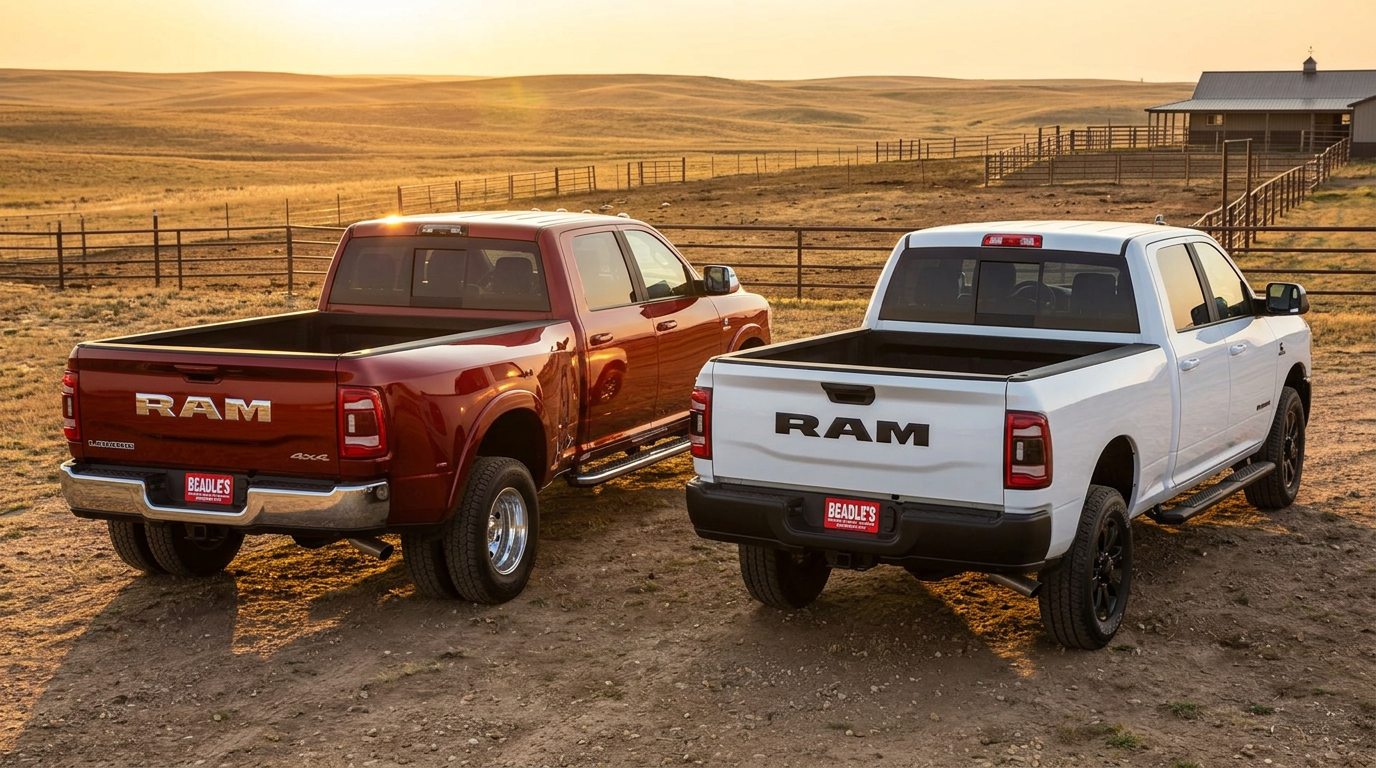
2026 Ram 3500 dually next to Ram 2500 size comparison

2026 Ram 3500 vs Ram 2500: Which Heavy-Duty Ram Do You Need?

If you're shopping for a heavy-duty Ram truck in South Dakota, you've probably wondered: Do I really need a 3500, or will a 2500 handle my work? Both are incredible trucks, both share the same engine options, and both are built for serious towing and payload. But they're engineered for different missions—and choosing the right one makes a real difference in performance, capability, and total cost of ownership.

At Beadle's Chrysler Center, we work with ranchers, contractors, ag operators, and families across Bowdle and the surrounding region. We've seen the 2500 tackle everything from hay hauling to livestock transport to everyday ranch work. And we've watched the 3500 handle the heavy stuff: gooseneck trailers, large RVs, commercial builds, and multi-ton loads. This guide breaks down the real differences so you can pick the truck that's right for your needs.

What is the difference between the Ram 2500 and Ram 3500?

On the surface, the 2026 Ram 3500 and Ram 2500 look similar. They share the same cab styles, the same engines, the same infotainment system, and the same 8-speed transmission. Both can be ordered with the legendary 6.7L Cummins diesel or the 6.4L HEMI HD gas engine. So what's different?

The 3500 is built heavier from the ground up. It has a reinforced frame, heavier-duty axles, a higher GVWR (Gross Vehicle Weight Rating) up to 14,000 lbs, and a GCWR (Gross Combined Weight Rating) that tops out at 45,000 lbs. The 3500 also comes standard with a dually option (dual rear wheels) on Crew Cab models, which spreads the load across more rubber and improves stability under extreme loads. The 2500, by contrast, is single rear wheel (SRW) only.

The 2500, meanwhile, has a class-exclusive coil-link rear suspension that delivers a smoother ride on pavement. It's more refined, lighter on its feet, and doesn't require as much bracing for everyday driving. The 2500 also gets exclusive variants like the Power Wagon (with electronic locking front diff and front sway bar disconnect) and the Rebel off-roader—neither available on the 3500.

FeatureRam 2500Ram 3500
Rear WheelsSingle Rear Wheel (SRW) onlyDually (DRW) on Crew Cab; standard leaf spring
Frame & AxlesStandard dutyHeavy-duty reinforced frame & axles
GVWRUp to ~12,500 lbsUp to 14,000 lbs (DRW)
GCWRUp to ~35,000 lbsUp to 45,000 lbs
Rear SuspensionCoil-link (smoother, class-exclusive)Leaf spring (standard)
Exclusive VariantsPower Wagon, RebelMega Cab (Cummins only)
Available Auto-Level Air SuspensionYesYes

In short: The 3500 is the load-hauler. The 2500 is the refined, versatile choice.

Should I buy a Ram 2500 or Ram 3500?

This is the question we hear most often, and the answer depends on what you're planning to do with the truck.

Buy the Ram 2500 if:

  • You haul hay, livestock, grain, or equipment on a standard trailer
  • Your max towing is under 20,000 lbs
  • You want the smoothest possible ride on pavement and don't need dually wheels
  • You like the idea of Power Wagon or Rebel capabilities
  • You value versatility: work truck on weekdays, capable daily driver on weekends
  • You want to minimize complexity and keep upkeep straightforward

Buy the Ram 3500 if:

  • You regularly tow over 20,000 lbs or work with gooseneck trailers
  • You need the dually option for maximum stability and load distribution
  • You haul large RVs, construction equipment, or multi-ton implements
  • You operate a small fleet or commercial hauling business
  • You need the Mega Cab (Cummins) for extra crew space with diesel power
  • Your work demands 45,000-lb GCWR and maximum structural reinforcement

Bottom line: For most South Dakota ranchers and farm operators, the 2500 does the job exceptionally well. The 3500 is for the folks who've outgrown the 2500 or need commercial-grade durability.

How much more can the Ram 3500 tow than the 2500?

When it comes to towing capacity, the numbers tell a dramatic story. Here are the 2026 specs:

Engine & ConfigRam 2500 Max TowRam 3500 Max Tow
6.4L HEMI HD~16,780 lbs18,150 lbs (HEMI DRW)
6.7L Cummins HO20,000 lbs36,610 lbs (Cummins DRW)

Those numbers are staggering. A 2500 with Cummins maxes out at 20,000 lbs. A 3500 with the same Cummins diesel can handle 36,610 lbs—that's an extra 16,610 lbs of capacity. Nearly doubled.

Why the jump? The 3500's reinforced frame, heavy-duty axles, dually wheels, and higher GCWR all work together. The dually wheels alone spread the load across six wheels instead of four, dramatically improving stability and weight distribution on the road.

Even the gas engines show a meaningful difference: the 3500 HEMI DRW edges out the 2500 HEMI by 1,370 lbs, which doesn't sound like much until you're at the trailer lot and that extra capacity means the difference between "yes, we can" and "we need a bigger truck."

For gooseneck or 5th-wheel trailers: Both trucks require you to use these hitch types for loads over their stated tongue-weight limits. The 2500 has a 2,000-lb max tongue weight (Class V), while the 3500 goes up to 2,300 lbs. For anything bigger, you're in gooseneck or 5th-wheel territory—and that's where the 3500's real advantage shows up.

Does the Ram 3500 ride rougher than the 2500?

Perception vs. reality: the 3500 can feel a bit rougher empty, especially compared to the 2500's class-exclusive coil-link rear suspension. The 3500's standard leaf-spring rear is engineered for load capacity, not luxury—it's firmer to support heavy trailers without sagging.

However, Ram offers the Auto-Level Rear Air Suspension option on both trucks. If you go that route, the 3500 ride quality smooths out dramatically on pavement. The air suspension automatically adjusts to maintain a level ride whether you're empty or loaded, which is why so many owners spec it as a must-have option.

Real talk: when you load a 3500 up (which is the whole point of owning one), the stiffer suspension actually feels better. You're not bouncing around; the truck is planted and controlled. Empty, a 2500 with its softer suspension will feel more "car-like." But put 10,000 lbs on each, and they feel very different—the 3500 is in its element.

For daily driving, especially if you're running light loads most days, the 2500 with its coil-link suspension is the more refined choice. For work, the 3500 (especially with air suspension) is optimized for what it's designed to do.

Is the Ram 3500 overkill for my needs?

Maybe. And that's not a marketing pitch—that's honest advice.

The 3500 is more truck. More frame. More axles. More capability. That also means:

  • Tighter turning radius (dually wheels)
  • Heavier steering (more frame mass)
  • More fuel consumption (additional structural weight)
  • Potential overpayment if you don't use the extra capacity

If your actual towing needs top out at 15,000 lbs, and you're unlikely to ever go higher, a 2500 with Cummins will handle that beautifully and with better everyday manners. You'll also have access to Power Wagon and Rebel variants, which the 3500 doesn't offer.

The honest question to ask yourself: Will I ever tow more than 20,000 lbs? Will I ever use gooseneck? Will my business grow in a way that demands more capacity? If the answers are "no," the 2500 is probably the smarter buy. If the answers are "yes, maybe, or we're growing," the 3500 is the long-term play.

For most South Dakota ranches, the sweet spot is the 2500 Cummins. It's not overkill. It's right-sized.

Which Ram heavy-duty truck is better for ranching in South Dakota?

We work with ranchers every single day, and we know the work. Hay hauling, livestock transport, feeding operations, equipment towing, and gravel roads—that's the South Dakota ranch reality. So here's what we see:

The Ram 2500 is the ranch standard. Most successful ag operations in our region run 2500s, and they handle the job with room to spare. The coil-link suspension soaks up rough roads better than the 3500's leaf springs, which matters when you're driving gravel five days a week. It's comfortable, versatile, and proven.

The Ram 3500 is for the ranches that have grown big. If you're running multiple trailers, hauling equipment to auction, or operating a commercial hay-hauling side business, the 3500's extra capacity and dually configuration make sense. It's also the choice for ranches that regularly work with large gooseneck trailers or pull livestock trailers in rough terrain—the dually wheels provide stability and traction on muddy roads and steep grades.

Both trucks are available with Cummins diesel in South Dakota, which is huge. The same 6.7L HO diesel with 1,075 lb-ft of torque is available in both. Snow Plow Prep is standard on 2026 models of each, so winter is covered. Both get the large 14.5" touchscreen with integrated towing displays—really helpful when you're managing trailers and cameras.

Our recommendation: Start with a 2500 Cummins if you're unsure. You can always upgrade to a 3500 next cycle if your needs grow. But if you already know you need the gooseneck, the commercial use, or the 3500's certified 36,000+ lb towing capacity, don't compromise. We have both on the lot, and we'll help you right-size the truck to your operation.
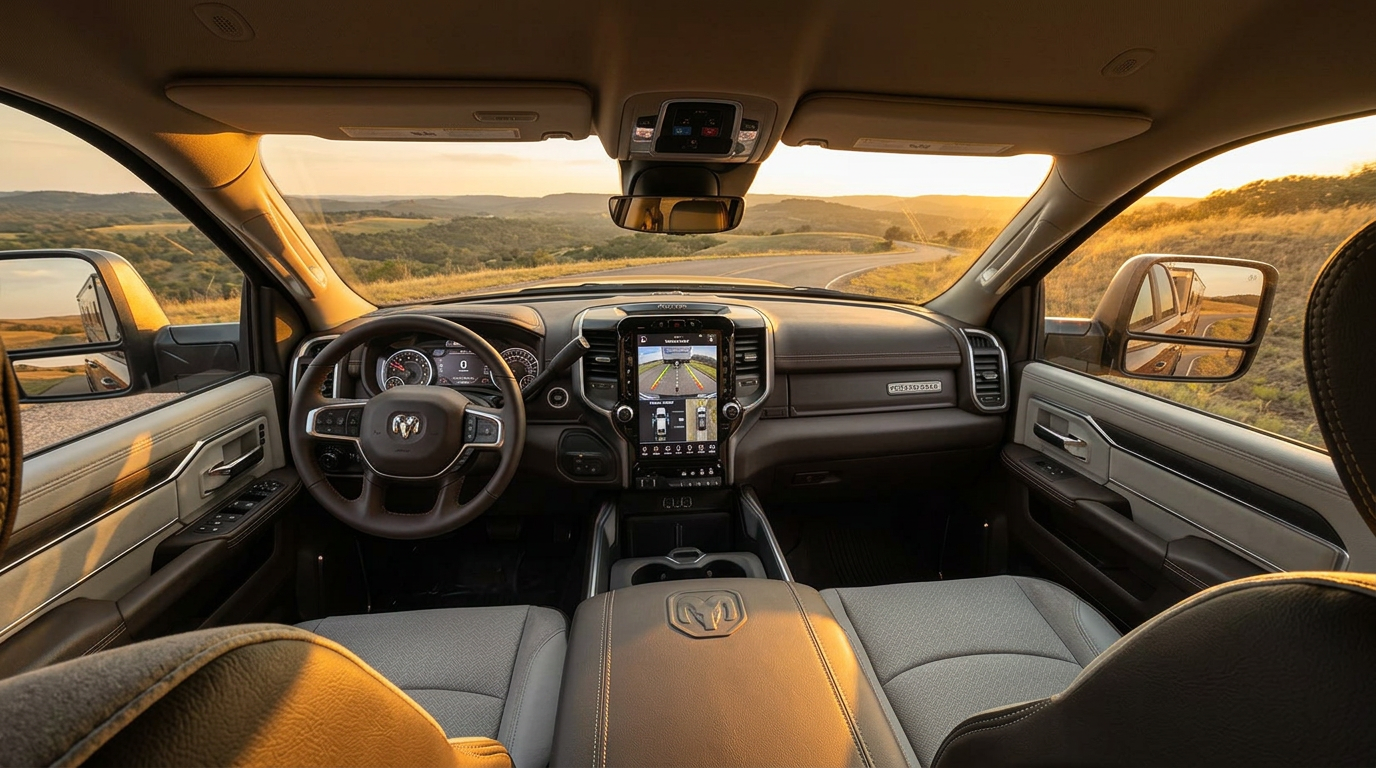
2026 Ram 3500 interior touchscreen towing display

Quick Overview: Ram 3500 vs Ram 2500

SpecRam 2500Ram 3500
Max Tow (Cummins)20,000 lbs36,610 lbs
Max Tow (HEMI)~16,780 lbs18,150 lbs (DRW)
Max Payload (HEMI)~4,580 lbs7,590 lbs (DRW)
Max Payload (Cummins)Up to ~4,500 lbs6,050 lbs (DRW)
GVWRUp to ~12,500 lbsUp to 14,000 lbs (DRW)
GCWRUp to ~35,000 lbsUp to 45,000 lbs
Rear ConfigSRW onlyDRW (dually) on Crew Cab
Engines6.4L HEMI or 6.7L Cummins6.4L HEMI or 6.7L Cummins
Diesel Torque1,075 lb-ft (best-in-class)1,075 lb-ft (best-in-class)
Transmission8-speed8-speed
Rear Suspension TypeCoil-link (class-exclusive, smooth)Leaf spring (load-rated)
Auto-Level Air SuspensionAvailableAvailable
Infotainment14.5" touchscreen option14.5" touchscreen option
Cummins Upcharge$12,995$12,995
Exclusive VariantsPower Wagon, RebelMega Cab (Cummins)
5th-Wheel/Gooseneck MinRequired over 20,000 lbsRequired over 23,000 lbs
Snow Plow PrepStandard (2026)Standard (2026)

How to Decide: The Right Ram for Your Work

Step 1: Know Your Max Towing Load

Add up the weight of the heaviest trailer or load you anticipate hauling in the next five years. Don't guess. Weigh it or look it up. If it's under 15,000 lbs, the 2500 is plenty. If it's 15,000–20,000 lbs, the 2500 with Cummins is your answer. If it's over 20,000 lbs or you're planning gooseneck work, the 3500 becomes the clear choice.

Step 2: Consider Your Hitch Type

Will you use bumper pull, weight-distribution, 5th-wheel, or gooseneck? The 2500 can handle bumper/WD pulls up to 20,000 lbs. Beyond that or with gooseneck, the 3500's reinforced structure and higher GCWR make it the safer, smarter choice.

Step 3: Evaluate Dually Needs

Do you need dually wheels for extra stability, traction in mud, or to meet industry standards for livestock hauling? The 3500 offers it. The 2500 doesn't. If you're operating in rough terrain or pulling heavy loads, dually wheels are a game-changer for control and safety.

Step 4: Think Long-Term

Is your business or operation growing? Buying a truck that you'll outgrow in three years is expensive. If there's a reasonable chance you'll need more capacity, the 3500 is the investment that lasts longer.

Step 5: Test Drive Both

Feel how each truck handles under load (we can simulate with weight in the bed or trailer). The 2500's smoother ride is noticeable, but so is the 3500's planted stability when it's pulling hard. What feels right to you matters.

Step 6: Choose Your Engine

Both trucks offer 6.4L HEMI and 6.7L Cummins. The Cummins is a $12,995 upcharge but delivers 1,075 lb-ft of best-in-class torque. If towing is your primary mission, Cummins is worth every penny. If you're doing mostly light work, HEMI saves money and still delivers solid performance.

Key Takeaways

  • The 2500 is the versatile ranch workhorse: 20,000-lb Cummins towing, class-exclusive coil-link suspension for a smooth ride, access to Power Wagon and Rebel, and proven performance on South Dakota ag operations.
  • The 3500 is the heavy commercial hauler: Up to 36,610 lbs of Cummins towing, dually option for load distribution and stability, reinforced frame and axles, 45,000-lb GCWR, and built for gooseneck and 5th-wheel work.
  • Both share the same engines, transmissions, and infotainment, so the decision is about frame strength, rear config, and capability ceiling, not basic reliability.
  • For most South Dakota ranches, the 2500 is right-sized. For operations that have grown or need commercial-grade towing, the 3500 is worth it.
  • Test drive both. Feel the difference in suspension, steering, and overall presence. The right truck is the one that fits your work and feels solid in your hands.

Frequently Asked Questions

Is the Ram 3500 worth the extra cost?

If you need the extra capacity and durability, absolutely. You're not paying for hype—you're paying for a reinforced frame, heavy-duty axles, dually wheels, and the structural engineering to safely handle 36,000+ lbs of towing. That's a fundamentally different truck. But if your actual towing tops out at 12,000 lbs, the extra cost is a waste. Be honest about your needs.

Can the Ram 2500 tow a large RV?

It depends on the RV weight. Most modern travel trailers in the 8,000–15,000-lb range are within the 2500's capability, especially with Cummins. But large fifth-wheels or Class A motorhomes often exceed 20,000 lbs, which is where the 3500 becomes the safer choice. Check your RV's dry weight and add water, propane, and cargo—that's your real towing weight.

What's the real-world difference in fuel economy?

The 3500's extra weight and dually configuration will slightly reduce fuel economy compared to a 2500, especially when running empty. Expect 15–17 mpg highway on the 2500 gas, 18–20 mpg on the 2500 diesel. The 3500 typically runs 1–2 mpg lower in real-world use. Under load, the difference shrinks because both trucks are optimized for their intended duty cycle.

Should I buy the dually option if it's available?

If you're towing regularly over 15,000 lbs or working in muddy/rough terrain, dually wheels provide real benefits: load distribution, traction, and stability. The trade-off is a slightly tighter turning radius and reduced maneuverability in tight spaces. For ranch work, commercial hauling, and heavy towing, dually is worth it. For light work, SRW is fine.

Can I buy a Ram 2500 and upgrade it later if I need more capacity?

You can't retrofit a 2500 into a 3500. But you can sell or trade the 2500 in a few years and move up to a 3500 if your needs change. Many operators do exactly this: start with a 2500, find out they've outgrown it, and upgrade. It's a reasonable strategy if you're uncertain.

My Take on the Ram 3500 vs. Ram 2500

I've stood on the lot here at Beadle's Chrysler Center for years, watching ranchers and contractors pick between these two trucks. The conversation almost always comes down to the same thing: will you actually use the extra capacity?

If the answer is yes, buy the 3500. Don't compromise. The dually wheels, the reinforced structure, and the ability to legally and safely tow 36,000+ lbs without worry—that's worth the investment. We have families and operations in the area that would never go back to a 2500 because they've seen what the 3500 can do under load.

If the answer is no, buy the 2500. A good 2500 Cummins will out-work most operations in South Dakota. It rides better, turns easier, and costs less. It's a truck built to last and sized right for real work—not theoretical capacity.

Both trucks are in our Bowdle showroom right now. We can show you the difference in person, put you behind the wheel, and help you make the right call. Because the best truck is the one that matches your needs, not someone else's. For the full breakdown on the 3500's specs, trims, and towing configurations, see our complete 2026 Ram 3500 buying guide.

About the Author

Lexy Tabbert — Beadle's Chrysler Center, Bowdle, SD

Lexy Tabbert is the Director of Sales and Marketing at Beadle's Chrysler Center in Bowdle, South Dakota. She covers Ram, Jeep, Dodge, and Chrysler vehicles — helping families, ranchers, and ag operators across the region find the right truck and configuration for their needs.

Posted in:

Related Posts

Is the 2027 Pacifica Right for Your South Dakota or North Dakota Family?

Quick Answer The 2027 Chrysler Pacifica fits Dakota families wanting three-row space, available all-wheel drive, and Stow 'n Go flexibility. It's gas-only now — a 3.6L V6 at about 20 mpg combined with AWD. Choose the Select AWD; pick a Toyota Sienna hybrid only if fuel economy is your top priority. Buying a family hauler in the Dakotas comes down to a few honest questions: will it fit everyone, can it handle a gravel road in February, and will it actually make your life easier on a busy weekday? The 2027 Pacifica answers most of those well — but it's not the right pick for every single buyer, and we'd rather tell you that up front. This guide is built to help you decide. We'll lay out exactly who the Pacifica is best for, whether a gas-only minivan still makes sense, why it beats a three-row SUV for a lot of families, and who should honestly look elsewhere. ===================== TOP CTA ROW ===================== Search Available Pacifica Inventory Get Pre-Approved ===================== TABLE OF CONTENTS ===================== On This Page Who is the 2027 Pacifica best for? Does a gas-only minivan still make sense now that the hybrid is gone? Pacifica vs. a three-row SUV — why a minivan? Who should look elsewhere? Pick the Pacifica if / Look elsewhere if Our recommendation ===================== H2 #1 ===================== Who is the 2027 Pacifica best for? The 2027 Pacifica is built for the family that needs to move people and gear, not just look like they might. If you've got three rows to fill — kids, car seats, the occasional extra passenger — and you want the flexibility to swap between hauling people and hauling stuff on the same trip, this is where the Pacifica shines. For families around Bowdle and across the high plains, three things tend to seal it: real interior space, available all-wheel drive for snow and gravel, and Stow 'n Go seating that folds the second and third rows flat into the floor without hauling seats out to the garage. That combination — AWD plus second-row Stow 'n Go — is something you genuinely can't get on any other minivan. From Beadle's Chrysler Center The families who love their Pacifica the most are the ones who actually use the flexibility — second row down for a lumber run on Saturday, full seven seats for church on Sunday. If you're going to leave the seats up and bolted in all year, you're paying for capability you won't use, and a simpler SUV might suit you better. ===================== H2 #2 ===================== Does a gas-only minivan still make sense now that the hybrid is gone? Here's the honest part: for 2027, the Pacifica is gas-only. The 3.6L Pentastar V6 is the single engine across the lineup, and the plug-in hybrid has been discontinued. So if you were hoping to plug in at home, that option no longer exists on a new Pacifica. But there's a real case for the gas V6, especially out here. It's a proven, mechanically simple engine paired with a disconnecting all-wheel-drive system — no charging to plan around when it's fifteen below, no range anxiety on a long stretch of empty highway, and nothing to fast-charge that you couldn't fast-charge anyway. For a rural family that drives real distances and parks outside in the cold, a tank of gas and a warm remote-started cabin is a genuinely simpler ownership story. The trade-off, stated plainly What you give up is fuel economy. A gas Pacifica lands around 22 mpg combined in front-wheel drive and about 20 combined with AWD. That's the cost of admission for the V6's simplicity and the available all-wheel drive. If saving fuel is the thing that matters most to you, that number is the one to weigh honestly. For most families we talk to, the math works: the V6 has the power for full loads and grades, the AWD handles the weather, and roughly 20 mpg is a fair price for not having to think about a charger in a Dakota winter. ===================== IMAGE BREAK ===================== ===================== H2 #3 ===================== Pacifica vs. a three-row SUV — why a minivan? A lot of families default to a three-row SUV without asking what they're actually giving up. The honest comparison comes down to two things a crossover simply can't match: Stow 'n Go seating and sliding doors. With Stow 'n Go, the Pacifica's second-row seats fold flat into the floor — no wrestling 50-pound seats out and finding somewhere to store them in the garage. In a three-row SUV, you either leave the seats up and live with a small cargo area, or you take them out and they live in your shop until spring. The Pacifica goes from seven seats to a flat cargo van in under a minute, in your driveway, with the seats still in the vehicle. The sliding doors matter more than people expect, too. In a packed parking lot or a tight garage, kids and car seats load through a wide opening with no door to swing into the truck parked next to you. For the day-to-day reality of family life — buckling toddlers, loading groceries, getting in and out a dozen times a day — that's a quality-of-life win an SUV doesn't offer. ===================== H2 #4 ===================== Who should look elsewhere? We'd rather you buy the right vehicle than the one with our name on the door, so here's the straight talk. If your single top priority is maximum fuel economy, the Pacifica is not your best match. The gas V6 is good for what it does, but it can't touch a hybrid on miles per gallon. The buyer whose number-one concern is squeezing every mile out of a gallon should cross-shop the Toyota Sienna, which is hybrid-only and lands around 36 mpg combined. You'll give up some power, the available mechanical AWD torque the Pacifica offers, and second-row Stow 'n Go — but if fuel cost is what keeps you up at night, that's a fair trade to consider. For just about everything else a Dakota family cares about, the Pacifica still makes the stronger case. ===================== DECISION OVERVIEW TABLE ===================== Pick the Pacifica if / Look elsewhere if Pick the 2027 Pacifica if… Look elsewhere if… You need real three-row space for people and gear You rarely carry more than four people You want available AWD for snow and gravel You only drive plowed town streets You'll actually use Stow 'n Go flexibility Your seats will stay up and bolted in all year You value sliding doors for kids and car seats Maximum fuel economy is your top priority About 20 mpg combined is acceptable to you You'd rather have a hybrid like the Toyota Sienna Bottom line: the Pacifica rewards families who use its space and flexibility and want weather capability. The one place it loses is the fuel-economy column — and only against a hybrid. ===================== NAMED RECOMMENDATION ===================== Our Recommendation The 2027 Pacifica is a strong fit for a South Dakota or North Dakota family that wants three-row space, available all-wheel drive, and Stow 'n Go flexibility — and doesn't need maximum fuel economy. We're not going to hedge on this. If that describes you, the Pacifica is the minivan to buy, and the value sweet spot is the Select AWD. It gets you the weather capability and the second-row Stow 'n Go that define this van, without paying up for the top-trim comfort features most families don't need. Step up to the Limited or Pinnacle only if you specifically want the heated second row, ventilated seats, or the family-tech upgrades. The only buyer we'd send elsewhere is the one whose top priority is fuel economy — that person should look at the Toyota Sienna hybrid. Everyone else: get the Select AWD. ===================== KEY TAKEAWAYS ===================== Key Takeaways The 2027 Pacifica is best for families who want three-row space, available AWD, and Stow 'n Go they'll actually use. It's gas-only now — a proven 3.6L V6, no charging to plan around in the cold, at the cost of about 20 mpg combined with AWD. Stow 'n Go seating and sliding doors are the two things a three-row SUV can't match for daily family life. If maximum fuel economy is your top priority, the Toyota Sienna hybrid is worth a look. Otherwise, the value pick is the Select AWD. ===================== FAQ ===================== Frequently Asked Questions Is the 2027 Chrysler Pacifica available as a hybrid? No. The plug-in hybrid has been discontinued, so the 2027 Pacifica is gas-only. Every trim uses the 3.6L Pentastar V6 with a 9-speed automatic. If you want a hybrid minivan, the Toyota Sienna is the alternative to consider. Which 2027 Pacifica is the best value for a Dakota family? The Select AWD is the value sweet spot. It gets you available all-wheel drive and second-row Stow 'n Go — the two things that define the Pacifica out here — without paying up for top-trim comfort features most families don't need. Why pick a Pacifica over a three-row SUV? Two things: Stow 'n Go seating that folds flat into the floor without removing seats, and sliding doors that make loading kids and car seats far easier in tight spaces. A three-row crossover can't match either, which is why a lot of families who try both come back to the minivan. What kind of fuel economy does the gas Pacifica get? The gas V6 Pacifica is EPA-estimated around 22 mpg combined in front-wheel drive and about 20 mpg combined with AWD. That's the trade-off for the V6's power and simplicity. If fuel economy is your number-one concern, the Toyota Sienna hybrid lands closer to 36 mpg combined. ===================== FIRST-PERSON CONCLUSION ===================== My Take on Whether the Pacifica Fits Your Family When a family sits down with me to figure out if the Pacifica is the one, I don't start with the brochure — I start with how they actually live. How many kids, how often the seats come down, how far off the pavement they really go. That conversation tells you more than any spec sheet, and it's usually clear pretty fast whether this van is the right call. My honest recommendation: if you want three-row room, the weather confidence of available AWD, and the Stow 'n Go flexibility, get the Pacifica — and the Select AWD is where I'd put my own money. The only family I'd steer toward a Toyota Sienna instead is the one where fuel economy beats everything else. That's a real reason, and I'll tell you so to your face. As your local South Dakota Chrysler dealer — and a convenient North Dakota Chrysler dealer for families just across the border — we're glad to help. If you want the full picture on trims, towing, and tech, take a look at our complete 2027 Chrysler Pacifica guide. And if you're anywhere near Bowdle, stop by Beadle's Chrysler Center — we'll put your family in one and figure out together whether it fits. ===================== BOTTOM CTA ROW ===================== Search Available Pacifica Inventory Get Pre-Approved Contact Beadle's Chrysler Center ===================== KEEP RESEARCHING ===================== Keep Researching the 2027 Pacifica Start with the full 2027 Chrysler Pacifica overview for trims, specs, and pricing. Then dig into related questions: · How the AWD Pacifica handles a South Dakota winter · Which Pacifica trim is right for your family · Pacifica vs. Sienna, Odyssey & Carnival ===================== QUICK ANSWERS MICRO Q&A ===================== Quick Answers Who is the Pacifica best for? Families wanting space, AWD, and Stow 'n Go. Is there a hybrid for 2027? No — gas-only 3.6L V6. Gas Pacifica fuel economy? About 22 combined FWD, 20 combined AWD. Best value trim? The Select AWD. Why a minivan over an SUV? Stow 'n Go and sliding doors. Does any other minivan offer AWD with Stow 'n Go? No — only the Pacifica. Who should look elsewhere? Buyers whose top priority is MPG. What's the MPG alternative? The Toyota Sienna hybrid (~36 combined). Where can I see one near me? Beadle's Chrysler Center, Bowdle, SD. ===================== ABOUT THE AUTHOR (LOCKED) ===================== About the Author Lexy Tabbert — Beadle's Chrysler Center, Bowdle, SD Lexy Tabbert is the Director of Sales and Marketing at Beadle's Chrysler Center in Bowdle, South Dakota. She covers Ram, Jeep, Dodge, and Chrysler vehicles — helping families, ranchers, and ag operators across the region find the right truck and configuration for their needs. Learn more about Lexy.

Comfort on Long Hauls: Pinnacle Luxury & Premium Appointments in the 2027 Pacifica

Quick Answer Heated front seats and a heated steering wheel are standard on every 2027 Chrysler Pacifica. Ventilated front seats and heated second-row seats arrive on the Limited and Pinnacle. The Pinnacle adds premium leather, a suede headliner, Blue Agave interior, captain's chairs, and the Ultra Console. A minivan earns its keep on the long days — the eight-hour drive to see family, the cross-state ballgame, the trip where the grandkids are buckled in back and you just want everyone to arrive relaxed instead of restless. That's where seat comfort, a quiet cabin, and climate control stop being spec-sheet items and start being the whole point. This guide walks through which 2027 Pacifica has heated and ventilated seats, what makes the Pinnacle interior special, how the cabin holds up on a real road trip, and exactly which comfort features are standard versus reserved for the higher trims. ===================== TOP CTA ROW ===================== Search Available Pacifica Inventory Get Pre-Approved ===================== TABLE OF CONTENTS ===================== On This Page Which Pacifica has heated and ventilated seats? What makes the Pinnacle interior special? Is the Pacifica comfortable for long road trips and grandparents? What comfort features come standard vs. higher trims? Comfort features by trim: a quick comparison How to set up your Pacifica for a long haul ===================== H2 #1 ===================== Which Pacifica has heated and ventilated seats? Here's the part that surprises a lot of shoppers: heated front seats and a heated steering wheel are standard on every 2027 Pacifica, all the way down to the LX. So even the entry trim takes the chill off a cold morning before you've left the driveway. What you step up for is the warm-weather and second-row comfort. Ventilated (cooled) front seats and heated second-row seats arrive on the Limited and Pinnacle. For a summer road trip, those cooled front seats are the feature people notice most — they pull heat away from your back on a long stretch of interstate, which keeps the driver fresher than air conditioning alone. The short version Heated front seats + heated steering wheel: standard on every trim. Ventilated front seats + heated second-row seats: Limited and Pinnacle. If cooled seats matter to you, your shopping starts at the Limited. Both the Limited and Pinnacle also add a wireless charging pad, so phones stay topped up without a tangle of cords across the console — a small thing that adds up on a trip where everyone's navigating, streaming, and texting ahead to the next stop. ===================== H2 #2 ===================== What makes the Pinnacle interior special? The Pinnacle is the top of the Pacifica range, and it's built around comfort. It starts with premium leather-trimmed seats and a suede headliner — the kind of soft-touch material overhead that you don't see in most minivans and that makes the cabin feel quieter and more finished. It's offered in a distinctive Blue Agave interior color that sets it apart from the usual all-black minivan look. The signature piece is the integrated Ultra Console between the front seats — a built-in storage and armrest setup that gives the driver and front passenger a genuine command-center feel rather than the open pass-through you find in lower trims. Behind it, the Pinnacle's second-row captain's chairs are the seats people remember: supportive, easy-sliding buckets that make the middle row feel like its own first-class section. From Beadle's Chrysler Center When a customer is debating Limited versus Pinnacle, we tell them to sit in the second row, not just the driver's seat. The Pinnacle's captain's chairs and the materials around them are what you feel on hour six of a drive. If the back seats are where the grandkids or guests ride most, that's where the upgrade pays off. ===================== IMAGE BREAK ===================== ===================== H2 #3 ===================== Is the Pacifica comfortable for long road trips and for grandparents hauling grandkids? Yes — and the things that make it comfortable for a young family are the same things empty-nesters and grandparents tell us they appreciate most. The cabin is genuinely quiet at highway speed, which means less fatigue over a long day and easier conversation between the front and back rows. After eight hours, a quiet cabin is the difference between arriving worn out and arriving ready to visit. Easy entry and exit is the other piece. The Pacifica's low step-in height, wide-opening power sliding doors, and tall door openings make it simple to get in and out without ducking or climbing — which matters whether you're loading a car seat or you'd just rather not crawl into a low coupe. For grandparents helping grandkids buckle in, that low, level access is a real, everyday convenience. Tri-zone automatic climate control is standard on every trim, so the driver, front passenger, and second row can each set their own temperature. On a trip where one person runs cold and another runs hot, that ends the thermostat tug-of-war — everybody gets their own comfort zone without anyone reaching for a vent. ===================== H2 #4 ===================== What comfort features come standard vs. higher trims? The Pacifica's strength is how much comfort comes standard before you spend a dollar on upgrades. Every trim — including the LX — comes with heated front seats, a heated steering wheel, tri-zone automatic climate control, remote start, power sliding doors, a power liftgate, and rear air conditioning with its own heater. That's a well-equipped baseline for a long-haul vehicle. From there, the comfort upgrades cluster on the Limited and Pinnacle: ventilated front seats, heated second-row seats, and a wireless charging pad on both, then the Pinnacle's premium leather, suede headliner, Blue Agave interior, second-row captain's chairs, and integrated Ultra Console on top. Knowing which features live where keeps you from overspending — if standard heated seats and tri-zone climate cover your needs, the lower trims already deliver. If you want cooled seats and a true second-row lounge, the Limited and Pinnacle are where to look. ===================== QUICK OVERVIEW TABLE ===================== Comfort features by trim: a quick comparison Comfort feature LX / Select Limited / Pinnacle Heated front seats & heated steering wheel Standard Standard Tri-zone automatic climate Standard Standard Ventilated (cooled) front seats Not available Yes Heated second-row seats Not available Yes Premium leather, suede headliner, Ultra Console No Pinnacle Worth stepping up if: you want cooled front seats for summer drives, heated seats for the second row, or the Pinnacle's premium leather and captain's-chair lounge for passengers who ride in back. Stay lower if: standard heated seats, heated steering wheel, and tri-zone climate already cover how your family travels — the LX and Select are genuinely well-equipped. ===================== HOW-TO ===================== How to set up your Pacifica for a comfortable long haul A few minutes of setup before you pull out makes a long drive noticeably better. Here's the order we'd tackle it. Match the trim to who rides where: if passengers spend the trip in the second row, the Limited or Pinnacle's heated rear seats and captain's chairs earn their cost. Set each climate zone before you leave: tri-zone control lets the driver, front passenger, and second row dial in their own temperature so no one's fighting the thermostat. Use remote start to pre-condition the cabin: standard on every trim — warm or cool the interior while you load up so the first mile is already comfortable. Stage charging up front: on Limited and Pinnacle, the wireless charging pad keeps a phone topped up cord-free for navigation and music. Try the seats in person: sit in both the front and second row at Beadle's Chrysler Center to feel the difference between ventilated and standard seats before you decide. ===================== KEY TAKEAWAYS ===================== Key Takeaways Heated front seats and a heated steering wheel are standard on every 2027 Pacifica, including the LX. Ventilated (cooled) front seats and heated second-row seats arrive on the Limited and Pinnacle. The Pinnacle adds premium leather, a suede headliner, the Blue Agave interior, second-row captain's chairs, and the integrated Ultra Console. A quiet cabin, easy step-in entry, and standard tri-zone climate make it comfortable for long road trips and for grandparents hauling grandkids. ===================== FAQ ===================== Frequently Asked Questions Which 2027 Pacifica has heated and cooled seats? Heated front seats and a heated steering wheel are standard on every trim, including the LX. Ventilated (cooled) front seats are available on the Limited and Pinnacle, which also add heated second-row seats. Does the base Pacifica come with heated seats? Yes. Heated front seats, a heated steering wheel, and tri-zone automatic climate control are all standard on the entry LX, so even the base Pacifica is well-equipped for cold-weather comfort. What makes the Pinnacle interior different? The Pinnacle adds premium leather-trimmed seats, a suede headliner, the distinctive Blue Agave interior color, second-row captain's chairs, and the integrated Ultra Console between the front seats — the most comfortable, finished cabin in the Pacifica lineup. Is the Pacifica comfortable for long road trips? Yes. A quiet cabin at highway speed, easy step-in entry, standard tri-zone climate control so each row sets its own temperature, and supportive seats make the Pacifica comfortable for long drives — including for grandparents hauling grandkids. ===================== FIRST-PERSON CONCLUSION ===================== My Take on the Pacifica for Long Hauls When someone tells me they do a lot of long driving — whether it's a young family on the regular trek to grandma's or empty-nesters who finally have time to go see everyone — I steer the conversation to the second row and the seats. Standard heated seats and tri-zone climate cover most people beautifully, and that's worth knowing before anyone spends up. My honest recommendation: if the front seats are where you live, the Limited's ventilated seats are the upgrade I'd make first — cooled seats change how you feel after a long summer leg. If passengers ride in back as much as up front, the Pinnacle's captain's chairs, premium leather, and suede headliner are the ones that make a road trip feel like a treat instead of a haul. As your local South Dakota Chrysler dealer — and a convenient North Dakota Chrysler dealer for families just across the border — we're glad to help. If you want the full picture on trims, tech, and safety, take a look at our complete 2027 Chrysler Pacifica guide. And if you're anywhere near Bowdle, stop by Beadle's Chrysler Center — sit in the second row, try the seats, and we'll help you find the trim that fits how your family travels. ===================== BOTTOM CTA ROW ===================== Search Available Pacifica Inventory Get Pre-Approved Contact Beadle's Chrysler Center ===================== KEEP RESEARCHING ===================== Keep Researching the 2027 Pacifica Start with the full 2027 Chrysler Pacifica overview for trims, specs, and pricing. Then dig into related questions: · Which Pacifica trim is right for your family · Family convenience tech in the Pacifica · Pacifica driver-assist & safety tech ===================== QUICK ANSWERS MICRO Q&A ===================== Quick Answers Which trims have heated front seats? Every trim, including the LX. Heated steering wheel? Standard on every trim. Which trims have ventilated seats? Limited and Pinnacle. Heated second-row seats? Limited and Pinnacle. What's the most comfortable trim? The Pinnacle. Pinnacle interior color? Blue Agave premium leather. Does the Pinnacle have captain's chairs? Yes, second-row captain's chairs. Is tri-zone climate standard? Yes, on every trim. Where can I see one near me? Beadle's Chrysler Center, Bowdle, SD. ===================== ABOUT THE AUTHOR (LOCKED) ===================== About the Author Lexy Tabbert — Beadle's Chrysler Center, Bowdle, SD Lexy Tabbert is the Director of Sales and Marketing at Beadle's Chrysler Center in Bowdle, South Dakota. She covers Ram, Jeep, Dodge, and Chrysler vehicles — helping families, ranchers, and ag operators across the region find the right truck and configuration for their needs. Learn more about Lexy.

2027 Chrysler Pacifica on an open South Dakota highway

Standard Safety in the 2027 Pacifica: What Every Trim Includes

Quick Answer Every 2027 Chrysler Pacifica — including the entry-level LX — comes standard with the full driver-assist suite: adaptive cruise with stop & go, forward collision warning with active braking, pedestrian braking, lane keep, and blind-spot monitoring. The Safety Sphere camera package is a separate option. When a family asks me which Pacifica trim they need "to get the safety stuff," I get to give them the answer they're hoping for: you already have it. The core driver-assist suite is standard on every trim, so you're not buying your way up the lineup just to get collision warning or blind-spot monitoring. This guide walks through exactly what's standard on all trims, what the optional Safety Sphere camera package actually adds, why standard safety matters on rural highways and in deer country, and whether all-wheel drive belongs in the safety conversation at all. ===================== TOP CTA ROW ===================== Search Available Pacifica Inventory Get Pre-Approved ===================== TABLE OF CONTENTS ===================== On This Page What driver-assist features are standard on every trim? What is the Safety Sphere package and how is it different? Why standard safety matters in deer country Does AWD count as a safety feature? Standard suite vs. the Safety Sphere option How to check the safety features on a Pacifica ===================== H2 #1 ===================== What driver-assist features are standard on every trim? Here's the part that surprises a lot of shoppers: the 2027 Pacifica's core driver-assist suite is standard on all trims, right down to the entry-level LX. You don't have to step up to a Limited or Pinnacle to get it. Every Pacifica leaves the lot with adaptive cruise control with stop & go, full-speed forward collision warning with active braking, pedestrian emergency braking, lane departure warning with lane keep, blind-spot monitoring, and rear cross-path detection. In plain terms: the Pacifica can hold a set distance behind the car ahead and even bring itself to a stop in traffic, warn you and brake if a collision is coming, watch for pedestrians, nudge you back if you drift out of your lane, and flag a vehicle in your blind spot or crossing behind you as you back out. That's a genuinely complete package — and it's the same on a $41,000 LX as it is on a loaded Pinnacle. The detail competitors get wrong A lot of comparison articles lump the standard driver-assist suite together with the optional camera package and treat them as one "safety upgrade." They're not. The active safety tech is standard on every trim. The camera package is a separate option. Keep those two straight and the lineup gets a lot easier to shop. For a family that just wants the protection without chasing a trim level, that standard suite is one of the strongest arguments for the Pacifica. The safety floor is high no matter where you start. ===================== H2 #2 ===================== What is the Safety Sphere package and how is it different? The Safety Sphere package is a separate option — not part of the standard suite. It's a camera-and-parking bundle that adds a 360-degree surround-view camera, a turn-signal blind-spot camera view, and front and rear park assist with automatic stop. It's optional on the Select and Limited and comes standard on the Pinnacle. Notice what it does and doesn't do. The standard driver-assist suite is the active safety net — the radar and braking systems that watch the road and intervene. Safety Sphere is about visibility and maneuvering: a bird's-eye view for tight parking, a camera that shows your blind spot when you signal, and sensors that can stop the van during low-speed parking. Useful, especially in a crowded lot or a tight garage, but it's a convenience-and-camera upgrade layered on top of safety tech you already have. So if a shopper tells me they want "the safety package," I always ask what they mean. If they want collision braking and blind-spot monitoring, that's standard — done. If they want the 360-degree camera and self-parking help, that's Safety Sphere, and we look at a Pinnacle or add it to a Select or Limited. ===================== IMAGE BREAK ===================== ===================== H2 #3 ===================== Why does standard safety matter for rural highway and deer-country driving? Out here, most miles aren't in town — they're on open two-lane highway at highway speed, often at dawn or dusk when deer are moving. That's exactly the situation where the standard suite earns its keep. Full-speed forward collision warning with active braking is watching the road ahead even when you've settled into the rhythm of a long, empty stretch. Adaptive cruise with stop & go takes the fatigue out of those long hauls — it holds your following distance so you're not constantly feathering the pedal. Lane departure warning catches the drift that creeps in on a monotonous drive. And blind-spot monitoring matters more than people expect on a highway, where closing speeds are high and a quick lane change to pass farm equipment needs to be a sure thing. From Beadle's Chrysler Center The question we hear most is whether the cheaper trims "skimp" on safety to hit their price. With the Pacifica, the honest answer is no — the active driver-assist tech is the same on an LX as it is on a Pinnacle. For families putting on a lot of rural highway miles, that's a real reason to feel good about the entry trim, not just the loaded one. ===================== H2 #4 ===================== Does AWD count as a safety feature? It's a fair question, and the honest answer is: indirectly. The available all-wheel drive (on Select, Limited, and Pinnacle) isn't a driver-assist system — it won't brake for you or watch your blind spot. What it does is help you get moving and track straight on snow and gravel, which absolutely contributes to confident control in bad weather. Think of it as two different layers. The standard driver-assist suite is the electronic safety net that works on every trim. AWD is mechanical traction that helps in winter. They complement each other, but they're not the same thing — and AWD is never a substitute for the active safety tech, which you get regardless of drivetrain. ===================== QUICK OVERVIEW TABLE ===================== Standard suite vs. the Safety Sphere option Feature Standard driver-assist suite Safety Sphere package (option) Adaptive cruise w/ stop & go Standard on all trims — Forward collision & active braking Standard on all trims — Blind-spot & rear cross-path Standard on all trims — 360-degree surround camera — Optional Select/Limited, standard Pinnacle Front/rear park assist w/ stop — Optional Select/Limited, standard Pinnacle You already have it if: you want collision braking, blind-spot monitoring, adaptive cruise, and lane keep — all standard on every trim, including the LX. Add Safety Sphere if: you want the 360-degree camera and self-stopping park assist — standard on Pinnacle, optional on Select and Limited. ===================== HOW-TO ===================== How to check the safety features on a Pacifica you're considering A few minutes up front saves any confusion later. Here's how I'd walk through it. Assume the active suite is there: adaptive cruise, collision braking, blind-spot monitoring, and lane keep are standard on every trim, so the entry LX has them too. Decide if you want the camera package: if a 360-degree view and self-stopping park assist matter to you, that's Safety Sphere — separate from the standard tech. Check the trim: Safety Sphere is standard on Pinnacle and optional on Select and Limited, so confirm which you're looking at. Consider drivetrain separately: AWD adds winter traction but isn't a driver-assist feature — weigh it on its own. Sit in one and try it: we'll demonstrate the systems in person at Bowdle so you know exactly how each one behaves before you buy. ===================== KEY TAKEAWAYS ===================== Key Takeaways The full driver-assist suite — adaptive cruise with stop & go, forward collision with active braking, pedestrian braking, lane departure with lane keep, blind-spot monitoring, and rear cross-path — is standard on every 2027 Pacifica, including the LX. The Safety Sphere package is a separate option: 360-degree surround camera, blind-spot camera view, and front/rear park assist with stop. It's optional on Select/Limited and standard on Pinnacle. Standard safety matters most on rural highways and in deer country, where collision braking, adaptive cruise, and blind-spot monitoring do real work. AWD helps with winter traction but isn't a driver-assist feature — it complements the standard safety tech rather than replacing it. ===================== FAQ ===================== Frequently Asked Questions Does the base Pacifica LX come with safety features? Yes. The entry-level LX includes the full standard driver-assist suite: adaptive cruise control with stop & go, full-speed forward collision warning with active braking, pedestrian emergency braking, lane departure warning with lane keep, blind-spot monitoring, and rear cross-path detection. You don't have to upgrade trims to get the core safety tech. Is the Safety Sphere package the same as the standard safety features? No. The standard driver-assist suite (collision braking, blind-spot monitoring, adaptive cruise, lane keep) is on every trim. The Safety Sphere package is a separate option that adds a 360-degree surround-view camera, a turn-signal blind-spot camera view, and front/rear park assist with automatic stop. It's optional on Select and Limited and standard on Pinnacle. Does the Pacifica have automatic emergency braking? Yes. Full-speed forward collision warning with active braking is standard on every trim, and pedestrian emergency braking is included as well. The system can warn you and apply the brakes if it detects an impending collision ahead. Is all-wheel drive a safety feature on the Pacifica? Not directly. The available AWD (Select, Limited, Pinnacle) improves winter traction on snow and gravel, which helps with control, but it isn't a driver-assist system. The active safety tech is standard on every trim regardless of whether you choose front-wheel drive or all-wheel drive. ===================== FIRST-PERSON CONCLUSION ===================== My Take on Pacifica Safety The thing I most want families to walk away knowing is that you don't have to buy up the lineup to be safe in a Pacifica. The active driver-assist suite — collision braking, blind-spot monitoring, adaptive cruise, lane keep — is standard on every trim, including the LX. That's not true of every minivan, and it's the first thing I point out when someone assumes the cheaper trim cuts corners on safety. Where I slow people down is the Safety Sphere package. It's a genuinely nice option — the 360-degree camera makes tight parking easy — but it's a camera-and-convenience upgrade, not the safety net. If you only remember one thing: the standard suite is the safety, Safety Sphere is the cameras. Don't pay for a trim thinking you're buying collision braking you already have. As your local South Dakota Chrysler dealer — and a convenient North Dakota Chrysler dealer for families just across the border — we're glad to help. If you want the full picture on trims, comfort, and winter capability, take a look at our complete 2027 Chrysler Pacifica guide. And if you're anywhere near Bowdle, stop by Beadle's Chrysler Center — we'll demonstrate every one of these systems in person so you know exactly what you're getting. ===================== BOTTOM CTA ROW ===================== Search Available Pacifica Inventory Get Pre-Approved Contact Beadle's Chrysler Center ===================== KEEP RESEARCHING ===================== Keep Researching the 2027 Pacifica Start with the full 2027 Chrysler Pacifica overview for trims, specs, and pricing. Then dig into related questions: · How the Pacifica's AWD handles a South Dakota winter · Which Pacifica trim is right for your family · Pacifica comfort & premium features ===================== QUICK ANSWERS MICRO Q&A ===================== Quick Answers Is safety tech standard on the LX? Yes — the full driver-assist suite is standard on every trim. Adaptive cruise control? Standard, with stop & go, on all trims. Automatic emergency braking? Yes — full-speed forward collision with active braking, standard. Blind-spot monitoring? Standard on all trims, with rear cross-path. Lane keep? Standard — lane departure warning with lane keep. What's the Safety Sphere package? 360 camera, blind-spot camera view, park assist with stop. Is Safety Sphere standard? Standard on Pinnacle; optional on Select and Limited. Is AWD a safety feature? It aids winter traction but isn't a driver-assist system. Where can I see one near me? Beadle's Chrysler Center, Bowdle, SD. ===================== ABOUT THE AUTHOR (LOCKED) ===================== About the Author Lexy Tabbert — Beadle's Chrysler Center, Bowdle, SD Lexy Tabbert is the Director of Sales and Marketing at Beadle's Chrysler Center in Bowdle, South Dakota. She covers Ram, Jeep, Dodge, and Chrysler vehicles — helping families, ranchers, and ag operators across the region find the right truck and configuration for their needs. Learn more about Lexy.