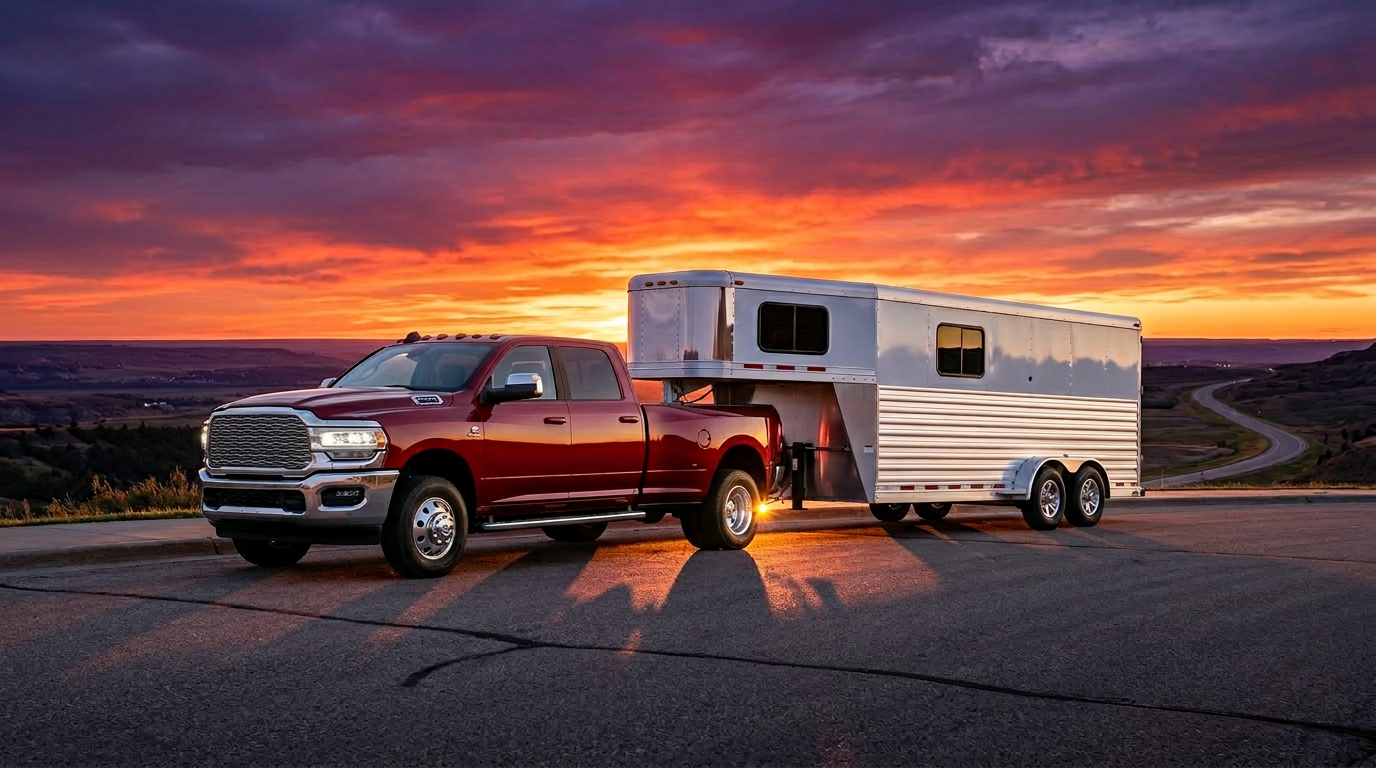





How much can the 2026 Ram 3500 actually tow — and which configuration gets you to the number you need? The answer depends on three things: your engine, your wheel type, and your axle ratio. Get any one of those wrong and you could leave thousands of pounds of towing capacity on the table. This guide breaks down every OEM-verified towing figure for the 2026 Ram 3500, organized by engine, cab, bed length, and single rear wheel (SRW) versus dual rear wheel (DRW) configuration. Every number comes directly from the 2026 Ram Heavy Duty Tow/Payload Chart, so you can match the right setup to your trailer before you ever visit the lot. Search Available Ram 3500 Inventory Get Pre-Qualified On This Page How much can the 2026 Ram 3500 tow? What is the maximum towing capacity with the Cummins diesel dually? How does towing capacity change between SRW and DRW? Which configuration matches your trailer? Can the Ram 3500 pull a 5th wheel or gooseneck trailer? What tow rating do I need for a large livestock trailer in South Dakota? How to match your Ram 3500 configuration to your trailer What axle ratio should I choose for maximum towing? Key Takeaways Frequently Asked Questions How much can the 2026 Ram 3500 tow? The 2026 Ram 3500 tops out at 36,610 pounds of maximum trailer weight when equipped with the 6.7L Cummins HO Turbo Diesel, dual rear wheels (DRW), a 3.42 axle ratio, and a 4x4 Regular Cab or Crew Cab 8-foot bed configuration. With the 6.4L HEMI V8, the maximum is 18,150 pounds in a DRW Crew Cab 8-foot bed with a 4.10 axle ratio. Those are the ceiling numbers, but your real tow rating depends on the specific combination of engine, cab, bed length, wheel type, axle ratio, and drivetrain you choose. A Cummins SRW Crew Cab tows a very different load than a Cummins DRW Regular Cab. The tables below lay out every configuration so you can find the exact number that applies to the truck you're building. All Figures SAE J2807 Compliant Every towing figure in this guide follows the SAE J2807 standard, which accounts for 300 lbs of passenger weight, 100 lbs of options, and 75 lbs of conventional trailering equipment (or 40 lbs gooseneck / 250 lbs 5th-wheel equipment). These aren't marketing numbers — they're tested, standardized ratings. What is the maximum towing capacity with the Cummins diesel dually? The Cummins DRW peaks at 36,610 pounds with a Gross Combined Weight Rating (GCWR) of 45,000 pounds. That number is available on the Regular Cab 8-foot bed 4x4 and the Crew Cab 8-foot bed 4x4, both with the 3.42 axle ratio and 14,000-pound GVWR. Configuration Wheels GVWR GCWR Max Tow (4x4) Reg Cab 8' / Crew Cab 8' DRW 14,000 lbs 45,000 lbs 36,610 lbs Crew Cab 8' DRW 14,000 lbs 43,040 lbs 34,490 lbs (4x2) Mega Cab 6'4" DRW 14,000 lbs 42,800 lbs 33,890 lbs Mega Cab 6'4" DRW 14,000 lbs 41,950 lbs 32,890 lbs The Cummins produces 430 horsepower and 1,075 lb-ft of torque for 2026 — a 10-horsepower increase over 2025 and the best-in-class available base diesel torque in the heavy-duty segment. When you pair that with dual rear wheels and the 14,000-pound GVWR chassis, you get towing numbers that handle the heaviest 5th-wheel campers, commercial equipment trailers, and multi-head livestock rigs that roll through the Northern Plains. How does towing capacity change between SRW and DRW? Wheel type is the single biggest variable in the Ram 3500's tow ratings. A Cummins DRW Crew Cab 8-foot bed 4x4 tows up to 36,610 pounds, while the same truck in SRW tops out at 26,080 pounds (Regular Cab 8-foot bed 4x4). That's a 10,530-pound difference driven entirely by whether you have four rear tires or six. Engine SRW Max Tow DRW Max Tow Difference 6.7L Cummins HO Diesel 26,080 lbs 36,610 lbs +10,530 lbs 6.4L HEMI V8 17,730 lbs 18,150 lbs +420 lbs The Cummins sees a massive jump because the DRW chassis raises the GVWR from 11,500–12,300 pounds to 14,000 pounds and the GCWR from roughly 34,000 to 45,000 pounds. The HEMI's DRW gain is smaller because its GCWR increase is more modest (24,250 to 25,000 pounds). If you're shopping a Ram 3500 specifically for towing, the SRW vs. DRW choice is where the real decision lives. For a deeper comparison of daily driving, tire costs, and maneuverability tradeoffs, see our SRW vs. DRW buyer's guide. Which configuration matches your trailer? What You're Towing Typical Weight Recommended Config Bumper-pull livestock trailer (12–16 head) 12,000–16,000 lbs Cummins SRW, 4x4 Large 5th-wheel camper 14,000–20,000 lbs Cummins SRW or DRW, 4x4 Gooseneck stock trailer (20+ head) 18,000–26,000 lbs Cummins DRW, 4x4 Hotshot flatbed / equipment trailer 25,000–36,000 lbs Cummins DRW, Reg or Crew Cab 8', 4x4 Flatbed with farm equipment 8,000–15,000 lbs HEMI or Cummins SRW, 4x4 Worth it if: you regularly tow above 20,000 pounds — the DRW Cummins is the only configuration that handles that range comfortably with margin to spare. Skip it if: your heaviest trailer stays under 17,000 pounds — an SRW keeps your tire costs lower and parks easier in town, and still handles the load. Can the Ram 3500 pull a 5th wheel or gooseneck trailer? Yes — and for trailers over 23,000 pounds, a 5th-wheel or gooseneck hitch is required on the Ram 3500. The factory 5th Wheel/Gooseneck Towing Prep Group (option code AHU, $745) adds 7-pin bed wiring, a 12-pin connector, and auxiliary camera provisions. It's also included in the Max Tow Package, which bundles it with auto-level rear air suspension. The maximum tongue weight for a conventional Class V receiver hitch on the Ram 3500 is 2,300 pounds — higher than the 2,000-pound limit on the Ram 2500. For 5th-wheel and gooseneck setups, OEM guidelines recommend tongue weight at 15% of gross trailer weight, versus 10% for conventional hitches. Hitch Threshold A 5th-wheel or gooseneck hitch is required for trailers over 23,000 lbs on the Ram 3500. Below that threshold, a conventional receiver hitch is permitted — but many owners still prefer gooseneck setups for stability at lower weights. For a deep dive into hitch types, prep groups, and configuration advice, see our 5th wheel and gooseneck towing guide. What tow rating do I need for a large livestock trailer in South Dakota? A fully loaded gooseneck livestock trailer hauling 20 or more head of cattle can easily push 22,000 to 28,000 pounds depending on breed, trailer size, and how many compartments you're filling. For that load range, you need a Cummins DRW configuration — it's the only Ram 3500 setup with enough margin above 26,000 pounds to keep you legal and safe. If you're running a smaller bumper-pull trailer with 10 to 16 head, a Cummins SRW handles that weight comfortably. The SRW tops out at 26,080 pounds, so you have thousands of pounds of headroom on a 14,000-to-18,000-pound loaded rig. For ag operators around Bowdle and across the Northern Plains, the practical question is usually about the worst-case scenario: hauling a full load on a hot day, on gravel, with hills. Build your towing requirement around that day, not the average day. If your worst-case load is 24,000 pounds, a 26,080-pound SRW rating doesn't leave much margin — and the DRW's 36,610-pound ceiling gives you room to breathe. How to match your Ram 3500 configuration to your trailer Start with your trailer's gross vehicle weight rating (the loaded weight, not the empty weight), then work backward to find the Ram 3500 configuration that exceeds it with margin. Weigh your loaded trailer: Use the trailer manufacturer's GVWR or weigh it on a certified scale at your heaviest realistic load — not the empty weight. Add 10–15% margin: If your loaded trailer weighs 22,000 lbs, target at least 24,200–25,300 lbs of towing capacity to account for passengers, gear, fuel, and uneven loads. Choose your wheel type: If your target number exceeds 26,000 lbs, you need DRW. Under 18,000 lbs, SRW works with either engine. Between 18,000 and 26,000 lbs, SRW with Cummins handles it. Choose your engine: The Cummins unlocks the highest tow ratings at every configuration level. The HEMI maxes at 18,150 lbs (DRW) — if your needs exceed that, the diesel is the only option. Check the axle ratio: The 4.10 axle ratio maximizes towing with the HEMI. For the Cummins, the 3.42 axle ratio delivers the highest tow ratings on DRW configurations. Confirm the hitch type: Conventional receiver up to 23,000 lbs. Above that, 5th-wheel or gooseneck required. Budget for the $745 factory prep group if it's not already included. What axle ratio should I choose for maximum towing on the Ram 3500? With the HEMI, the 4.10 axle ratio consistently delivers the highest tow ratings across every configuration. With the Cummins, the picture is different — the 3.42 axle ratio produces the maximum tow ratings on DRW configurations because the higher GCWR ceiling (45,000 lbs) pairs with the diesel's enormous low-end torque. Engine Config 3.42 Axle 3.73 Axle 4.10 Axle Cummins DRW Crew Cab 8' 4x4 36,610 lbs — — Cummins SRW Reg Cab 8' 4x4 26,080 lbs — — HEMI DRW Crew Cab 8' 4x2 — 15,750 lbs 18,150 lbs HEMI SRW Crew Cab 6'4" 4x2 — 15,490 lbs 17,730 lbs Source All towing figures from the 2026 Ram Heavy Duty Tow/Payload Chart (v1.9), SAE J2807 compliant. Figures assume properly equipped vehicle with required trailering equipment. Key Takeaways The Cummins DRW tops out at 36,610 lbs — the dual rear wheel upgrade is the single biggest variable in maximum tow capacity, adding over 10,500 lbs to Cummins configurations. The HEMI maxes at 18,150 lbs (DRW) — capable for bumper-pull and moderate gooseneck loads, but the Cummins is the only option above that threshold. A 5th-wheel or gooseneck hitch is required for trailers over 23,000 lbs. The factory prep group (AHU) runs $745 or comes bundled in the Max Tow Package. Build your configuration around your worst-case towing day — not your average load. The right margin keeps you legal, safe, and confident on South Dakota gravel and hills. Frequently Asked Questions Is the 2026 Ram 3500 Cummins more powerful than the 2025? Yes. The 2026 Cummins HO Turbo Diesel produces 430 horsepower, up from 420 in 2025. Torque remains at 1,075 lb-ft. The 10-hp increase doesn't change the maximum tow ratings dramatically, but it's a measurable improvement in pulling power, especially on grades and in high-altitude conditions. Can I tow 30,000 pounds with a Ram 3500 SRW? No. The maximum SRW towing capacity is 26,080 lbs with the Cummins. To tow 30,000 pounds, you need a DRW configuration, which raises the ceiling to 36,610 lbs. There's no SRW option on the Ram 3500 — or any truck in the class — that rates above 26,080 lbs. Does the Ram 3500 come with a gooseneck hitch from the factory? Not a complete hitch, but you can order the 5th Wheel/Gooseneck Towing Prep Group (AHU, $745), which installs the wiring harness, 7-pin bed connector, and 12-pin connector at the factory. You'll still need to add your own gooseneck ball or 5th-wheel hitch. The Max Tow Package includes this prep group plus auto-level rear air suspension. What's the GCWR of the 2026 Ram 3500? The highest GCWR is 45,000 lbs, available on the Cummins DRW Crew Cab 8-foot bed and Regular Cab 8-foot bed in 4x4 with a 3.42 axle ratio. The HEMI's highest GCWR is 25,000 lbs on DRW configurations. GCWR represents the maximum combined weight of the truck, passengers, cargo, and trailer. My Take on the Ram 3500's Towing Capacity I talk to ranchers and ag operators every week who are comparing the 2500 and 3500, and the conversation almost always comes back to one question: "Do I need the dually?" The honest answer is that most folks pulling a bumper-pull stock trailer or a mid-size 5th wheel don't — the SRW handles those loads with plenty of margin. But if you're running a loaded gooseneck with 20-plus head, pulling commercial equipment, or towing a big 5th-wheel camper across the hills between here and the Black Hills, the DRW's 36,610-pound ceiling gives you a level of confidence that the SRW can't match. The 2026 Cummins bump to 430 horsepower is a nice improvement, but the real story with the 3500 is still the DRW chassis. That 14,000-pound GVWR and 45,000-pound GCWR are what separate it from everything else in the segment. If you know you need those numbers, nothing else in the Ram lineup — or the class — gets you there the same way. For the full picture on everything the 2026 Ram 3500 offers beyond towing, check out our complete 2026 Ram 3500 guide. And if you want to talk through your specific towing setup, stop by Beadle's Chrysler Center in Bowdle — I'm happy to walk through the configurations and help you find the right match for what you're pulling. Shop Ram 3500 Inventory Get Pre-Qualified Contact Us in Bowdle About the Author Lexy Tabbert — Beadle's Chrysler Center, Bowdle, SD Lexy Tabbert is the Director of Sales and Marketing at Beadle's Chrysler Center in Bowdle, South Dakota. She covers Ram, Jeep, Dodge, and Chrysler vehicles — helping families, ranchers, and ag operators across the region find the right truck and configuration for their needs. Learn more about Lexy.