




2026 Jeep Grand Wagoneer L vs. Tahoe High Country vs. Expedition Platinum: A Plains Family Comparison
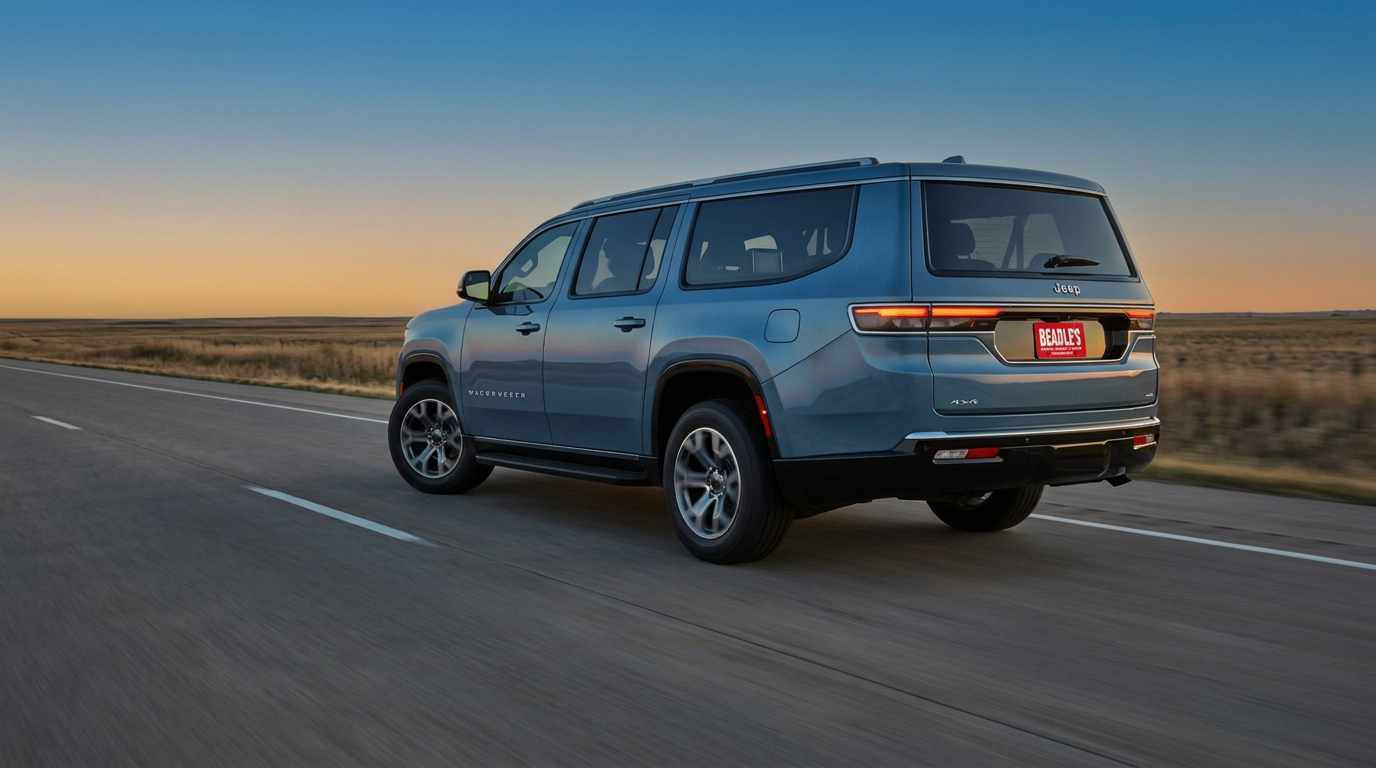
If you’re a South Dakota family that’s been driving Tahoes, Suburbans, or Expeditions for the last fifteen years, the 2026 Jeep Grand Wagoneer L just walked into the same conversation. The price drop on the new lineup made that real. So now you’re standing in your driveway looking at a Tahoe High Country, an Expedition Platinum, and a Grand Wagoneer L 4×4 — three trucks that didn’t used to be in the same room — and trying to figure out which one is actually right for the way your family lives.
This is a straight comparison written for that exact buyer. Not a “Jeep wins everywhere” piece — each of these three has real wins and real trade-offs. Here’s how they stack up on the things that matter when you’re hauling a family across the state, pulling a boat to Lake Oahe, and getting to school on a gravel road in February.
On This Page
- Why is the Grand Wagoneer L cross-shopped with these two?
- How do their starting prices compare?
- Which has the most usable third row?
- How do the powertrains compare?
- How do they tow?
- How do the tech and driver-assist systems compare?
- How do they handle South Dakota gravel and winter?
- Quick side-by-side comparison
- How to choose between the three
- When does each truck win?
- Key takeaways
- Frequently asked questions
Why is the Grand Wagoneer L cross-shopped with the Tahoe High Country and Expedition Platinum?
Until 2026, you couldn’t realistically compare these three. The 2025 Grand Wagoneer L started in the mid $90s, which put it next to the Escalade and Navigator. The Tahoe High Country and Expedition Platinum were in a different price tier. With the 2026 refresh, the Grand Wagoneer L 4×4 starts in the high $60s and the Limited 4×4 in the mid $70s — the same neighborhood as a loaded Tahoe High Country or Expedition Platinum.
All three are full-size three-row SUVs with body-on-frame construction, real towing capability, premium leather interiors, and the kind of long-haul comfort families need across South Dakota distances. Where they differ is wheelbase, powertrain philosophy, the tech stack, and what comes standard at the price point you’re shopping. Those differences are what this guide is about.
How do their starting prices compare?
All three sit in the same price band, with the Grand Wagoneer L 4×4 setting the lowest entry point and the Expedition Platinum at the highest.
| Model | Starting MSRP zone | Body length |
|---|---|---|
| 2026 Jeep Grand Wagoneer L 4×4 | High $60s | Long-wheelbase (~226 in.) |
| 2026 Jeep Grand Wagoneer L Limited 4×4 | Mid $70s | Long-wheelbase (~226 in.) |
| 2026 Chevy Tahoe High Country 4WD | Mid-to-high $70s | Standard wheelbase (~211 in.) |
| 2026 Ford Expedition Platinum 4×4 | Low-to-mid $80s | Standard wheelbase (~210 in.) |
A few things worth noting on the price zones. Tahoe and Expedition both have long-wheelbase versions — the Suburban and the Expedition MAX — that compete more directly with the Grand Wagoneer L on body length. Those run several thousand dollars more than the standard-wheelbase Tahoe and Expedition listed above, and they push the cross-shop into the $80s and $90s. If body length is the priority, that’s the right comparison. If price is the priority, the Grand Wagoneer L’s L wheelbase is in your budget while the Suburban High Country and Expedition MAX Platinum probably aren’t.
Which one has the most usable third row?
Wheelbase is the right place to start, because it determines how much room the third row actually has. The Grand Wagoneer L’s wheelbase is 130 inches, against 121 inches on the Tahoe and 122 inches on the Expedition. That extra 8 to 9 inches of wheelbase translates directly into adult-usable third-row legroom and cargo behind the third row.
The Tahoe and Expedition’s third rows are usable for kids and short trips, but most adult passengers will be ready to climb out of them after an hour. The Grand Wagoneer L’s third row is the one your in-laws can actually ride in to a wedding in Sioux Falls without complaining when they get out. The Suburban and Expedition MAX match it on body length, but at a meaningfully higher price.
Cargo with all three rows up
All three carry similar cargo behind the third row in standard-wheelbase form — enough for groceries and a weekend overnight bag, not enough for a hockey-bag tournament weekend. The Grand Wagoneer L pulls ahead here because the L wheelbase preserves cargo space behind row three even with adults seated. For deeper third-row and cargo specifics, our third-row and family road-trip guide walks through real-use scenarios.
How do the powertrains compare?
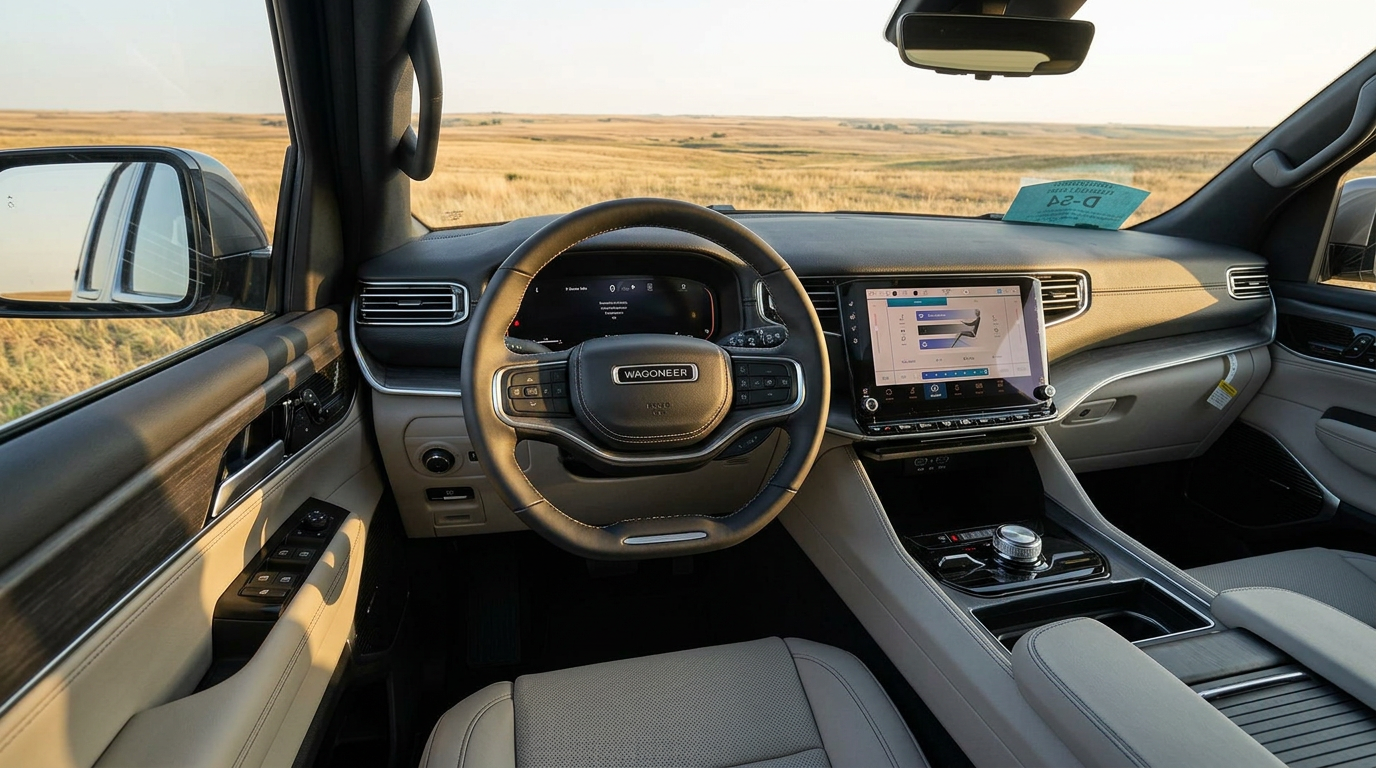
Three different engineering choices — a twin-turbo inline-six, a naturally aspirated V8, and a twin-turbo V6. None of them is wrong. They feel different on the road and they hand power to the driver in different ways.
| Spec | Grand Wagoneer L | Tahoe High Country | Expedition Platinum |
|---|---|---|---|
| Engine | 3.0L Hurricane SO twin-turbo I-6 | 6.2L V8 (3.0L Duramax diesel optional) | 3.5L EcoBoost twin-turbo V6 |
| Horsepower | 420 hp | 420 hp (V8) / 305 hp (diesel) | 400 hp |
| Torque | 468 lb-ft | 460 lb-ft (V8) / 495 lb-ft (diesel) | 480 lb-ft |
| Transmission | 8-speed automatic | 10-speed automatic | 10-speed automatic |
On paper, the three are remarkably close. The Tahoe’s V8 and the Grand Wagoneer L’s Hurricane SO both make 420 hp, with the Hurricane edging out on torque (468 vs. 460 lb-ft). The Expedition’s EcoBoost trades a few horsepower for the highest torque of the three gas engines at 480 lb-ft, and the Tahoe’s optional Duramax diesel pushes torque all the way to 495 lb-ft. In real-world driving, the Hurricane SO feels smooth and effortless on the highway with a strong torque curve from low rpm. The 6.2L V8 in the Tahoe High Country sounds the best of the three and has decades of proven reliability. The Expedition’s EcoBoost is torque-rich and pulls confidently, especially when towing. Pick the one whose character matches what you actually want from a daily driver.
How do they tow?
All three are real tow rigs. The differences matter most at the upper end — when you’re hauling a long camper or a 22-foot fishing boat with a full tank.
- Grand Wagoneer L: rated up to 10,000 lbs with the available HD Trailer Tow Package, per Jeep’s capability page. The package adds an integrated trailer brake controller, blind-spot detection with trailer, the 2-speed transfer case, and the 3.92 axle ratio.
- Tahoe High Country (6.2L V8): rated up to 8,400 lbs with the Max Trailering Package. The diesel version’s tow rating is similar.
- Expedition Platinum (3.5L EcoBoost): rated up to 9,600 lbs when properly equipped with the HD Tow Package on a standard-wheelbase 4×4.
For a typical Lake Oahe fishing-boat trailer in the 4,000-to-5,000-pound range loaded, all three handle the job. For a 30-foot travel trailer or a 3-horse trailer pushing 8,000 lbs, the Grand Wagoneer L and Expedition give you more headroom. If you regularly tow at the upper end of a vehicle’s capability, the right answer is to step up to a Ram 2500 or HD-class truck rather than max out a half-ton SUV.
How do the tech and driver-assist systems compare?
The infotainment systems are three different philosophies. Uconnect 5 (Jeep) keeps your phone projection front and center with Apple CarPlay and Android Auto. Google Built-In (Chevy) bakes Google Maps and the Play Store directly into the dash and treats your phone as a secondary device. SYNC 4 (Ford) sits between the two with strong native navigation and full phone projection.
Where the Grand Wagoneer L has a real advantage that doesn’t show up on a feature checklist: hands-free driver assist. Active Driving Assist is standard on every 2026 Grand Wagoneer L trim, including the entry 4×4 — no subscription, no trial-period clock running out. Super Cruise on the Tahoe High Country and BlueCruise on the Expedition Platinum are both excellent systems, but they typically require a paid subscription after an introductory trial. Over a 5-year ownership window, that adds up.
Worth checking before you buy
All three include the standard adaptive cruise, blind-spot, lane-keep, and emergency-braking suites. The differences are in the hands-free driving feature and the subscription model. If you’ve never used hands-free driving on a long highway drive, schedule a test drive on a clear stretch of road. That’s the only way to feel whether it’s worth subscribing for.
How do they handle South Dakota gravel and winter?
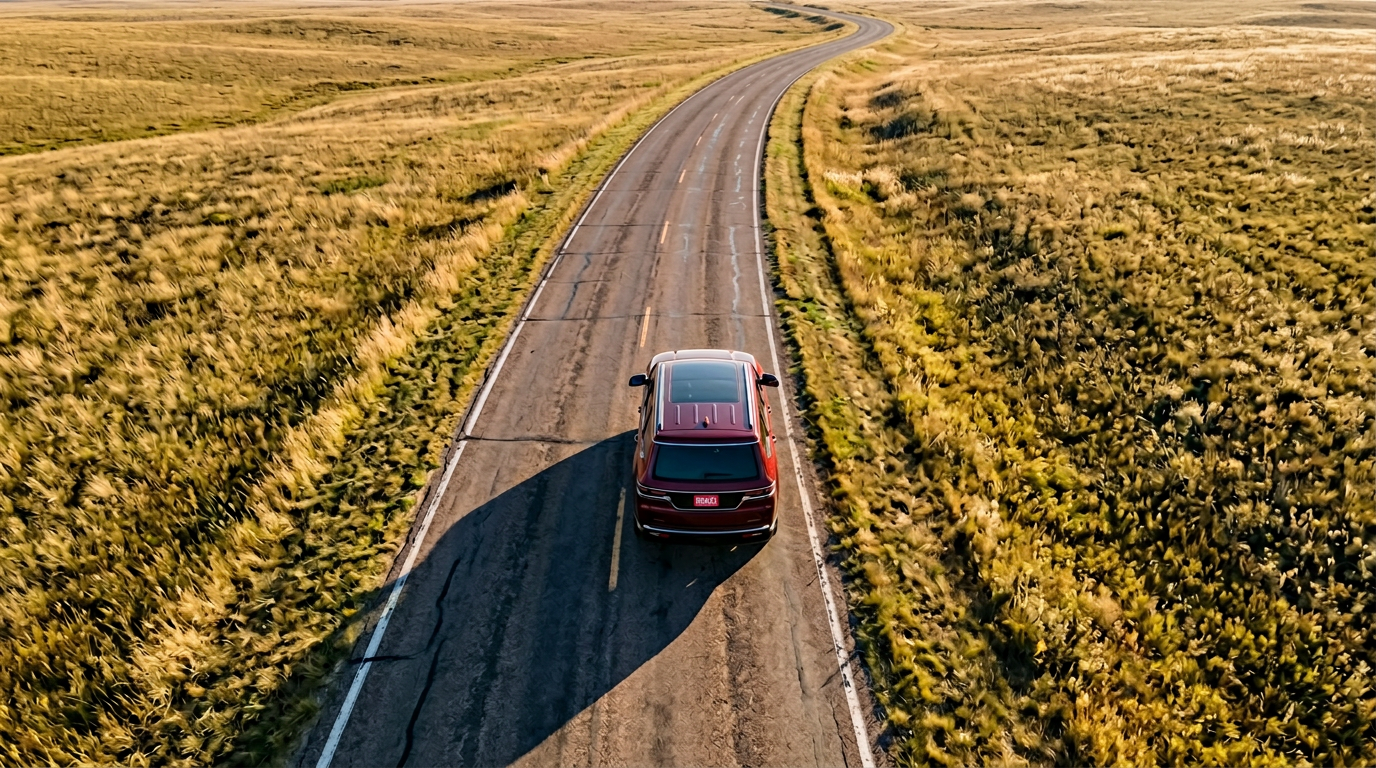
All three are real four-wheel-drive trucks with low-range capability and electronic terrain modes. They each handle plowed county roads, an icy driveway, and a wet gravel road with no drama. Where they differ is in the philosophy.
- Grand Wagoneer L Selec-Terrain: on-demand transfer case with Auto, Snow, Sand, Mud, Sport, and (with HD Trailer Tow) a 2-speed low range. The L wheelbase plants the truck on highway crosswinds in a way the shorter trucks don’t quite match.
- Tahoe High Country Autotrac: automatic 4WD with low range. Fewer terrain modes than Selec-Terrain, but the system makes its own decisions and most owners just leave it in Auto.
- Expedition Platinum 4A: intelligent 4WD with an Auto setting that distributes torque on the fly. Easy to live with year-round.
For most South Dakota families, all three are more than capable. The L wheelbase is a real comfort factor on long, windy highway drives — Bowdle to Sioux Falls, Bowdle to Rapid City. If winter gravel and crosswind stability are a high priority, our South Dakota winter and gravel guide goes deeper on the Grand Wagoneer L specifically.
The fastest way to settle the cross-shop question is back-to-back drives. Schedule one with us.
Schedule a Test DriveQuick side-by-side comparison
The bullets above translated into a single decision-friendly view.
| Dimension | Grand Wagoneer L | Tahoe High Country | Expedition Platinum |
|---|---|---|---|
| Starting MSRP zone | High $60s (4×4) | Mid-to-high $70s | Low-to-mid $80s |
| Body length | Long (~226 in.) | Standard (~211 in.) | Standard (~210 in.) |
| Engine character | Smooth twin-turbo I-6 | Naturally aspirated V8 sound | Torque-rich twin-turbo V6 |
| Available max towing | Up to 10,000 lbs (HD Tow) | Up to 8,400 lbs (Max Trailering) | Up to 9,600 lbs (HD Tow) |
| Hands-free driver assist | Active Driving Assist standard, no subscription | Super Cruise (subscription after trial) | BlueCruise (subscription after trial) |
| Adult-usable third row | Yes (L wheelbase) | Kids and short trips | Kids and short trips |
| Closest size-matched trim | Already long-wheelbase | Suburban (steps up several thousand) | Expedition MAX (steps up several thousand) |
How to choose between the three
Here’s the practical decision flow we walk customers through on the lot.
- Decide on body length first. If you regularly carry six or seven people with luggage, you need long-wheelbase. The Grand Wagoneer L has it standard. The other two require stepping up to Suburban or Expedition MAX, which moves them out of this price band.
- Match engine character to how you drive. If the V8 sound is non-negotiable, that’s the Tahoe. If you want the strongest torque-rich pull, that’s the Expedition. If you want refined and effortless on long highway miles, that’s the Grand Wagoneer L.
- Be honest about subscription tolerance. If you’ll never pay for hands-free driving after the trial expires, the Grand Wagoneer L’s standard Active Driving Assist saves real money over time.
- Test-drive the third row. Have an adult sit back there for the full drive. The decision usually makes itself once you do.
- Run the actual numbers. A loaded Tahoe High Country and a Grand Wagoneer L Limited can land within a few thousand dollars of each other once you spec them out. The right answer depends on which standard equipment matters more to you.
- Check warranty fit. All three have similar bumper-to-bumper terms, but powertrain coverage and roadside assistance details differ. Ask the seller for the exact warranty package on your specific build before signing.
When does each truck win?
None of these is the right answer for everyone. Here’s where each one wins outright.
The Grand Wagoneer L wins on: body length and adult-usable third row at this price band, the highest tow rating with HD Tow Package, hands-free driver assist standard with no subscription, and the lowest starting MSRP for a long-wheelbase three-row at this trim level.
The Tahoe High Country wins on: the V8 driving character, decades of GM half-ton refinement, and Super Cruise hands-free for buyers who already use Google services and don’t mind the subscription. If you’ve owned a Tahoe for fifteen years and the muscle memory matters, this is the comfortable choice.
The Expedition Platinum wins on: the highest torque of the three gas engines (480 lb-ft) for confident pulling, BlueCruise for owners who already have it on another Ford, and SYNC 4’s strong native navigation. Ford loyalists who like the EcoBoost feel will land here naturally.
Key Takeaways
- The 2026 price drop puts the Grand Wagoneer L 4×4 in the same price neighborhood as a Tahoe High Country and an Expedition Platinum for the first time. Cross-shop is real now.
- The Grand Wagoneer L has the longest wheelbase of the three by 8 to 9 inches, which translates directly into adult-usable third-row legroom. The Suburban and Expedition MAX match it, but at a meaningfully higher price.
- Up to 10,000 lbs of towing with the HD Trailer Tow Package is the highest of the three. The Tahoe High Country tops out at 8,400 lbs with the V8 and Max Trailering Package; the Expedition Platinum reaches up to 9,600 lbs with HD Tow.
- Active Driving Assist Level 2 hands-free is standard on every 2026 Grand Wagoneer L trim with no subscription. Super Cruise (Tahoe) and BlueCruise (Expedition) typically require a paid subscription after the introductory trial.
Frequently Asked Questions
Is the 2026 Grand Wagoneer L bigger than a Tahoe?
Yes — the Grand Wagoneer L’s wheelbase is 130 inches against the standard Tahoe’s 121 inches, and the body is 15 inches longer overall. The Suburban is the long-wheelbase Chevy that competes more directly with the L on size, but it pushes into a higher price range than the standard Tahoe High Country.
Which one tows the most?
The Grand Wagoneer L, at up to 10,000 lbs with the available HD Trailer Tow Package per Jeep’s capability page. The Expedition Platinum reaches up to 9,600 lbs with HD Tow, and the Tahoe High Country’s 6.2L V8 with Max Trailering Package is rated up to 8,400 lbs. Confirm the exact tow rating on the window sticker for the specific build you’re considering.
Is Super Cruise better than Active Driving Assist?
Both are capable Level 2 hands-free systems on mapped highways. Super Cruise has a longer track record and a slightly larger mapped-road network. Active Driving Assist is closing the gap and is standard on every 2026 Grand Wagoneer L trim without a subscription, while Super Cruise typically requires a paid subscription after the introductory trial. The right call depends on whether you’ll actually pay the monthly fee long-term.
Will the Grand Wagoneer L hold its value as well as a Tahoe?
Tahoe and Suburban have a long-running residual-value reputation that the Grand Wagoneer nameplate is still building. Resale is shaped by demand, supply, and condition more than badge alone. With the 2026 price reset, the Grand Wagoneer L is more accessible to a broader buyer pool, which generally helps used-market demand. Lease residuals from the lender are the practical place to compare apples-to-apples — ask the seller to run all three on the same term and miles.
Should I cross-shop the Suburban or Expedition MAX instead?
If body length is your top priority, the Suburban High Country and Expedition MAX Platinum are the closer wheelbase matches to the Grand Wagoneer L. They run several thousand dollars more than the standard Tahoe and Expedition listed in this comparison and push the cross-shop into the $80s and $90s. At that price, the Grand Wagoneer L Summit also enters the conversation.
My Take on the Grand Wagoneer L Cross-Shop
We see Tahoe loyalists and Expedition loyalists in our showroom every week. Brand loyalty is real, and there are good reasons to buy any of these three trucks. What changed in 2026 is that the Grand Wagoneer L is now in the conversation at all — that wasn’t true a year ago.
For the families I talk to most often — replacing an older Suburban with three teenagers and a fishing boat to pull — the Grand Wagoneer L 4×4 with the 85th Anniversary Edition or a Limited with Reserve makes the most sense. The L wheelbase is the right answer for adult third-row passengers and tournament-weekend cargo, the standard hands-free driver assist saves a real number of subscription dollars over a 5-year hold, and the up-to-10,000-pound tow rating is the highest of the three. For Ford and Chevy loyalists who specifically want their existing brand’s powertrain character, the Expedition Platinum and Tahoe High Country are still the right answer.
For the rest of the 2026 picture — refresh, capability, tech, colors, safety — read our 2026 Jeep Grand Wagoneer L overview. If you want to see how the Grand Wagoneer L specifically handles plains winters and gravel-road realities, our South Dakota winter and gravel guide covers it. And if you’re anywhere near Bowdle, drive all three back-to-back. That’s the only way to feel which one is yours.
About the Author
Lexy Tabbert — Beadle’s Chrysler Center, Bowdle, SD
Lexy Tabbert is the Director of Sales and Marketing at Beadle’s Chrysler Center in Bowdle, South Dakota. She covers Ram, Jeep, Dodge, and Chrysler vehicles — helping families, ranchers, and ag operators across the region find the right truck and configuration for their needs. Learn more about Lexy.
2026 Jeep Grand Wagoneer L Trim Guide: 4×4, Limited, Summit, and the 85th Anniversary Sweet Spot
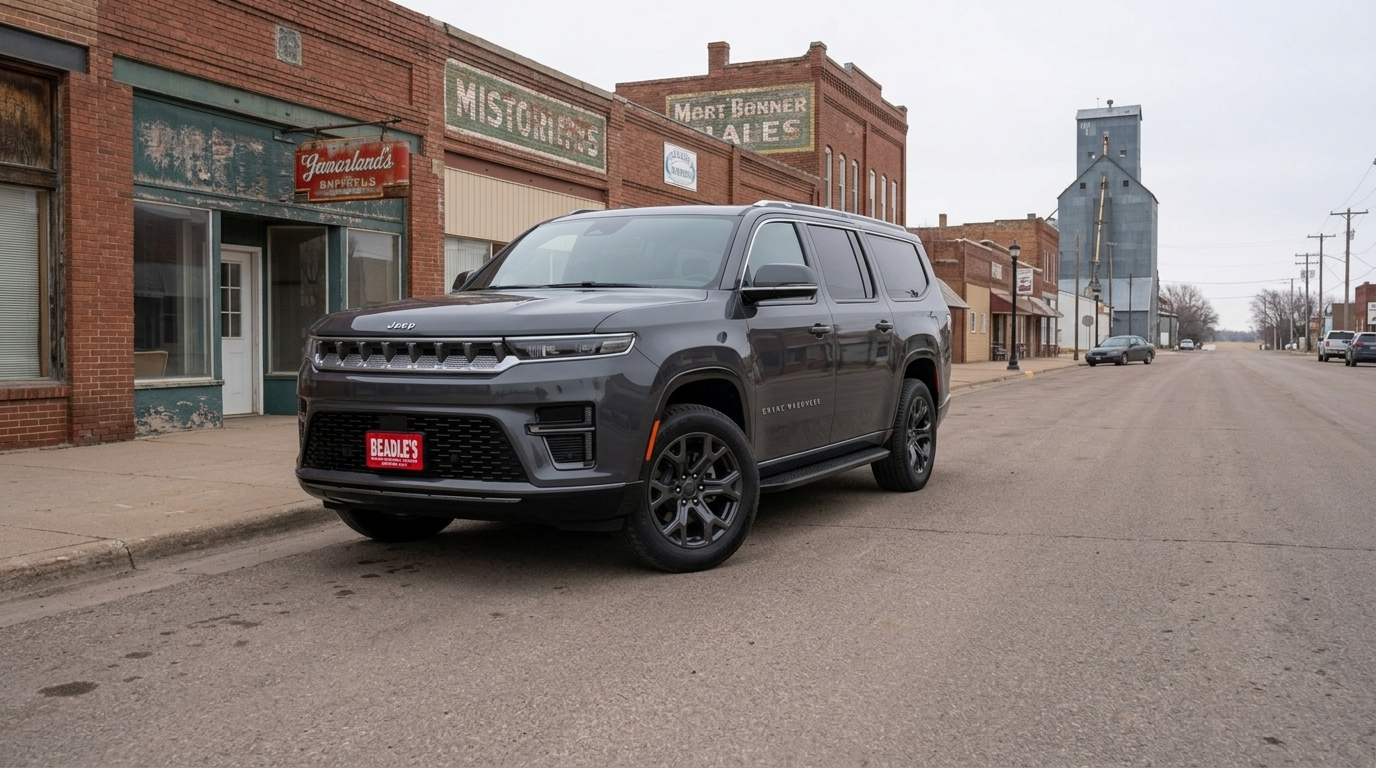
The 2026 Jeep Grand Wagoneer L lineup is genuinely different from what was on the lot a year ago. Trim names changed. Standard equipment moved. Air suspension is no longer standard at the entry of the lineup. Two new entry trims dropped the starting price by tens of thousands of dollars. And, frankly, a lot of the trim guides floating around online are still mixing 2025 names (“Series II / III”) with 2026 specs — which doesn’t help anyone trying to make a real decision.
Here’s a clean walkthrough of every 2026 Grand Wagoneer L trim — what comes standard, what’s optional, what each step up actually buys you, and which trim makes sense for which kind of South Dakota family. We’ll keep the names accurate and the trade-offs honest.
On This Page
- What are the 2026 Grand Wagoneer L trim levels?
- What does the 2026 Grand Wagoneer L 4×4 actually include?
- What does the Limited add over the base 4×4?
- What does the Summit add over the Limited?
- What is the 85th Anniversary Edition?
- How do Altitude, Reserve, and Obsidian work?
- 2025 Series II equivalent — which 2026 trim replaces it?
- How to pick the right 2026 Grand Wagoneer L trim for your family
- Key takeaways
- Frequently asked questions
What are the 2026 Grand Wagoneer L trim levels?
For 2026, the lineup is Grand Wagoneer L 4×2, Grand Wagoneer L 4×4, Limited, and Summit. Series I, Series II, and Series III are not 2026 trim names — those were retired with the 2025 model year. On top of the four trims, Jeep stacks a few appearance-and-content packages: 85th Anniversary on the 4×4, Altitude on the Limited, Reserve on either Limited or Summit, and Obsidian on the Summit.
Every trim runs the same Hurricane Twin Turbo Standard Output inline-six and the same 8-speed automatic. They share the long-wheelbase body, three-row layout, and the full Level-2-hands-free-capable safety suite. The differences are about suspension, audio, seats, wheels, lighting, and the fit-and-finish layer — not powertrain. If you want the year-over-year context for the trim renaming, our guide to what changed on the 2026 Grand Wagoneer L covers it in detail.
What does the 2026 Grand Wagoneer L 4×4 actually include?
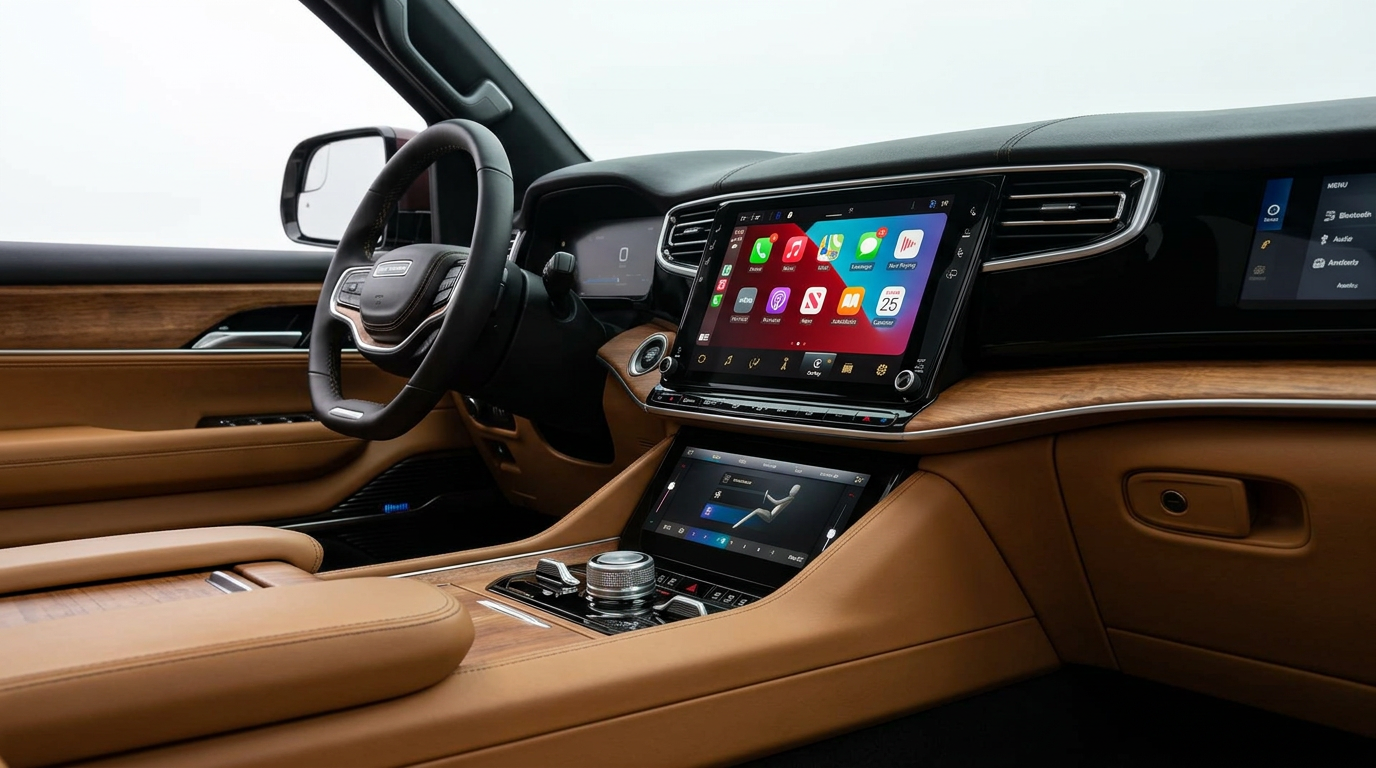
The 4×4 is the new entry-of-the-lineup trim, starting in the high $60s. It’s important to be clear about what “entry trim” actually means here, because it is not a stripped-down truck. The 2026 Grand Wagoneer L 4×4 includes the entire Active Driving Assist Level 2 hands-free system, the full safety suite, leather seats with heat and ventilation up front, the 12-inch Uconnect 5 touchscreen, and the power 60/40 third row.
Standard equipment that often surprises people at this price:
- Hurricane Twin Turbo SO inline-six (420 hp / 468 lb-ft) and 8-speed automatic
- Selec-Terrain System with single-speed on-demand transfer case and front-axle disconnect
- Anti-Spin rear differential
- 20-inch machine-face painted aluminum wheels
- Active Driving Assist (Level 2 hands-free), adaptive cruise with stop and go, active lane management, blind-spot with rear cross-path, pedestrian and cyclist emergency braking, intersection collision assist, traffic sign recognition, drowsy driver detection
- Uconnect 5 with 12.0-inch touchscreen, 10.25-inch digital cluster, Apple CarPlay and Android Auto, 4G LTE Wi-Fi hotspot, Alexa Built-In, wireless charging pad
- 9-speaker Alpine audio with subwoofer
- Leather-trimmed bucket seats, 8-way power driver and passenger
- Heated and ventilated front seats, heated steering wheel
- 3rd-row 60/40 power fold and recline
- Hands-free power liftgate, automatic headlamps, rain-sensitive wipers
- Body side steps
- Class IV receiver hitch with 7- and 4-pin trailer wiring
What it does not include at base: Quadra-Lift air suspension, McIntosh audio, heated second-row seats, 20-way power seats, the surround-view camera, and the augmented head-up display. Those move up the trim ladder. The surround-view camera can be added via Premium Group I; the rest require stepping into Limited (with packages) or Summit.
What does the Limited add over the base 4×4?
Limited is the mid-trim, starting in the mid $70s. It steps up wheels, interior trim, and second-row comfort, and it unlocks the option packages that bring air suspension and McIntosh audio onto the truck.
What’s standard on Limited that the base 4×4 does not have:
- 22-inch painted aluminum wheels with 285/45R22 all-season tires
- Heated second-row captain’s chairs
- Real Wood Interior Accents III
The packages that matter on Limited:
- Convenience Group I — adds Quadra-Lift air suspension, semi-active damping, surround-view camera, Park & Unpark Assist, side distance warning, smartphone-as-a-key prep, and 2nd-row window shades. This is the package to look at if you want the air suspension experience without going all the way to Summit.
- Premium Group II — adds the 19-speaker McIntosh audio, the three-panel sunroof, power deployable running boards, the interior rear-facing camera, luxury floor mats, and the cargo mat. Audio-quality buyers stop here.
- Reserve (29D) — bundles most of the above plus an Augmented Head-Up Display, the 12-inch digital cluster, and Altitude appearance content. This is the one-package path to a near-Summit Limited.
Where Limited makes the most sense: families who want air suspension, McIntosh audio, and heated second-row seats without paying Summit money. A Limited with Reserve gets you most of the Summit experience at a meaningfully lower starting price.
What does the Summit add over the Limited?
Summit is the top trim, starting in the high $90s. It is the executive-level configuration — air suspension, McIntosh, and surround-view aren’t optional, they’re standard. Twenty-way power seats with massage are standard. The 12-inch digital cluster is standard. The three-panel sunroof is standard. If “I want every box ticked from the factory” is the brief, this is the trim.
What’s standard on Summit that Limited does not have at base:
- Quadra-Lift air suspension
- 23-speaker McIntosh Reference audio system
- 20-way power driver and passenger seats with massage
- Heated and ventilated front seats with massage; heated 2nd row standard
- 12-inch digital instrument cluster
- Three-panel sunroof
- Surround-view camera, side distance warning, Park & Unpark Assist with stop
- Hands-free Active Driving Assist Level 2 (standard across the lineup, but Summit comes complete)
The Summit Reserve package (29K) takes it further with the premium leather, real wood IV interior, suede headliner, front console cooler, ventilated rear seats, and the auto-dim digital rear-view mirror. Obsidian Appearance Package adds blacked-out exterior elements and 22-inch tinted polished wheels with black inserts.
What is the 85th Anniversary Edition?
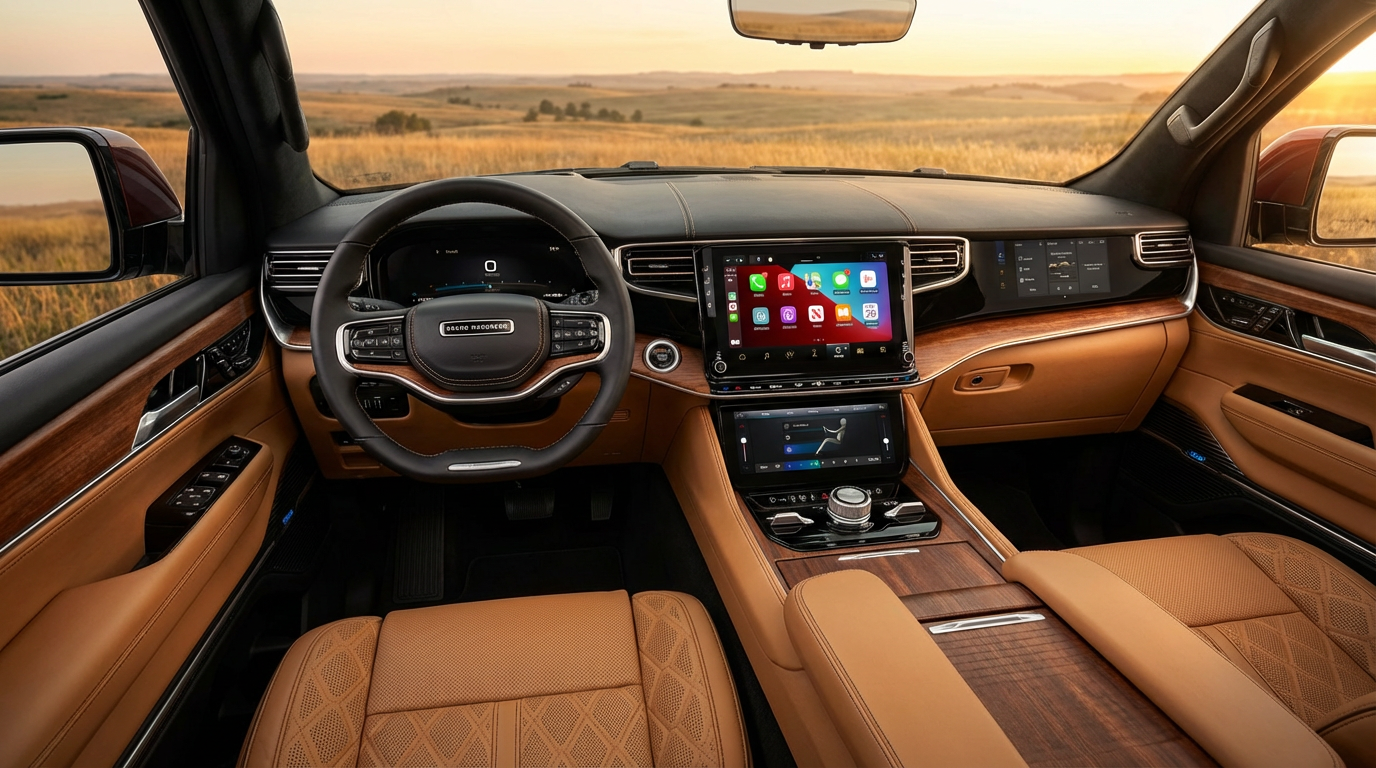
The 85th Anniversary is a Quick Order Package that lays on top of the Grand Wagoneer L 4×4. Adding it lands the total MSRP in the high $70s, and in return it adds about $9,000 of content — most of it items that are otherwise reserved for Limited or Summit.
What the 85th Anniversary includes
- 19-speaker McIntosh audio system
- 22×9.0-inch painted aluminum wheels with 285/45R22 Pirelli all-season tires
- Three-panel sunroof
- Surround-view camera and Park & Unpark Assist with stop
- Auto-power-folding mirrors with memory and approach lamps
- Two-Tone Paint Group (gloss black roof) — pairs with Bright White or Silver Zynith
- Desert Bronze tow hooks and 85th Anniversary badging on the fenders, liftgate, and 4×4 callouts
- Titanium grille and daylight-opening uppers
- Berber front and rear floor mats and a Berber cargo mat
- Leather-trimmed bucket seats with accent stitching
- Interior rear-facing camera, side distance warning, and a few smaller convenience features
For most buyers, the 85th Anniversary is the trim’s value sweet spot. Compare the math: a base 4×4 plus 85th Anniversary lands close to a Limited 4×4 fitted with Premium Group II, but you walk away with the 19-speaker McIntosh, 22-inch Pirelli wheels, three-panel sunroof, surround-view camera, two-tone paint, and unique 85th badging on top of standard 4×4 content. Where you give up ground compared with a real Limited is the ride — you’re still on the steel coil with rear load leveling rather than air suspension — and the second row is not heated.
How do Altitude, Reserve, and Obsidian work?
These are stackable Quick Order Packages — they don’t replace a trim, they layer on top of it. Each one has a different home trim and a different point of view.
| Package | Available on | What it does |
|---|---|---|
| Altitude (29X) | Limited only | Appearance pack: titanium accents on the daylight openings and upper grille, gloss-black exterior accents, 22-inch painted gloss-black wheels. |
| Reserve (29D on Limited; 29K on Summit) | Limited or Summit | On Limited, adds 19-speaker McIntosh, Quadra-Lift air suspension, semi-active damping, Augmented HUD, 12-inch cluster, three-panel sunroof, deployable running boards, and Altitude appearance. On Summit, adds premium leather, real wood IV, suede headliner, front console cooler, ventilated rear seats, and the digital auto-dim mirror. |
| Obsidian (29Z) | Summit only | Blacked-out appearance pack: titanium grille and daylight-opening uppers, gloss-black exterior accents, 22-inch tinted polished wheels with black inserts, real wood IV interior accents. |
The clearest mental model: Altitude and Obsidian are mostly visual; Reserve is the content-loaded option. If you want a near-Summit experience without paying Summit money, Limited with Reserve is the path. If you want the Summit experience with even more luxury content, Summit with Reserve is the path.
2025 Series II equivalent — which 2026 trim replaces it?
Most cross-shoppers asking us this question came out of a 2025 Series II or were planning on one. The honest answer: there is no exact one-to-one replacement, because Jeep added two new trims below where the 2025 lineup started. Here is the closest read.
| 2025 trim | Closest 2026 equivalent | What’s different |
|---|---|---|
| Series II 4×4 | Limited 4×4 | Air suspension and McIntosh now live in packages instead of being standard. Limited starts well below where Series II started. |
| Series III 4×4 | Summit 4×4 | Most of the Series III experience is now on Summit, with Reserve adding the premium leather and real wood IV. |
| — (no 2025 trim) | Grand Wagoneer L 4×4 | New entry point. Active Driving Assist, leather, heated/ventilated front seats, and the power third row are still standard. |
| — (no 2025 trim) | Grand Wagoneer L 4×2 | New rear-wheel-drive trim. Removes Selec-Terrain and the on-demand transfer case; same powertrain. |
Worth it (the 2026 lineup) if: you want the new exterior refresh, the Sea Salt and Black interior option, fresh warranty math, and you’re willing to add a package or two for air suspension or McIntosh.
Skip it (and chase a leftover 2025) if: you specifically want the 23-speaker McIntosh Reference and Quadra-Lift air suspension as standard equipment without optioning, and you find a 2025 Series II discounted aggressively enough to net out below a comparably equipped 2026 Limited.
How to pick the right 2026 Grand Wagoneer L trim for your family
Use this six-step process to land on the right trim instead of guessing or working from a feature list. It mirrors the conversation we have with families on the lot.
- Confirm the use case: three rows used regularly, long highway miles, replacing a Tahoe XL, Suburban, Yukon XL, or Expedition Max. If the L’s wheelbase advantage doesn’t matter for how you actually use a vehicle, the standard Grand Wagoneer is a smaller, cheaper option to consider.
- Set the suspension priority: if you’ve previously owned air suspension and would miss it, plan on Limited with Convenience Group I (or Reserve), or Summit. If you’ve only ever had a steel-spring SUV, the base 4×4 will feel completely normal.
- Audition the audio: the 9-speaker Alpine on the 4×4 is competent. McIntosh (19 speakers on Limited or 85th Anniversary, 23 on Summit) is a different listening experience. Sit in both for a song or two before deciding.
- Check the second-row needs: if you’ll have car seats year-round in row two, heated second-row seats are a meaningful winter comfort upgrade. That puts you on Limited at a minimum.
- Plan for towing: if a boat, camper, or stock trailer is in the picture, add the HD Trailer Tow Package on the 4×4, Limited, or Summit. It unlocks the up-to-10,000-pound rating, the trailer brake controller, blind-spot with trailer detection, and the 2-speed transfer case.
- Pick the appearance lane: chrome-and-bright, blacked-out, or anniversary-edition. Bright trim is standard. Altitude or Obsidian goes black. 85th Anniversary adds Desert Bronze tow hooks and badging.
Once you’ve picked a trim, the next question is usually space. Want to see how the third row and cargo work in practice?
Browse our 2026 Grand Wagoneer L inventoryKey Takeaways
- The 2026 Grand Wagoneer L lineup is 4×2, 4×4, Limited, and Summit. Series I, II, and III are not 2026 trim names.
- Active Driving Assist Level 2, leather seats, heated and ventilated front seats, the power third row, and the 12-inch Uconnect 5 screen are standard on every trim — including the entry 4×4.
- Air suspension, McIntosh audio, heated second-row seats, 20-way power seats, and the surround-view camera move up the trim ladder for 2026. Most are standard or available on Limited and standard on Summit.
- The 85th Anniversary on the 4×4 is the value sweet spot — McIntosh, sunroof, 22-inch Pirelli wheels, and surround-view for a content value of about $9,000 over the base 4×4. Limited with Reserve is the path to a near-Summit experience without Summit money.
Frequently Asked Questions
Does the 2026 Grand Wagoneer L 4×4 come with air suspension?
No. The 2026 Grand Wagoneer L 4×4 (entry trim) uses a steel coil suspension with rear load leveling. Quadra-Lift air suspension is standard on Summit and available on Limited through Convenience Group I or the Reserve package. This is one of the bigger differences from 2025, when air suspension was standard at Series II.
Which 2026 Grand Wagoneer L trims include McIntosh audio?
The 23-speaker McIntosh Reference is standard on Summit. The 19-speaker McIntosh is available on Limited via Premium Group II or Reserve, and on the Grand Wagoneer L 4×4 via the 85th Anniversary Edition. The base 4×4 and 4×2 use a 9-speaker Alpine system with subwoofer.
Is the 85th Anniversary Edition worth the price premium?
For most buyers, yes. The package adds about $9,000 of content over the base 4×4 — McIntosh audio, 22-inch Pirelli wheels, three-panel sunroof, surround-view camera, two-tone paint, and unique badging. You give up air suspension and heated second-row seats compared with Limited, but the content per dollar is strong if you can live with the steel-spring ride.
What is the difference between Altitude, Reserve, and Obsidian?
Altitude is a Limited-only appearance package — titanium accents and gloss-black 22-inch wheels. Obsidian is a Summit-only blacked-out appearance package with tinted polished wheels and black exterior accents. Reserve is the content package — on Limited it adds McIntosh, air suspension, an Augmented Head-Up Display, the 12-inch cluster, the sunroof, and deployable running boards; on Summit it adds premium leather, real wood IV, suede headliner, front console cooler, ventilated rear seats, and the digital auto-dim mirror.
Do I need 4×4, or is the 4×2 enough for South Dakota?
For Bowdle and the surrounding region, plan on 4×4. Gravel road conditions in spring, ice on county roads in winter, and snow drifts on rural driveways are real factors here. The 4×2 is a fine choice if you live in town and rarely leave paved roads, but the on-demand transfer case and Selec-Terrain System on the 4×4 add real winter and gravel capability for a small step up in MSRP.
My Take on Picking the Right 2026 Grand Wagoneer L Trim
Most South Dakota families I talk to land in one of three places. The Grand Wagoneer L 4×4 with the 85th Anniversary Edition is the value pick — McIntosh, the panoramic sunroof, the 22-inch Pirelli wheels, surround-view, and unique badging on top of an entry-trim chassis that already has Active Driving Assist, leather, heated and ventilated front seats, and the power third row. If you want air suspension and heated second-row seats, step into Limited with Reserve. If you want every box ticked, that’s Summit, ideally with the Reserve content package on top.
Where buyers most often overspend is by going to Summit when a Limited with Reserve would have given them 90% of the experience for meaningfully less money. Where buyers most often underspend is by going to base 4×4 without the 85th Anniversary or HD Trailer Tow Package, then realizing on a long drive that they wanted the McIntosh, the sunroof, and the surround-view camera all along. Both are correctable on the second purchase, not the first.
For the full 2026 picture — refresh, capability, tech, colors, safety — read our 2026 Jeep Grand Wagoneer L overview. Once you have a trim in mind, the next question is usually space, and our third-row and family road-trip guide walks through how the L wheelbase actually plays out for car seats, hockey-bag weekends, and four-hour drives. And if you’re anywhere near Bowdle, come sit in two trims back to back. The decision becomes obvious once you do.
About the Author
Lexy Tabbert — Beadle’s Chrysler Center, Bowdle, SD
Lexy Tabbert is the Director of Sales and Marketing at Beadle’s Chrysler Center in Bowdle, South Dakota. She covers Ram, Jeep, Dodge, and Chrysler vehicles — helping families, ranchers, and ag operators across the region find the right truck and configuration for their needs. Learn more about Lexy.
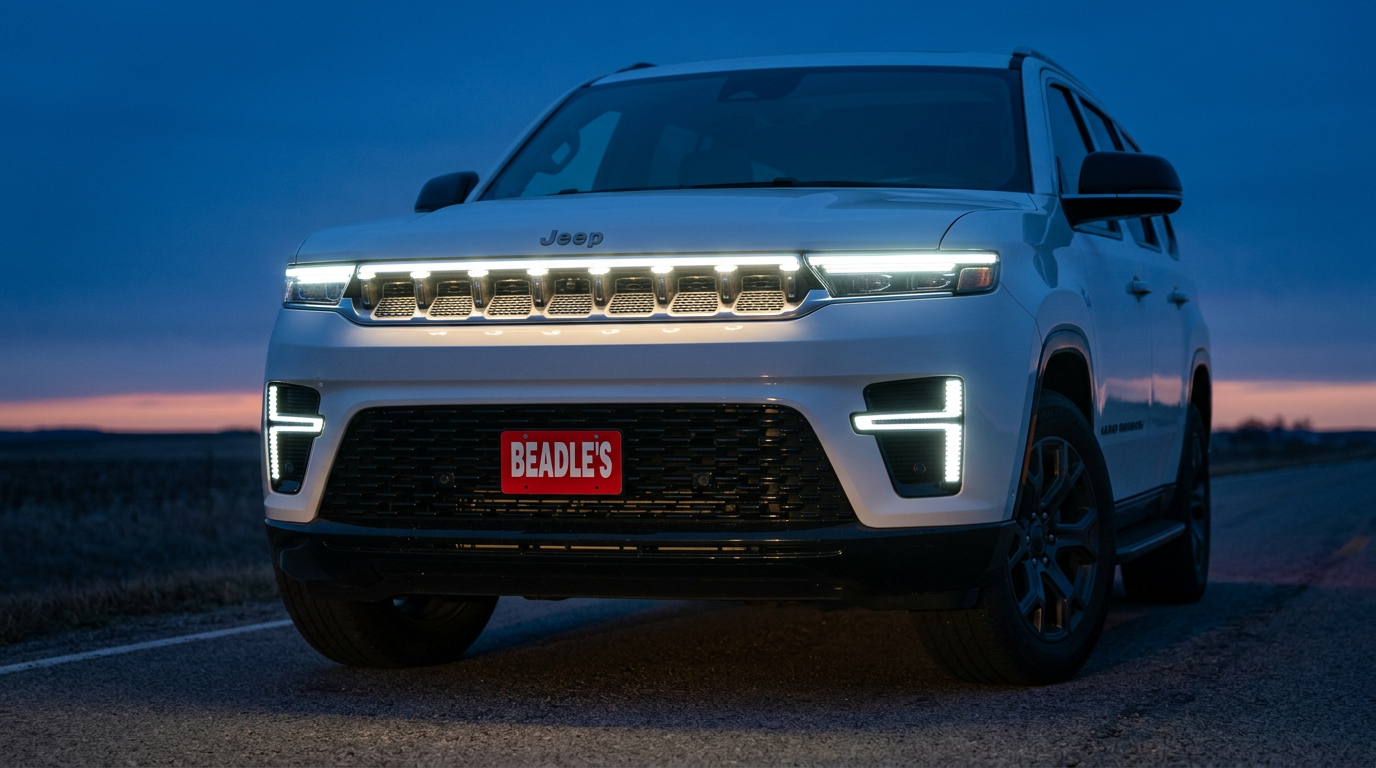
If you’ve been watching Grand Wagoneer L pricing for a while, the 2026 model is going to do a double-take on you. The same long-wheelbase three-row Jeep that carried a high-90s starting price in 2025 now opens in the high $60s — and it’s not because Jeep made a stripped-down version. It’s a real refresh, with new styling, a new interior color, a different powertrain, and a re-thought trim ladder.
Here’s what actually changed for 2026, what stayed the same, what got removed at the entry trim to make the math work, and how to decide whether the trade-offs matter for the way your family will use it. We’ll keep it honest — including the parts most outlets are leaving out.
On This Page
- What’s the headline change for the 2026 Grand Wagoneer L?
- Why does the 2026 Grand Wagoneer L cost less than the 2025 did?
- What’s the same between the 2025 and 2026 Grand Wagoneer L?
- What’s actually new on the 2026 Grand Wagoneer L?
- What did Jeep take out of the base trim?
- 2025 Series II vs. 2026 Limited 4×4 — which is the better deal?
- How to decide if the 2026 Grand Wagoneer L 4×4 fits your family
- What’s coming later in the 2026 model year?
- Key takeaways
- Frequently asked questions
What’s the headline change for the 2026 Grand Wagoneer L?
Two things, and they’re connected: a major refresh of the look, interior, powertrain, and trim names — and a starting price that lands tens of thousands of dollars below where 2025 started. The result is a Grand Wagoneer L that’s still recognizably the same big, refined, three-row Jeep, but now reaches families who would never have considered it last year.
The 2026 lineup is now Grand Wagoneer L 4×2, Grand Wagoneer L 4×4, Limited, and Summit — the “Series II” and “Series III” names are gone. The Hurricane Twin Turbo inline-six remains the engine family, but Jeep has switched to the Standard Output (SO) version paired with an in-house eight-speed automatic. Inside, a new Sea Salt and Black colorway with Capri leather joins the existing Global Black, and the exterior gets refreshed grille and lighting. The 4×4 system is now badged as Selec-Terrain with a single-speed on-demand transfer case rather than the older Quadra-Trac nomenclature.
Why does the 2026 Grand Wagoneer L cost less than the 2025 did?
Jeep added two new entry trims below where the 2025 lineup started — the Grand Wagoneer L 4×2 and the Grand Wagoneer L 4×4 — and re-set the floor of the lineup. The 2025 lineup essentially started with what we’d now call mid-trim equipment as standard. The 2026 lineup splits that out, so you can buy in at the high $60s if you don’t need air suspension and McIntosh audio, or step up to Limited or Summit if you do.
The short version
Compared to the 2025 Series II’s starting MSRP, the 2026 Grand Wagoneer L 4×4’s starting MSRP is more than $26,000 lower. That gap isn’t because Jeep cheapened the truck — it’s because they added a trim below where the lineup used to start. The Limited 4×4 is the closest 2026 equivalent of the old Series II, and it lands well below where the 2025 Series II started, too.
For families in our trade area who’ve been replacing Tahoes, Suburbans, and Yukon XLs every five or six years, this changes the cross-shop. The 2026 Grand Wagoneer L 4×4 now starts in the same neighborhood as a loaded Tahoe High Country or Expedition Platinum — territory it never reached before. If you’re deciding between the new Grand Wagoneer L and the truck currently in your driveway, our Grand Wagoneer L vs. Tahoe High Country and Expedition Platinum comparison walks through the differences for the way South Dakota families actually use these trucks.
What’s the same between the 2025 and 2026 Grand Wagoneer L?
The structural DNA of this SUV did not change. It’s still the long-wheelbase Grand Wagoneer body — about a foot longer than the standard Grand Wagoneer — with three full rows, the body-on-frame construction, and the same overall packaging that earned the L its reputation as the rare three-row that adults actually fit in.
The full safety and driver-assistance suite carries over and remains standard on every trim, including the new entry-level 4×4. That includes Active Driving Assist (Jeep’s Level 2 hands-free system), adaptive cruise with stop-and-go, active lane management, blind-spot with rear cross-path, pedestrian and cyclist emergency braking, intersection collision assist, traffic sign recognition, and drowsy driver detection. Standard means standard — you don’t have to step up a trim or add a package.
Tech also carries: Uconnect 5 with the 12-inch touchscreen, wireless phone projection (Apple CarPlay and Android Auto), 4G LTE Wi-Fi hotspot, Alexa Built-In, wireless charging pad, and a hands-free power liftgate are all standard across the lineup, just as they were in 2025. With the available HD Trailer Tow Package, Jeep rates the Grand Wagoneer L for up to 10,000 pounds of towing — a Best-in-Class available number, per Jeep’s own capability page.
What’s actually new on the 2026 Grand Wagoneer L?
Four real changes you can see and feel: the front-end refresh, a new interior colorway, a powertrain swap to the Hurricane Standard Output, and a re-named trim ladder with stackable appearance packages.
Refreshed front-end and lighting. A reworked seven-slot grille with new gloss-black billet detailing, new full-LED headlights, and revised lower fascia. Three new exterior colors join the palette — Fathom Blue Pearl-Coat, Steel Blue, and High Gloss Black as a primary monotone — while Diamond Black Crystal, Midnight Sky, and River Rock are retired.
New Sea Salt and Black interior with Capri leather. The 2025 lineup was essentially Global Black or saddle-on-Series III. For 2026, Jeep added a lighter two-tone option — Sea Salt and Black with Capri leather — and made it available all the way down to the entry 4×2. Tupelo and Black is now reserved for Summit.
Hurricane Twin Turbo Standard Output (SO) and an in-house 8-speed. The 2025 lineup ran the Hurricane HO. For 2026, every trim uses the SO version of the same 3.0-liter twin-turbo inline-six. Per Jeep, the 2026 setup makes 420 horsepower and 468 lb-ft of torque, paired with an 880RE eight-speed automatic. We get into what that means for real-world feel below.
New trim names and stackable appearance packages. Series II and Series III are gone. The lineup is now Grand Wagoneer L 4×2, 4×4, Limited, and Summit. On top of that, Jeep stacks 85th Anniversary on the 4×4, Altitude on the Limited, Reserve on both Limited and Summit, and Obsidian on the Summit. The 85th Anniversary is the visual standout for the entry 4×4 — adds 22-inch wheels with Pirellis, the 19-speaker McIntosh, three-panel sunroof, and unique badging.
What did Jeep take out of the base trim?
To set the new entry price, Jeep moved several items that were standard on the 2025 Series II up the ladder, where they’re now standard on Limited or Summit (or available via packages). This is the part competitors keep glossing over. Here’s the honest comparison.
| Equipment | 2025 Series II (entry of lineup) | 2026 Grand Wagoneer L 4×4 (new entry) |
|---|---|---|
| Suspension | Quadra-Lift air suspension standard | Steel coil with rear load leveling; air suspension is standard on Summit and available on Limited |
| Audio | 23-speaker McIntosh Reference standard | 9-speaker Alpine with subwoofer standard; McIntosh available with 85th Anniversary or higher trims |
| Front seat adjustment | 12-way power driver and passenger | 8-way power driver and passenger |
| Heated second-row seats | Standard | Standard on Limited and Summit; not on the entry 4×4 |
| Augmented Head-Up Display | Standard | Available via the Limited Reserve package |
| Surround-view camera and Park & Unpark Assist | Standard | Standard on Summit; available via Premium Group I on the entry 4×4 |
| Instrument cluster | 12-inch digital cluster standard | 10.25-inch digital cluster standard; 12-inch on Summit and Reserve-equipped Limited |
Worth noting
What did not get cut at the entry trim: the Level 2 hands-free Active Driving Assist, the full safety suite, Uconnect 5 with the 12-inch screen, leather seats, heated and ventilated front seats, heated steering wheel, the power 60/40 third row, and the hands-free power liftgate. Those stayed standard.
2025 Series II vs. 2026 Limited 4×4 — which is the better deal?
If you’ve been cross-shopping a leftover 2025 against the new 2026 Limited, this is the closest apples-to-apples comparison. Limited 4×4 is what replaces Series II in the 2026 lineup — same audience, different starting point.
| Comparison | 2025 Series II 4×4 | 2026 Limited 4×4 |
|---|---|---|
| Starting MSRP zone | Mid $90s | Mid $70s |
| Engine | Hurricane HO twin-turbo I-6 | Hurricane SO twin-turbo I-6 (420 hp / 468 lb-ft) |
| Transmission | 8-speed (ZF 8HP75) | 8-speed (in-house 880RE) |
| Air suspension | Standard | Available via Convenience Group I or Reserve package |
| Standard audio | 23-speaker McIntosh Reference | 9-speaker Alpine; 19-speaker McIntosh via Premium Group II or Reserve |
| Heated second row | Standard | Standard |
| Available max towing | Up to 10,000 lbs with HD Trailer Tow | Up to 10,000 lbs with HD Trailer Tow |
Worth it (the 2026 Limited 4×4) if: you want the new look, the new interior color, fresh warranty math, and you’re fine adding a package to get air suspension. The starting price savings absorb the package cost and then some.
Skip it (and chase a leftover 2025) if: you specifically want the 23-speaker McIntosh and air suspension as standard, you don’t care about the refresh, and you find a 2025 Series II at a deep dealer discount that nets out below a similarly equipped 2026 Limited.
How to decide if the 2026 Grand Wagoneer L 4×4 fits your family
Here’s the simple way to walk through it. If you can answer “yes” to most of these, the 2026 base 4×4 is the right starting point. If you stack up “no’s,” step up to Limited or Summit instead.
- Confirm the use case: three rows used regularly, long highway miles common, replacing a Tahoe XL, Suburban, Yukon XL, or Expedition Max.
- Decide on suspension: if you don’t haul heavy trailers and never used air suspension on a previous SUV, the standard rear load-leveling setup is plenty. If you do tow regularly, plan to step up.
- Audition the audio: if you live with podcasts and country radio, the 9-speaker Alpine is fine. If you genuinely listen for sound quality, plan on the 19-speaker McIntosh through 85th Anniversary or Limited Premium Group II.
- Check the second row: if you’ll have car seats year-round, heated second-row seats are a real comfort factor in South Dakota winters. That puts you on Limited at minimum.
- Plan the towing: if a boat, camper, or stock trailer is in the picture, add the HD Trailer Tow Package. It unlocks the up-to-10,000-pound rating, the trailer brake controller, blind-spot with trailer detection, and the 2-speed transfer case.
- Test-drive the powertrain: the SO Hurricane is smoother and more relaxed than a V-8. If you came out of an EcoBoost or 5.7 HEMI, sit in it for a long highway drive before deciding.
Want to see what’s actually on the lot in Bowdle right now?
Browse our 2026 Grand Wagoneer L inventoryWhat’s coming later in the 2026 model year?
Jeep has confirmed a range-extender hybrid Grand Wagoneer L is planned for later in the 2026 model year, drawing from the same Stellantis powertrain family that’s powering the Ram 1500 REV’s range-extender. It’s a gas engine acting as a generator for an electric drive system — meaningful highway range without plug-dependency, with strong torque off the line.
What we don’t know yet: launch date, trim availability, exact range, exact pricing, or how it fits into the lineup we just walked through. Jeep has shared the broad direction, not the spec sheet.
Should you wait?
For most rural-South-Dakota family buyers, no. The current Hurricane SO 2026 is here, in stock, and a known commodity. The range-extender will be its own buying decision when it lands — different powertrain warranty, different fueling pattern, different price. If you need a three-row right now, buy what’s available and let the next-gen powertrain prove itself before you put your name on one.
Key Takeaways
- The 2026 Grand Wagoneer L starts in the high $60s because Jeep added two new entry trims below where the 2025 lineup started — not because they cheapened the SUV.
- The 2026 Limited 4×4 is the closest equivalent of the old 2025 Series II and lands well below it on the sticker, with a fresh warranty cycle and the new look.
- What changed at the entry 4×4: air suspension, McIntosh audio, 12-way seats, heated second row, augmented HUD, and surround-view camera moved up the trim ladder. Active Driving Assist Level 2, the full safety suite, Uconnect 5 with the 12-inch screen, leather seats, heated and ventilated front seats, and the power third row stayed standard.
- The Hurricane Twin Turbo SO inline-six paired with an 880RE 8-speed makes 420 hp and 468 lb-ft, and the family rates up to 10,000 pounds of towing with the available HD Trailer Tow Package.
Frequently Asked Questions
Did Jeep change the Grand Wagoneer L name for 2026?
The model name is the same — Grand Wagoneer L. What changed are the trim names. Series II and Series III are gone for 2026, replaced by Grand Wagoneer L 4×2, Grand Wagoneer L 4×4, Limited, and Summit, with Altitude, Reserve, and Obsidian appearance packages stacking on top.
Is air suspension still available on the 2026 Grand Wagoneer L?
Yes — Quadra-Lift air suspension is standard on Summit and available on Limited through Convenience Group I or the Reserve package. It’s no longer standard at the entry of the lineup the way it was in 2025, but it’s still part of the higher-trim recipe.
Is the new Hurricane SO engine less powerful than the 2025 HO?
The Standard Output version of the Hurricane Twin Turbo makes 420 hp and 468 lb-ft, which is below the High Output tune used in the 2025 Grand Wagoneer L. In a vehicle this size, 420 hp and 468 lb-ft feels relaxed and smooth on the highway and pulls full trailers without strain. Drive it back-to-back with the 2025 if you want to feel the difference.
What does the 2026 Grand Wagoneer L tow?
Up to 10,000 pounds with the available HD Trailer Tow Package, per Jeep’s capability page. The package adds a 2-speed transfer case, 3.92 axle ratio, electronic limited-slip rear, integrated trailer brake controller, blind-spot detection with trailer, trailer light monitoring, and trailer tire pressure monitoring. Without that package, the truck is still rated for serious towing, just at a lower cap.
Should I wait for the range-extender hybrid?
Probably not, unless you really want first-year hybrid technology. The range-extender is planned for later in the 2026 model year, but pricing, availability, and final specs aren’t public yet. The current Hurricane SO Grand Wagoneer L is here, in stock, and a known commodity. Most rural family buyers should buy what’s available now and let the next-gen powertrain mature before signing on for one.
My Take on the 2026 Grand Wagoneer L
The Grand Wagoneer L has been one of the most-talked-about trucks in our showroom this spring, and the conversations almost all start the same way: someone replacing a Tahoe XL or a Suburban, who used to write off Grand Wagoneer L as out of reach. The 2026 changed that math. The price floor moved, but the bones — the long wheelbase, the standard Level 2 hands-free, the genuinely usable third row — did not.
Where I land: the 2026 Grand Wagoneer L 4×4 with the 85th Anniversary Edition is the sweet spot for most South Dakota families I talk to. You get the McIntosh, the panoramic sunroof, the 22-inch wheels, the surround-view camera, and unique badging on top of an entry-trim chassis that already has Active Driving Assist standard, leather, heated and ventilated front seats, and the power third row. If you tow regularly or want the air suspension, step into the Limited with Reserve. If you want every box ticked, that’s Summit. Our 2026 Grand Wagoneer L trim guide walks through what each trim adds, so you can decide where on the ladder you actually need to land.
If you want the rest of the year-by-year picture — trim ladder, capability, tech, colors, safety — our full 2026 Jeep Grand Wagoneer L overview walks through every section in the same level of detail. And if you’re anywhere near Bowdle, come sit in one. The third row, the second-row tilt-and-slide, and the new Sea Salt cabin are things you have to feel in person to decide on.
About the Author
Lexy Tabbert — Beadle’s Chrysler Center, Bowdle, SD
Lexy Tabbert is the Director of Sales and Marketing at Beadle’s Chrysler Center in Bowdle, South Dakota. She covers Ram, Jeep, Dodge, and Chrysler vehicles — helping families, ranchers, and ag operators across the region find the right truck and configuration for their needs. Learn more about Lexy.
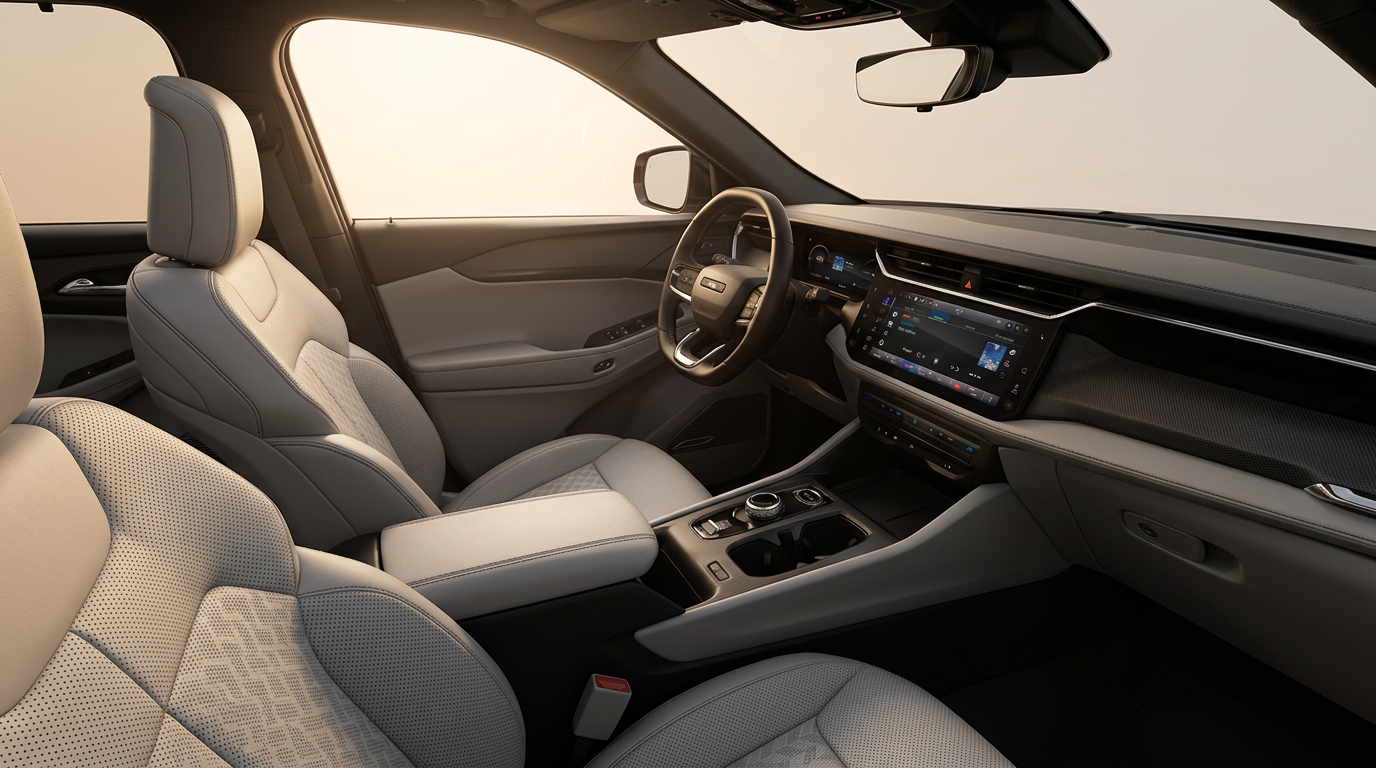
Jeep turns 85 in 2026, and the Cherokee 85th Anniversary Edition is how that milestone shows up on a window sticker. It’s a specific trim — priced between the Limited and Overland at $40,905 — that adds sport seats, cognac interior stitching, a nine-speaker amplified audio system with subwoofer, and the full tech suite as standard content at a lower price than the Overland.
This guide covers exactly what the 85th Anniversary Edition adds over the Limited, where it fits in the Cherokee lineup, what it doesn’t include that the Overland does, and whether the anniversary package represents a better value for specific buyers than stepping up or staying down.
On This Page
- What is the Cherokee 85th Anniversary Edition?
- What does the 85th Anniversary add over the Limited?
- What is the 85th Anniversary audio system?
- How does the 85th Anniversary compare to the Overland?
- Who is the 85th Anniversary Edition for?
- How to decide between the 85th Anniversary and adjacent trims
What is the Cherokee 85th Anniversary Edition?
The 85th Anniversary Edition is a standalone trim in the 2026 Cherokee lineup — not a package you add to an existing trim. It sits between the Limited ($40,000) and the Overland ($43,000+) at an MSRP of $40,905, making it the second most expensive Cherokee trim by base price.
As a trim level, it inherits the Limited’s mechanical and safety content — Jeep Active Drive I 4×4, the full driver-assist suite, heated front seats, heated steering wheel, power liftgate, and Selec-Terrain — then layers on interior appointments and technology content that distinguish it from the Limited. The anniversary-specific content is exclusive to this trim and not available as a package on other trims.
The name refers to 2026 marking 85 years of Jeep as a brand — a milestone tied to the brand’s World War II origins. The interior details reinforce that identity: Cognac stitching, sport seats with a distinct look, and anniversary floor mats. It’s a content play as much as an anniversary celebration.
What does the 85th Anniversary add over the Limited?
The 85th Anniversary Edition starts with the Limited’s feature set and adds five specific upgrades — for $905 over the Limited’s $40,000 base. Here is what the anniversary trim adds:
- Capri Leatherette Performance Seats — the 85th uses sport-oriented performance seat design with distinct bolstering and the Cognac stitching detail. The Limited uses standard Perforated Capri Leatherette without the anniversary-specific styling.
- Cognac Interior Stitching — contrasting cognac accent stitching on seats, steering wheel, and interior trim pieces. Not available on any other Cherokee trim.
- 85th Anniversary Berber Floor Mats (front and rear) — embroidered anniversary-specific floor mat set included as standard content, not an add-on.
- 85th Anniversary Door Decals — exterior trim identification specific to this edition.
- 9 Amplified Speakers with Subwoofer — the 85th Anniversary includes the upgraded audio system as standard content. On the Limited, premium audio requires package selection; on the 85th, it’s included at base MSRP.
The full tech suite — Apple CarPlay, Android Auto, GPS Navigation, Alexa Built-In, 4G LTE Wi-Fi, and SiriusXM with 360L — is also standard on the 85th Anniversary. On the Limited, GPS navigation is not available through any package; the Tech Group that adds GPS is Laredo-only. The 85th Anniversary is the entry point for GPS nav and Alexa Built-In in the Cherokee lineup without stepping to the Overland.
Common Mistake
Some buyers assume the 85th Anniversary is just a Limited with decals. It’s not — the sport seat design, Cognac stitching, audio upgrade, and included tech suite represent genuine content additions that would cost more than $905 if added piecemeal. The pricing reflects that this trim bundles content efficiently rather than just applying a badge.
What is the 85th Anniversary audio system?
The 9 Amplified Speaker system with subwoofer on the 85th Anniversary Edition is a significant step up from the base audio on lower trims. The subwoofer is integrated into the cargo floor area and provides bass response that the smaller speaker configurations can’t replicate — relevant for buyers who use the vehicle on long highway drives or as a daily commuter where audio quality matters for hours at a time.
The audio system pairs with SiriusXM with 360L, which includes SiriusXM’s personalized listening experience beyond traditional satellite radio — algorithmic recommendations and on-demand content layered over the satellite broadcast. For long-distance drives between Bowdle and Sioux Falls or Minneapolis, having that audio depth available matters more than on urban commutes where stop-and-go limits listening time.
Apple CarPlay and Android Auto are standard on the 85th Anniversary with no package required. The center display connects wirelessly for compatible devices, enabling navigation, phone, and media integration without a cable. Combined with the 4G LTE Wi-Fi hotspot, the 85th Anniversary is the entry point for buyers who want complete connected-vehicle capability without stepping to the Overland.
How does the 85th Anniversary compare to the Overland?
The Overland starts at approximately $43,000 — roughly $2,000 more than the 85th Anniversary’s $40,905. Here is what the Overland adds that the 85th Anniversary doesn’t include:
| Feature | 85th Anniversary | Overland |
|---|---|---|
| MSRP (base) | $40,905 | ~$43,000 |
| Panoramic sunroof | — | Standard |
| Wireless charging | — | Standard |
| Memory seat / mirrors / HVAC | — | Standard |
| Hands-free power liftgate | — | Standard |
| Two-tone paint option | — | Available |
| Ventilated front seats | — | Adv. Protech Grp |
| Heated rear seats | — | Adv. Protech Grp |
| Sport performance seats | ✓ (Cognac) | Unique style |
| 9-speaker + subwoofer audio | Standard | Standard |
| Anniversary interior details | ✓ (exclusive) | — |
Both trims include GPS navigation and full tech suite as standard. Overland Advanced Protech Group ($995) required for ventilated seats and heated rear seats.
Who is the 85th Anniversary Edition for?
The 85th Anniversary Edition is the right choice for buyers who want premium audio, the full connected-vehicle tech suite, and a sport interior with distinctive styling — without paying Overland pricing. The approximately $2,000 difference to the Overland buys a panoramic sunroof, wireless charging, and memory settings; if those features aren’t priorities, the 85th Anniversary delivers comparable daily-driving value for less.
The Cognac stitching and anniversary seat design are worth noting as differentiators for buyers who care about interior personality. The Limited uses standard Capri Leatherette; the 85th Anniversary uses the same base material in a sport seat configuration with anniversary-specific stitching and appearance. If interior character matters and sunroof doesn’t, the 85th Anniversary is the stronger daily-driver trim.
Buyers who want the panoramic sunroof — and specifically the dual-pane version standard on the Overland — need to step to the Overland or add the single-pane sunroof to a Laredo (available as a standalone package, not available on Limited). The 85th Anniversary does not offer a sunroof option of any kind. If natural light is a priority, the Overland is the only path to a sunroof at the top of the Cherokee lineup.
How to decide between the 85th Anniversary and adjacent trims
The 85th Anniversary sits in a narrow band between the Limited and the Overland. Here’s how to navigate the decision:
- Start with the sunroof question: If a panoramic sunroof matters, stop here — the 85th Anniversary doesn’t offer one, period. Your choice is Laredo with the sunroof package ($1,595, cannot be combined with Tech Group) or Overland with the dual-pane standard. If sunroof isn’t on your list, continue evaluating.
- Compare audio value: The 9-speaker + subwoofer system is standard on the 85th Anniversary. If premium audio is important and you’ve been looking at the Limited with a package to add it, check whether the 85th Anniversary’s base price with included audio beats the Limited-plus-package math. It typically does.
- Evaluate the tech suite: GPS navigation, Alexa Built-In, and the full connectivity suite are standard on the 85th Anniversary without package selection. If you’ve been configuring a Limited and adding packages to match that list, you may find the 85th Anniversary reaches the same content at comparable or lower total cost.
- Check wireless charging and memory settings: If wireless charging or memory seat/mirror settings are on your must-have list, you need the Overland. These features are not available on the 85th Anniversary at any price and cannot be added via packages.
- Consider the anniversary styling timing: The 85th Anniversary Edition is tied to the 2026 model year — it will not carry over indefinitely. If the Cognac stitching and sport seat design are appealing and inventory of this specific trim is available now, that’s worth factoring in. Anniversary editions in any brand tend to have limited production runs.
Key Takeaways
- The 85th Anniversary Edition is a standalone trim at $40,905 — $905 over the Limited and roughly $2,000 under the Overland. It’s not a package or a decal kit.
- Over the Limited, it adds sport performance seats with Cognac stitching, anniversary floor mats, anniversary door decals, 9-speaker amplified audio with subwoofer, and the full tech suite (GPS, Alexa, CarPlay, Wi-Fi) as standard content.
- Versus the Overland, it lacks the panoramic sunroof, wireless charging, memory seat/mirrors/HVAC, and hands-free liftgate. Those features are not available on the 85th Anniversary and cannot be added.
- The 85th Anniversary is the value entry point for premium audio and full tech connectivity — buyers who want those features without the Overland’s sunroof-focused premium may find it the better choice.
- Anniversary editions have limited production runs tied to the model year. If inventory is available and the interior styling appeals, 2026 is the window for this specific trim.
Frequently Asked Questions
Is the 85th Anniversary Edition just a decal package on the Limited?
No — the 85th Anniversary is a distinct trim level with genuine content additions beyond the Limited. It adds Capri Leatherette Performance Seats with Cognac stitching, 85th Anniversary Berber floor mats, a 9-speaker amplified audio system with subwoofer, and the full tech suite (GPS navigation, Alexa, CarPlay, Wi-Fi) as standard content. The $905 premium over the Limited reflects those additions.
Does the 85th Anniversary have a sunroof?
No — the 2026 Cherokee 85th Anniversary Edition does not include a sunroof and does not offer one as an option. The panoramic sunroof is exclusive to the Overland trim, where it’s standard. The Laredo offers a single sunroof package ($1,595) that cannot be combined with the Tech Group. If a sunroof is a priority, the Overland is the appropriate trim.
Will the 85th Anniversary Edition be available in future model years?
The 85th Anniversary Edition is specific to the 2026 model year, marking 85 years of the Jeep brand. Anniversary editions are typically tied to the milestone year and don’t continue in subsequent model years. If you’re interested in this trim, 2026 inventory is the window — future model years will not carry this designation.
Does the 85th Anniversary include GPS navigation?
Yes — GPS navigation is standard on the 85th Anniversary Edition. The full tech suite including Apple CarPlay, Android Auto, GPS navigation, Alexa Built-In, 4G LTE Wi-Fi, and SiriusXM with 360L is included as standard content without requiring a package. On the Limited, GPS navigation is not available through any package — the Tech Group that adds it is available only on the Laredo trim. The 85th Anniversary is the entry point for GPS navigation between the Laredo and Overland.
My Take on the 85th Anniversary Edition
The Cherokee 85th Anniversary sits in an interesting position. It’s not the flashiest trim — the Overland gets the sunroof, the memory settings, and the wireless charging — but for buyers who want premium audio and the full connected tech suite without climbing to $43,000, the 85th does the job efficiently. The audio upgrade alone is worth pausing on: the 9-speaker system with a subwoofer changes the listening experience in a meaningful way, and it’s packaged in at $40,905 rather than requiring an add-on decision.
The Cognac stitching and sport seats also have more visual presence than they photograph — in person the interior has a refined look that separates it from the Limited. Whether that’s worth $905 to any individual buyer is a personal call, but the anniversary interior isn’t just a badge. It’s a different-looking cabin.
If you want to compare the 85th Anniversary to what’s in stock versus what we can order, check current Cherokee inventory at Beadle’s or stop by Bowdle and we’ll walk you through the trim differences on an actual vehicle. The interior distinction is something you want to see in person.
About the Author
Lexy Tabbert — Beadle’s Chrysler Center, Bowdle, SD
Lexy Tabbert is the Director of Sales and Marketing at Beadle’s Chrysler Center in Bowdle, South Dakota. She covers Ram, Jeep, Dodge, and Chrysler vehicles — helping families, ranchers, and ag operators across the region find the right truck and configuration for their needs. Learn more about Lexy.
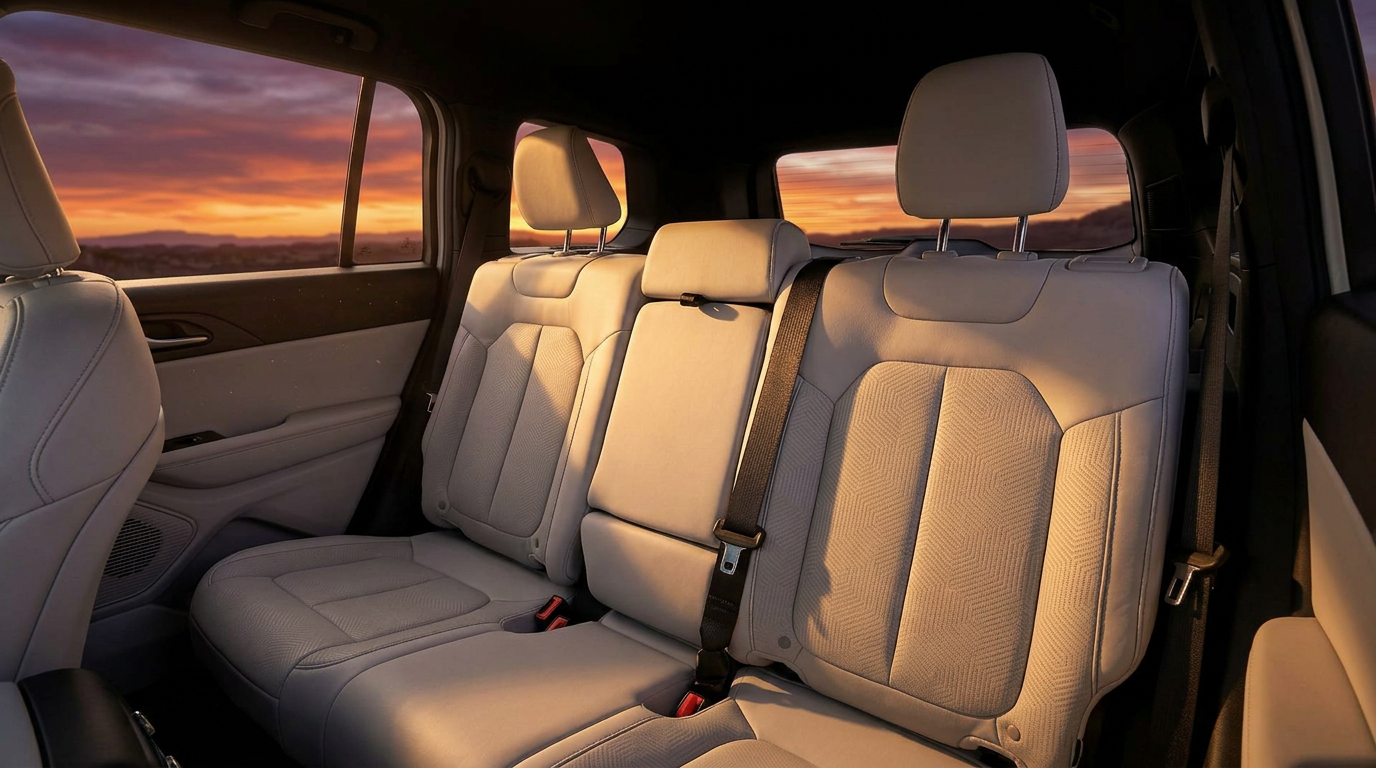
The 2026 Jeep Cherokee carries 33.6 cubic feet of cargo behind the second row and 68.3 cubic feet with the rear seat folded — 30 percent more than the previous Cherokee generation. For a compact SUV that looks from the outside like a normal-sized crossover, that number surprises a lot of buyers when they actually open the hatch.
This guide covers the real-world meaning of those numbers, how the 2026 Cherokee interior compares to competing compact SUVs, what changed in the redesign, how the seating and cargo configurations work, and which trim levels add meaningfully to interior quality and comfort.
On This Page
- What are the 2026 Cherokee’s cargo numbers?
- How does Cherokee cargo compare to competing SUVs?
- What changed in the 2026 Cherokee interior redesign?
- How does the rear seat fold and how usable is the flat floor?
- What interior upgrades does each trim level add?
- How to configure Cherokee cargo for different hauling needs
What are the 2026 Cherokee’s cargo numbers?
The 2026 Jeep Cherokee provides 33.6 cubic feet of cargo space behind the second row and 68.3 cubic feet with the rear seat folded flat. These are the two measurements that matter for daily use: behind-seat for normal cargo-while-carrying-passengers, and maximum load for full hauling configuration.
To put 33.6 cubic feet in practical terms: that’s enough for a week’s worth of groceries for a family of four, two full-size suitcases standing upright, or a couple of large coolers for a hunting or fishing trip. The floor width and the flat, low load height make it easier to use that space than vehicles with similar volume numbers but awkward hatch openings or high load floors.
The 68.3 cubic feet behind the first row — with rear seats fully folded — handles building materials, livestock feed bags, equipment loads, or anything requiring flat, uninterrupted floor space. That’s a meaningful jump in usability for buyers who need the SUV to work as a hauler on a weekly basis.
How does Cherokee cargo compare to competing compact SUVs?
The compact SUV segment is competitive on cargo numbers, but the 2026 Cherokee’s 68.3 cubic feet of maximum cargo puts it toward the top of the class. The prior Cherokee generation offered significantly less — the 30 percent increase in the 2026 redesign was one of the most substantial changes Jeep made to the platform.
What differentiates cargo capacity in this class isn’t just raw numbers but usable volume — the height of the opening, the width of the load floor, and whether the folded seatbacks create a level or angled surface. The 2026 Cherokee provides a relatively flat floor when the rear seats fold, which matters more in practice than marginal volume differences between competing models.
Common Mistake
Buyers comparing cargo numbers between vehicles often miss that “behind first row” and “behind second row” measurements vary by which manufacturer uses them as marketing figures. Always compare the same measurement. The Cherokee’s 33.6 cu ft (behind row 2) and 68.3 cu ft (behind row 1) are the meaningful comparisons to make — don’t compare the Cherokee’s max number to another brand’s second-row number and draw conclusions from that.
What changed in the 2026 Cherokee interior redesign?
The 2026 Cherokee represents a full-generation redesign — not a refresh. The interior changes go well beyond trim updates. The cargo volume increase of 30 percent came from structural changes to the rear compartment and a revised rear seat design, not from squeezing passenger space.
The instrument panel is new, with a larger central display and more driver-focused layout. Cabin noise reduction was addressed in the redesign — the 2026 Cherokee is substantially quieter on highway and at gravel road speeds than the previous generation. The N95+ Bio HVAC Cabin Filter is standard across all trims, which matters for buyers in agricultural areas where dust, pollen, and seasonal particulate matter are common concerns.
Rear passenger space also improved in the redesign — rear headroom and legroom are more generous than the prior generation, addressing one of the most consistent criticisms of the previous Cherokee platform. For families where rear seat comfort matters — and in South Dakota, where long-distance drives are routine — this is a practical improvement.
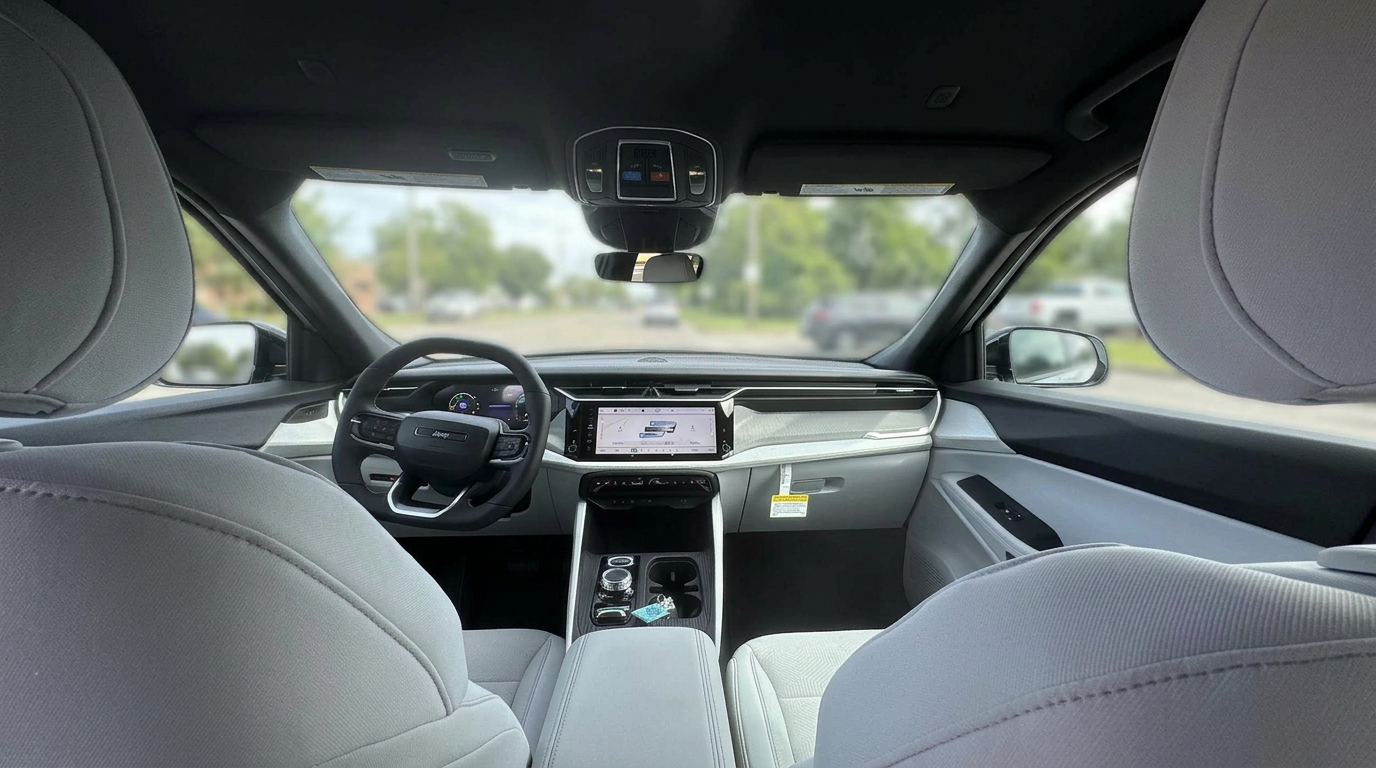
How does the rear seat fold and how usable is the flat floor?
The 2026 Cherokee rear seat folds in a 60/40 split configuration — both halves or one at a time. This gives you three options: full rear passenger use, half cargo/half passenger (useful for hauling one long item while keeping one rear passenger seat), or full flat cargo mode with both halves down.
When both halves are folded, the resulting floor surface is reasonably flat with minimal step or angle between the folded seatbacks and the cargo floor. This is the design improvement that makes the 68.3 cubic feet number genuinely useful — a high step or severe angle in the fold-flat position wastes usable cargo length even when the volume number is large.
For long cargo — lumber runs, antenna poles, fishing rods, kayak paddles — the length from the closed hatch to the back of the folded front seats is sufficient for most items under 8 feet. Buyers regularly transporting longer items will still need a truck or a dedicated cargo vehicle; the Cherokee handles the typical weekend hauling load without issue.
Power Liftgate — Available Laredo and Above
The power liftgate is standard on Laredo, Limited, 85th Anniversary, and Overland trims — not available on the base Cherokee 4×4. If hands-free or power hatch access is important (common for grocery runs, loading feed bags, or any scenario where both hands are occupied), that’s a Laredo-and-up feature. The Overland adds a hands-free variant that opens when you stand behind the hatch with the key fob in your pocket.
What interior upgrades does each trim level add?
Interior quality and comfort features step up meaningfully across the Cherokee lineup. Here’s what changes from trim to trim:
| Feature | Base 4×4 | Laredo | Limited | Overland |
|---|---|---|---|---|
| Seat material | Soul Cloth | Cloth (Labyrinth) | Capri Leatherette | Unique Leatherette |
| Heated front seats | — | ✓ | ✓ | ✓ |
| Heated steering wheel | — | — | ✓ | ✓ |
| Power liftgate | — | ✓ | ✓ | ✓ |
| Panoramic sunroof | — | Pkg only ($1,595) | — | Standard |
| Wireless charging | — | — | — | Standard |
| Memory seat / mirrors | — | — | — | Standard |
| Ventilated front seats | — | — | — | Adv. Protech Grp |
Heated steering wheel starts at Limited. Wireless charging and memory seat are Overland standard. 85th Anniversary shares the Limited’s interior features plus sport seats and upgraded audio.
How to configure Cherokee cargo for different hauling needs
The Cherokee’s 60/40 split rear seat and flat fold-down floor give you four practical configurations depending on what you’re hauling:
- Normal passenger + cargo (all seats up — 33.6 cu ft): Full five-passenger seating with 33.6 cubic feet behind the second row. Handles groceries, gear bags, hunting day packs, and typical weekly hauling without touching the seat configuration. This is the default for most South Dakota buyers on most days.
- One long item + rear passenger (40% side folded): Fold the smaller 40 percent section of the rear seat to open a longer cargo channel on one side while keeping one rear seating position. Works for lumber boards, toolboxes, or any single long item that doesn’t fit standing in the cargo area.
- Max cargo — no passengers (both sides folded — 68.3 cu ft): Fold both rear halves for the full flat floor. This is the configuration for feed bags, a dog kennel, ATV gear, camping loads, or any scenario where you’re hauling and not carrying passengers. At 68.3 cubic feet the floor is long and wide enough for most compact truck-style loads.
- Covered protection for valuables (hatch closed, cargo cover up): The cargo area sits below the beltline when the rear seats are up, keeping contents out of sightline from outside. For buyers who leave gear or tools in the vehicle, keeping items in the rear cargo zone rather than visible through side windows reduces theft opportunity on a daily basis.
- Cold-weather prep — pre-loaded before trips: Load coolers, gear bags, and supplies the evening before a hunting or fishing trip. The Cherokee’s 4×4 system and heated interior mean you’re not doing a morning cold-load. With remote start (Laredo and above), the cabin is warm and the cargo is already packed — you’re out the door on schedule on a January morning.
Key Takeaways
- The 2026 Cherokee carries 33.6 cubic feet behind the second row and 68.3 cubic feet maximum — 30 percent more than the previous generation. The 30 percent jump came from structural redesign, not from reducing passenger space.
- The rear seat folds 60/40 and creates a reasonably flat floor, making the 68.3 cubic feet usable rather than just a marketing number. Width and load height are buyer-relevant — the Cherokee loads easily without a high lift-over.
- Power liftgate is standard on Laredo, Limited, 85th Anniversary, and Overland — not on the base Cherokee 4×4. Buyers who load and unload frequently should factor this in when comparing trims.
- Heated seats start at Laredo, heated steering wheel at Limited, wireless charging and memory seat at Overland. Interior comfort features step up meaningfully at each trim boundary.
- The N95+ Bio HVAC Cabin Filter is standard on all trims — relevant for agricultural and dust-heavy environments throughout the region.
Frequently Asked Questions
How much bigger is the 2026 Cherokee cargo space compared to the old Cherokee?
The 2026 Cherokee offers 30 percent more cargo space than the previous generation — a result of the full platform redesign. The new model provides 33.6 cubic feet behind the second row and 68.3 cubic feet with the rear seat folded flat. The increase came from structural changes to the rear compartment and a revised seat fold design, not from reducing rear passenger room.
Does the 2026 Cherokee have a flat cargo floor when the rear seats fold?
Yes — the 2026 Cherokee rear seats fold to create a relatively flat floor with minimal step between the folded seatbacks and the cargo floor surface. The 60/40 split allows one or both halves to fold independently, giving you the option to keep one rear passenger seat in use while opening cargo space on the other side.
Does the Cherokee have a power liftgate?
Yes — power liftgate is standard on Laredo, Limited, 85th Anniversary, and Overland trims. The base Cherokee 4×4 does not include a power liftgate. The Overland adds a hands-free version that opens when you stand behind the vehicle with the key fob. If power liftgate access is important for your daily use, the Laredo is the entry point for that feature.
Is the 2026 Cherokee interior quiet enough for highway driving?
Cabin noise reduction was a focus area in the 2026 redesign. The 2026 Cherokee is substantially quieter on highway and at gravel road speeds than the previous generation — which was one of the more consistent criticisms of the prior platform. For buyers who do long-distance highway driving or regular gravel road travel, the noise improvement is noticeable compared to both the old Cherokee and many competing compact crossovers.
My Take on the Cherokee’s Interior and Cargo Space
The 30 percent cargo increase in the 2026 generation is one of those things that buyers notice immediately in person but would never guess from looking at the vehicle from the outside. The 2026 Cherokee doesn’t look dramatically bigger than the old one — the interior packaging improvement happened inside the same footprint, which is the harder engineering problem to solve. When you open the hatch and see how the load floor drops down and how far back it extends, it lands differently than a spec sheet number.
The N95+ cabin filter is a detail I find myself mentioning more often than I expected when talking to buyers in this area. During spring field work season, during combine harvest, during the dry August weeks when the county roads throw dust up all day — having a cabin filter that actually blocks particulate matter rather than just catching the biggest pieces is a real quality-of-life difference for people in ag country. It’s standard equipment on a $35,000 vehicle. That would have been a luxury feature on any vehicle five years ago.
For the full trim-by-trim breakdown including interior seating materials, package options, and pricing, our 2026 Cherokee pillar page has everything in one place. Stop by Beadle’s in Bowdle and we can walk you through the actual cargo floor — it’s one of those things that reads better in person than on paper.
About the Author
Lexy Tabbert — Beadle’s Chrysler Center, Bowdle, SD
Lexy Tabbert is the Director of Sales and Marketing at Beadle’s Chrysler Center in Bowdle, South Dakota. She covers Ram, Jeep, Dodge, and Chrysler vehicles — helping families, ranchers, and ag operators across the region find the right truck and configuration for their needs. Learn more about Lexy.
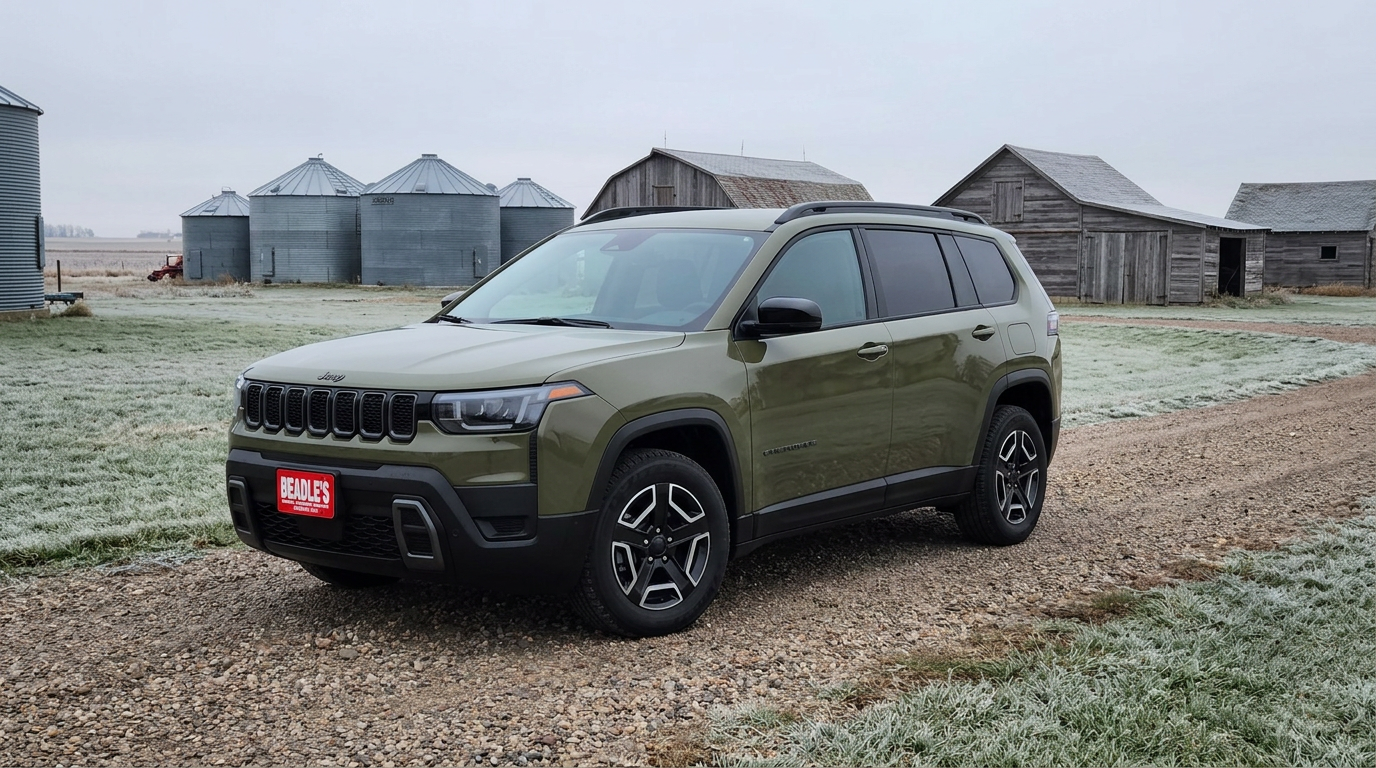
Most crossover buyers in South Dakota aren’t shopping for a rock crawler. They need a vehicle that handles graveled county roads, soft field approaches, rutted two-tracks, and seasonal mud without requiring thought or special procedure. Eight inches of ground clearance and Jeep Active Drive I on the 2026 Cherokee are engineered for exactly that kind of use.
This guide covers how the Cherokee’s Active Drive I 4×4 system actually works, what the rear-axle disconnect does, what 8 inches of clearance means on back roads in this region, and how to get the most out of the system on the roads South Dakota buyers actually drive.
On This Page
- What is Jeep Active Drive I on the 2026 Cherokee?
- How does the rear-axle disconnect system work?
- What does 8 inches of ground clearance handle?
- How does Active Drive perform on gravel and two-track roads?
- How does Cherokee 4×4 compare to a traditional truck 4WD?
- When to engage vs. let the system manage automatically
What is Jeep Active Drive I on the 2026 Cherokee?
Jeep Active Drive I is the 2026 Cherokee’s standard 4×4 system — available on every trim, with no FWD option and no upgrade required. It’s a full-time intelligent 4×4 system that monitors wheel speed and traction conditions continuously, distributing torque between front and rear axles as conditions demand.
Unlike traditional part-time 4WD systems that require the driver to manually shift into 4-High or 4-Low, Active Drive I operates automatically. There’s no lever to pull, no button to hold, and no procedure to follow before you turn onto a rough road. The system monitors and responds in real time — you drive, it manages traction.
Combined with Selec-Terrain’s four modes (Auto, Sport, Snow, Sand/Mud), Active Drive I gives the driver the ability to tell the system what kind of surface it’s operating on — and the system adjusts accordingly. On most South Dakota back roads, Auto mode and Active Drive I handle conditions without any manual input at all.
How does the rear-axle disconnect system work?
The Active Drive I system includes a rear-axle disconnect — a mechanism that decouples the rear axle from the drivetrain during low-demand conditions to reduce friction and improve fuel economy. When you’re cruising on dry pavement at highway speed with no traction demand, the rear axle disconnects, the Cherokee effectively drives on front-wheel power, and the hybrid system operates more efficiently.
When the system detects a need for all-wheel torque — wheel slip, demanding surface conditions, or a Selec-Terrain mode that requires full engagement — the rear axle reconnects automatically. Reconnection happens in milliseconds. From the driver’s seat, you don’t feel the transition.
Common Mistake
Buyers sometimes interpret the rear-axle disconnect as a weakness — “it’s not really in 4×4 all the time.” The disconnect is a fuel economy feature, not a capability compromise. When traction demand is present, the system reconnects before you’ve lost control. The tradeoff is that on surfaces where you want proactive full engagement — ice, deep mud — Snow or Sand/Mud mode keeps the system in a higher-readiness state rather than waiting to detect slip first. Use the terrain modes appropriately and the disconnect isn’t a concern.
What does 8 inches of ground clearance actually handle?
Eight inches of ground clearance is the measurement from the lowest point of the vehicle’s underbody to the ground surface. For comparison: a typical sedan has 5–6 inches, a standard crossover has 7–8 inches, and a body-on-frame truck runs 8–10 inches or more. The Cherokee’s 8 inches puts it at the capable end of the crossover segment.
What 8 inches handles on South Dakota roads: standard gravel county road washboard, moderate snow accumulation (4–5 inches of packed snow on a road surface), typical field approach ruts, low-water creek crossings on ranch roads, and most rock or debris on unpaved surfaces. What it doesn’t handle: deep snow drifts the vehicle has to push through, significant rock ledges, or conditions that require high-clearance truck-level underbody protection.
For the driving conditions most central South Dakota buyers encounter — seasonal county roads, pasture access tracks, gravel approaches, and occasional soft ground — 8 inches of clearance is sufficient. Buyers who regularly navigate terrain that challenges a half-ton pickup belong in a truck; buyers who need reliable capability on everything short of that are well-served by the Cherokee’s clearance numbers.
How does Active Drive perform on gravel and two-track roads?
Gravel is the default surface for a large portion of rural South Dakota driving, and Active Drive I handles it without any special procedure. In Auto mode, the system monitors surface conditions continuously — when loose gravel causes minor front-wheel slip, torque shifts rearward automatically to maintain directional stability.
Two-track roads — the kind that run out to pastures, hunting spots, or remote fence lines — often combine loose surface with uneven terrain and occasional soft spots. The Cherokee’s hybrid system contributes here in a specific way: the electric motors provide instant, smooth torque at low speeds, which helps maintain momentum on soft ground without the jerky throttle response of a traditional gas engine trying to modulate power at low RPM. Creeping through a soft spring pasture approach at 5 mph is where that smoothness is most noticeable.
Rough Road Cruise Control
The 2026 Cherokee includes Rough Road Cruise Control as standard equipment on all trims. On washboard gravel or uneven surfaces, this feature maintains a steady vehicle speed without the constant throttle adjustment that standard cruise control struggles with on rough terrain. For long gravel county road commutes, it reduces driver fatigue meaningfully. Engage it the same way as highway cruise control — it activates and holds speed on rough surfaces where highway cruise would normally need constant correction.
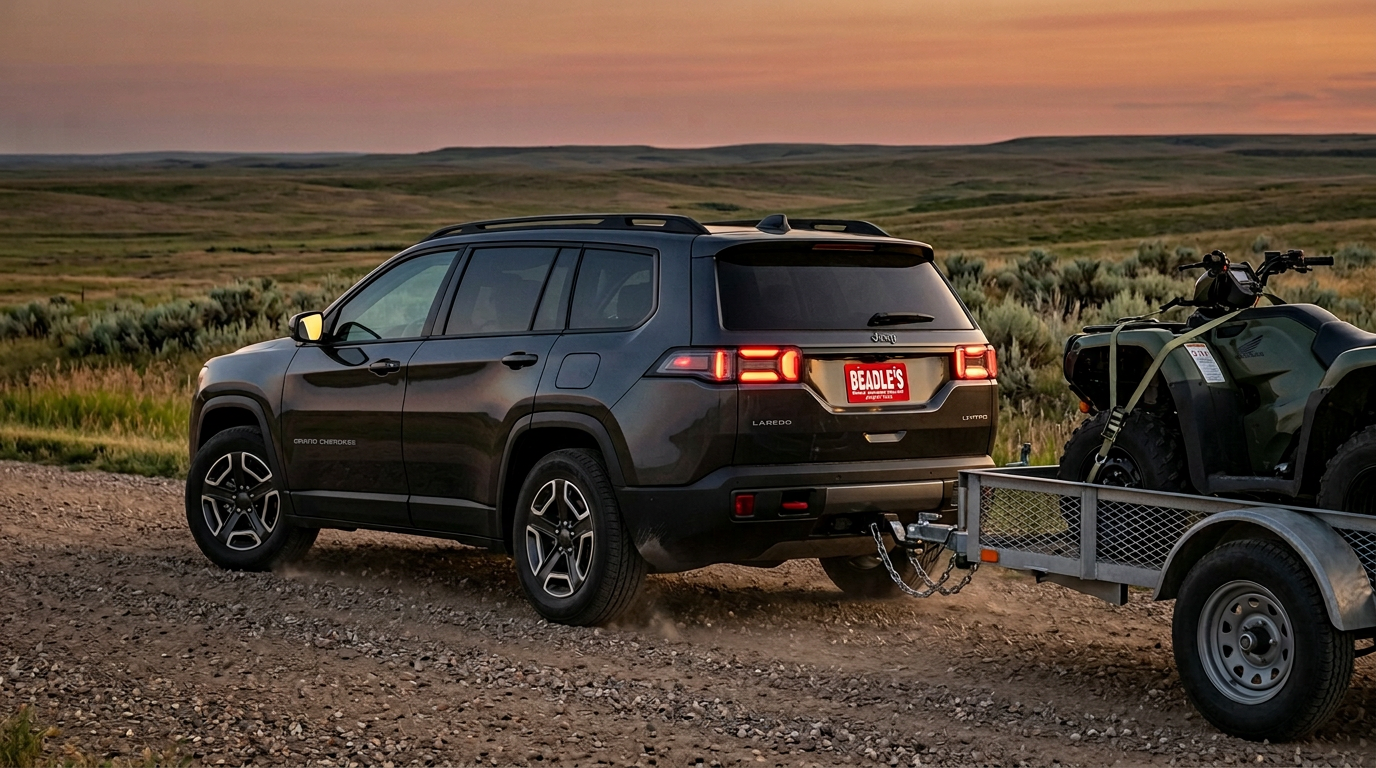
How does Cherokee 4×4 compare to traditional truck 4WD?
Traditional truck 4WD — the kind found on a Ram 1500 or Ram 2500 — uses a transfer case with selectable 2WD, 4-High, and 4-Low ranges. The driver chooses the range based on conditions, and the system locks front and rear driveshafts together mechanically in 4-High or 4-Low. At low speeds in 4-Low, the mechanical advantage is significant for extreme off-road demand.
Active Drive I operates differently: it’s a full-time intelligent system without a manual low-range selection. It continuously varies torque split rather than mechanically locking axles. For the conditions most Cherokee buyers encounter — gravel, mud, snow, soft ground — the Cherokee’s system is more convenient and equally capable. You don’t need to stop and shift into 4-High before a county road; Active Drive I is already managing traction.
Where traditional truck 4WD wins: sustained extreme off-road use, rock crawling, deep ruts requiring mechanical low-range torque multiplication, and recovery situations requiring locked axle traction. The Cherokee is not designed for those conditions and doesn’t pretend to be. For ranch and ag buyers who need that level of capability regularly, a Ram 1500 or larger truck is the right tool. For buyers who need reliable all-surface performance on everything short of extreme off-road, Active Drive I covers the job without the complexity of a manual transfer case.
When to engage vs. let the system manage automatically
Active Drive I manages traction automatically in most situations. Here’s when to let it work on its own, and when manual Selec-Terrain input improves what the system does:
- Dry or lightly wet pavement — leave it in Auto: Active Drive I and Auto mode handle all normal on-road conditions. No input needed. The rear-axle disconnect operates for fuel efficiency and the system manages traction reactively. This is the correct default for most daily driving.
- Gravel county roads — Auto handles it, Sand/Mud if it’s loose: Standard packed gravel in Auto mode is fine — the system adjusts for occasional slip automatically. If the road has been freshly graveled and the surface is genuinely loose, switching to Sand/Mud allows slightly more wheel movement to find traction without the traction control suppressing it.
- Ice or packed snow — switch to Snow proactively: Don’t wait for wheel slip. If the temperature is below freezing and any road surface could be icy, engage Snow mode before you reach the problem section. The system’s proactive throttle and braking calibration in Snow mode prevents the slip that Auto would react to after the fact.
- Soft field approaches or mud — switch to Sand/Mud: Before you turn off the gravel onto a soft approach, engage Sand/Mud. The mode allows controlled wheel spin to maintain momentum on soft ground. Switching after you’ve already bogged down in mud is less effective than setting the mode before you enter the soft section.
- If you get stuck — don’t spin the wheels: If the Cherokee becomes high-centered or genuinely stuck, prolonged wheel spin digs you deeper. Stop, assess whether backing out is possible, and if needed engage Sand/Mud for the recovery attempt. The 5,350-lb GVW rating means a recovery strap or come-along is viable on most vehicles your buyers would have nearby. The Cherokee’s tow hook points are accessible for exactly this situation.
Active Drive I vs. Traditional 4WD: Quick Reference
| Condition | Active Drive I (Cherokee) | Traditional Truck 4WD |
|---|---|---|
| Gravel county roads | Handles automatically | Typically 2WD — driver shifts if needed |
| Packed snow / ice | Snow mode — proactive traction | 4-High — driver must engage |
| Soft mud / field approach | Sand/Mud mode — controlled spin | 4-High or 4-Low depending on severity |
| Rock crawling / extreme terrain | Not designed for this | 4-Low — mechanical advantage |
| Daily driving ease | Fully automatic, no procedure | Requires manual shift selection |
| Fuel economy | Rear-axle disconnect saves fuel | 2WD mode needed for efficiency |
Active Drive I is standard on all five 2026 Cherokee trims. Traditional 4WD comparison based on typical body-on-frame truck architecture.
Key Takeaways
- Jeep Active Drive I is a full-time intelligent 4×4 system — standard on every 2026 Cherokee trim with no FWD option. It manages traction automatically without driver input in most conditions.
- The rear-axle disconnect improves fuel economy on pavement by decoupling the rear axle at low traction demand. It reconnects automatically in milliseconds when conditions require it.
- Eight inches of ground clearance handles standard gravel roads, moderate snow, pasture approaches, and most back-road conditions in central South Dakota. It is not a rock crawler — buyers who need sustained extreme off-road capability should be in a truck.
- Rough Road Cruise Control is standard on all trims — it maintains steady speed on washboard gravel where highway cruise control would require constant correction.
- Use Selec-Terrain proactively: Snow mode before icy roads, Sand/Mud before soft approaches. Active Drive I is reactive in Auto mode; terrain modes make it proactive.
Frequently Asked Questions
Is Jeep Active Drive I the same as AWD?
Active Drive I is Jeep’s 4×4 system, not a generic AWD system. The distinction matters in design philosophy: most crossover AWD systems are primarily on-road stability systems that reactively distribute torque. Active Drive I is built around Jeep’s 4×4 architecture, with Selec-Terrain terrain mode integration and a rear-axle disconnect for efficiency. For South Dakota’s mix of paved, gravel, snow, and soft terrain, Active Drive I provides more deliberate traction management than a typical crossover AWD system.
Does the Cherokee have a 4-Low setting?
No — Jeep Active Drive I does not have a 4-Low range. It’s a full-time intelligent 4×4 system designed for on-road and moderate off-road use, not sustained extreme off-road or rock crawling. For buyers who regularly need 4-Low mechanical low-range capability — deep recovery situations, serious rock terrain — a body-on-frame truck or a Wrangler/Gladiator with a low-range transfer case is the appropriate platform.
Will the Cherokee handle South Dakota gravel roads without damage?
Yes — the Cherokee’s 8 inches of ground clearance and 4×4 system are suited for standard gravel county road driving. Routine gravel travel does not require any special procedure or mode selection; Auto mode handles it. For loose freshly-graveled surfaces, Sand/Mud mode allows more appropriate wheel response. As with any vehicle, avoid sharp gravel edges at speed and be aware that stone chip risk to paint and glass is inherent to gravel road driving regardless of vehicle type.
What is Rough Road Cruise Control on the Cherokee?
Rough Road Cruise Control is a standard feature on all 2026 Cherokee trims that allows the cruise control system to maintain a set speed on uneven or washboard surfaces — conditions where standard adaptive cruise control typically disengages or struggles to hold a steady speed. For South Dakota buyers who commute long distances on gravel county roads, it reduces driver fatigue on rough-surface stretches without requiring constant manual throttle adjustment.
My Take on the Cherokee’s 4×4 for South Dakota Back Roads
The buyers who push back on the Cherokee’s 4×4 capability are almost always comparing it to a truck — and that’s not the right comparison. The Cherokee isn’t trying to do what a Ram 2500 does. What it does do is handle every surface a rural South Dakota driver encounters on a normal week without requiring any thought or special procedure. Gravel roads, muddy field approaches, snow-packed county roads — all of it in Auto mode or with a single terrain mode selection, without stopping, without a manual shift, without worrying about it.
The Rough Road Cruise Control is one of those features that gets mentioned in the delivery walkthrough and immediately resonates with buyers who do long gravel commutes. Standard cruise control on washboard gravel is frustrating — you’re constantly hunting the right speed as the road surface changes. Rough Road Cruise Control holds it. For someone driving 20 miles of gravel county road twice a day, that’s a meaningful quality-of-life upgrade that has nothing to do with off-road capability in the traditional sense.
For the full picture on the 2026 Cherokee’s specs and what the 4×4 system looks like alongside all five trim levels, our complete 2026 Cherokee guide covers all of it. Stop by Beadle’s in Bowdle if you want to see Active Drive I on a specific unit — we can take it out on the gravel and show you exactly how it behaves.
About the Author
Lexy Tabbert — Beadle’s Chrysler Center, Bowdle, SD
Lexy Tabbert is the Director of Sales and Marketing at Beadle’s Chrysler Center in Bowdle, South Dakota. She covers Ram, Jeep, Dodge, and Chrysler vehicles — helping families, ranchers, and ag operators across the region find the right truck and configuration for their needs. Learn more about Lexy.
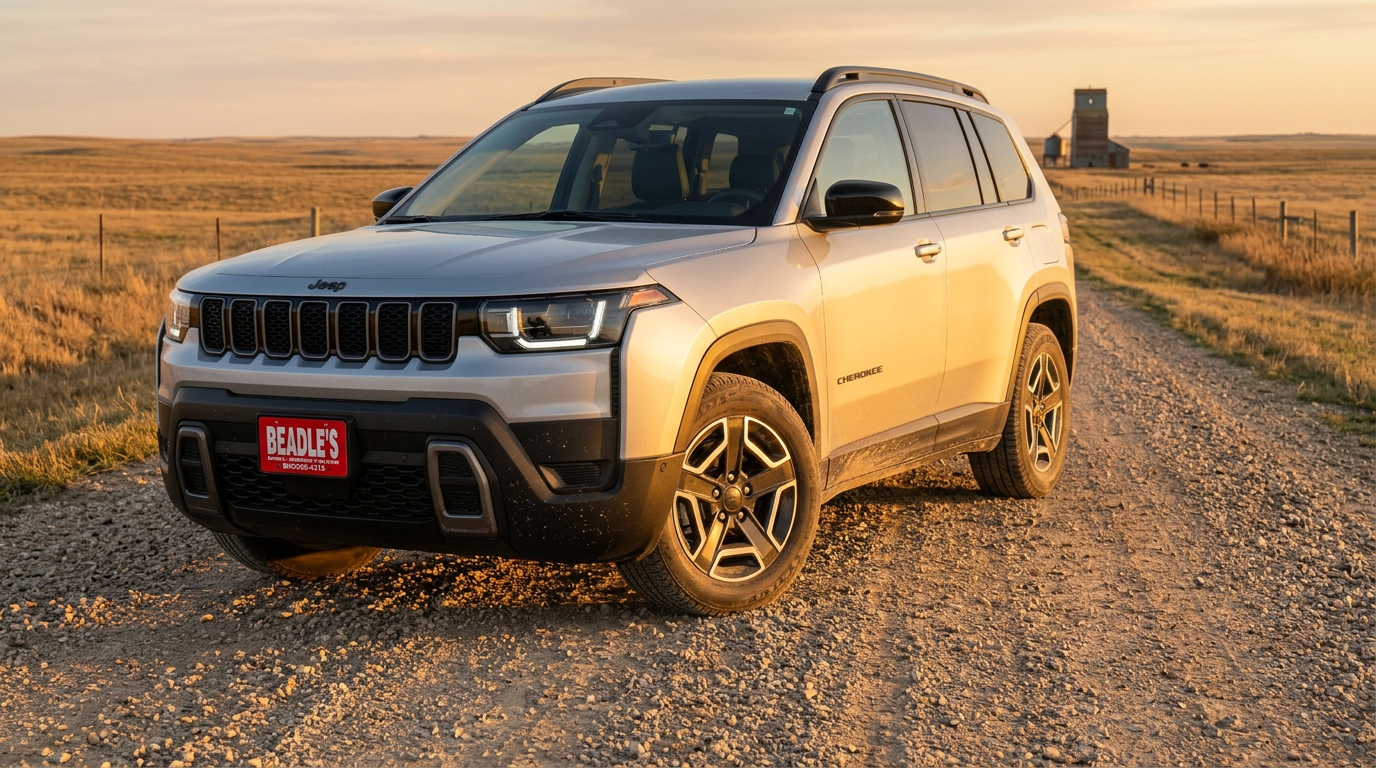
Five hundred miles per tank in a 4×4 SUV — without plugging in, without changing how you drive, without a gas station stop between Bowdle and Rapid City. That’s what the 2026 Jeep Cherokee’s self-charging hybrid delivers, and for South Dakota buyers who cover real distances on a regular basis, the numbers matter.
This guide breaks down the 2026 Cherokee’s estimated 37 mpg combined rating — what it means on actual South Dakota roads, how range changes by season, how it compares to competing crossovers, and what driving habits get the most out of the hybrid system on long rural drives.
On This Page
- What is the 2026 Cherokee’s fuel economy rating?
- What does 37 mpg mean on real South Dakota roads?
- How far can the Cherokee go on a full tank?
- How does fuel economy change in winter vs. summer?
- How does the Cherokee’s fuel economy compare to other crossovers?
- How to maximize range on long South Dakota drives
What is the 2026 Cherokee’s fuel economy rating?
The 2026 Jeep Cherokee is rated at an estimated 37 mpg combined, driven by the 1.6L I4 turbocharged hybrid powertrain paired with two electric drive motors. This is a self-charging hybrid — the battery charges through regenerative braking and engine output while driving, with no plugging in required. The system manages energy recovery automatically; there’s no mode to engage or charging routine to follow.
The 37 mpg figure is an estimated combined rating — a blend of city and highway driving. For South Dakota buyers who spend the majority of their miles on open highway, real-world economy often comes in close to or better than the combined estimate, since highway driving at steady speed is where the hybrid system’s energy recovery is most consistent.
Common Mistake
Buyers sometimes compare the Cherokee’s 37 mpg estimated combined to a conventional SUV’s highway-only number and conclude the difference is smaller than they expected. The comparison should be combined-to-combined — most non-hybrid midsize crossovers rate in the mid-to-upper 20s combined. The Cherokee’s hybrid advantage is most visible on mixed driving: town errands, county road commutes, and the highway segments in between, which describes most rural South Dakota driving.
What does 37 mpg actually mean on South Dakota roads?
EPA estimates are measured in controlled test cycles. Real-world economy depends on road type, speed, load, temperature, and driving behavior — all of which vary significantly in central South Dakota. Here’s how the Cherokee’s hybrid system tends to perform across the driving conditions buyers in this area actually face:
| Driving Condition | Expected Economy | Why |
|---|---|---|
| Open highway (65–75 mph) | Near or above 37 mpg | Steady-speed cruising, consistent regenerative recovery on deceleration |
| Town/in-town stops | Varies — hybrid advantage | Regenerative braking on every stop recovers energy that conventional vehicles waste as heat |
| Gravel county roads | Near combined estimate | Lower average speed means more electric-motor contribution at low demand |
| Towing (with Trailer Tow Group) | Reduced — varies by load | Additional weight and aerodynamic drag reduce both gas and hybrid efficiency |
| Cold start, sub-zero temps | Below estimate until warm | Battery charges and discharges more slowly in extreme cold; gas engine carries more load |
Real-world economy varies by driver behavior, conditions, and load. The 37 mpg figure is an estimated combined rating.
How far can the 2026 Cherokee go on a full tank?
The 2026 Cherokee delivers over 500 miles of estimated range per tank. For buyers in central South Dakota, that range has practical meaning: Bowdle to Rapid City is roughly 230 miles. Bowdle to Sioux Falls is about 240 miles. Bowdle to Bismarck is around 175 miles. On a single tank, you can make most common round trips in the region without stopping for fuel.
The 500-mile figure assumes mixed driving at or near the 37 mpg combined estimate. At sustained highway speeds — which describes most rural South Dakota travel — real-world range can come close to or exceed that number in favorable conditions. In winter or under heavier load, expect something closer to the 400-mile range as a conservative planning figure.
Range in Rural SD Context
Gas stations in central South Dakota can be 40–60 miles apart on some routes. Even in a conservative winter scenario, the Cherokee’s 400-plus mile range gives you significant buffer. The recommendation: treat the half-tank mark as your fill-up trigger in rural driving, not the quarter-tank warning. That keeps you well clear of range anxiety on any road in the region.
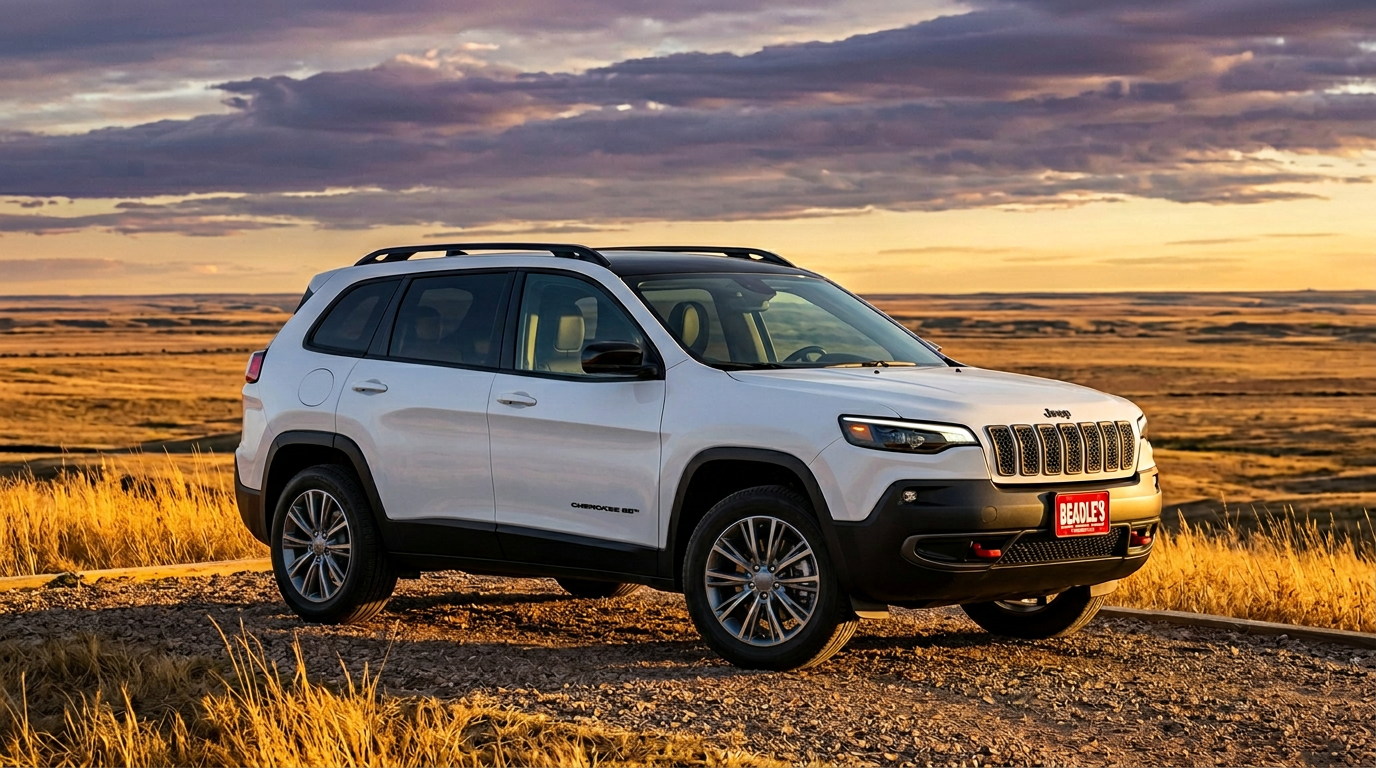
How does fuel economy change in winter vs. summer?
All vehicles — hybrid or conventional — experience reduced fuel economy in cold weather. For the Cherokee’s hybrid system, the cold-weather impact has two components: the gas engine runs more frequently at cold starts while the battery warms up, and battery charge and discharge efficiency drops in sub-zero temperatures.
In practical terms, a Cherokee owner in Bowdle should expect noticeably better economy from May through September than from November through February. Summer highway driving on dry roads at steady speed is when the hybrid system operates closest to the 37 mpg estimate. January driving at -10F with the heat running full and a cold battery will produce lower economy — budget conservatively for winter months and you won’t be caught short.
The remote start feature (available Laredo and above) reduces the cold-start fuel economy penalty meaningfully: a pre-warmed engine and battery contribute to better efficiency from the moment you pull out of the driveway, rather than running on cold-start enrichment for the first 5–10 minutes of the drive. It’s one of the practical fuel economy benefits of the remote start feature beyond cabin comfort.
How does the Cherokee’s fuel economy compare to other crossovers?
The Cherokee’s estimated 37 mpg combined stands out in its segment. Most non-hybrid midsize crossovers with standard 4×4 or AWD rate in the low-to-mid 20s combined — meaning the Cherokee delivers roughly 50 percent better estimated economy than a comparable non-hybrid 4×4 crossover on mixed driving.
The comparison that matters most for buyers in this market: at $3.50 per gallon and 15,000 miles per year, a crossover getting 25 mpg costs approximately $2,100 in fuel annually. A Cherokee at 37 mpg costs approximately $1,420 — a difference of about $680 per year. Over five years of ownership, that’s roughly $3,400 in fuel savings, which offsets a meaningful portion of the Cherokee’s price premium over a base non-hybrid 4×4 crossover.
For buyers putting above-average miles on the vehicle — rural commutes, regular long-distance runs — the savings compound. At 20,000 miles annually, the annual fuel difference grows to roughly $900, and five-year savings approach $4,500. Fuel prices fluctuate and real-world economy varies, but the directional math consistently favors the Cherokee’s hybrid system for high-mileage rural drivers.
How to maximize range on long South Dakota drives
The Cherokee’s hybrid system manages energy recovery automatically — you don’t need to drive it differently to take advantage of it. But a few habits consistently improve real-world range, especially on long rural drives.
- Use remote start on cold mornings: Pre-warming the engine and battery before you drive reduces the cold-start efficiency penalty. A 10-minute remote start warm-up in January means the hybrid system is operating closer to its efficient range from the first mile of the drive, not the tenth.
- Brake early and smoothly on the highway: The Cherokee recovers energy through regenerative braking every time you decelerate. Anticipating stops and easing off the throttle earlier — rather than braking hard at the last moment — gives the system more time to recover energy. On a long highway run with regular deceleration for towns or intersections, this habit adds up.
- Use Auto or Sport mode on open highway — not Snow mode: Snow mode’s conservative throttle calibration is the right call on winter roads, but it’s not optimized for fuel economy on dry highway. When conditions allow Auto mode, the system manages the rear-axle disconnect and electric motor contribution for efficiency. Save Snow mode for when conditions actually warrant it.
- Keep tire pressure at spec through the seasons: Tire pressure drops approximately 1 PSI for every 10-degree Fahrenheit drop in temperature. South Dakota winter temperature swings can drop tire pressure 5–8 PSI below summer inflation. Under-inflated tires increase rolling resistance and reduce economy. The Cherokee’s Selectable Tire Fill Alert makes it easy to check — use it at the start of each season.
- Fill up at or above half tank on rural routes: This is less about economy and more about range management. With 500-plus miles of estimated range, you won’t run out of fuel — but in areas where stations are 50+ miles apart, keeping the tank above half eliminates any concern about finding an open station after hours or in a weather event.
Key Takeaways
- The 2026 Cherokee is rated at an estimated 37 mpg combined — a self-charging hybrid that requires no plugging in. Battery charges automatically through regenerative braking and engine output while driving.
- 500-plus miles of estimated range per tank covers most common South Dakota round trips on a single fill-up — Bowdle to Rapid City and back is well within range.
- Cold weather reduces economy — budget conservatively for November through February. Remote start (Laredo and above) reduces the cold-start penalty by pre-warming the engine and battery.
- At 15,000 miles per year, the Cherokee’s hybrid system saves an estimated $680 annually in fuel compared to a non-hybrid 4×4 crossover at 25 mpg combined. High-mileage drivers see proportionally greater savings.
Frequently Asked Questions
Does the 2026 Cherokee need to be plugged in to charge?
No. The 2026 Cherokee is a self-charging hybrid — the battery charges automatically through regenerative braking and the gas engine while you drive. There is no charging port, no charging cable, and no plugging in required. It operates exactly like a conventional gas vehicle from a fueling and routine standpoint — fill it with regular unleaded, drive it, and the hybrid system manages everything else.
What fuel does the 2026 Cherokee use?
The 2026 Cherokee runs on regular unleaded gasoline — no premium required, no special fuel. The hybrid system adds no fueling complexity: you fill the tank at a normal gas station just as you would with any conventional vehicle. Confirm the fuel specification on the window sticker or owner’s manual of any specific unit.
Does towing reduce the Cherokee’s fuel economy?
Yes — towing a trailer reduces fuel economy on any vehicle, hybrid or not. Additional weight and aerodynamic drag from a trailer require more engine output, which increases fuel consumption. The Cherokee’s hybrid system still contributes during towing, but economy will be meaningfully below the 37 mpg combined estimate when pulling near the 3,500-lb tow limit. Plan range conservatively on towing trips — treat 300-350 miles as your range buffer when towing.
Is 37 mpg accurate in real-world South Dakota driving?
The 37 mpg combined is an estimated EPA figure based on standardized test cycles. Real-world economy depends on speed, temperature, load, and driving behavior. For South Dakota buyers doing primarily open highway driving in moderate weather, real-world economy often comes close to the combined estimate. Winter cold start conditions and towing will reduce economy below the estimate. Mixed rural driving — town, county road, and highway combined — is where the hybrid system’s stop-start energy recovery delivers meaningful economy versus a conventional gas crossover.
My Take on the Cherokee’s Fuel Economy for South Dakota Buyers
The fuel economy conversation at Beadle’s usually starts with range and ends with the math. Buyers who cover real miles — commuting between towns, making supply runs, driving kids to activities in Mobridge or Aberdeen — quickly see that the Cherokee’s hybrid system pays for itself in a way that’s hard to ignore when fuel prices climb. The $680-per-year estimate at 15,000 miles is a conservative starting point; higher-mileage drivers see the savings compound faster.
What I tell buyers most often is that the self-charging hybrid part is the piece that matters most: there’s nothing to plug in, nothing to manage, no range anxiety about finding a charging station. You fill it with regular gas the same way you always have, and the hybrid system does its work without asking anything from you. For a buyer who wasn’t considering a hybrid before, that simplicity tends to change the conversation.
For a full look at the 2026 Cherokee’s powertrain and how the hybrid system works, our complete 2026 Cherokee guide covers all of it. And if you want to talk through the real numbers for your specific driving situation, stop by Beadle’s in Bowdle — we can work through what the fuel savings actually look like for your annual mileage.
About the Author
Lexy Tabbert — Beadle’s Chrysler Center, Bowdle, SD
Lexy Tabbert is the Director of Sales and Marketing at Beadle’s Chrysler Center in Bowdle, South Dakota. She covers Ram, Jeep, Dodge, and Chrysler vehicles — helping families, ranchers, and ag operators across the region find the right truck and configuration for their needs. Learn more about Lexy.
The Cherokee Overland is the fully-loaded trim — the one where you stop asking “is this included?” and start asking “is there anything it doesn’t have?” At $43,000-plus, it’s the top of the 2026 Cherokee lineup, and it adds a specific set of features that aren’t available on any lower trim regardless of package selection.
This guide covers exactly what’s standard on the 2026 Cherokee Overland, what the Overland adds over the Limited, what you can add through the available Advanced Protech Group package, and who this trim is actually built for.
On This Page
- What is the 2026 Cherokee Overland?
- What features are standard on the Overland?
- What does the panoramic sunroof add to daily driving?
- What does the navigation and wireless charging include?
- Is the Overland worth the premium over the Limited?
- Who is the Cherokee Overland built for?
- How to decide if the Overland is the right Cherokee for you
What is the 2026 Cherokee Overland?
The Cherokee Overland is the top trim in the 2026 Jeep Cherokee lineup — positioned above the Limited and 85th Anniversary at a starting MSRP of approximately $43,000. Like every 2026 Cherokee, it comes with the 1.6L turbocharged hybrid powertrain, standard 4×4 with Selec-Terrain, 8 inches of ground clearance, and the full active safety suite. What separates the Overland from every trim below it is a set of features that cannot be added to a Limited or Laredo through any package or option.
The Overland also carries one available package — the Advanced Protech Group ($995) — that adds ventilated front seats, heated rear seats, a surround view camera, auto parking, camera washers, and a wiper de-icer. This package is Overland-exclusive: it’s not available on any other Cherokee trim.
Common Mistake
Buyers sometimes assume they can get Overland-level features — panoramic sunroof, wireless charging, GPS navigation, memory seats — on a Limited by adding packages. They can’t. These features are standard on the Overland and not available on lower trims through any package or dealer add-on. If any one of those features is on your must-have list, the Overland is the only path.
What features are standard on the 2026 Cherokee Overland?
The Overland includes everything from the Laredo and Limited, plus a set of standard features exclusive to this trim level:
| Feature | Standard on Overland | Available on Limited? |
|---|---|---|
| Dual-Pane Panoramic Sunroof | Yes | No |
| Wireless Charging Pad | Yes | No |
| Built-in GPS Navigation | Yes | No |
| Hands-Free Power Liftgate | Yes | Standard liftgate only |
| Memory (driver seat, mirrors, radio, HVAC) | Yes | No |
| Exterior Mirrors with Memory | Yes | No |
| Unique Perf. Capri Leatherette Seats | Yes | Perforated Capri Leatherette |
| Two-tone exterior paint option | Yes (Gloss Black roof) | No |
| Trailer Tow Group (AHC) available | Yes ($995) | Yes ($995) |
Feature content verified against 2026 Cherokee build guide. Verify on window sticker of any specific unit.
What does the panoramic sunroof add to daily driving?
The Overland’s Dual-Pane Panoramic Sunroof spans a significant portion of the roof, bringing in natural light across both front and rear seating positions. It’s not a standard single-pane moonroof — it’s a full panoramic setup that changes how the interior of the Cherokee feels, particularly on long drives where the open feel of the cabin matters.
For South Dakota buyers doing long highway runs — Pierre, Bismarck, Rapid City — the sunroof changes the quality of that drive in a way that’s hard to quantify but immediately noticeable. The rear passengers get the benefit as well, which matters for family buyers where adult rear-seat occupants are a regular consideration.
This is the one feature on the Overland that has no workaround on a lower trim. The panoramic sunroof is not available as a package on the Limited. It’s available as an optional add-on on the Laredo only (not combined with the Tech Group). If the sunroof is a priority, the Overland is the only guaranteed path.
What does the navigation and wireless charging include?
The Overland comes with built-in GPS navigation and a wireless charging pad as standard equipment — neither requires a package or add-on at this trim level. Apple CarPlay and Android Auto are also standard (as they are on the Laredo and above), but the Overland’s built-in navigation operates independently of your phone — useful when you’re in areas with spotty cell service, which describes a meaningful portion of rural central South Dakota.
The wireless charging pad sits in the center console area and charges any Qi-compatible phone without a cable. For buyers who spend real time in the vehicle commuting or driving between towns, it’s the kind of feature that becomes part of the daily routine quickly — phone goes in, starts charging, no cables involved.
Navigation in Low-Signal Areas
Built-in GPS navigation doesn’t rely on cellular data — it works on its own satellite connection. In areas west of the Missouri where cell coverage drops, the built-in nav continues to function while phone-based navigation apps like Google Maps or Apple Maps may lose routing. For buyers who regularly travel rural roads in Corson, Dewey, or Ziebach counties, this is a practical advantage over CarPlay-only navigation.
Is the Overland worth the premium over the Limited?
The gap between the Limited ($40,000) and the Overland ($43,000+) is approximately $3,000 in base MSRP. What that $3,000 buys is a specific list: panoramic sunroof, wireless charging, built-in GPS navigation, hands-free liftgate, memory system (seat, mirrors, radio, HVAC), and the unique Capri Leatherette seat upgrade.
Whether that’s worth it depends on which of those features matter to you. If none of those four items — sunroof, wireless charging, GPS, hands-free liftgate — are on your list, the Limited delivers the Cherokee’s core premium package (heated steering wheel, Leatherette seating, remote start) at a lower price point. If even one of those Overland-specific items is a consistent priority, the $3,000 difference is well-justified, because there’s no way to add them to a Limited after purchase.
The 85th Anniversary Edition at $40,905 is the middle option worth comparing: it sits between the Limited and Overland in price and adds the 9-speaker audio system and heritage interior styling — but it doesn’t include any of the Overland-exclusive tech (no sunroof, no wireless charging, no built-in GPS). If audio quality and interior character are the priority, the 85th Anniversary may be the better value. If technology and the sunroof are the priority, the Overland is the right answer.
Who is the Cherokee Overland built for?
The Overland is built for buyers who want the Cherokee’s full capability package — 4×4, hybrid efficiency, 8-inch ground clearance — in a vehicle that doesn’t feel like a compromise on daily comfort or technology. It’s the trim that makes the most sense when the Cherokee is the primary vehicle for a household doing real daily miles.
In practical South Dakota terms: buyers who commute significant distances between small towns, who carry adult passengers regularly in rear seats, who travel rural areas where cell coverage is unreliable, or who simply want to get in the vehicle and have everything work — seat adjusts to their position, phone charges without a cable, navigation knows where they’re going — without thinking about it. The memory system alone is underappreciated: if two people share the vehicle, not having to readjust the seat and mirrors every time is a genuine quality-of-life upgrade.
Advanced Protech Group — Overland Only
The Overland’s available Advanced Protech Group ($995) adds ventilated front seats, heated rear seats, a surround view camera, auto parking, camera washers, and a wiper de-icer. This package is not available on any other Cherokee trim. If ventilated seats or heated rear seats are on your list, the Overland is the only Cherokee that offers them.
How to decide if the Overland is the right Cherokee for you
The Overland is a clear choice for some buyers and unnecessary for others. Work through this decision in order:
- Do you want the panoramic sunroof? If yes — the Overland is the only 2026 Cherokee that has it. Stop here. The Overland is your trim. If no, keep going.
- Do you want wireless charging and built-in GPS navigation as standard? Both are Overland-only. If these are consistent daily-use features for you, the $3,000 premium over the Limited is justified. If you’re fine with a cable and phone-based navigation, the Limited covers your needs.
- Do you travel regularly in areas with unreliable cell service? Built-in GPS navigation works without cell signal. If your regular routes include stretches where coverage drops, the Overland’s standalone navigation is a practical advantage.
- Do two people share the vehicle regularly? The Overland’s memory system stores driver seat position, mirrors, radio, and HVAC settings. If two drivers use the same vehicle, this feature pays off every single drive.
- Do you want ventilated seats or heated rear seats? These are only available on the Overland via the Advanced Protech Group. If either is on your list, no other Cherokee trim can provide them.
Key Takeaways
- The panoramic sunroof, wireless charging, built-in GPS navigation, hands-free liftgate, and memory system are Overland-exclusive — they cannot be added to a Limited through any package.
- The Overland starts at approximately $43,000 — roughly $3,000 over the Limited. The price difference buys a specific list of features, not a general upgrade.
- The Advanced Protech Group ($995, Overland-only) adds ventilated front seats, heated rear seats, surround view camera, auto parking, camera washers, and wiper de-icer. No other Cherokee trim offers these features.
- The 85th Anniversary at $40,905 adds heritage audio and interior styling but does not include any Overland-exclusive tech. If the sunroof or navigation matter, the Overland is the right answer.
Frequently Asked Questions
Can you get a panoramic sunroof on the Cherokee Limited?
No — the panoramic sunroof is standard on the Overland only and is not available on the Limited or any other trim through a package or dealer add-on. A panoramic sunroof is available as an optional package on the Laredo ($1,595), but it cannot be combined with the Tech Group on that trim. If the panoramic sunroof is a priority, the Overland is the only guaranteed path to that feature.
Does the Cherokee Overland come with heated rear seats?
Heated rear seats are not standard on the Overland but are available through the Advanced Protech Group package ($995), which is exclusive to the Overland trim. This package also includes ventilated front seats, a surround view camera, auto parking, camera washers, and a wiper de-icer. No other 2026 Cherokee trim offers heated rear seats or ventilated seats through any package.
What is the starting price of the 2026 Cherokee Overland?
The 2026 Cherokee Overland starts at approximately $43,000 before destination charge ($1,995). Optional features include the Advanced Protech Group ($995) and two-tone exterior paint with Gloss Black roof. Confirm current pricing on any specific unit at Beadle’s — window sticker pricing is the authoritative reference.
Does the Cherokee Overland still come with 4×4?
Yes — Jeep Active Drive I 4×4 with Selec-Terrain is standard on the Overland, just as it is on every other 2026 Cherokee trim. There is no FWD version of the 2026 Cherokee. The Overland adds premium comfort and technology features on top of the same 4×4 capability that’s available on the base Cherokee 4×4.
My Take on the Cherokee Overland
The buyers who end up in the Overland at Beadle’s tend to fall into one of two groups: buyers who did the research, decided the sunroof or navigation were non-negotiable, and came in specifically for it — and buyers who started on a Limited, went through the feature comparison, and realized the $3,000 difference covered things they actually use every day. The second group surprises themselves more often than not.
The memory system is one of those features that’s easy to dismiss on paper and hard to give up once you’ve had it. If two people share a vehicle, resetting the seat position and mirrors every time becomes the kind of small friction that accumulates over years of ownership. The built-in GPS matters more than buyers expect west of the Missouri where phone signal can get unreliable — Google Maps stopping mid-route because it lost data isn’t a hypothetical for a lot of our buyers.
For a full look at all five 2026 Cherokee trims and how they compare, our complete 2026 Cherokee guide covers all of it. If you want to sit in an Overland and see whether the sunroof and interior feel like the right fit, stop by Beadle’s in Bowdle — that’s the fastest way to answer the question.
About the Author
Lexy Tabbert — Beadle’s Chrysler Center, Bowdle, SD
Lexy Tabbert is the Director of Sales and Marketing at Beadle’s Chrysler Center in Bowdle, South Dakota. She covers Ram, Jeep, Dodge, and Chrysler vehicles — helping families, ranchers, and ag operators across the region find the right truck and configuration for their needs. Learn more about Lexy.
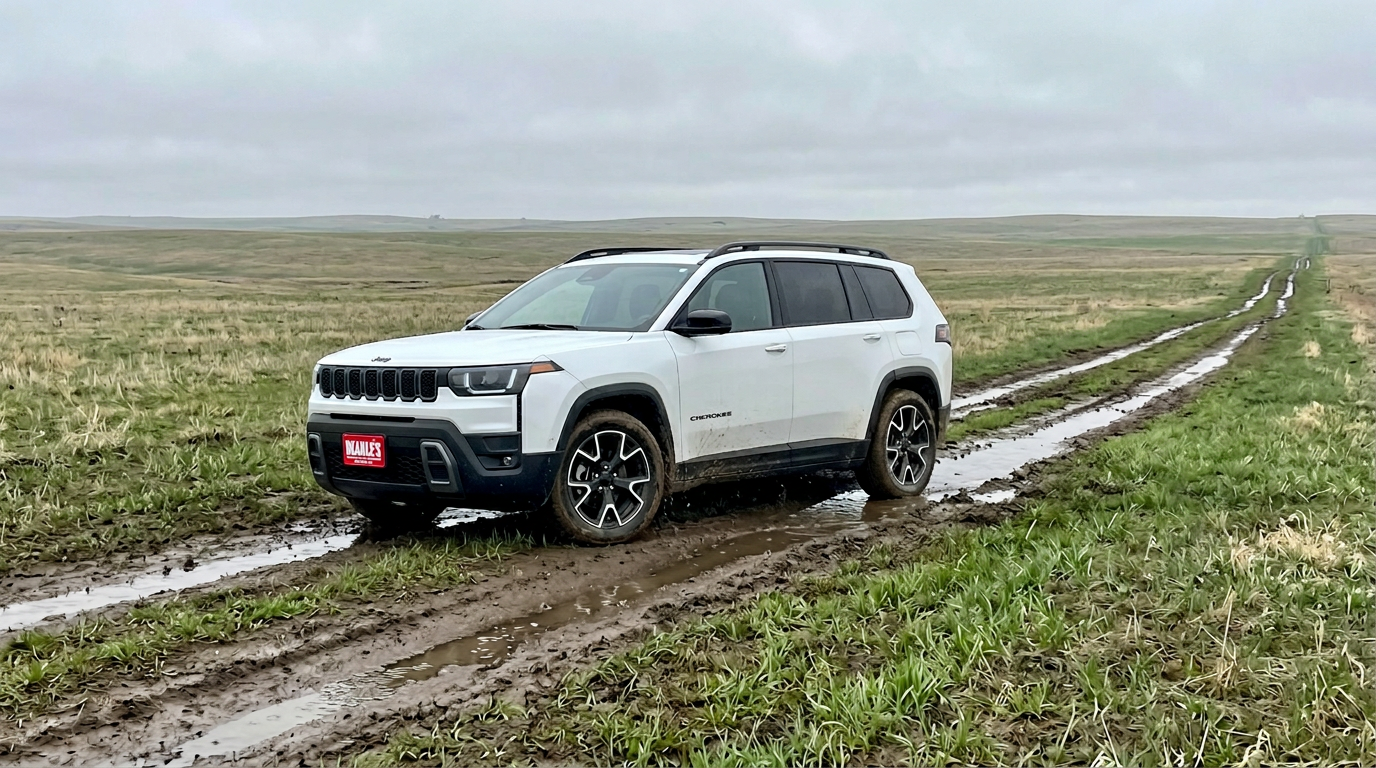
The 2026 Jeep Cherokee comes with four Selec-Terrain modes — Auto, Sport, Snow, and Sand/Mud — and most buyers use exactly one of them for the life of the vehicle. That’s not necessarily wrong, but understanding what each mode actually changes can make a real difference on South Dakota’s mix of pavement, gravel, packed snow, and soft field approaches.
This guide explains what each Selec-Terrain mode does, when to use it, and how the system interacts with the Cherokee’s hybrid powertrain — so you’re making the most of a system that’s included on every trim, on every Cherokee, at no extra cost.
On This Page
- What is Selec-Terrain and how does it work?
- When should you use Auto mode?
- When should you use Snow mode in South Dakota?
- When should you use Sand/Mud mode?
- When should you use Sport mode?
- How does Selec-Terrain interact with the hybrid system?
- How to use Selec-Terrain correctly on South Dakota roads
What is Selec-Terrain and how does it work?
Selec-Terrain is Jeep’s terrain management system — a dial or button interface that lets you tell the Cherokee what kind of surface you’re on so it can adjust throttle response, transmission behavior, torque distribution, and traction control settings accordingly. It’s standard on every 2026 Cherokee trim.
The system doesn’t physically lock differentials or change your ride height — those are capabilities on more off-road-specific Jeep platforms. What Selec-Terrain does is tune how the Cherokee’s Jeep Active Drive I 4×4 system and hybrid powertrain respond to inputs. Different modes optimize those responses for different surface conditions, making the vehicle more predictable and capable on the surface you’re actually driving on.
Common Mistake
Many Cherokee owners leave the dial in Auto mode year-round because they assume it’s always optimizing for current conditions. Auto is a good default on paved roads, but it’s reactive — it responds to traction loss after it’s detected. Snow mode on winter roads, and Sand/Mud on soft ranch approaches, configure the system proactively before the vehicle encounters the demanding condition. Leaving it in Auto on ice or soft ground means you’re relying on the system to catch up rather than getting ahead of the conditions.
When should you use Auto mode?
Auto is the default mode and the right choice for most daily driving — paved highway, normal town driving, dry or lightly wet pavement. In Auto, the Cherokee manages torque split between front and rear axles continuously based on wheel speed and traction sensors, and the rear-axle disconnect operates normally for fuel efficiency when full 4×4 isn’t needed.
For South Dakota buyers, Auto covers the US-12 highway run to Mobridge, paved county road commutes, and any pavement where conditions are normal. It does not require manual override — the system reads conditions and adjusts continuously.
Where Auto falls short: hard-packed snow, black ice, and loose surfaces. In these conditions, Auto is still managing traction reactively — it detects slip and responds. Snow and Sand/Mud modes change the system’s behavior before slip occurs. If you’re heading into conditions you know will be demanding, switch modes before you get there, not after you’ve already felt the vehicle move.
When should you use Snow mode in South Dakota?
Snow mode is the most-used non-Auto mode for buyers in central South Dakota — and the one most often underutilized. It’s designed for compacted snow and ice, and it changes three things at once: throttle application is softened for smoother starts, transmission shift points are adjusted to keep the engine in a more controlled power band, and the traction control system is calibrated for low-friction surfaces.
In practical terms: when you pull away from a stop on a glazed county road in Snow mode, the Cherokee doesn’t immediately snap torque to the wheels the way it would in Auto or Sport. It builds power more gradually, which significantly reduces the chance of breaking traction on the first 20 feet of acceleration. On deceleration, the transmission uses engine braking more aggressively, so you’re slowing with more control than brake-only stopping on ice.
When to Engage Snow Mode
Any time you’re on packed snow, ice, or freezing rain — including paved roads that haven’t been treated. A good rule for South Dakota driving: if the temperature is below 32F and you’re on any surface that could be slick, Snow mode is the right setting. Switch before you leave the driveway, not after you’ve already turned onto the county road.
When should you use Sand/Mud mode?
Sand/Mud mode is built for loose, low-traction surfaces where the wheels need to spin slightly to find purchase — soft field approaches, muddy ranch roads, loose gravel on a shoulder, or sandy river access roads near Lake Oahe. The mode increases throttle sensitivity at the upper end of the pedal travel while allowing more wheel spin than the traction control would normally permit.
The difference from Snow mode is the approach to wheel spin. Snow mode minimizes wheel spin — you want traction on ice, not spinning. Sand/Mud allows controlled spin because on a soft surface, some wheel movement clears material and helps the tire find grip. Over-tightening traction control on sand or mud causes the vehicle to bog; Sand/Mud mode prevents that.
For South Dakota buyers with ranch or farm access: if you’re driving to a pasture gate in spring when the approach has softened, or crossing a muddy two-track to a deer stand in October, Sand/Mud is the correct mode. It’s also the right setting for loose gravel on a freshly graveled road section where the surface hasn’t packed down yet.
When should you use Sport mode?
Sport mode is the pavement performance setting — it sharpens throttle response, firms up steering feel, and holds transmission gears longer before upshifting. It’s designed for driving situations where you want more immediate response from the powertrain: highway passing, on-ramp acceleration, or simply a more engaged driving feel on a dry two-lane.
For South Dakota buyers, Sport mode is most relevant on dry highway driving where you want the Cherokee’s 210 hp hybrid powertrain to respond more immediately when you ask for power. The electric motor’s instant torque is already a characteristic of the hybrid system — Sport mode amplifies that responsiveness further.
What Sport mode is not: an off-road setting. Don’t use it on gravel, loose ground, or winter surfaces. The sharper throttle and reduced traction intervention that make Sport feel responsive on dry pavement make it the wrong choice on anything slick. If you leave the highway and turn onto a gravel county road, switching to Auto or Snow (depending on conditions) is the right move.
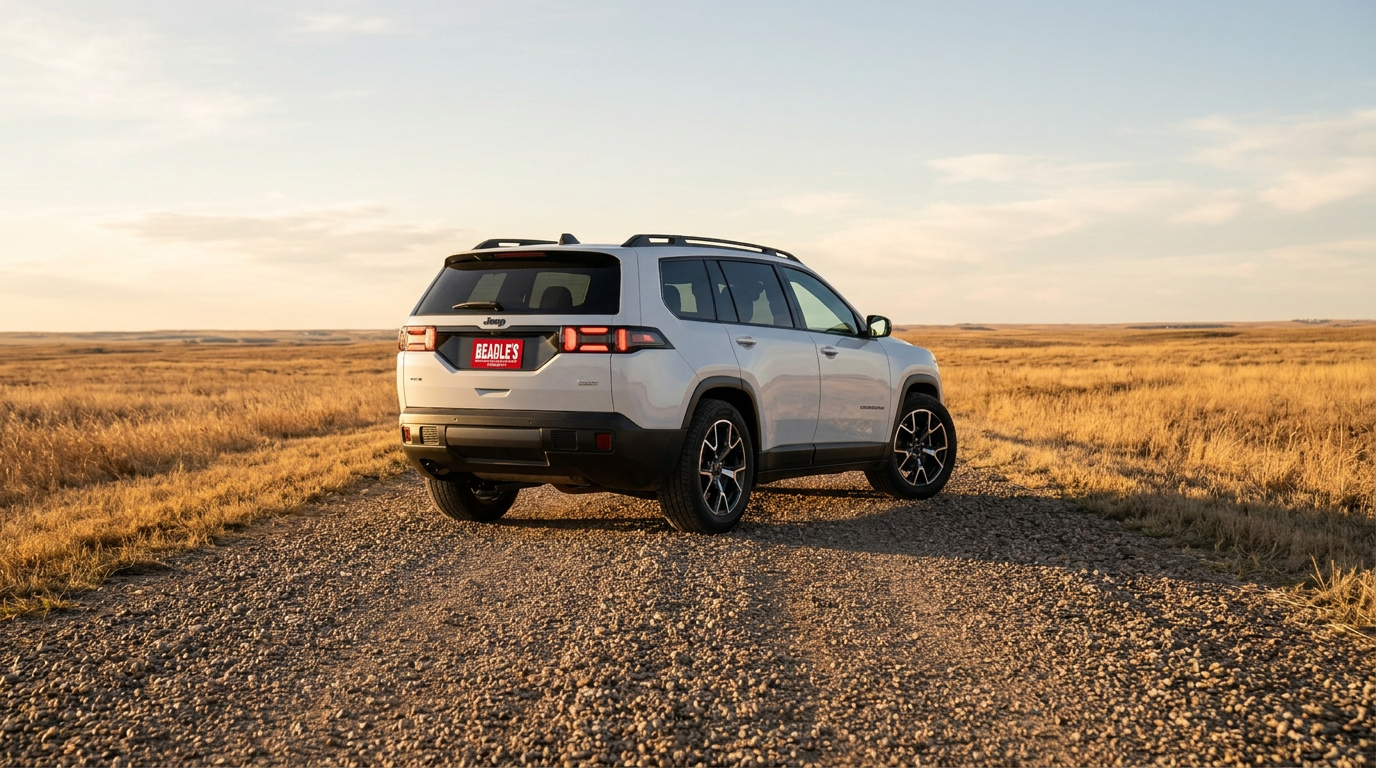
How does Selec-Terrain interact with the Cherokee’s hybrid system?
The 2026 Cherokee’s hybrid powertrain and Selec-Terrain system are integrated — each terrain mode doesn’t just change mechanical settings, it also adjusts how the electric motors and gas engine work together to deliver power.
In Auto mode, the hybrid system prioritizes fuel efficiency — the rear-axle disconnect engages when full 4×4 isn’t needed, and the electric motors handle low-demand driving. In Snow mode, the system keeps the hybrid powertrain more available for immediate torque delivery, because precise, instant power from the electric motors helps control wheel behavior on slick surfaces. In Sand/Mud mode, the powertrain allows for slightly more aggressive torque output at the wheels. In Sport mode, the hybrid system responds more immediately to throttle inputs, with the electric motors contributing to that sharper acceleration feel from a stop or mid-range.
One practical consequence for South Dakota buyers: the electric motor’s instant torque delivery is most noticeable on Snow and Sand/Mud mode applications — situations where that immediate, smooth power is exactly what helps the vehicle maintain traction. The hybrid architecture isn’t just about fuel economy; it also makes Selec-Terrain’s lower-traction modes work more precisely than they would with a traditional gas-only powertrain.
How to use Selec-Terrain correctly on South Dakota roads
Most buyers default to Auto and never think about Selec-Terrain again. This decision guide helps you match mode to conditions so the Cherokee is working the way it’s designed to.
- Default to Auto for all normal paved driving: Dry or lightly wet pavement, normal commutes, highway driving in good conditions. Auto manages the 4×4 system continuously without requiring any input from you. Start here and switch only when conditions change.
- Switch to Snow before you hit slick conditions: If the temperature is below freezing and any road surface could be icy or packed — switch to Snow mode before you leave, not after the first moment of wheel slip. County road in January, overnight freeze on the bridge deck, glazed highway on-ramp — Snow mode proactively, not reactively.
- Use Sand/Mud for soft field and ranch approaches: Spring mud, soft pasture access, loose gravel that hasn’t packed, sandy lake shore roads. Sand/Mud allows the wheel spin those surfaces actually need. Don’t use it on ice — Snow mode is for frozen, Sand/Mud is for soft.
- Use Sport only on dry pavement when you want sharper response: Passing on the highway, confident two-lane driving on a dry summer road. Switch back to Auto any time you turn off pavement or weather conditions deteriorate.
- Switch modes while moving if conditions change mid-drive: Selec-Terrain can be changed while the vehicle is moving — you don’t need to stop. If you turn off US-12 onto an unpaved county road, switching from Auto to Snow or Sand/Mud while rolling is normal operation. The system reconfigures immediately on engagement.
Quick Mode Reference: Which Selec-Terrain Setting for Which Road
| Condition | Correct Mode | Why |
|---|---|---|
| Dry pavement — highway or town | Auto | System manages torque split for efficiency and stability |
| Packed snow or ice | Snow | Softened throttle, engine braking on decel, proactive traction |
| Soft field approach, mud, loose gravel | Sand/Mud | Allows controlled wheel spin to find purchase on loose surface |
| Dry highway — passing, spirited driving | Sport | Sharpened throttle and steering response on dry pavement only |
| Mixed conditions — uncertain surface | Auto or Snow | Default to conservative; switch to Snow if any ice is possible |
| Wet pavement, light rain | Auto | Auto handles wet pavement well; Snow reserved for frozen conditions |
Selec-Terrain is standard on all five 2026 Cherokee trims. Modes can be changed while the vehicle is in motion.
Key Takeaways
- Selec-Terrain is standard on every 2026 Cherokee trim — four modes: Auto, Sport, Snow, Sand/Mud. No upgrade required to access any mode.
- Auto is correct for most daily driving. Switch to Snow proactively on any icy or snow-packed surface — before you need it, not after you’ve already felt wheel slip.
- Sand/Mud is for loose surfaces (soft ground, mud, loose gravel). It allows controlled wheel spin that Auto and Snow would otherwise suppress.
- Sport is a dry pavement mode only. Sharper throttle and reduced traction intervention are the wrong settings on any slick or loose surface.
- The Cherokee’s hybrid electric motors make Selec-Terrain more precise — instant torque delivery in Snow and Sand/Mud modes responds more smoothly than a traditional gas powertrain in low-traction situations.
Frequently Asked Questions
Does every 2026 Cherokee trim have Selec-Terrain?
Yes — Selec-Terrain with Auto, Sport, Snow, and Sand/Mud modes is standard on all five 2026 Cherokee trims: Cherokee 4×4, Laredo, Limited, 85th Anniversary, and Overland. It requires no package or upgrade. All four modes are available on every Cherokee regardless of trim level.
Can you change Selec-Terrain modes while driving?
Yes — Selec-Terrain modes can be changed while the vehicle is in motion. You don’t need to stop to switch from Auto to Snow or Sand/Mud. The system reconfigures immediately when a new mode is selected. This is especially useful on South Dakota roads where you may transition from paved highway to gravel county road mid-drive.
What’s the difference between Snow mode and Auto on a snowy road?
Auto detects wheel slip and responds — it’s a reactive system. Snow mode configures throttle response, transmission shift behavior, and traction control settings proactively, before you reach a slick patch. On a packed-snow county road, Snow mode softens your initial acceleration so wheels don’t break traction at the start of a pull, and uses engine braking more aggressively on deceleration so you slow more smoothly on ice. Auto is reactive to slip; Snow mode prevents it from happening in the first place.
Is Selec-Terrain the same as locking the 4×4?
No. Selec-Terrain adjusts how the Cherokee’s Jeep Active Drive I system manages torque distribution, throttle, and transmission behavior — it doesn’t lock differentials the way a traditional 4WD Low or locker system does. The Cherokee’s Active Drive I is a full-time 4×4 system designed for both on-road and moderate off-road use. Selec-Terrain optimizes how that system behaves for specific surfaces. For the terrain conditions most South Dakota buyers encounter — gravel, mud, packed snow, loose ground — Selec-Terrain’s four modes provide all the adjustment you need.
My Take on Selec-Terrain for South Dakota Driving
The question I hear most often from buyers after they’ve had the Cherokee for a few months is some version of “I didn’t realize how much difference Snow mode makes.” Most of them used Auto through their first few winter drives, hit a slick patch on a county road, and then switched to Snow — and immediately felt the difference in how the vehicle pulled away from the next stop. It’s one of those things that’s hard to explain until you’ve felt it.
The Sand/Mud mode is underappreciated for ranch and ag buyers specifically. Central South Dakota has a lot of roads and approaches that are exactly what that mode was designed for — soft field entrances in spring, muddy two-tracks after a rain. The Cherokee handles those situations well in Sand/Mud in a way it wouldn’t in Auto, where the traction control would fight you instead of letting the wheels work.
For a full breakdown of the 2026 Cherokee’s 4×4 capability and trim options, our complete 2026 Cherokee guide covers all of it. If you want to see the Selec-Terrain system in a specific unit we have in inventory, stop by Beadle’s in Bowdle — we’ll walk you through it on the lot.
About the Author
Lexy Tabbert — Beadle’s Chrysler Center, Bowdle, SD
Lexy Tabbert is the Director of Sales and Marketing at Beadle’s Chrysler Center in Bowdle, South Dakota. She covers Ram, Jeep, Dodge, and Chrysler vehicles — helping families, ranchers, and ag operators across the region find the right truck and configuration for their needs. Learn more about Lexy.
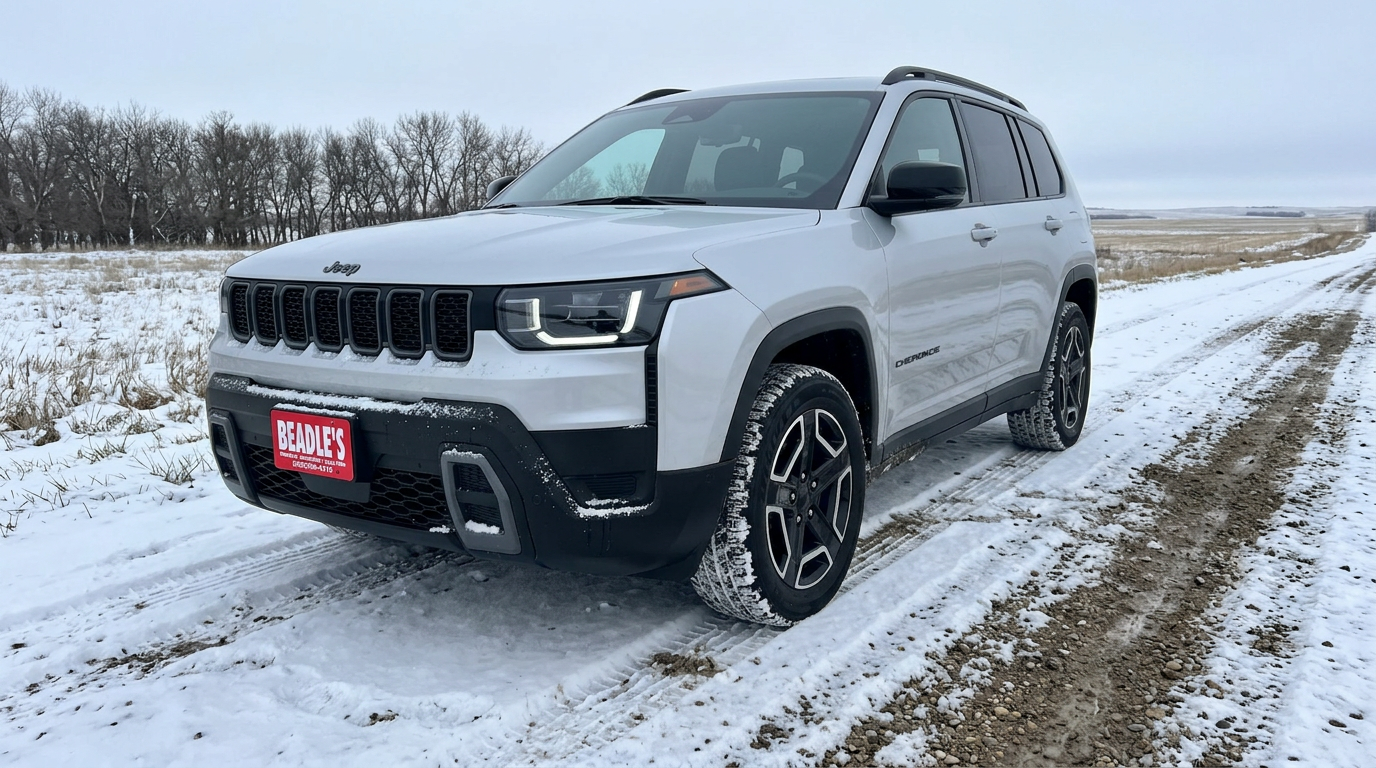
For buyers in central South Dakota, a vehicle’s winter performance isn’t a feature — it’s a baseline requirement. Packed snow on county roads, black ice on the highway, temperatures that drop into negative territory, and the reality of being 40 miles from the nearest dealership mean you need a vehicle that handles the conditions without a second thought.
This guide covers exactly how the 2026 Jeep Cherokee performs in a South Dakota winter: how the 4×4 system handles ice and snow, what Selec-Terrain’s Snow mode actually does, which heated features come on which trims, and how the hybrid system holds up in extreme cold.
On This Page
How does the 2026 Cherokee handle ice and packed snow?
The 2026 Cherokee runs Jeep Active Drive I with rear-axle disconnect — a full-time 4×4 system that monitors wheel slip and distributes torque between the front and rear axles automatically. On ice and packed snow, this means the system is already managing traction before you feel the slide, not after you’ve already lost grip.
Eight inches of ground clearance keeps the Cherokee above typical snow accumulation on county roads and ranch approaches. The hybrid powertrain’s electric motors deliver instant torque at low speeds — the same characteristic that helps with highway passing also helps when you’re creeping out of a drifted approach at 5 mph.
Common Mistake
Buyers assume “4×4” means the system is always engaged at full capacity. Jeep Active Drive I uses a rear-axle disconnect in low-demand conditions to improve fuel economy — the system reconnects automatically when traction demands it. In true winter conditions, the rear axle stays engaged. But if you’re on a slick road and the system hasn’t sensed slip yet, switching to Snow mode tells the Cherokee to stay in a more proactive traction state. Don’t rely on the system catching up to conditions — use Snow mode proactively.
Does the Cherokee have a Snow mode, and what does it actually do?
Yes — Snow mode is one of the four Selec-Terrain settings standard on every 2026 Cherokee trim. Engaging Snow mode changes how the Cherokee manages throttle response, transmission shift points, and torque distribution to reduce wheel spin on slick surfaces.
In practical terms: Snow mode softens initial throttle application so the wheels are less likely to break traction when you accelerate from a stop on ice. It also keeps the transmission in lower gears longer during deceleration, using engine braking to slow the vehicle instead of relying entirely on the friction brakes. On a glare-ice county road in January, this makes a noticeable difference in how predictably the Cherokee slows down and pulls away from a stop.
The other three Selec-Terrain modes — Auto, Sport, and Sand/Mud — are available year-round. Auto handles most paved winter driving without any manual input. Snow mode is the right choice when you’re on compacted snow or ice and want the Cherokee managing traction more conservatively from the start, not reacting after the fact.
What heated features come standard on each 2026 Cherokee trim?
Heated features are one of the most trim-specific aspects of the 2026 Cherokee — and the most commonly misunderstood by buyers who assume all trims are similarly equipped. Here’s exactly what each trim includes:
| Heated Feature | Cherokee 4×4 | Laredo | Limited / 85th Anniv. | Overland |
|---|---|---|---|---|
| Heated front seats | No | Yes | Yes | Yes |
| Heated steering wheel | No | No | Yes | Yes |
| Heated exterior mirrors | No | Yes | Yes | Yes |
| Remote start | No | Yes | Yes | Yes |
| Heated rear seats | No | No | No | Available (Adv. Protech Group) |
Feature content is standard unless noted. Verify on window sticker of any specific unit.
For most South Dakota buyers, the Laredo is the practical minimum for winter comfort — remote start lets the cabin warm up before you get in, heated seats take care of the cold on the way to work, and heated mirrors keep your visibility clear on frosty mornings. If you want the heated steering wheel, the Limited is your starting point. Heated rear seats are only available on the Overland via the Advanced Protech Group package.
How does the Cherokee’s hybrid system perform in extreme cold?
Cold weather affects hybrid battery performance across all hybrid vehicles — the Cherokee’s 1.6L self-charging hybrid is no exception. In extreme cold, lithium-ion battery chemistry slows, which can reduce how aggressively the electric motors contribute at startup and in stop-and-go driving. The Cherokee’s gas engine compensates by running more consistently until the battery reaches operating temperature.
In practical terms for South Dakota winters: the Cherokee still starts and drives normally in extreme cold — the hybrid system doesn’t prevent the vehicle from operating. What you may notice is slightly reduced fuel economy on very cold days compared to the EPA’s 37 mpg combined estimate, as the gas engine carries more of the load while the battery warms up. This is consistent with how all hybrid systems behave in sub-zero temperatures.
Remote Start Advantage
Using remote start (available Laredo and above) in extreme cold gives the Cherokee time to warm the cabin and let the battery reach closer to operating temperature before you drive. This reduces the cold-start fuel economy impact and means your heated seats and steering wheel are already working when you get in. For central South Dakota winters, remote start is a functional tool, not just a convenience.
What makes standard 4×4 better than AWD for South Dakota winters?
Most crossovers in the Cherokee’s segment offer all-wheel drive — either as a standard feature or an upgrade. The Cherokee doesn’t offer AWD: it comes with Jeep Active Drive I 4×4 on every trim, and the distinction matters for buyers who are serious about winter driving.
AWD systems in crossovers are typically designed around on-road stability — they’re reactive systems that send power to slipping wheels after the fact. Jeep’s Active Drive I is designed for both on-road winter conditions and off-road demand. It monitors wheel slip continuously, uses terrain-specific modes via Selec-Terrain, and is built around a mechanical 4×4 architecture rather than a purely software-managed torque vectoring system.
For county road driving in January, the difference is most noticeable in two places: controlled starts on hard-packed snow and stability on banked curves. The Cherokee’s system is more mechanically direct — it’s not guessing at traction, it’s managing it. Combined with 8 inches of ground clearance, the Active Drive I system gives the Cherokee a genuine capability advantage over most AWD crossovers in true winter conditions.
How to prep a 2026 Cherokee for a South Dakota winter
The Cherokee handles winter conditions well out of the box, but a few preparation steps will make a meaningful difference once temperatures drop into the single digits and below.
- Check and rotate tires before first hard freeze: The Cherokee’s standard all-season tires are rated for winter use, but tread depth matters more than anything else on ice. If your tread is under 4/32″, consider replacing before November. For buyers who drive significant distances on gravel or unpaved roads, dedicated winter tires on a separate set of wheels are worth considering.
- Confirm remote start is set up before you need it: Remote start is standard on the Laredo and above. Set up the app or key fob sequence before the first cold snap — figuring it out at -15F in the parking lot is not the time. A 10-minute warm-up window is enough for the cabin to reach comfortable temperature and for the hybrid battery to begin warming.
- Switch to Snow mode proactively, not reactively: Engage Selec-Terrain Snow mode before you hit slick conditions — before you leave the driveway on a cold morning, not after you’ve already felt the rear step out on a turn. The system reconfigures throttle and torque delivery immediately on engagement.
- Top up washer fluid to a -40 rated formula: Standard washer fluid freezes. South Dakota winters regularly see temperatures where sub-standard fluid will freeze on the windshield or in the lines. Fill with a -40-rated formula before the season starts. The Cherokee’s N95 HVAC cabin filter handles air quality, but the windshield is your responsibility.
- Keep the tank above half: A full fuel tank adds weight over the rear axle and reduces condensation in the fuel system. On long rural drives in winter, range anxiety is a real concern — staying above half keeps your 500-mile range buffer intact and means you’re not making unplanned stops in weather you’d rather not stop in.
Key Takeaways
- Jeep Active Drive I 4×4 with rear-axle disconnect is standard on every 2026 Cherokee trim — no FWD version exists. The system manages traction automatically, with Snow mode available for proactive winter driving.
- Selec-Terrain Snow mode softens throttle response and increases engine braking on deceleration — engage it before you reach slick conditions, not after.
- Heated front seats and remote start start at the Laredo ($38,000). The heated steering wheel requires the Limited ($40,000). Heated rear seats are only available on the Overland via the Advanced Protech Group package.
- The hybrid system performs normally in extreme cold — fuel economy may be slightly reduced on very cold starts while the battery warms up, but the vehicle operates as expected. Remote start mitigates this.
Frequently Asked Questions
Does the 2026 Jeep Cherokee come with heated seats?
Heated front seats are standard on the Laredo, Limited, 85th Anniversary, and Overland. They are not included on the base Cherokee 4×4. If heated seats are a priority for South Dakota winter driving, the Laredo ($38,000) is the minimum trim. Heated rear seats are only available on the Overland via the Advanced Protech Group package.
Will the Cherokee’s hybrid battery die in a South Dakota winter?
No. The Cherokee’s self-charging hybrid system is designed to operate in extreme temperatures. In very cold weather, hybrid batteries charge and discharge more slowly than in moderate temperatures, so the gas engine carries more of the load on cold starts. The vehicle starts and drives normally. You may see slightly lower fuel economy on the coldest days, but the system does not fail or prevent normal operation.
Does the Cherokee have remote start?
Yes — remote start is standard on the Laredo, Limited, 85th Anniversary, and Overland. It is not included on the base Cherokee 4×4. For South Dakota winters, remote start is a meaningful feature: it allows the cabin to pre-warm and the hybrid battery to begin reaching operating temperature before you start driving.
Is the Cherokee better than AWD crossovers in South Dakota winters?
The Cherokee’s Jeep Active Drive I 4×4 system offers a more mechanically direct approach to traction management than most crossover AWD systems, which are primarily designed for on-road stability. Combined with Selec-Terrain Snow mode, 8 inches of ground clearance, and Rough Road Cruise Control, the Cherokee is more capable in true winter conditions — packed snow, ice, and rural road conditions — than most AWD crossovers in its class. That said, no 4×4 system overcomes poor tires or excessive speed on ice. Tread depth and driver behavior still matter most.
My Take on the Cherokee in a South Dakota Winter
The number one thing I hear from buyers who’ve come from a front-wheel-drive car or a crossover with a basic AWD system is that the Cherokee feels different in a way they didn’t expect — more planted, more predictable. Part of that is Snow mode, which genuinely changes how the vehicle behaves on a slick morning. Part of it is just the nature of Jeep’s 4×4 architecture versus the reactive torque-splitting systems most crossovers use.
The heated feature conversation comes up with almost every buyer we talk to. If you’re in South Dakota and you’re buying a vehicle you plan to drive year-round, the Laredo is genuinely the practical floor for winter comfort — heated seats and remote start matter in a way that’s hard to overstate once you’ve spent a few weeks without them in January. The heated steering wheel on the Limited is one of those features that takes about three cold mornings to go from “that seems nice” to “I will never buy a vehicle without one.”
For a full look at the 2026 Cherokee’s specs and trims, our complete 2026 Cherokee guide covers all of it. And if you want to talk through which trim makes the most sense for your situation, stop by Beadle’s in Bowdle — we can pull any unit on the lot and go through what’s equipped before you make a decision.
About the Author
Lexy Tabbert — Beadle’s Chrysler Center, Bowdle, SD
Lexy Tabbert is the Director of Sales and Marketing at Beadle’s Chrysler Center in Bowdle, South Dakota. She covers Ram, Jeep, Dodge, and Chrysler vehicles — helping families, ranchers, and ag operators across the region find the right truck and configuration for their needs. Learn more about Lexy.
Connect with us


