




Blog / Bowdle Chrysler Dealer

Blog

All Bowdle Chrysler Dealer Ram Dealer in South Dakota
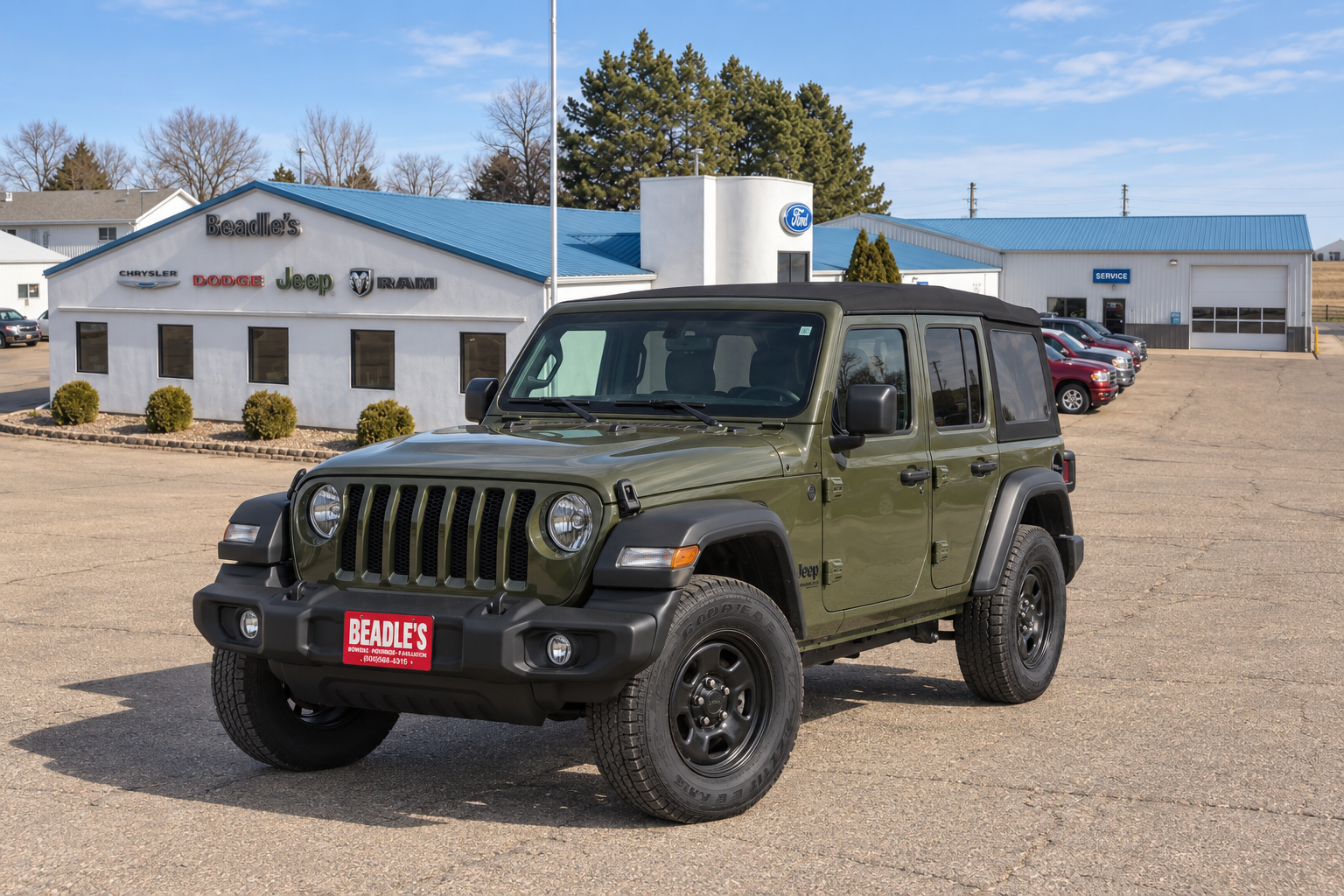
2026 Jeep Wrangler Sport parked in front of the Beadle's Chrysler Center building in Bowdle, South Dakota, at Beadle's Chrysler Center

Wrangler vs Grand Cherokee, and New vs Used: Which Jeep Should You Buy?

There is a conversation that happens in our showroom more than any other, and it usually starts with a couple standing between a Wrangler and a Grand Cherokee. He wants the Wrangler. She rode in her sister's Grand Cherokee to Aberdeen last month and noticed how quiet it was. Then somebody points out the used Wrangler Unlimited on the lot and asks whether that would not do just as well as a new Sport. Three vehicles, two questions, one family. Let me try to sort it out the way I would if you were standing in front of me. Short answer: the Grand Cherokee is the better family SUV and the Wrangler is the better second vehicle, and which one you need depends on whether it is replacing the family hauler or joining the Ram already in the yard. On new versus used, a new 4-Door Sport buys you Jeep's factory warranty, the current 12.3-inch screen, and a known history from mile one; a used Unlimited buys you more Jeep for the money if you are willing to do some homework. Here is how I would think through all of it. Search Wrangler Inventory Get Pre-Qualified On This Page Wrangler or Grand Cherokee: which Jeep fits a rural family? What the Grand Cherokee does better What the Wrangler does that the Grand Cherokee cannot New 4-Door Sport or used Wrangler Unlimited? Reliability, warranty, service, and holding value How to decide in one visit Wrangler or Grand Cherokee: Which Jeep Fits a Rural Family? If this vehicle is the family's main rig, the one that does the Aberdeen runs, the ball games, and the grandparents' house at Christmas, buy the Grand Cherokee. If the family already has a crew cab for that and this one is the hunting rig, the lake rig, or the one you finally get to buy for yourself, buy the Wrangler. Both are real Jeeps with real four-wheel drive, and both will get you home on an unplowed township road. The difference is what they are built around. The Grand Cherokee is built around the cabin: quiet, comfortable, a big cargo hold, and 4x4 tucked underneath so you never have to think about it. The Wrangler is built around the hardware: solid axles, a low range on every trim, a spare on the tailgate, and a body where the roof, the doors, and even the windshield come off. Almost nobody buys a Wrangler because it was the sensible choice, and that is fine, because it was never trying to be. Here is the honest side by side. What Matters to You Jeep Wrangler Jeep Grand Cherokee Seats Two rows; 2-Door or 4-Door Five-seat two-row, or three-row Grand Cherokee L Highway comfort and noise Louder; the Sahara hardtop is the quiet one Far quieter and more comfortable 4x4 Part-time with low range on Sport through Rubicon; Selec-Trac full-time on Sahara Full-time 4x4, set-and-forget Engines 3.6L V6 (manual or automatic), 2.0L turbo, 6.4L V8 on 392 3.6L V6 or 2.0L turbo Towing, properly equipped 4-Door 3,500 lbs; 2-Door 2,000 lbs Up to 6,200 lbs Open-air Roof, doors, and windshield all come off Sunroof at most Built for Gravel, pasture, sloughs, boat ramps Family miles with 4x4 for the bad days Both are on our lot in Bowdle. Our Grand Cherokee page and the 2026 Grand Cherokee guide cover that side of the showroom in the same detail we give the Wrangler here. What the Grand Cherokee Does Better Comfort, quiet, room, and towing. If the sister's Grand Cherokee impressed you on that Aberdeen trip, it is because those are exactly the things it was designed to do, and it does them better than any Wrangler ever will. The Grand Cherokee is far quieter and more comfortable on the highway, full stop. It seats five in the two-row version, or you can step up to the three-row Grand Cherokee L when there are more kids, more grandkids, or more hunting buddies than a Wrangler will ever hold. It runs the same 3.6L V6 or 2.0L turbo family you will find in the Wrangler, and properly equipped it tows up to 6,200 pounds, which puts a bigger boat or a small stock trailer in play without borrowing the Ram. Its full-time 4x4 means you never touch a lever; it just sends power where it is needed on a glazed county road at 6 a.m. If you want the winter deep dive on that side of the lot, our Grand Cherokee winter guide covers it. The sister test If the thing you remember from riding in somebody else's Jeep is how quiet and comfortable it was, that is the Grand Cherokee talking, and no Wrangler trim will give you that same feeling. If the thing you remember is the top being off, that is the Wrangler talking, and no Grand Cherokee will give you that. Trust the memory. It is telling you which one you actually want. What the Wrangler Does That the Grand Cherokee Cannot Come apart, crawl, and go where the side-by-side goes while still being licensed and heated. The Wrangler is the only Jeep on the lot where the roof, the doors, and the windshield all come off, and the only one with a true low range on every single trim. Every Wrangler rides on solid front and rear axles with a two-speed transfer case: Command-Trac with a 2.72:1 low range on Sport, Sport S, and Willys, Selec-Trac full-time on the Sahara, and Rock-Trac with a 4:1 low range on the Rubicon, which also adds front and rear electronic lockers, a front sway-bar disconnect, heavy-duty Dana 44-class axles, and 33-inch off-road tires. The Willys splits the difference with a locking rear differential and all-terrain tires on the Sport's chassis, which is why it is the hunter's pick around here. Every trim carries a full-size spare on the tailgate and a skid plate under the fuel tank, and ground clearance runs about 10 inches on a Sport and closer to 10.8 on a Rubicon with 33s. None of that is on a Grand Cherokee, because a Grand Cherokee does not need it. Then there is the part that does not fit in a spec table. The two front Freedom panels lift off in a minute with no tools. The full metal doors come off on quick-release hinges. The Sunrider soft top folds back from the driver's seat. A Wrangler on a July evening on a county road with the top down is the reason people put up with the wind noise the other eleven months. The 6-speed manual is still standard behind the 3.6L V6, too, which some of you have been waiting a long time to hear. The trim guide walks through every piece of that hardware if you want it. New 4-Door Sport or Used Wrangler Unlimited? First, the vocabulary: "Wrangler Unlimited" is simply what Jeep called the 4-Door for years, and it is still how older used listings describe it. A used Unlimited and a new 4-Door are the same body. The real question is what the newer one gives you for the difference in payment. A new 2026 4-Door Sport gives you three things a used one usually cannot. The first is Jeep's factory warranty, from mile one, with the service department that sold it standing behind it. The second is the current interior: every 2026 trim comes with the 12.3-inch Uconnect touchscreen and wireless Apple CarPlay and Android Auto, where older used Wranglers often have a smaller screen and a wired connection, if they have one at all. The third is a known history. You are the first owner. Nobody has run it through a slough with the doors off and let it sit wet, and nobody has lifted it on parts you cannot identify. Add the current 3.6L V6 with the manual or the 8-speed automatic, or the 2.0L turbo, plus the option to build it the way you want with heated seats, a hardtop, or the tow package, and the new Sport is the safe, simple answer. A used Unlimited gives you one thing the new one cannot: more Jeep for the same money. The payment that buys a new Sport might buy a used Sahara with the hardtop or a used Rubicon with lockers and 33s already on it, and Wranglers are so well built that a well-kept one with real miles is often a fine vehicle. What you give up is the warranty, the current screen and safety tech, and the certainty about where it has been. That is why the homework matters: service records, whether the top and doors ever leaked, what the tires and brakes have left, and whether the previous owner did the maintenance or just the modifications. One advantage of buying from us is that Beadle Auto Group has used Wranglers across all of our lots, not just the ones parked in Bowdle, so if the right used Unlimited is sitting in Mobridge we can bring it over. We do not publish payment numbers in a blog post, because they change with the month's programs and your trade, but getting pre-qualified takes a few minutes and lets us show you the new Sport and the used Unlimited side by side in actual monthly terms. Reliability, Warranty, Service, and Holding Value Wranglers are simple, well-understood vehicles, and that is most of what reliability means out here: the 3.6L V6 has been under Wrangler hoods for years, the solid axles have very few moving parts, and every mechanic within a hundred miles has had one on the hoist. Nobody has to drive to Sioux Falls to get one fixed. A new Wrangler carries Jeep's factory warranty, and our service department at Beadle's Chrysler Center in Bowdle handles warranty work, oil changes, and tires right here; you can reach them at 605-460-6277. On a used Unlimited, ask us what factory coverage, if any, is still in effect, because a newer used one may have some left. Either way, the things that actually give a Wrangler trouble are usually the things the owner did to it or forgot to do for it, which is why a known history is worth so much more on a Wrangler than on most vehicles. On value, this is the part that surprises people who have only ever owned a truck: Wranglers hold their value better than almost anything else on the lot. That cuts both ways. It is why a used Unlimited is not cheap, and it is also why a new 4-Door Sport is a lower-risk purchase than it looks, because five years from now somebody in Eureka or Ipswich will still want it. If you are trading a truck in, that resale strength is part of the math, and we are happy to run it with you. How to Decide in One Visit Four vehicles and two questions sounds like a long afternoon. It does not have to be. Here is the order I would do it in. Settle the job first. Is this the family's main vehicle or the second one? If it is the main one, drive the Grand Cherokee first. If it is the second one, skip to the Wranglers. Drive the Grand Cherokee and the Wrangler on the same loop, including a stretch of highway. The noise difference is the thing people underestimate until they hear it back to back. Sit in the back seat of each one with whoever rides there most, and load the dog crate or the hockey bag. Compare the new Sport to the used Unlimited on paper: warranty, screen and safety equipment, tires and brakes remaining, service records, and what it would cost to add what the new one already has. Get pre-qualified so we can put real monthly numbers next to each option instead of guessing. Ask about the other lots. If the used Wrangler you want is not in Bowdle, Beadle Auto Group may have it in Mobridge. Quick Overview: Is a New 4-Door Wrangler Sport Worth It? Consideration New 2026 4-Door Sport Used Wrangler Unlimited Warranty Jeep's full factory warranty from mile one Whatever remains, if any; ask us Screen and connectivity 12.3-inch Uconnect, wireless CarPlay and Android Auto standard Varies by year; often smaller and wired History Known from day one Depends on records and the previous owner Hardware for the money Sport-level: Command-Trac, all-seasons, soft top May reach a Sahara or Rubicon at a similar payment Build it your way Order color, top, engine, and packages Take it as it sits Worth it if: you want the warranty and the service department behind it, the current screen and safety equipment, a clean history, and the ability to order it the way you want before pheasant opener. Skip it if: you would rather have Rubicon or Sahara hardware at a Sport payment and you are willing to do the homework on a used one — in that case ask us what Beadle Auto Group has on the other lots. Key Takeaways Grand Cherokee if it is the family's main vehicle: far quieter, more comfortable, five seats or the three-row L, full-time 4x4, and up to 6,200 pounds of towing. Wrangler if it is the second vehicle with a use story: solid axles, low range on every trim, lockers on Rubicon, and a roof, doors, and windshield that come off. "Wrangler Unlimited" on a used listing just means 4-Door; it is the same body as a new 4-Door Sport. New buys you Jeep's factory warranty, the 12.3-inch screen with wireless CarPlay, and a known history; used buys you more hardware for the money if you do the homework. Wranglers are serviced right here in Bowdle and hold their value better than almost anything on the lot. Frequently Asked Questions Is the Grand Cherokee or the Wrangler better in snow? Both are genuinely good. The Grand Cherokee's full-time 4x4 is easier because it manages itself, and it is the more comfortable winter commuter. The Wrangler has more ground clearance and a true low range on every trim, so it is the one for breaking a drift on a section line. Winter tires help both more than any option does. What is the difference between a Wrangler Unlimited and a Wrangler 4-Door? Nothing. "Unlimited" was Jeep's name for the four-door Wrangler for many years, and older used listings still use it. A new one is simply called the Wrangler 4-Door. Same body, same idea. Does a new Wrangler come with a warranty, and where do I get it serviced? Yes. Every new Wrangler carries Jeep's factory warranty, and the service department at Beadle's Chrysler Center in Bowdle handles warranty work, maintenance, and tires. Call 605-460-6277 to schedule. Ask us for the current warranty terms when you are in. Can I see used Wranglers from the other Beadle lots? Yes. Beadle Auto Group keeps used Wranglers across its lots, not only in Bowdle. Tell us what year, trim, and top you are after and we can pull one over from Mobridge so you can drive it next to a new 4-Door Sport. My Take on Which Jeep to Buy When that couple is standing between the two, I ask one question before anything else: what is this vehicle replacing? If the answer is the family SUV, I walk them to the Grand Cherokee, and I do not feel one bit bad about it, because it is the better vehicle for that job and she was right about the quiet. If the answer is "nothing, the truck stays," then we are talking about a Wrangler, and the only question left is which one. On new versus used, I lean new for most people, and not because I sell them. A Wrangler is a vehicle that gets used hard and modified often, and the warranty, the current screen, and knowing exactly where it has been are worth more on a Wrangler than on almost anything else we sell. But if you have the patience to do the homework and the used Unlimited on the lot has the hardtop and the records, I will tell you that too. I have owned three of these. Two were used. Both were fine, because I knew who had them before me. For the full rundown on trims, engines, towing, and winter, our 2026 Jeep Wrangler guide has all of it. And if you are anywhere near Bowdle, come stand between the two yourself. We will make it easy. Search Wrangler Inventory Get Pre-Qualified Contact Beadle's Chrysler Center About the Author Lexy Tabbert — Beadle's Chrysler Center, Bowdle, SD Lexy Tabbert is the Director of Sales and Marketing at Beadle's Chrysler Center in Bowdle, South Dakota. She covers Ram, Jeep, Dodge, and Chrysler vehicles — helping families, ranchers, and ag operators across the region find the right truck and configuration for their needs. Learn more about Lexy.
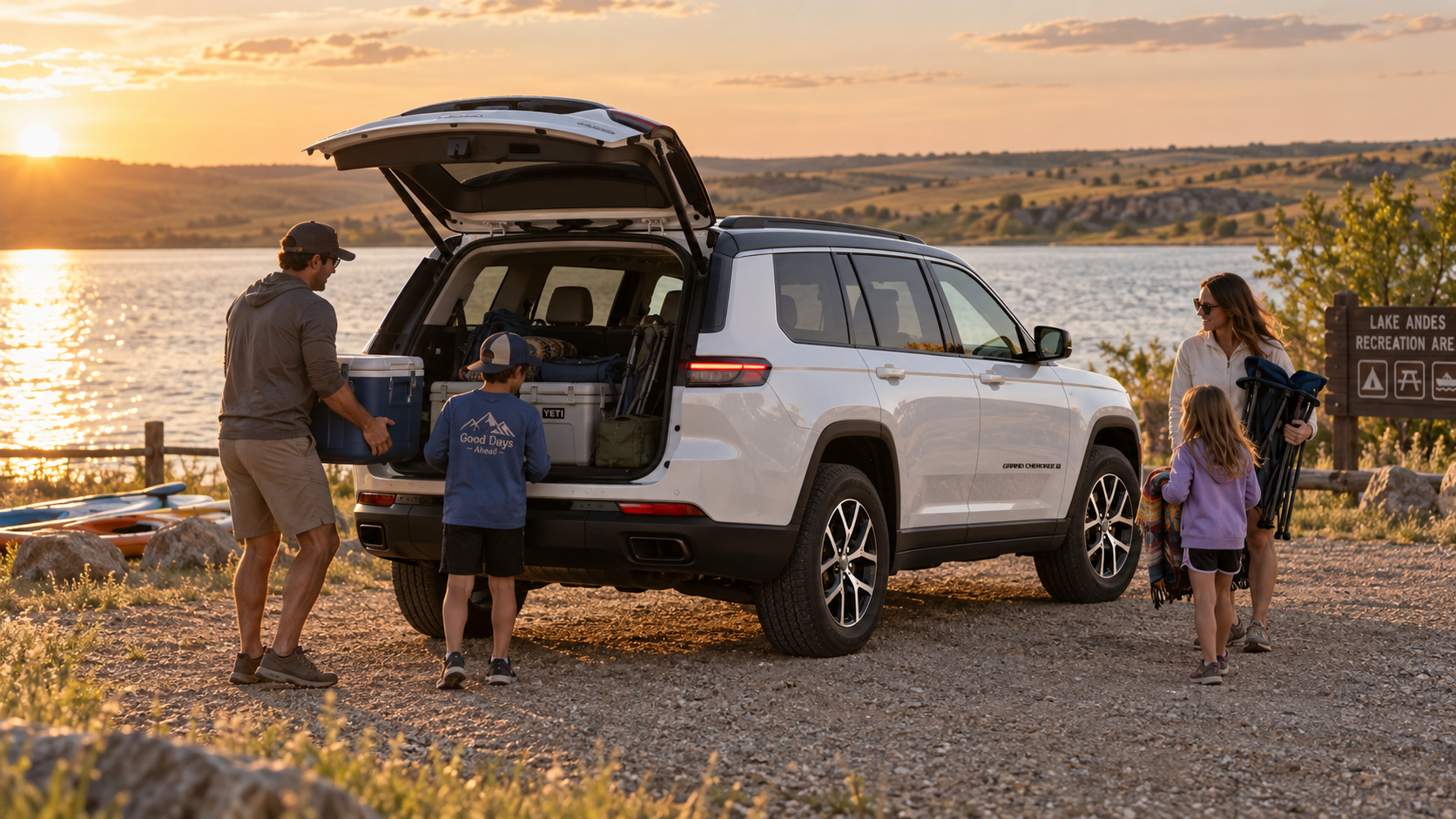
Family loading up a 2026 Jeep Grand Cherokee L at the lake in South Dakota, at Beadle's Chrysler Center

Is the 2026 Grand Cherokee the Right Family SUV for South Dakota?

By the time most families get to me, they have already read the reviews and driven a few things. The question they really want answered is simpler and more local: is the Grand Cherokee the right family SUV for life out here — long drives across the plains, real winters, gravel roads, and the occasional trailer? This is the post that ties it all together. The honest answer for most families around Bowdle is yes — it is comfortable on long hauls, genuinely capable in snow and on gravel, tows enough for typical needs, and holds its value. But it is not the right pick for everyone, and I would rather tell you that up front. Here is who it fits and who should look elsewhere. Search Grand Cherokee Inventory Get Pre-Qualified On This Page Is it comfortable on long plains drives? Can it handle winter and gravel? Does it tow and haul enough for a family? Who should look elsewhere? How to decide if it fits your family Is It Comfortable on Long Plains Drives? Yes — long-haul comfort is one of the Grand Cherokee's real strengths, and out here where the nearest big town can be an hour-plus away, that matters more than a spec sheet lets on. The cabin is quiet and settled at highway speed, the seats are made for distance, and higher trims add creature comforts that turn a long drive into an easy one — heated and ventilated seats, a big Uconnect touchscreen, and available leather. If you need a third row for a bigger family, the Grand Cherokee L stretches to 204.9 inches and seats six or seven while keeping that same composed ride. For families who spend real time on the road, that comfort is worth a lot. Our trim comparison lays out which step gets you which comfort features. Can It Handle Winter and Gravel? This is where the Grand Cherokee separates itself from a lot of family crossovers. It uses a true four-wheel-drive system — not light car-based all-wheel drive — so it handles snow, ice, and unplowed gravel with real confidence. Ground clearance starts at 8.4 inches and, with the available Quadra-Lift air suspension, rises to as much as 10.9 inches to clear the packed ridge on an unplowed road. The 4x4 hardware steps up by trim, from the Laredo's set-and-forget Quadra-Trac I to the Summit's low-range Quadra-Drive II. For most families here, even the base system is genuinely enough. If you want the full winter rundown, our South Dakota winter guide goes deep on it. Real 4x4 is the difference A lot of family SUVs look capable but run light-duty all-wheel drive. The Grand Cherokee's true 4x4 hardware is built for drifts, ice, and section-line gravel — the kind of roads that separate a real capability SUV from a pavement crossover. Does It Tow and Haul Enough for a Family? For typical family use, yes. Properly equipped, the Grand Cherokee tows up to 6,200 pounds with either engine — enough for a fishing boat, a small camper, or a utility trailer. On cargo, it flexes between two-row and L depending on how many kids and how much gear you carry. Measure Two-Row Grand Cherokee L Seating 5 6 or 7 Length 193.5″ 204.9″ Max cargo 70.8 cu ft 84.6 cu ft Max towing 6,200 lbs 6,200 lbs If you have five or fewer and want a slightly shorter, easier-to-park SUV, the two-row is the pick. If you need the third row for a bigger crew or car seats plus grandparents, the L is the answer — and it still tows the same 6,200 pounds. Who Should Look Elsewhere? I would rather point you to the right vehicle than sell you the wrong one, so here is the honest part. The Grand Cherokee is a great fit for a lot of families, but not all of them. If you regularly tow heavy — a big camper, a loaded stock trailer, or gooseneck loads well past 6,200 pounds — you want a pickup, not a midsize SUV, and we can point you toward the right truck. On the other end, if you never leave the pavement, never see a gravel road, and just need to get around town, you could save money with a lighter crossover and still be perfectly happy. The Grand Cherokee earns its keep for families who want real capability and long-haul comfort together; if you only need one of those, there may be a better-value answer. How to Decide If It Fits Your Family A few honest questions will tell you whether the Grand Cherokee is your SUV or whether something else fits better. Run through these before you shop. Count your seats: five or fewer points to the two-row; a bigger crew points to the Grand Cherokee L. Be honest about your roads: if you drive gravel and real winters, the true 4x4 is worth it; if you never leave pavement, weigh a lighter crossover. Add up your towing: if you stay under 6,200 pounds you are fine; if you tow heavy, look at a pickup instead. Match the trim to your comfort: higher trims add heated and ventilated seats and a bigger screen for long drives. Drive it loaded: bring the car seats and the family so you can feel the real fit before you decide. Quick Overview: Is It Right for You? It fits well if Look elsewhere if You drive gravel and real plains winters You never leave paved roads You tow a boat, small camper, or utility trailer You regularly tow heavy past 6,200 lbs You want long-haul comfort and real capability You only need a basic around-town runabout Worth it if: you want one vehicle that is comfortable on long drives and genuinely capable in snow, gravel, and light towing. Skip it if: you tow heavy for a living (get a truck) or never leave pavement (a lighter crossover saves money). Key Takeaways The Grand Cherokee is comfortable on long plains drives and quiet at highway speed, with a third-row L for bigger families. It uses true 4x4 — not light AWD — so it handles snow and gravel with real confidence. It tows up to 6,200 pounds with either engine — plenty for a boat, small camper, or utility trailer. Look elsewhere if you tow heavy for a living (buy a truck) or never leave pavement (a lighter crossover saves money). Frequently Asked Questions Is the Grand Cherokee a good family SUV for South Dakota? For most families out here, yes. It is comfortable on long drives, uses true four-wheel drive that handles snow and gravel well, tows up to 6,200 pounds, and holds its value. It fits families who want capability and comfort together. Should I get the two-row or the Grand Cherokee L? Choose based on seating and cargo. The two-row seats five and is a bit shorter and easier to park. The L stretches to 204.9 inches, seats six or seven, and offers more cargo — while towing the same 6,200 pounds. Both handle winter the same. Is the Grand Cherokee good enough for towing a camper? For a smaller camper, boat, or utility trailer under 6,200 pounds, yes — properly equipped with the Trailer Tow Package, either engine handles it. If you regularly tow a large camper or heavy loads well past that, a pickup is the better tool. Is a Grand Cherokee worth it over a cheaper crossover? It depends on your roads. If you drive gravel and real winters or tow, the Grand Cherokee's true 4x4 and towing earn their keep. If you never leave pavement and just need to get around town, a lighter crossover can save you money and still fit your life. My Take on the Grand Cherokee for Families When a family sits down with me and lays out how they actually live — the school runs, the drives to the city, the winters, the boat in the summer — the Grand Cherokee lands right in the middle of what most of them need. It is comfortable enough for the long hauls and capable enough for the bad roads, and that combination is exactly why folks around here keep coming back to it. But I will always tell you the truth about fit. If you are towing heavy every week, I am going to walk you over to a truck. If you genuinely never leave the pavement, I will tell you that you could spend less and be just as happy. The Grand Cherokee is for the family that wants one vehicle to do a lot of things well — and for that family, it is a really easy recommendation. For the full rundown on trims, engines, and towing, our 2026 Grand Cherokee guide covers it. And if you are anywhere near Bowdle, stop by Beadle's Chrysler Center — bring the car seats and the family, and we will help you figure out honestly whether it is the right fit before you decide. Search Grand Cherokee Inventory Get Pre-Qualified Contact Beadle's Chrysler Center About the Author Lexy Tabbert — Beadle's Chrysler Center, Bowdle, SD Lexy Tabbert is the Director of Sales and Marketing at Beadle's Chrysler Center in Bowdle, South Dakota. She covers Ram, Jeep, Dodge, and Chrysler vehicles — helping families, ranchers, and ag operators across the region find the right truck and configuration for their needs. Learn more about Lexy.
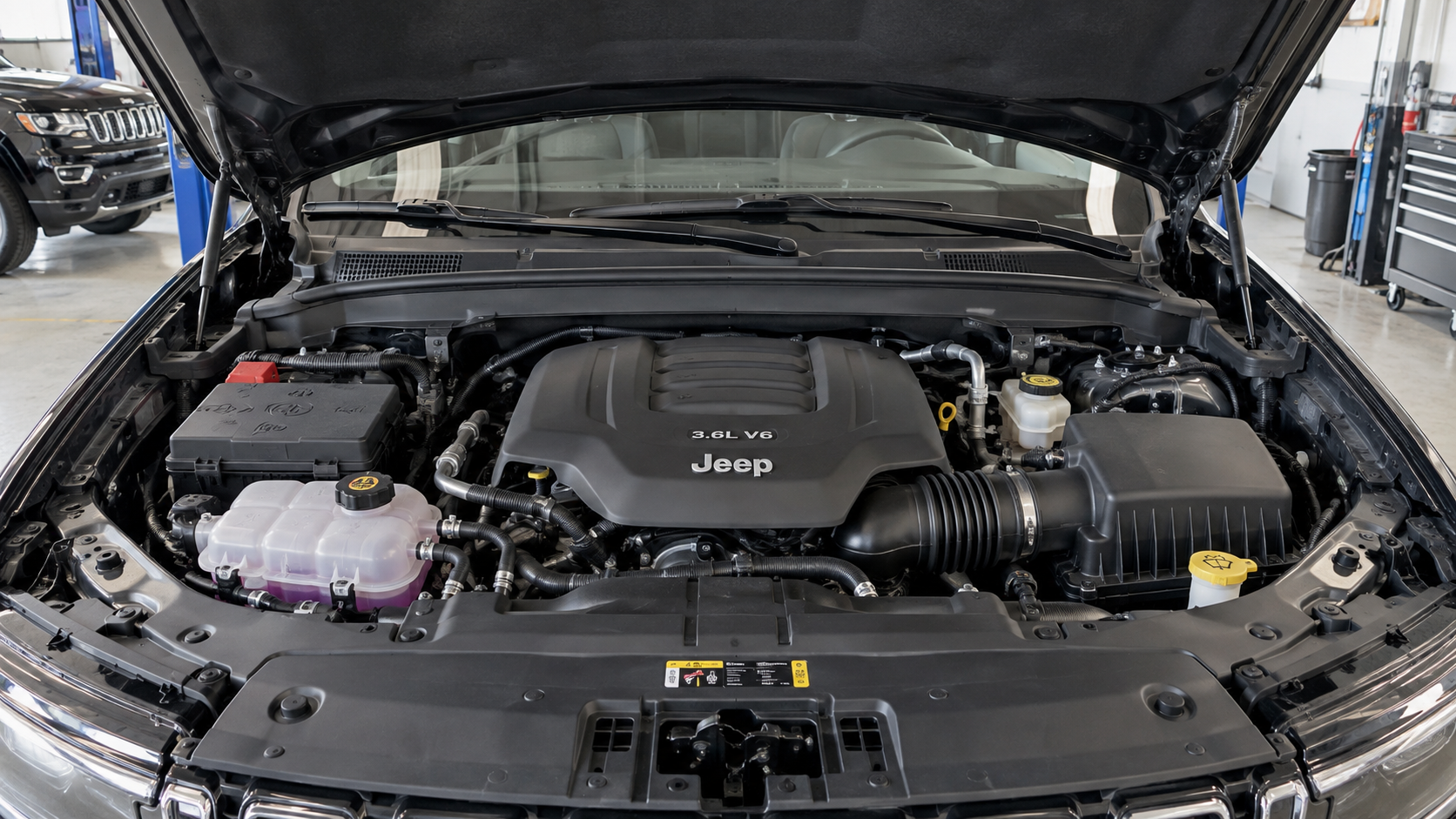
2026 Jeep Grand Cherokee 3.6L Pentastar V6 engine bay, at Beadle's Chrysler Center

2026 Grand Cherokee: 3.6L V6 vs 2.0L Hurricane Turbo

One of the first real decisions on a 2026 Grand Cherokee is under the hood: the standard 3.6L Pentastar V6 or the available 2.0L Hurricane turbo four. It is a genuine trade-off, not a case of one being simply better — and the right pick depends on how you drive and what you tow. Let me walk you through both the way I would on the lot. The honest summary: the V6 is proven, smooth, and straightforward, while the Hurricane turbo makes more power, pulls harder down low, and even returns slightly better fuel economy. Both tow the same, both use the same 8-speed automatic, and there is no V8 in the lineup. Here is how they actually compare. Search Grand Cherokee Inventory Get Pre-Qualified On This Page The head-to-head numbers Who should get the 3.6L V6? Who should get the Hurricane turbo? Do they tow and sip fuel differently? How to choose between them The Head-to-Head Numbers Both engines are strong choices, so it helps to see them side by side before we talk about who each one fits. Here is exactly how they line up. Spec 3.6L Pentastar V6 2.0L Hurricane Turbo Horsepower 293 hp 324 hp Torque 260 lb-ft 332 lb-ft Standard on Laredo Limited & Summit MPG (4x4, city/hwy/combined) 19 / 25 / 21 21 / 26 / 23 Max towing 6,200 lbs 6,200 lbs Transmission 8-speed automatic 8-speed automatic No V8 in this lineup The 2026 Grand Cherokee comes with these two engines — there is no HEMI V8 option. Both send power through the same well-proven 8-speed automatic, so the driving feel is more about the engine character than the gearbox. Who Should Get the 3.6L V6? If you want proven and straightforward, the 293-horsepower Pentastar V6 is your engine. It is the standard powerplant on the Laredo and it has earned a lot of trust over the years. The V6 is smooth, quiet, and simple — a naturally aspirated engine with a long, well-understood track record. For a family that mostly drives around town, runs the highway, and tows lighter loads now and then, it has all the power you need and none of the complexity you do not. It is also the engine you get on the more affordable Laredo, so it keeps the entry point sensible. If your priority is a dependable, no-surprises drivetrain that our technicians know inside and out, the V6 is an easy one to recommend. Who Should Get the Hurricane Turbo? If you want the most power and the strongest low-end pull, the 2.0L Hurricane turbo is the pick. At 324 horsepower and 332 lb-ft, it out-muscles the V6 on paper and, more importantly, in how it feels off the line. That extra torque arrives lower in the rev range, which makes the turbo feel eager when you are merging, passing on a two-lane, or pulling a trailer up a grade. It is standard on the Limited and Summit, so you get it as part of stepping into those trims. And here is the part people do not expect: the turbo also returns slightly better EPA fuel economy than the V6 in 4x4 form. More power and a touch better mileage is a genuinely appealing combination, especially if you tow near the vehicle's limit or just enjoy a stronger-feeling engine. Best for towing near the limit Both engines are rated to tow the full 6,200 pounds, but the turbo's stronger low-end torque makes hauling a loaded trailer feel more relaxed. If you regularly tow close to the maximum, the Hurricane is the nicer tool for the job. Do They Tow and Sip Fuel Differently? On towing capacity, no — both engines are rated to the same 6,200 pounds when properly equipped with the Trailer Tow Package. On fuel and feel, yes, there is a real difference. In 4x4 form, the V6 is EPA-rated at 19 city, 25 highway, and 21 combined, while the Hurricane turbo comes in a bit better at 21 city, 26 highway, and 23 combined. It is not a night-and-day gap, but the turbo does the harder-pulling work while also being slightly more efficient. Where you will notice the biggest difference is under load: the turbo's low-end torque makes a loaded trailer feel less like work. If you want the numbers on what the Grand Cherokee can actually pull, our towing capacity guide breaks it all down. How to Choose Between the Two Engines A few honest questions usually settle it fast. Walk through these and the right engine tends to pick itself. Start with your trim: the Laredo comes with the V6, while the Limited and Summit come standard with the turbo — so your trim often decides for you. Weigh how you tow: if you regularly pull near 6,200 pounds, lean turbo for its stronger low-end torque. Think about fuel: if combined mileage matters to you, the turbo's 23 mpg edges out the V6's 21. Value proven simplicity: if you want the most straightforward, well-known engine, the V6 is the answer. Drive both: the turbo feels punchier and the V6 feels smooth and familiar — a test drive makes the difference obvious. Quick Overview: Which Engine Is Worth It? Consideration 3.6L V6 2.0L Hurricane Turbo Best trait Proven and smooth Most power and torque Feel under load Capable and steady Stronger, more relaxed pull Combined MPG (4x4) 21 23 Worth it if (turbo): you want the most power, tow near the limit, and like the slightly better mileage. Skip it if: you value a proven, straightforward engine and the Laredo's V6 already has all the power you need. Key Takeaways The 3.6L Pentastar V6 makes 293 hp and 260 lb-ft, is standard on the Laredo, and is proven and smooth. The 2.0L Hurricane turbo makes 324 hp and 332 lb-ft, is standard on Limited and Summit, and pulls harder down low. Both tow the full 6,200 pounds and use the same 8-speed automatic — there is no V8. The turbo is the pick for maximum power, towing near the limit, and slightly better mileage; the V6 is the pick for proven simplicity. Frequently Asked Questions Is the Hurricane turbo better than the V6 in the Grand Cherokee? It depends on what you want. The 2.0L Hurricane turbo makes more power (324 hp / 332 lb-ft), pulls harder at low rpm, and returns slightly better 4x4 fuel economy. The 3.6L V6 (293 hp / 260 lb-ft) is proven, smooth, and straightforward. Both tow 6,200 pounds, so the right choice comes down to your priorities. Does the turbo get better gas mileage than the V6? Slightly, yes. In 4x4 form the Hurricane turbo is EPA-rated at 21 city / 26 highway / 23 combined, versus 19 / 25 / 21 for the V6. It is not a huge gap, but the turbo makes more power and is a touch more efficient. Which engine is better for towing? Both engines are rated to tow the full 6,200 pounds with the Trailer Tow Package. The Hurricane turbo's stronger low-end torque (332 lb-ft) makes a loaded trailer feel more relaxed, so it is the nicer choice if you regularly tow near the limit. Does the 2026 Grand Cherokee offer a V8? No. The 2026 Grand Cherokee is offered with the 3.6L Pentastar V6 or the 2.0L Hurricane turbo four — there is no HEMI V8 in this lineup. Both engines pair with the same 8-speed automatic. My Take on the Engine Choice This is one of my favorite questions on the lot because there really is no wrong answer — both engines are good. When someone tells me they want simple and proven, I point them at the V6 in a Laredo and tell them honestly it has all the power most families ever use. It is smooth, it is familiar, and it keeps the price sensible. When someone tows near the limit, or just likes a stronger-feeling engine, I steer them to the Hurricane turbo. That low-end torque makes a real difference with a trailer behind you, and the slightly better mileage is a nice bonus for an engine that also makes more power. It comes standard as you step up into the Limited and Summit, so it often lines up with the trim they were leaning toward anyway. My best advice is to drive both back to back — the difference in character is obvious in about two miles. For the full rundown on trims, towing, and winter capability, our 2026 Grand Cherokee guide covers it. And if you are near Bowdle, stop by Beadle's Chrysler Center and we will get you behind the wheel of each. Search Grand Cherokee Inventory Get Pre-Qualified Contact Beadle's Chrysler Center About the Author Lexy Tabbert — Beadle's Chrysler Center, Bowdle, SD Lexy Tabbert is the Director of Sales and Marketing at Beadle's Chrysler Center in Bowdle, South Dakota. She covers Ram, Jeep, Dodge, and Chrysler vehicles — helping families, ranchers, and ag operators across the region find the right truck and configuration for their needs. Learn more about Lexy.
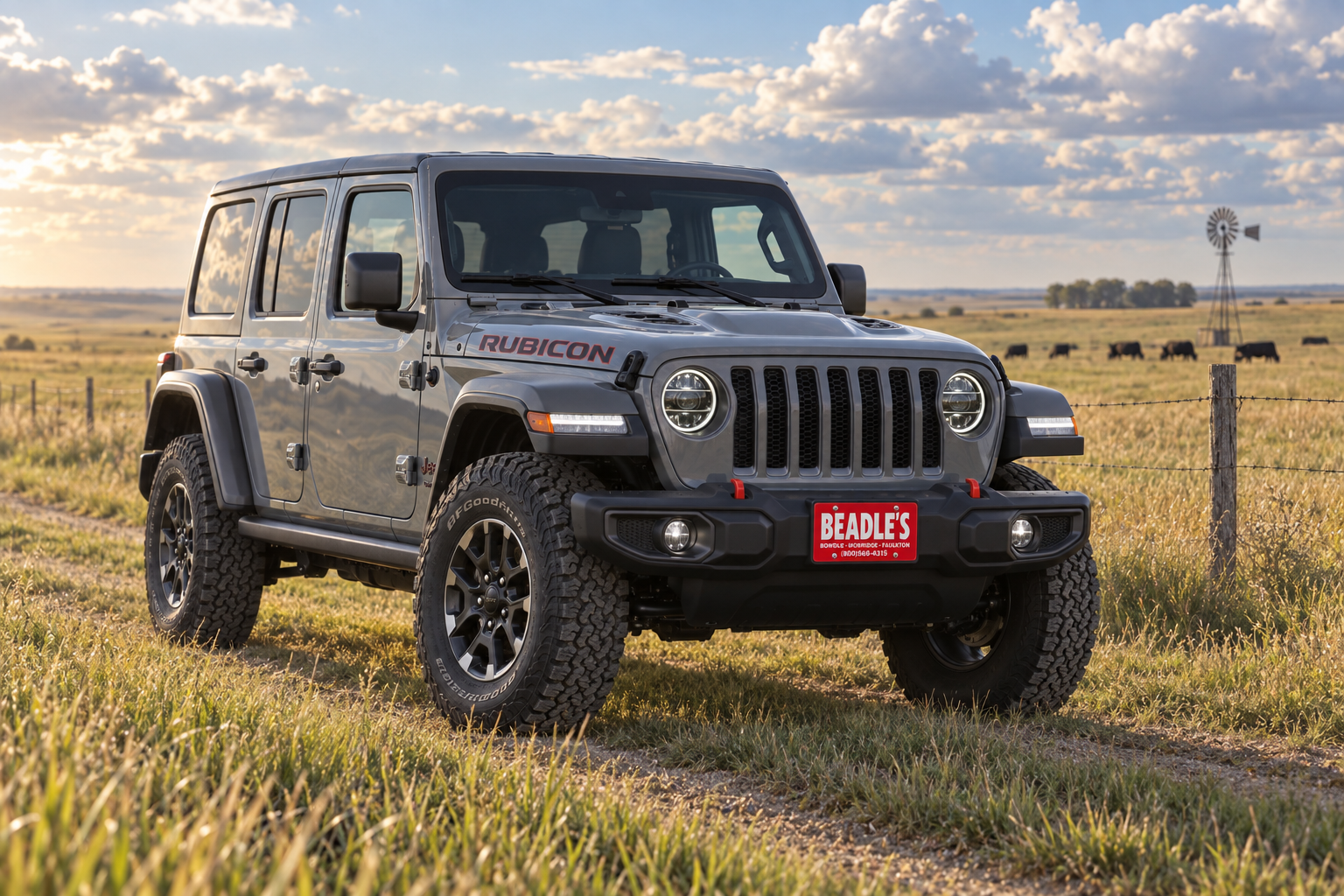
2026 Jeep Wrangler Rubicon on a pasture two-track in central South Dakota, at Beadle's Chrysler Center

Wrangler vs Bronco: An Honest Comparison From a Store That Sells Both

Somebody asks us this one just about every week, usually a guy who already has a Ram or an F-150 in the yard and wants the second vehicle to be the fun one. Wrangler or Bronco? He has driven both, or he is about to, and he wants somebody to tell him straight. So here is the straight version: I have owned three Wranglers, and Beadle Auto Group sells the Bronco at Beadle Ford just down the road from us in Bowdle. I do not need to talk you out of either one. I just want you in the right one for the roads you actually drive. Short answer: they are two different ways of solving the same problem. The Wrangler keeps solid axles, a proper low range, and a body where everything comes off. The Bronco went with an independent front suspension, a set of drive modes it calls G.O.A.T. modes, and a noticeably quieter highway ride. Which one is right for you comes down to how much of your year is spent on gravel and pasture versus the blacktop to Aberdeen, and how much you care about doing the thinking yourself instead of turning a dial. Search Wrangler Inventory Get Pre-Qualified On This Page Why we can give you a straight answer Solid axles or independent front: what it means on a section line Which one is quieter on the road to Aberdeen? Tops, doors, and the windshield Winter and hunting season in each one How to test drive both in one afternoon Why We Can Give You a Straight Answer Because we sell both. Beadle's Chrysler Center handles the Wrangler in Bowdle, and Beadle Ford handles the Bronco, and the same family owns both stores. Whichever one you drive home, it came from us. That takes most of the sales pressure out of this conversation. Most Wrangler-versus-Bronco articles are written by somebody who only sells one of them, or by a national outlet that tested both in the desert and never once backed a boat trailer down a muddy ramp at Lake Oahe. We live where you live. We know what a soft top sounds like at seventy on Highway 12 in January, and we know what happens to an independent front end after enough years of washboard. Both vehicles are good. They are just good at slightly different things. If you want the other side of this same conversation, our Ford store's take is written for the same sixty-mile radius. Read both. Then go drive both. This post is the Jeep side, and I will try to keep it honest. Solid Axles or Independent Front: What It Means on a Section Line This is the biggest mechanical difference between the two, and it is the one that matters most out here. Every Wrangler rides on a solid front axle and a solid rear axle. The Bronco uses an independent front suspension. Neither is wrong; they just trade different things. A solid axle is a beam with a differential in the middle, so when one front tire drops into a washout, the other one is pushed up to stay planted. That is why a Wrangler keeps all four tires on the ground crossing a rutted two-track through the CRP, and why the ground clearance under the differential does not change as the suspension moves. Solid axles are also simple. They take a bigger tire without drama, they shrug off the kind of abuse a pasture hands out, and there are fewer moving parts to wear out. The trade-off is that a solid front axle transmits more of the road into the cabin. On a washboard gravel road at speed, an independent front suspension like the Bronco's soaks up more of the chatter and steers a little more precisely, and on the highway it simply feels more like a modern SUV. Where the Wrangler pulls ahead is the hardware you can put behind those axles. Here is what each trim actually bolts on, because the Wrangler lineup is really a hardware ladder. Wrangler Trim 4x4 System and Low Range Traction Hardware and Tires Sport / Sport S Command-Trac part-time 4x4, 2.72:1 low range 245/75R17 all-season tires, full-size spare, fuel-tank skid plate Willys Command-Trac part-time 4x4, 2.72:1 low range Locking rear differential, 245/75R17 all-terrain tires Sahara Selec-Trac full-time 4x4 with 4-Auto, 2.72:1 low range 255/70R18 all-season tires, body-color hardtop standard Rubicon / Rubicon X Rock-Trac heavy-duty part-time 4x4, 4:1 low range Dana 44-class heavy-duty axles, electronic front and rear lockers, front sway-bar disconnect, 33-inch off-road tires (35s available) The Bronco has drive modes, and they are genuinely clever; turn the dial to the surface you are on and the truck sorts out the rest. The Wrangler asks you to pick the transfer-case position yourself, which some people love and some people find old-fashioned. If you want the full hardware walk trim by trim, our Wrangler trim guide goes through every axle and locker. Which One Is Quieter on the Road to Aberdeen? The Bronco. I am not going to pretend otherwise. Its independent front suspension and its body design give it a quieter, smoother highway ride than a Wrangler, and if most of your miles are blacktop, you will notice that on the very first drive. That said, the gap depends a lot on which Wrangler you are comparing. A Sport with the standard Sunrider soft top is the loudest thing in the lineup at highway speed; wind noise is just part of the deal, and I say that as somebody who has driven one to the Hills more times than I can count. A Sahara with its standard body-color Freedom hardtop, 18-inch all-season tires, and Selec-Trac left in 4-Auto is a different animal. It is still a Wrangler, but it is a Wrangler you can carry on a conversation in at seventy. Every trim gets the 12.3-inch Uconnect screen with wireless Apple CarPlay and Android Auto, and heated front seats plus a heated steering wheel come standard on Sahara, Rubicon, and 392, or in the Convenience Group on the Sport line, so the cold-morning comfort side is closer than people expect. The honest highway test If you drive to Aberdeen every day for work and the gravel is a weekend thing, the Bronco's ride will probably win you over, and I will say that out loud. If the gravel is every day and the highway is the exception, the Wrangler's ride is a small price for what it does the rest of the week. Be honest with yourself about which one you are. Tops, Doors, and the Windshield Both of these vehicles let you take the roof and the doors off, and that is a big part of why anybody in Walworth County buys either one. The difference is in how far each one goes and how quickly you can do it. On the Wrangler, the two front roof panels, the Freedom panels, lift off in about a minute with no tools, which is the everyday version of open-air driving: pull them at the elevator on a July afternoon, set them in the back, and you are done. The whole hardtop comes off if you want it to, and the Sunrider soft top folds back from the driver's seat. Every trim gets full metal doors on quick-release hinges, and the windshield folds forward, which is a Wrangler signature that dates back to the flat-fender days. If you want both tops, the Dual Top Group gives you the hardtop for November and the soft top for June. The Bronco's removable roof and doors are well thought out too, and Beadle Ford can show you how its system works. The practical difference I point out to people is storage: whichever one you buy, a full hardtop needs a spot in the shop or garage when it is off, and doors need somewhere they will not get scratched. Our hunting and lake rig post walks through the doors-off-in-September, doors-on-before-deer-opener calendar most of our customers end up following. Winter and Hunting Season in Each One Both will get you down an unplowed township road and both will get you into a cattail slough. The Wrangler gives you more control over how; the Bronco makes it easier. The Bronco's G.O.A.T. modes are the simple button for people who do not want to think about a transfer case: pick the mode, drive. The Wrangler's approach is more hands-on. On Sport, Sport S, and Willys you shift Command-Trac into 4-High when the gravel gets slick and into 4-Low when you are easing through a drift or crawling out of a wet ditch. The Sahara's Selec-Trac has a 4-Auto position you can leave engaged on pavement all winter, which is the closest the Wrangler gets to set-and-forget. The Rubicon's Rock-Trac with its 4:1 low range and front and rear lockers is more than most hunters will ever use, but when a section line has drifted shut and you need to walk it out in low range with both diffs locked, nothing else on either lot does it as well. For the hunting side specifically, every Wrangler carries a full-size spare on the tailgate, a skid plate under the fuel tank, and a 21.5-gallon fuel tank, which matters when the nearest pump is thirty miles from the slough. The Willys adds a locking rear differential and all-terrain tires, which is why I call it the hunter's value pick. A properly equipped 4-Door tows 3,500 pounds and a 2-Door tows 2,000, enough for a two-place enclosed or a modest fishing boat; anything heavier is a job for the Ram already in your yard. And the Wrangler still offers a 6-speed manual behind the 3.6L V6 on Sport through Rubicon, which is not a winter feature exactly, but it is a feature some of you have been waiting years to have again. For the full cold-weather rundown, including the honest soft-top-at-twenty-below answer, read our Wrangler winter guide. On winter comfort, it is close. A Bronco with the right equipment and a Wrangler Sahara or Rubicon both give you heated seats, a heated wheel, and a hardtop that seals. The difference again comes back to noise and ride, and the Bronco wins that part. How to Test Drive Both in One Afternoon Because both stores are in Bowdle, you can settle this argument in a single afternoon instead of arguing about it all winter. Here is how I would do it. Start with the one you think you want. Drive it first while you are fresh, so your first impression is of the vehicle you have been picturing. Drive the same loop in both. Ask for a route with a stretch of highway, a mile of washboard gravel, and a section-line approach if the weather allows. Do not compare a pavement drive in one against a gravel drive in the other. Pull the roof panels off in the lot. Time it. Notice where they go and whether you could do it alone with a bad shoulder. Load what you actually haul. Bring the dog crate, the decoy bag, or the kid's hockey bag and see how the back of each one takes it. Ask about your trailer by weight. Tell each store what the boat or enclosed trailer weighs loaded, not empty, and let them tell you whether that vehicle should pull it. Sleep on it. Nobody at either store needs you to decide the same day. The right one will still be the right one on Monday. Quick Overview: Is the Wrangler the Right One for You? Consideration Jeep Wrangler Ford Bronco Front suspension Solid axle, every trim Independent front suspension Low-range gearing 2.72:1 standard; 4:1 on Rubicon Drive-mode based (G.O.A.T. modes) Lockers and sway-bar disconnect Front and rear lockers plus disconnect on Rubicon; rear locker on Willys Ask Beadle Ford by trim Highway ride and noise Louder, especially with the soft top; Sahara hardtop is the quiet one Quieter, smoother Open-air Removable roof and doors, folding windshield, Freedom panels off in a minute Removable roof and doors Manual transmission 6-speed standard with the 3.6L V6 Ask Beadle Ford Towing (properly equipped) 4-Door 3,500 lbs; 2-Door 2,000 lbs Ask Beadle Ford Worth it if: gravel, pasture, and sloughs are most of your miles, you want a real low range and lockers you control, you like the idea of a manual, or you want the roof, doors, and windshield all out of the way. Skip it if: the daily commute is mostly highway and a quiet, smooth ride matters more to you than solid axles — in that case go drive the Bronco at Beadle Ford and we will not be offended. Key Takeaways Beadle Auto Group sells both, so this is a fit question, not a sales pitch. The Wrangler runs solid front and rear axles on every trim; the Bronco uses an independent front suspension that rides quieter on the highway. The Wrangler's hardware ladder is the difference: 2.72:1 low range on Sport through Sahara, 4:1 Rock-Trac with front and rear lockers on Rubicon, a locking rear diff and all-terrains on Willys. Both take the roof and doors off; the Wrangler adds a folding windshield and no-tools Freedom panels. The Wrangler still offers a 6-speed manual with the 3.6L V6, and a properly equipped 4-Door tows 3,500 pounds. Frequently Asked Questions Is the Wrangler or the Bronco better in a South Dakota winter? Both handle drifted gravel and unplowed township roads well. The Wrangler gives you a true low range on every trim and, on the Rubicon, front and rear lockers for the worst days; the Bronco's drive modes make slippery conditions simpler to manage. Either way, buy a hardtop and put winter tires on it. Which one is quieter on the highway? The Bronco has the quieter, smoother highway ride, mostly because of its independent front suspension. Among Wranglers, a Sahara with the body-color hardtop and all-season tires is the quietest choice; a Sport with the soft top is the loudest. Can I still get a Wrangler with a manual transmission? Yes. The 6-speed manual is the standard transmission with the 3.6L V6 on Sport, Sport S, Willys, Sahara, and Rubicon. The 2.0L turbo and the 392 V8 are automatic only. Where can I drive a Wrangler and a Bronco back to back? In Bowdle. Beadle's Chrysler Center has the Wrangler and Beadle Ford has the Bronco, both part of Beadle Auto Group. Call ahead to 605-460-6254 and we can line up both drives on the same afternoon. My Take on Wrangler vs Bronco I sell Wranglers, so take this for what it is worth, but I have also sent people down the road to Beadle Ford when it was the right call, and I will keep doing it. The Bronco is a genuinely good vehicle. If the person in front of me commutes to Aberdeen five days a week and wants the gravel and the open-air on weekends, the Bronco's quieter ride is a real advantage and I say so. But if the gravel is every day, if the vehicle is going to spend October in the CRP and January breaking a drift on a section line, if you want a low range and lockers you control instead of a dial, or if you have been waiting for a manual, the Wrangler is the one I would put in your yard. The solid axles are not a compromise out here. They are the point. And there is a reason the used Wranglers on every lot in the state hold their value the way they do. If you want the whole picture on trims, engines, towing, and winter, our 2026 Jeep Wrangler guide covers all of it. And if you are anywhere near Bowdle, come drive one. Then drive the other. We are happy either way. Search Wrangler Inventory Get Pre-Qualified Contact Beadle's Chrysler Center About the Author Lexy Tabbert — Beadle's Chrysler Center, Bowdle, SD Lexy Tabbert is the Director of Sales and Marketing at Beadle's Chrysler Center in Bowdle, South Dakota. She covers Ram, Jeep, Dodge, and Chrysler vehicles — helping families, ranchers, and ag operators across the region find the right truck and configuration for their needs. Learn more about Lexy.
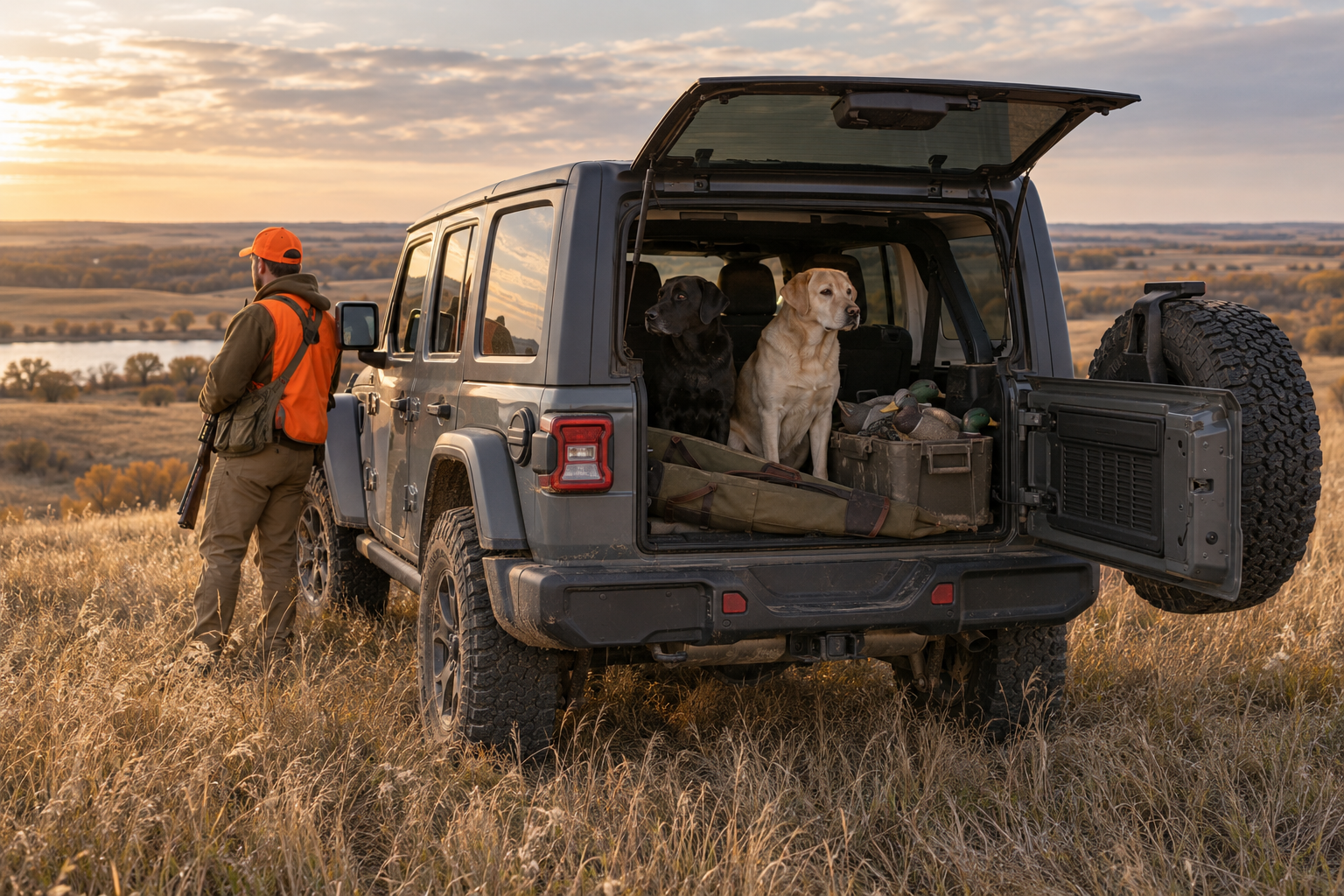
2026 Jeep Wrangler with the tailgate open, two Labs and shotgun cases in the back at the edge of a CRP field, at Beadle's Chrysler Center

The Wrangler as a Pheasant-Hunting and Lake Oahe Rig

Around here, a Wrangler is rarely bought as a daily driver first. It is bought because there is a story behind it: two Labs, a couple of shotgun cases, a CRP field at the end of a section line on the third Saturday of October, and a boat ramp at Mobridge the rest of the year. The pickup already handles the work. The Jeep is the one that goes where the truck is too long and the side-by-side is not street legal, and it is supposed to be fun doing it. So the honest question is whether the 2026 Wrangler actually earns that job. Short answer: yes, and better than most people expect, as long as you pick the right trim and tires and go in with clear eyes about cargo and wet dogs. This post covers the hunting side, the Lake Oahe side, which hardware matters for CRP and cattail sloughs, and how the doors and roof really come off and go back on between the September dove hunt and deer opener — from people who sell and service these in Bowdle. Search Wrangler Inventory Get Pre-Qualified On This Page Is the Wrangler a good pheasant-hunting rig? Which trim and tires for CRP, sloughs, and mud? How do the doors and roof come off, and where do you put them? Will it handle a Lake Oahe boat ramp and shoreline two-track? How to set up a Wrangler for pheasant opener Is the Wrangler a Good Pheasant-Hunting Rig? Yes. Every 2026 Wrangler has real part-time or full-time 4x4 with a true low range, roughly 10 inches of ground clearance or more, a skid plate under the fuel tank, and a full-size spare on the tailgate — which is exactly the list you want when the "road" into a walk-in area is a pair of ruts through waist-high grass. What makes it a good hunting rig is not any one feature; it is that the whole vehicle is short, tall, and built to be driven somewhere the county does not maintain. A 4-Door turns around in a field approach where a crew-cab pickup needs a three-point plan. It crosses a washed-out section-line ditch without dragging its belly. And the tailgate-mounted spare means the cargo floor stays flat for a kennel or a dog mat instead of hiding a jack under everything you packed. Now the honest part, because the neighbor who has owned three of them would tell you. Cargo behind the second row of a 4-Door is real but it is not a pickup bed: two Labs and a couple of gun cases and a cooler fit; two big kennels, four hunters, and a week's worth of gear do not. A wet dog in a closed cabin smells like a wet dog in a closed cabin. And after a muddy morning in a slough bottom, the floor will need a hose and the seats will need a towel. None of that changes the answer. It just tells you to plan the cargo area before opener instead of the morning of. Late-season hunting adds one more question: the top. A soft top is fine in October and gets loud and drafty by December. If your hunting runs into the cold months, our Wrangler winter guide covers the hardtop, heat, and traction question in full. Which Trim and Tires for CRP, Cattail Sloughs, and Mud? For most hunters around Bowdle, the Willys is the sweet spot: it adds all-terrain tires and a locking rear differential to the Sport's Command-Trac 4x4, which is the hardware that matters most on wet CRP edges and slough two-tracks. The Rubicon is the pick if you regularly push into the soft bottoms, because its 33-inch tires, front and rear lockers, sway-bar disconnect, and 4:1 low range are built for exactly that. Trim 4x4 and Traction Tires Where It Fits for Hunting Sport / Sport S Command-Trac part-time, 2.72:1 low range 245/75R17 all-season Gravel, field approaches, dry CRP; plan on a tire upgrade for mud Willys Command-Trac, 2.72:1, locking rear differential 245/75R17 all-terrain The hunting value pick: slough edges, wet two-tracks, cattail margins Sahara Selec-Trac full-time, 2.72:1, can stay in 4-Auto 255/70R18 all-season The comfortable daily that still hunts; swap tires if you chase birds in the wet Rubicon / Rubicon X Rock-Trac, 4:1 low range, front and rear lockers, sway-bar disconnect LT285/70R17 (33-inch) off-road; 35s available Slough bottoms, river-bottom timber, anywhere you would otherwise turn around Ground clearance is roughly 10 inches on Sport and Sahara, about 10.8 inches on a Rubicon with the 33s, and about 12.9 inches with the 35-inch tire package. On a CRP two-track that last inch or two is the difference between the skid plate riding over the center hump and the center hump riding on the skid plate. Tires matter at least as much: the Sport's all-seasons are fine on gravel and dry stubble and will pack full of gumbo the first time you get greedy at a slough. The trim guide explains each trim's hardware as hardware if you want the full breakdown. Sloughs are where you learn to stop A cattail slough bottom in a wet fall is gumbo over water, and no locker fixes that once you are in it. Lockers and low range let you get out of the soft edge you eased into; they do not let you drive across the middle. Park on the firm ground, walk the last fifty yards, and keep a tow strap and a buddy with a truck in the plan. The Wrangler will get you closer than anything else you own — it just cannot repeal physics. How Do the Doors and Roof Come Off, and Where Do You Put Them? The two front roof panels — the Freedom panels on a hardtop — lift off in about a minute with no tools, the soft top folds back over the front seats, and the full metal doors come off their quick-release hinges in a few minutes each with a helper. The windshield folds too. The whole point is that a September dove hunt with the doors off and a November deer opener with everything buttoned up are the same Jeep. On a hardtop, the two front panels are the ones you will actually take off on a regular basis: pop the latches, lift them out, and you have open sky over the front seats. The full three-piece hardtop can come off entirely, but that is a two-person job in the shop, not something you do in a field approach. On the standard Sunrider soft top (Sport, Sport S, Willys, and Rubicon), the front section flips back like a big sunroof in seconds, and the whole top folds down when you want it. The Dual Top Group gets you both, which is the setup a lot of hunters around here end up with: soft top for September through the early season, hardtop bolted on for the cold months. The doors are simpler than people expect. Every trim has full metal doors on quick-release hinges: unplug the wiring connector, undo the check strap, lift straight up, and the door comes off. Having a second set of hands the first few times saves your paint and your back. Reinstalling is the same in reverse. Storage is the part nobody thinks about until the doors are leaning against the lawn mower. Doors go on an old blanket along the shop wall, or on a simple hanging rack, hinge-side up so nothing bends. Roof panels stack flat somewhere dry; ask us about a padded storage bag for them. And put it all back on before the first real cold snap — a doors-off October morning is glorious and a doors-off November morning is a bad decision you only make once. Will It Handle a Lake Oahe Boat Ramp and Shoreline Two-Track? Yes, and the boat ramp is where a Wrangler makes its case better than almost anywhere. Every trim has a real low range for pulling a boat out on a slimy ramp, the short wheelbase makes backing a single-axle trailer straightforward, and the ground clearance and 4x4 handle the low-water shoreline two-tracks that show up when Oahe drops in late summer. At the Mobridge-area ramps, the problem is never the pavement; it is the green slime below the waterline and the wet gravel above it when the lake is down. Shift into 4-Low before you back down, and the Jeep will walk a loaded boat trailer up the ramp at idle without spinning a tire. A Sahara's Selec-Trac adds a nice wrinkle for lake days: you can leave it in 4-Auto on the wet pavement around the ramp and parking lot without worrying about binding, then drop to low range for the pull. Shoreline two-tracks are a different kind of driving. The ruts are usually dried mud that turns slick after a rain, there is always a washout you did not see last year, and the approach to a good bank-fishing spot often means a short, steep pitch over rocks. A Willys on its all-terrains handles most of it; a Rubicon on 33s handles all of it with the sway bar disconnected so the front axle can flex over the rough spots. Either way, the full-size spare on the tailgate means a sidewall cut from a sharp rock is an inconvenience instead of a phone call. The one thing to be honest about is the trailer behind you. A properly equipped 4-Door is rated to tow 3,500 pounds and a 2-Door 2,000 pounds, which covers most 16-to-18-foot aluminum fishing boats on a single-axle trailer and does not cover a big walleye boat on a tandem. Our towing guide walks through the ratings, the tow package, and how to weigh your rig before you count on the Jeep for lake duty. How to Set Up a Wrangler for Pheasant Opener A little prep the week before opener keeps the Jeep from being the thing you are thinking about when the roosters get up. This is the list I would work through. Put the doors and roof back on if they came off for dove season, and check that the panels are latched tight. October mornings in a CRP field are cold enough without a draft. Set up the cargo area: a rubber mat or a kennel behind the second row, gun cases flat on top or along the side, cooler and vest bag where a wet dog cannot sit on them. Check the tires and the spare: proper pressure on all five, including the full-size spare on the tailgate, and look for any sidewall damage from the summer's shoreline trips. Pack the recovery kit: a tow strap, a shovel, and a pair of gloves live in the Jeep from opener through the end of deer season. The tow hooks are there for a reason. Use 4-High on the gravel in, 4-Low at the slough: part-time 4x4 on Sport, Willys, and Rubicon is for loose surfaces, not dry pavement. Shift to low range before the two-track gets soft, not after. Hose it out the same day: mud, feathers, and dog hair come out easily when they are fresh and stubbornly when they are a week old. Willys or Rubicon for a Hunting and Lake Rig? Consideration Willys Rubicon Lockers Rear Front and rear, plus sway-bar disconnect Low range 2.72:1 Command-Trac 4:1 Rock-Trac Tires 245/75R17 all-terrain 33-inch off-road (35s available) Ground clearance (approx.) About 10″ About 10.8″ (about 12.9″ on 35s) Boat ramp hitch Add the tow group Class II hitch standard Worth it (Rubicon) if: you hunt slough bottoms and river-bottom timber, you drive the shoreline two-tracks at low water, or you want the front locker and the 33s from day one instead of adding tires later. Skip it (get the Willys) if: most of your hunting is walk-in CRP off a gravel approach and your lake days are ramp-to-ramp — the Willys' all-terrains and rear locker cover that, and the difference stays in your pocket. Key Takeaways Every 2026 Wrangler has real 4x4 with a low range, about 10 inches or more of clearance, a fuel-tank skid plate, and a full-size spare on the tailgate — the right list for CRP and slough two-tracks. The Willys (all-terrains plus a rear locker) is the hunting value pick; the Rubicon (33s, front and rear lockers, sway-bar disconnect, 4:1 low range) is for the soft bottoms. Freedom panels lift off in about a minute with no tools; doors come off their quick-release hinges in a few minutes each. Store doors on a blanket or a rack and put everything back on before the cold. At a Lake Oahe ramp, shift to 4-Low before you back down; a 4-Door is rated for 3,500 pounds with the tow group. Lockers get you out of a slough edge, not across the middle. Park on firm ground and walk the last fifty yards. Frequently Asked Questions Will two Labs and my gear fit in the back of a 4-Door Wrangler? Two dogs behind the second row with gun cases and a cooler is a normal load for a 4-Door, and the flat floor with the spare on the tailgate helps. Two large kennels plus four hunters and a week of gear is a pickup job. Bring your kennel to the lot and try it; that answers the question faster than any spec. Do I need a Rubicon to hunt pheasants in South Dakota? No. A Willys with its all-terrain tires and locking rear differential handles walk-in CRP, gravel approaches, and most slough edges. The Rubicon's front locker, 33-inch tires, sway-bar disconnect, and 4:1 low range earn their keep in soft slough bottoms and river-bottom timber. How long does it take to get the doors off a Wrangler? A few minutes per door once you have done it a couple of times: unplug the wiring connector, undo the check strap, and lift the door off its quick-release hinges. The front Freedom panels on a hardtop come off in about a minute with no tools. A helper makes both jobs easier on your paint. Is a soft top okay for late-season hunting? It works, but it is louder and draftier once the real cold sets in, and it does not hold heat like the hardtop. If your hunting runs through December, a hardtop or the Dual Top Group is the better setup, along with heated seats and a heated wheel where the trim offers them. My Take on the Wrangler as a Hunting and Lake Rig This is the Wrangler at its best. It is not the comfortable choice or the sensible choice, and nobody around here pretends it is; it is the vehicle that gets you to the far corner of the CRP before daylight and up the ramp at Mobridge with the boat behind it, and then does it again with the doors off in July. The hardware is real, and on our roads it earns its keep. If I am helping a hunter who mostly walks public ground off a gravel approach, I point them at a 4-Door Willys and tell them to spend the savings on a good kennel and a set of winter tires. If they hunt the sloughs hard or run the shoreline two-tracks all summer, the Rubicon is worth it and I say so. Either way, I tell them to try the doors and the roof panels on the lot before they buy, because the first time the front panels come off in about a minute is usually the moment the decision gets made. The full rundown on trims, engines, tops, towing, and winter is in our 2026 Jeep Wrangler guide. And if you are anywhere near Bowdle before opener, stop by Beadle's Chrysler Center, bring the dogs, and we will see how they fit. Search Wrangler Inventory Get Pre-Qualified Contact Beadle's Chrysler Center About the Author Lexy Tabbert — Beadle's Chrysler Center, Bowdle, SD Lexy Tabbert is the Director of Sales and Marketing at Beadle's Chrysler Center in Bowdle, South Dakota. She covers Ram, Jeep, Dodge, and Chrysler vehicles — helping families, ranchers, and ag operators across the region find the right truck and configuration for their needs. Learn more about Lexy.
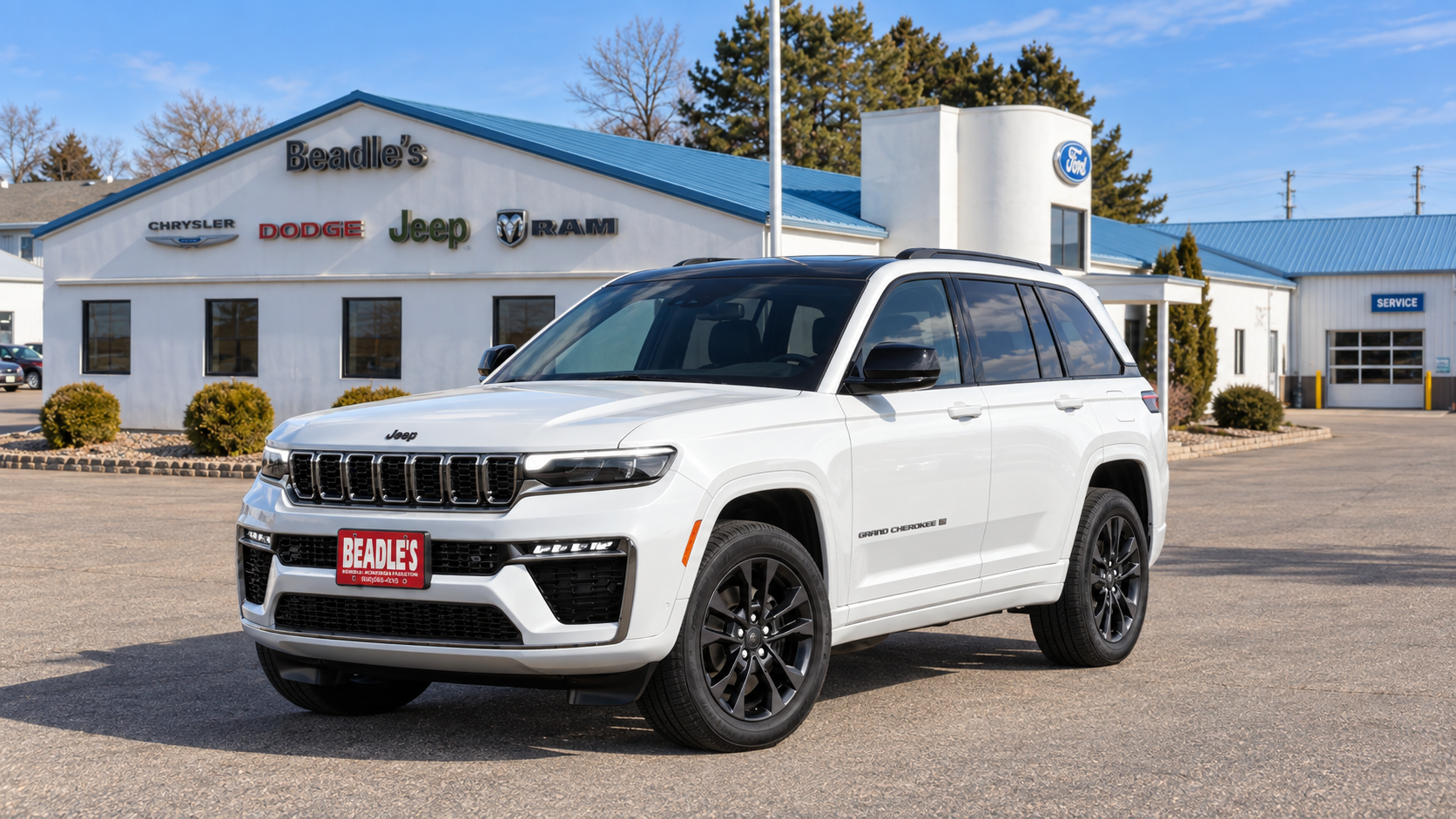
2026 Jeep Grand Cherokee parked outside the dealership building, at Beadle's Chrysler Center

Is the Grand Cherokee Reliable? Value, Warranty & Local Service

Reliability is the question that really decides an SUV purchase out here. A vehicle can look great on the lot, but if it strands you on a gravel road or lives at a service department two hours away, none of the rest matters. So when families ask me whether the Jeep Grand Cherokee holds up, I give them the honest, dealer's-eye answer — the good and the things to think about. The short version: the Grand Cherokee is built on proven, well-understood mechanical pieces, it holds its value well for a midsize SUV, and — the part that matters most around Bowdle — you can get it serviced right here instead of driving to a metro dealer for every oil change or warranty visit. Here is how ownership actually shakes out. Search Grand Cherokee Inventory Get Pre-Qualified On This Page Are the engines and transmission dependable? Is the air suspension a reliability risk? What affects long-term value? Warranty and local service in Bowdle How to keep yours dependable Are the Engines and Transmission Dependable? Yes — and this is where the Grand Cherokee earns a lot of quiet confidence. It runs on two engines that are known quantities, paired with a transmission that has been in service for years across a huge range of vehicles. The standard 3.6L Pentastar V6 makes 293 horsepower and 260 lb-ft, and it has been the workhorse Jeep engine for a long time. It is smooth, straightforward, and there is nothing exotic about keeping it running. The available 2.0L Hurricane turbo four steps up to 324 horsepower and 332 lb-ft, giving you stronger low-end pull. Both engines send power through the same 8-speed automatic, a well-proven gearbox that shifts cleanly and has a long track record behind it. There is no V8 and no plug-in hybrid in this lineup — just two engines that our technicians know inside and out. Proven beats flashy Neither engine is a science experiment. The Pentastar V6 and the 8-speed automatic are the kind of hardware that keeps running with regular maintenance, and parts and know-how are easy to come by. That is exactly what you want in a vehicle you plan to keep for years. Is the Air Suspension a Reliability Risk? Let me be balanced here: the available Quadra-Lift air suspension is a genuinely nice comfort and capability feature, and it is not a reason to avoid the Grand Cherokee. But it is also a more complex system than a standard steel-spring setup, and some buyers keep things simple by skipping it. The upside is real: air suspension lets the vehicle raise up to 10.9 inches of ground clearance for deep snow or rough ground, then lower for an easier step-in and smooth highway ride. If you value that flexibility, it is worth having. The honest trade-off is that any air system has more moving parts than a conventional suspension, so it is one more thing to maintain over a long ownership. If you plan to keep the vehicle a decade and want the fewest possible variables, the standard suspension on a Laredo or Limited is a perfectly capable, simpler choice. Neither answer is wrong — it just depends on how you weigh comfort and capability against long-term simplicity. What Affects Long-Term Value? The Grand Cherokee is a strong name in a popular segment, which helps it hold value better than a lot of family SUVs. But the choices you make at purchase, and how you care for it, move the needle more than most people realize. Here is what actually matters. Factor Why It Matters What Helps Maintenance history Buyers pay for proof it was cared for Keep records of every service Mileage Big driver of resale on any SUV Reasonable annual miles hold value Trim and equipment 4x4 and popular features resell better Choose a well-optioned, in-demand trim Condition Interior wear and body care show Protect the interior and wash off road salt Consistent service On-time upkeep prevents costly damage Stay on the maintenance schedule None of this is complicated — it is mostly about buying a sensible configuration and keeping up with the basics. If you are still deciding between engines or trims, our V6-versus-turbo breakdown and our trim comparison can help you land on a version that both fits your life and resells well. Warranty and Local Service in Bowdle Every new Grand Cherokee comes backed by the factory warranty, which covers you against defects during the covered period. But here is the part I care about most, and the part a lot of buyers overlook: where you actually get the work done. A warranty is only convenient if there is a dealer nearby to honor it. Buy from a metro store and every oil change, recall, and warranty repair can mean a long drive across the state. Buy and service here at Beadle's Chrysler Center in Bowdle, and routine maintenance and covered warranty work happen right in your own community — no burning half a day on the road. Our service department has the Jeep-trained technicians and the equipment to handle it, from a quick oil change to bigger warranty jobs. Service you can actually reach Our service department is right here in Bowdle at 605-460-6277. That local connection is a real part of what a Grand Cherokee is worth over years of ownership — the warranty means more when the shop that stands behind it is down the road, not across the state. How to Keep Your Grand Cherokee Dependable Reliability is not just what you buy — it is how you keep it. A few habits go a long way toward a Grand Cherokee that runs strong and holds its value. Stay on the oil change schedule: both engines reward regular, on-time oil service more than almost anything else. Keep every record: save your service receipts so you can prove the maintenance history at resale. Wash off the road salt: rinse the underbody through winter to protect the body and brake lines from corrosion. Address recalls and warranty items early: handle covered work while it is covered, right here in town. Service it locally: a nearby dealer that knows the vehicle keeps upkeep easy so you actually stay on schedule. Is the Air Suspension Worth It Long-Term? Consideration Standard Suspension Quadra-Lift Air Ride and capability Composed and dependable More comfort and adjustable clearance Ground clearance 8.4″ Up to 10.9″ Long-term simplicity Fewer parts to maintain More complex system to care for Worth it if: you want the extra ground clearance and ride comfort, and you keep up with maintenance. Skip it if: you plan to own the vehicle a long time and prefer the fewest moving parts — a standard Laredo or Limited stays plenty capable. Key Takeaways The Grand Cherokee runs on a proven Pentastar V6 or Hurricane turbo and a well-established 8-speed automatic — known, dependable hardware. Air suspension adds comfort and adjustable clearance; skipping it keeps things simpler for very long ownership. Both are valid choices. Long-term value comes down to maintenance history, mileage, trim choice, and condition — mostly things you control. Every new one is backed by the factory warranty, and you can service it locally in Bowdle instead of driving to a metro dealer. Frequently Asked Questions Is the Jeep Grand Cherokee a reliable SUV? It is built on well-proven pieces — the long-running 3.6L Pentastar V6 or the 2.0L Hurricane turbo, paired with a well-established 8-speed automatic. With regular maintenance and consistent service, it holds up well for families who plan to keep it for years. Should I avoid the air suspension for reliability? Not necessarily. Quadra-Lift air suspension is a nice comfort and capability feature that adds adjustable ground clearance. It is a more complex system than standard springs, so some long-term owners keep it simple and choose a standard suspension. Both are reasonable — it depends on how you weigh comfort against simplicity. Can I get my Grand Cherokee serviced near Bowdle? Yes. Beadle's Chrysler Center in Bowdle has a full service department with Jeep-trained technicians, so routine maintenance and covered warranty work can be done right here instead of a long drive to a metro dealer. You can reach the service department at 605-460-6277. Does the Grand Cherokee hold its value? It is a strong name in a popular segment, which helps resale for a midsize SUV. What you control matters most: a documented maintenance history, reasonable mileage, a well-optioned 4x4 trim, and good condition all help it hold value over time. My Take on Grand Cherokee Ownership When someone on the lot asks me the reliability question straight, I give it to them straight back. The Grand Cherokee is not built on anything exotic — the Pentastar V6, the Hurricane turbo, and the 8-speed automatic are all proven, and our technicians know them well. That is exactly the kind of vehicle I feel good putting a family into for the long haul. If you want the extra comfort and clearance, the air suspension is a fine choice as long as you keep up with maintenance. If you would rather keep it simple for a decade of ownership, a standard Laredo or Limited will not let you down. Either way, the thing I remind everyone is that value comes from care — stay on the schedule, keep your records, and the Grand Cherokee gives it back. And the piece I am proudest of: you can own one out here without owning a long commute to the service department. For the full rundown on trims, engines, and towing, our 2026 Grand Cherokee guide covers it. If you are anywhere near Bowdle, stop by Beadle's Chrysler Center — we are happy to talk honestly about what ownership really looks like, and we will be here to service it long after the sale. Search Grand Cherokee Inventory Get Pre-Qualified Contact Beadle's Chrysler Center About the Author Lexy Tabbert — Beadle's Chrysler Center, Bowdle, SD Lexy Tabbert is the Director of Sales and Marketing at Beadle's Chrysler Center in Bowdle, South Dakota. She covers Ram, Jeep, Dodge, and Chrysler vehicles — helping families, ranchers, and ag operators across the region find the right truck and configuration for their needs. Learn more about Lexy.
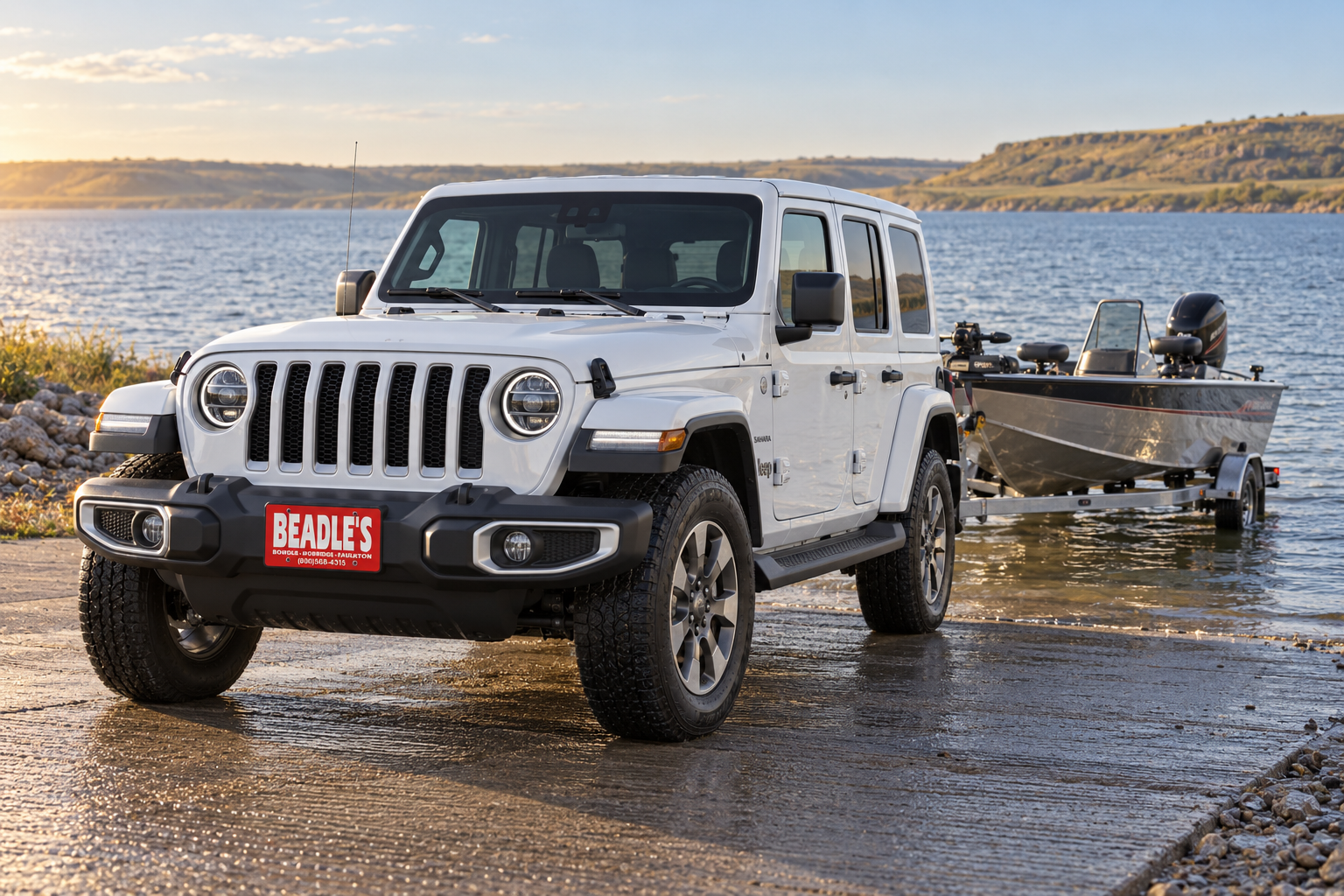
2026 Jeep Wrangler 4-Door backing a fishing boat down a Lake Oahe boat ramp, at Beadle's Chrysler Center

What Can a Wrangler Tow? Boats, Enclosed Trailers, and the Tow Package

Nobody around Bowdle buys a Wrangler to be their tow rig. You already own the truck for that. But the towing question still comes up in almost every conversation, because the honest plan is that the Jeep will pull the fishing boat to Oahe on a Saturday while the Ram stays hooked to the stock trailer, or that the 2-place enclosed will follow it to the river bottoms in January. So the question is not "can it tow" but "can it tow my stuff" — and that deserves a real number, not a shrug. Short answer: a properly equipped 4-Door Wrangler is rated to tow 3,500 pounds and a 2-Door is rated for 2,000. That covers most 16-to-18-foot aluminum fishing boats and most 2-place enclosed trailers, once you actually weigh them. Anything bigger is a Ram job, and I will tell you where that line is. Below is what the ratings mean, what the tow package includes, how to figure out what your own rig weighs, and how to launch at a slimy ramp without embarrassing yourself in front of the whole parking lot. Search Wrangler Inventory Get Pre-Qualified On This Page How much can a Wrangler tow? Can it pull my 16-foot Lund or a 2-place enclosed trailer? Do I need the tow package, and what does it include? When is it a Ram job? How to tow with a Wrangler without drama How Much Can a Wrangler Tow? A 2026 Wrangler 4-Door is rated to tow up to 3,500 pounds, and a 2-Door is rated for up to 2,000 pounds, when it is properly equipped with the Trailer Tow and Aux Switch Group. Those numbers hold across the trims; the body style is what sets the rating, not whether you bought a Sport or a Rubicon. Body Max Towing (properly equipped) What That Usually Covers Around Here Wrangler 4-Door 3,500 lb 16-to-18-foot aluminum fishing boat on a single-axle trailer, a 2-place enclosed snowmobile trailer, a small utility trailer with an ATV Wrangler 2-Door 2,000 lb A small aluminum boat, a single-place trailer, a light utility trailer — weigh it first Two things to keep straight. First, "properly equipped" is doing real work in that sentence: the rating assumes the factory tow group with its hitch and wiring, which we cover below. Second, the rating is the trailer's total weight rolling down the road — boat, motor, trailer, fuel, batteries, and every tackle box and cooler you throw in — not the empty number on the boat dealer's brochure. The body-style gap is the biggest reason a 4-Door is the right Wrangler for almost everyone who tows anything. Every new Wrangler on our lot as I write this is a 4-Door, and the 2-Door is something we order to spec for people who specifically want it. If you are still deciding between the two, our 2-Door vs 4-Door guide walks through the cargo and towing trade-offs in detail. Can It Pull My 16-Foot Lund or a 2-Place Enclosed Trailer? Usually, yes, on a 4-Door — but the only honest answer is to add up your specific rig. A 16-foot aluminum fishing boat with an outboard on a single-axle trailer, and a 2-place enclosed trailer with two sleds inside, both typically land under the 4-Door's 3,500-pound rating. "Typically" is the important word, because a big four-stroke, a full livewell, a kicker motor, and a weekend's worth of gear add up faster than you think. Here is how I tell people to do the math. Take the boat's dry weight from the builder, add the motor, add the trailer, add fuel and batteries, then add what you actually carry: anchors, a cooler full of ice, rods, tackle, life jackets, the dog's water jug. For an enclosed trailer, it is the trailer's empty weight plus both sleds plus fuel plus the spare belts, tools, and gear that ride along. If that total is comfortably under 3,500 pounds, a 4-Door will handle it. If the total is close, treat it as over, because the number you are guessing at is always the one that bites you. A 2-Door at 2,000 pounds is a different conversation. A small aluminum boat on a light trailer or a single-place sled trailer is in range; a loaded 16-footer with a four-stroke is not something I would put behind a 2-Door and hope. If a 2-Door is the Jeep you want and the boat is part of the plan, weigh the rig before you order, not after. Weigh the whole rig once Loaded the way you actually tow it, pull the trailer across a scale — the elevator or the co-op will usually let you, and it takes five minutes. Do it once and you will know your real number for as long as you own the boat. It is the difference between guessing and knowing, and it is the first question we will ask you on the lot. Do I Need the Tow Package, and What Does It Include? Yes, if you plan to tow anything on a regular basis. The Trailer Tow and Aux Switch Group is what makes the Wrangler "properly equipped" for its rating, and it includes a Class II receiver hitch, a 7-pin and 4-pin trailer wiring harness, and a bank of auxiliary switches. On the Rubicon, the Class II hitch is already standard. The hitch is the obvious part. The wiring is the part people forget until they are standing at the ramp at dusk with no trailer lights. Having both the 7-pin and 4-pin connectors from the factory means a fishing boat with a flat-four plug and an enclosed trailer with a round seven-way both hook up without adapters or a rewiring job in the driveway. The aux switches are a bonus that Jeep owners end up loving: a factory-wired set of switches for the things people add to a hunting or lake rig, like a light bar or a winch, without splicing into anything. Can you add a hitch later? Sure. But a factory group that arrives wired, integrated, and covered under Jeep's factory warranty is usually the cleaner path, and it is one of the boxes I tell people to check when they order a 4-Door with a boat in the plan. If you are cross-shopping engines while you are at it, the V6 vs turbo guide explains why the 2.0L turbo's torque makes a loaded trailer feel easier from a stop, though either engine handles the rating. When Is It a Ram Job? Anything over 3,500 pounds, anything with a heavy tongue, and anything tall and wide enough to act like a sail in a west wind is a Ram job. That means the stock trailer, the camper, the tandem-axle enclosed car hauler, the skid steer, and the big walleye boat on a tandem trailer all stay behind the pickup. I say that as someone who sells both. A Wrangler is a short-wheelbase 4x4 with a boxy body, and that shape is wonderful for a slough two-track and merely adequate for a long, heavy trailer on a windy highway. A 20-foot enclosed trailer at the limit will push a Wrangler around in a crosswind between Mobridge and Selby in a way it simply will not push a Ram 1500 or 2500. The Jeep can tow within its rating all day; it just does not make a heavy trailer disappear the way a full-size truck does. The nice thing about buying here is that the Ram inventory is on the same lot. Most of our Wrangler buyers already have a Ram or another half-ton in the yard, and for them the Jeep is the second vehicle that handles the light stuff and the fun stuff. If you are the rare buyer trying to make one vehicle do both, come talk to us honestly about what you tow, and we will tell you whether that is a Wrangler with the tow group or a Ram 1500 — we are happy either way. How to Tow With a Wrangler Without Drama A Wrangler tows fine within its rating if you respect the short wheelbase and set it up right. Here is the routine I would run before the first trip to the ramp. Weigh the loaded rig and confirm it sits under 3,500 pounds on a 4-Door or 2,000 on a 2-Door. Write the number on a piece of tape inside the glove box. Check the hitch, ball, and plug: the Class II receiver, the right ball size for the coupler, and the 4-pin or 7-pin connector clicked in. Test the lights before you leave the yard. Balance the load: keep enough weight forward on the trailer that it tracks straight instead of wagging, and follow the trailer maker's guidance on tongue weight. A tail-heavy boat trailer is the most common cause of a scary highway moment. Use low range at the ramp: shift into 4-Low before you back down a slimy or steep ramp. Every trim has a real low range — 2.72:1 on Sport, Willys, and Sahara and 4:1 on the Rubicon — and it gives you slow, controlled power pulling the boat out. Slow down and leave room: the Wrangler's short wheelbase and tall body feel a crosswind more than your pickup does. Drop your speed, add following distance, and let the truckers by. Check the trailer tires and bearings before the first trip of the season. The Jeep is rarely the thing that ends a lake day early; the trailer is. Is the Trailer Tow and Aux Switch Group Worth It? Consideration Without the Group With the Group Receiver hitch Standard on Rubicon only Class II receiver on any trim Trailer wiring Aftermarket install Factory 7-pin and 4-pin harness Accessory power Splice it yourself Factory-wired auxiliary switches Rated towing Not properly equipped 3,500 lb (4-Door) / 2,000 lb (2-Door) Worth it if: a boat, a sled trailer, or a small utility trailer is part of the plan, or you expect to add lights or a winch to a hunting rig later. Skip it if: the Ram will always do the towing and the Jeep is strictly the top-off, doors-off second vehicle — though on a Rubicon you get the hitch either way. Key Takeaways A properly equipped Wrangler 4-Door is rated to tow 3,500 pounds; a 2-Door is rated for 2,000 pounds. The body style sets the number, not the trim. Most 16-to-18-foot aluminum fishing boats and 2-place enclosed trailers fit under the 4-Door rating — but weigh your loaded rig once so you know instead of guess. The Trailer Tow and Aux Switch Group adds the Class II hitch, 7-pin and 4-pin wiring, and auxiliary switches; the Rubicon includes the hitch as standard. Every trim has a real low range for pulling a boat up a slimy ramp. Stock trailers, campers, tandem-axle enclosed trailers, and anything heavy in a crosswind are a Ram job — and the Rams are on the same lot. Frequently Asked Questions Can a 2-Door Wrangler tow a fishing boat? A properly equipped 2-Door is rated for 2,000 pounds, which covers a small aluminum boat on a light trailer. A loaded 16-footer with a four-stroke outboard is likely over that, so weigh the rig. If a boat is part of the plan, the 4-Door's 3,500-pound rating is the safer fit. Does the Wrangler Rubicon come with a hitch? Yes, the Class II receiver hitch is standard on the Rubicon. The Trailer Tow and Aux Switch Group is still how you get the factory 7-pin and 4-pin wiring harness and the auxiliary switches, so ask us about it if you plan to tow regularly. Which Wrangler engine is better for towing? Both the 3.6L V6 and the 2.0L turbo handle the Wrangler's rating. The turbo's 295 lb-ft of torque makes a loaded trailer feel easier pulling away from a stop or up a ramp, while the V6 is the one you can pair with the manual. The rating itself does not change with the engine. Can a Wrangler tow a camper? Only a very small, light one that stays under 3,500 pounds loaded, and even then the Wrangler's short wheelbase and tall body feel a crosswind more than a pickup does. For a typical travel trailer, that is a Ram job. We have Ram 1500 and heavy-duty trucks on the same lot in Bowdle if that is the real need. My Take on Towing With a Wrangler The Wrangler is an honest light-duty tow vehicle, and I would rather sell it to you that way than let you find out otherwise on Highway 12 with a trailer swaying behind you. For the fishing boat, the sled trailer, and the utility trailer with the four-wheeler on it, a 4-Door with the tow group is a good, capable rig, and it turns a lake weekend into a one-vehicle trip so the truck can stay home. If I am helping someone who tows a boat every other weekend all summer, I tell them to order the 4-Door with the Trailer Tow and Aux Switch Group and to weigh the rig once so we both know the number. If they are eyeing a 2-Door, I ask what is behind it before we go any further. And if the conversation turns to the stock trailer or the camper, I walk them across the lot to the Rams, because that is the right answer and they already know it. The full picture on trims, engines, 4x4 systems, and the rest of what a Wrangler does around here is in our 2026 Jeep Wrangler guide, and if the Jeep's real job is the boat ramp and the shoreline, our hunting and Lake Oahe post covers that side of it. Or stop by Beadle's Chrysler Center in Bowdle with your trailer weight in hand and we will get you set up right. Search Wrangler Inventory Get Pre-Qualified Contact Beadle's Chrysler Center About the Author Lexy Tabbert — Beadle's Chrysler Center, Bowdle, SD Lexy Tabbert is the Director of Sales and Marketing at Beadle's Chrysler Center in Bowdle, South Dakota. She covers Ram, Jeep, Dodge, and Chrysler vehicles — helping families, ranchers, and ag operators across the region find the right truck and configuration for their needs. Learn more about Lexy.
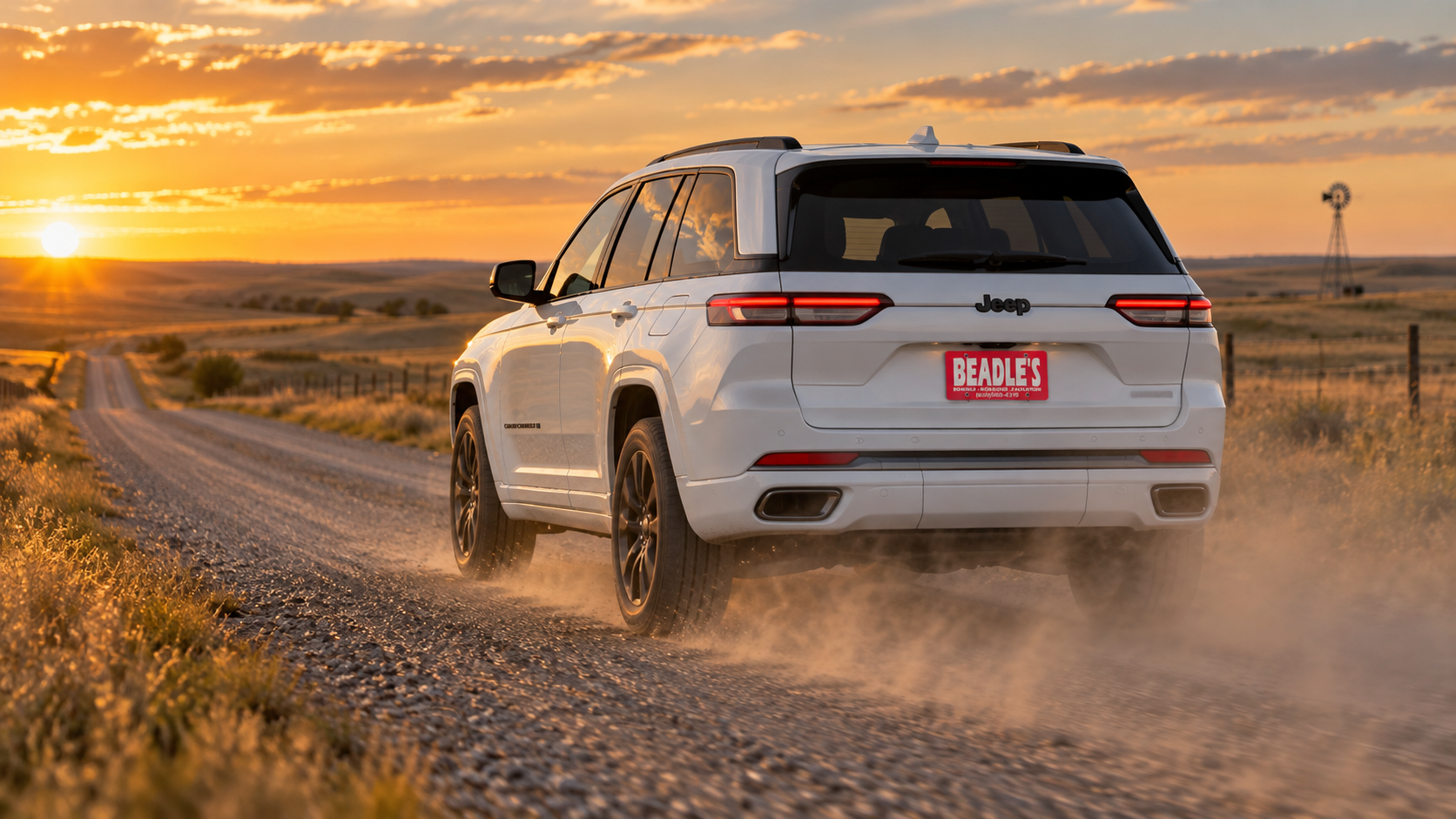
2026 Jeep Grand Cherokee on a gravel road at sunset in South Dakota, at Beadle's Chrysler Center

Grand Cherokee vs Explorer, Traverse & Highlander for SD Families

If you are cross-shopping a midsize family SUV, the Jeep Grand Cherokee usually ends up on the same list as the Ford Explorer, Chevy Traverse, and Toyota Highlander. They are all good vehicles, and they will all get your family to school and back. But out here, "good in the city" and "good in a plains winter" are not the same test — and that is where these SUVs start to separate. This is a fair, honest look at how the Grand Cherokee compares through the lens that matters in central South Dakota: winter, gravel, and real four-wheel drive. I am not going to run down anyone else's vehicle with made-up numbers — I will tell you where the Grand Cherokee's design gives it an edge, and where a rival might suit you better. Search Grand Cherokee Inventory Get Pre-Qualified On This Page Real 4x4 vs car-based all-wheel drive Ground clearance and towing on bad roads Where the rivals might suit you better What to weigh side by side So which one should a SD family buy? Real 4x4 vs Car-Based All-Wheel Drive This is the biggest difference, and it is a design difference, not a marketing one. The Grand Cherokee is built as a true four-wheel-drive SUV, and its higher trims add a genuine low range for the worst conditions. The Explorer, Traverse, and Highlander are car-based crossovers that offer all-wheel-drive systems designed mainly for pavement and light snow. For a family that spends winters on plowed streets, a good crossover AWD system is genuinely fine. But when the road has not been plowed, when you are on drifted gravel, or when you want a low range to crawl through something deep, the Grand Cherokee's hardware is built for it in a way most car-based systems are not. It is the difference between a system meant to keep you moving on a snowy highway and one meant to get you down an unbroken section line. A fair word on the rivals The Explorer, Traverse, and Highlander are well-built, popular family SUVs, and their AWD systems handle typical winter driving just fine. This is not about one being junk — it is about matching the vehicle to how rough your roads actually get. If yours get rough, that is where the Grand Cherokee's design pulls ahead. Ground Clearance and Towing on Bad Roads Two numbers matter a lot out here, and the Grand Cherokee is strong on both. It offers up to 10.9 inches of ground clearance with the available Quadra-Lift air suspension, and it tows up to 6,200 pounds when properly equipped with the Trailer Tow Package. That clearance is what keeps you from high-centering on the packed ridge in an unplowed road, and it gives you more room over ruts and washboard gravel. Car-based crossovers typically ride lower, though exact clearance varies by model and trim. On towing, the Grand Cherokee's 6,200-pound rating is competitive for the class and enough for a typical boat, small camper, or utility trailer — check the specific trim and configuration, since capability varies across every SUV in this comparison. Where the Rivals Might Suit You Better Being honest cuts both ways. The main trade-off with the two-row Grand Cherokee is that it seats five, while some car-based rivals are built around three rows and may offer more standard third-row and passenger room for the money. If a roomy third row is your top priority, that is a real point in the crossovers' favor. If you want a third row from a Grand Cherokee, that is exactly what the longer Grand Cherokee L is for — but a family whose number-one need is maximum people space at a lower price may find a car-based three-row fits that specific goal well. The honest way to think about it: the crossovers optimize for interior space and on-road comfort, while the Grand Cherokee optimizes for genuine capability. Decide which one your life actually leans on more. What to Weigh Side by Side Rather than throw around competitor numbers that change by trim and model year, here is an honest framework. The Grand Cherokee figures below are verified; the rivals are described in general terms because their specifics vary by trim — always confirm the exact model you are considering. What to Weigh 2026 Grand Cherokee Explorer / Traverse / Highlander Drivetrain type True 4x4; low range on higher trims Car-based AWD; varies by model Max ground clearance Up to 10.9″ (air suspension) Typically lower; varies by trim Max towing (properly equipped) 6,200 lbs Varies by model and setup Third row Grand Cherokee L only Often standard; room varies Best at Winter, gravel, real capability Interior space, on-road comfort For the deeper story on how the Grand Cherokee actually behaves when the roads go bad, our South Dakota winter guide walks through the 4x4 systems in plain terms. So Which One Should a South Dakota Family Buy? If your winters are spent mostly on plowed roads and highways and your top priority is the roomiest third row for the money, a car-based crossover can be a smart, comfortable pick — there is no shame in that. But if you drive unplowed gravel, break your own trail, tow, or just want the peace of mind of a true four-wheel-drive SUV, the Grand Cherokee is built for exactly that. And if you love the Grand Cherokee's capability but need more seats, the Grand Cherokee L gives you a third row without giving up the real 4x4. Our two-row-versus-L comparison helps you size that up, and our reliability and value guide covers the long-term ownership side of the decision. How to Compare These SUVs Honestly Cut through the marketing and compare them on your own terms with a few deliberate steps. Name your worst-road day: picture the toughest drive you actually make in a year and judge each SUV against that, not an average Tuesday. Separate wants from needs: decide whether real capability or maximum interior room is the priority you cannot compromise on. Check the drivetrain, not just the badge: confirm whether a model offers a true low range or a pavement-focused AWD system. Verify the exact trim's numbers: ground clearance and towing shift by trim and configuration, so confirm the specific vehicle you would buy. Test drive on a road you know: take each one down gravel or a rough stretch near home, not just the smooth route by the dealership. Is the Grand Cherokee the Right Pick Over a Crossover? Consideration Grand Cherokee Car-Based Rival Unplowed roads & gravel Built for it Fine on plowed roads Standard third-row room L body only Often a strength Capability ceiling Higher (low range, clearance) Lower; on-road focus Worth it if: you drive unplowed gravel, break your own trail, tow, or want genuine four-wheel-drive capability with a family SUV. Skip it if: you stick to plowed roads and highways and your top priority is the largest, roomiest third row for the money. Key Takeaways The Grand Cherokee is a true 4x4 with a low range on higher trims; the Explorer, Traverse, and Highlander use car-based AWD built mainly for pavement. Up to 10.9 inches of ground clearance and 6,200 pounds of towing give the Grand Cherokee an edge on bad roads and with a trailer. Car-based rivals may offer more standard third-row and passenger room — a fair point if space is your top priority. Choose capability (Grand Cherokee) or maximum interior room (crossovers) based on how rough your real roads get. Frequently Asked Questions Is the Grand Cherokee better in snow than an Explorer, Traverse, or Highlander? For deep snow, drifts, and unplowed gravel, the Grand Cherokee's true four-wheel-drive design — with a low range on higher trims and up to 10.9 inches of ground clearance — is built for tougher conditions than the car-based all-wheel-drive systems in most crossovers. On plowed roads and highways, all of them handle winter well. How much can the Grand Cherokee tow compared to these rivals? Properly equipped with the Trailer Tow Package, the Grand Cherokee tows up to 6,200 pounds — competitive for the class and plenty for a typical boat, small camper, or utility trailer. Towing capacity on the Explorer, Traverse, and Highlander varies by model and configuration, so compare the exact trims you are considering. Do the competitors have a third row when the Grand Cherokee does not? The two-row Grand Cherokee seats five, and some car-based rivals are built around three rows that may offer more standard passenger room for the price. If you want a third row from a Grand Cherokee, the longer Grand Cherokee L provides one while keeping the true four-wheel-drive capability. Which family SUV is the right choice for central South Dakota? If you drive unplowed gravel, break your own trail, or tow, the Grand Cherokee's genuine capability is hard to beat. If you stick to plowed roads and want the roomiest third row for the money, a car-based crossover can be the better fit. Match the vehicle to how rough your roads actually get. My Take on the Cross-Shop I will never tell someone the Explorer, Traverse, or Highlander is a bad vehicle, because it is not — they are popular for good reasons, and plenty of families around here are happy in them. What I do is ask about the roads people actually drive. When someone tells me they head out before the plow, run gravel every day, or tow a boat to the lake, that is when I know the Grand Cherokee's real four-wheel drive is going to earn its place in their driveway. The honest trade-off is third-row space, and I say so up front. If maximum seating for the money is the whole game, a crossover might be your answer — or step up to the Grand Cherokee L and get the seats without giving up the capability. There is a right answer for every family; it just depends on which test your roads put you through. If you want the full breakdown on trims, engines, and towing, our 2026 Grand Cherokee guide lays it out. And if you are near Bowdle, bring your cross-shop list to Beadle's Chrysler Center — I am happy to talk through all of them straight, no pressure. Search Grand Cherokee Inventory Get Pre-Qualified Contact Beadle's Chrysler Center About the Author Lexy Tabbert — Beadle's Chrysler Center, Bowdle, SD Lexy Tabbert is the Director of Sales and Marketing at Beadle's Chrysler Center in Bowdle, South Dakota. She covers Ram, Jeep, Dodge, and Chrysler vehicles — helping families, ranchers, and ag operators across the region find the right truck and configuration for their needs. Learn more about Lexy.
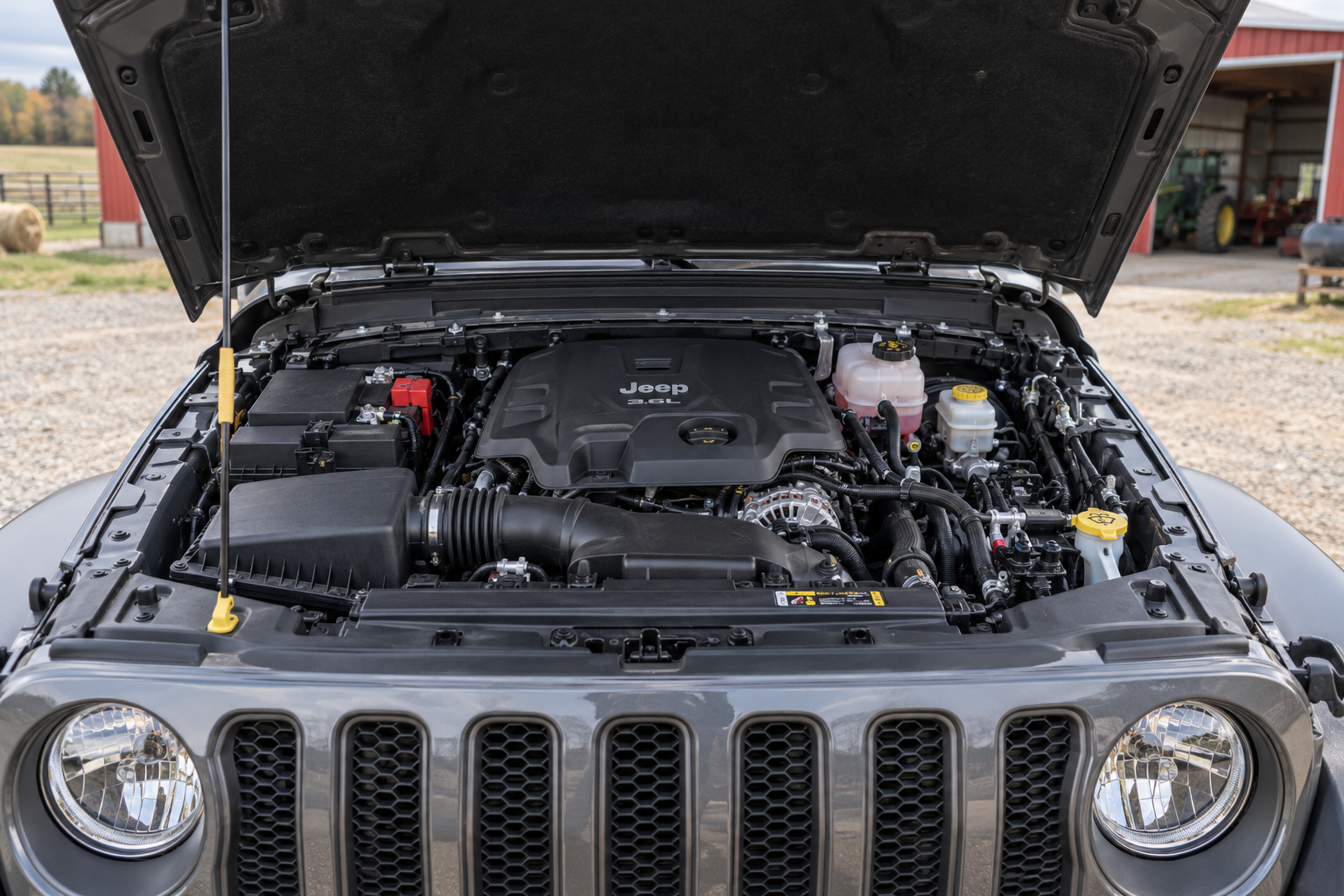
3.6L Pentastar V6 engine bay of a 2026 Jeep Wrangler, at Beadle's Chrysler Center

3.6L V6 vs 2.0L Turbo (and the Manual): Which Wrangler Engine?

Every Wrangler conversation on our lot gets to the same fork about ten minutes in. The 4-door is settled, the trim is mostly settled, and then somebody leans on the fender and asks: the V6 or the turbo? Usually right behind it, from whoever learned to drive on a three-on-the-tree, comes the second question — can I still get a stick? Those are the two engine questions I hear most in Bowdle, and they deserve a straight answer instead of a brochure. Short version: both engines are good, and the right one depends on how you will use the Jeep. The 3.6L Pentastar V6 is the known quantity, and it is the only Wrangler engine you can pair with the 6-speed manual. The 2.0L turbo four makes more torque, is a little easier on fuel, and comes only as an automatic. The 392 V8 is its own animal. Below is how I walk a neighbor through it — cold starts, gravel, the four-hour run to the Hills, and the manual question — using only the numbers I can stand behind. Search Wrangler Inventory Get Pre-Qualified On This Page Which engine is better for cold starts and gravel? Which one is better for a long highway run to the Hills? Can you still get a manual, and on which trims? Is there a hybrid Wrangler, and what about the 392? How to pick your Wrangler engine in five minutes Which Engine Is Better for Cold Starts and Gravel? Both engines start and run fine on a twenty-below morning with a healthy battery, so cold starts are not the deciding factor. Gravel is where you feel a difference: the 2.0L turbo makes 295 lb-ft of torque against the V6's 260 lb-ft, and it delivers it lower in the rev range, which means less downshifting on a washboard section line or pulling out of a soft slough edge. The 3.6L V6 is rated at 285 horsepower and 260 lb-ft. It likes to rev, and with the 8-speed automatic it finds the gear it wants without any fuss. With the 6-speed manual, you are the one finding the gear, and on gravel that is honestly part of the appeal for some folks. The 2.0L turbo four is rated at 270 horsepower and 295 lb-ft, always with the 8-speed automatic. On paper the V6 wins horsepower and the turbo wins torque; on a county road at 45 mph, torque is what you notice. On the cold-weather side, both take a few miles to bring real heat, and if you have the heated seats and heated wheel (standard on Sahara, Rubicon, and 392, available on the Sport line in the Convenience Group with remote start), you will lean on them the first ten minutes of a January morning either way. Remote start plus heated seats matters more to your winter comfort than which engine is under the hood. Our Wrangler winter guide gets into the top, doors, and heat question in detail. Torque is what you feel on gravel Horsepower is what gets you to 70 on the highway. Torque is what gets a loaded Jeep moving from a stop on a soft shoulder, up a boat ramp, or through a drift without the transmission hunting. The 2.0L turbo's 295 lb-ft is the single biggest reason people who drive a lot of gravel end up liking it more than they expected to. Which One Is Better for a Long Highway Run to the Hills? The 2.0L turbo is a little easier on fuel, but the gap is smaller than the internet makes it sound. Both engines land somewhere in the low-20s on the highway by EPA estimate; the turbo edges into the low-to-mid 20s, and the 392 is in the mid-teens. On a four-hour run to the Black Hills, the shape of the Jeep and the tires under it will affect your mileage as much as the engine choice. Engine Output Transmission Available On Highway MPG (EPA est., approx.) 3.6L Pentastar V6 285 hp / 260 lb-ft 6-speed manual standard; 8-speed automatic optional Sport, Sport S, Willys, Sahara, Rubicon, Rubicon X (2-Door and 4-Door) Low 20s (automatic) 2.0L turbo four 270 hp / 295 lb-ft 8-speed automatic only Sport line, Sahara, Rubicon (2-Door and 4-Door) Low-to-mid 20s 6.4L V8 (392) 470 hp / 470 lb-ft 8-speed automatic only 392 only (4-Door only) Mid-teens Here is the honest part. A Wrangler is a box with a flat windshield, and a west wind between Faulkton and Pierre does not care which engine you bought. A Rubicon on 33-inch off-road tires will use more fuel than a Sport on its 245/75R17 all-seasons, and a soft top adds wind noise that makes the trip feel thirstier than it is. If you are chasing the best highway number, the turbo in a Sport S or Sahara on stock all-season tires is the combination. If you are running 33s and a soft top, the engine will not rescue your mileage; buy the one you like. The good news for either engine is the 21.5-gallon fuel tank, which is enough range to make the Hills from Bowdle without planning the trip around a fuel stop. Where the turbo's advantage really shows up is the daily grind — the Aberdeen commute, the school-and-elevator loop — where a few tenths of a gallon a day add up over a year. Can You Still Get a Wrangler With a Manual, and on Which Trims? Yes. The 6-speed manual is the standard transmission with the 3.6L V6 on Sport, Sport S, Willys, Sahara, Rubicon, and Rubicon X, in both the 2-Door and the 4-Door. The 8-speed automatic is the extra-cost option on the V6. You cannot get a manual with the 2.0L turbo or the 392; those are automatic only. That makes the Wrangler one of the last new vehicles you can buy around here with three pedals, and for a certain kind of buyer that is the whole reason to walk onto the lot. If that is you, I am not going to talk you out of it. A manual V6 Willys or Rubicon is a genuinely fun thing to drive down a section line, and the 4:1 low range on a Rubicon with a stick gives you a crawl gear you can feather with your foot. The trade-offs are real, though, and I would rather you hear them from me than discover them in February. In a drift, on a slick boat ramp, or creeping up to a cattle guard on ice, the automatic is simply easier — a steady, gentle throttle with no clutch to manage. If your spouse or your teenager will drive the Jeep, the automatic is the one they will actually want. The manual is the right call when you want it; it is rarely the right call when you are just trying to save on the option. One practical note: most of what we stock is the automatic, so if you want the manual, plan on ordering it or ask us what is in the pipeline. The trim guide explains what each trim's hardware actually does on our roads if you are still weighing Willys against Rubicon. Is There a Hybrid Wrangler for 2026 or 2027, and What About the 392? There is no plug-in hybrid Wrangler in the 2026 or 2027 lineup. The three engines are the 3.6L V6, the 2.0L turbo, and the 6.4L V8 in the 392, and that is the whole list for both model years. We get the hybrid question a few times a month, usually from someone who read about one a while back. The plain answer is that it is not offered for either year, and I am not going to speculate about the future. If a lower fuel bill is the reason you were asking, the 2.0L turbo in a Sport S or Sahara on all-season tires is the most fuel-conscious Wrangler you can buy today. The 392 sits at the opposite end: the 6.4L V8 at 470 horsepower and 470 lb-ft, 8-speed automatic only, 4-Door only, carrying over unchanged into 2027. Nobody in Walworth or Edmunds County needs one, and I say that with affection, because a few people around here want one badly enough that it does not matter. It is the Wrangler you buy because you always wanted a V8 Jeep and the kids are finally out of the house. Expect mid-teens fuel economy and a grin every time you start it. How to Pick Your Wrangler Engine in Five Minutes This is the order I walk through with folks at the desk. It usually settles the question before we open the calculator. Decide on the transmission first: if you want the manual, you are getting the 3.6L V6 and the decision is made. If you want an automatic, both engines are on the table. Count your highway miles: a lot of Aberdeen or Pierre commuting tilts toward the 2.0L turbo; mostly county roads and hunting season tilts toward whichever one you like the sound of. Think about what you tow: either engine handles the Wrangler's rating, but the turbo's torque makes a loaded boat trailer feel easier from a stop. Our towing guide covers the 2-Door and 4-Door ratings and the tow package. Match it to the trim: the 392 forces the V8; Sport through Rubicon take either the V6 or the turbo. Pick the trim for its hardware, then choose the engine. Drive both back to back: ten minutes on the gravel south of town in each one tells you more than any spec sheet. We will have both warmed up if you call ahead at 605-460-6254. Is the 2.0L Turbo Worth It Over the V6? Consideration 3.6L V6 2.0L Turbo Output 285 hp / 260 lb-ft 270 hp / 295 lb-ft Transmission 6-speed manual standard, 8-speed auto optional 8-speed automatic only Feel on gravel from a stop Good — likes revs Better — torque arrives early Highway mileage (approx.) Low 20s Low-to-mid 20s Trims Sport through Rubicon X Sport line, Sahara, Rubicon Worth it if: you want an automatic anyway, you drive a lot of highway miles, or you tow a boat or a small trailer and want the extra torque from a stop. Skip it if: you want the manual, or you simply prefer a six-cylinder and are happy to give up a little mileage for it — the V6 is a fine engine and there is nothing wrong with choosing it on feel. Key Takeaways The 3.6L V6 (285 hp / 260 lb-ft) is the only Wrangler engine offered with the 6-speed manual; the 8-speed automatic is optional on it. The 2.0L turbo (270 hp / 295 lb-ft) is automatic only and makes more torque, which is what you feel on gravel and pulling a trailer from a stop. Highway mileage is close: roughly low 20s for the V6 automatic, low-to-mid 20s for the turbo. Tires, top, and wind matter as much as the engine. There is no plug-in hybrid Wrangler for 2026 or 2027. The 392's 6.4L V8 is 4-Door and automatic only. Pick the transmission first, then the trim, then the engine — and drive both before you decide. Frequently Asked Questions Is the V6 or the 2.0L turbo better in a South Dakota winter? Both start and run well in the cold, so the winter answer comes down to the rest of the Jeep: heated seats and a heated wheel, a hardtop, remote start, and good tires. The turbo's extra torque helps a little getting moving on packed snow, but either engine will get you to town. Which Wrangler trims come with a manual transmission? The 6-speed manual is standard with the 3.6L V6 on Sport, Sport S, Willys, Sahara, Rubicon, and Rubicon X in both the 2-Door and 4-Door. The 2.0L turbo and the 392 V8 are automatic only. What kind of mileage will a Wrangler get on a four-hour drive to the Black Hills? By EPA estimate, roughly low 20s highway for the V6 automatic and low-to-mid 20s for the 2.0L turbo. A headwind, a soft top, and 33-inch tires all pull that down. With the 21.5-gallon tank, either engine makes the trip from Bowdle without needing to plan around a fuel stop. Can I get the 392 V8 in a 2-Door or with a manual? No. The 392 is offered only as a 4-Door with the 8-speed automatic, in both 2026 and 2027. If you want a manual, the 3.6L V6 is the engine that comes with it. My Take on the Wrangler Engine Choice I have watched a lot of people agonize over this one, and almost nobody regrets either engine. What people do regret is buying the automatic when they really wanted the stick, or buying the stick to save money and handing the keys to a spouse who hates it. Settle the transmission question honestly and the engine question mostly settles itself. If I am helping someone who commutes to Aberdeen and pulls a fishing boat to Oahe on weekends, I point them at the 2.0L turbo — the torque and the slightly better mileage both work in their favor every day. If I am helping someone who wants a manual Willys for pheasant season and the occasional Hills trip, the V6 is the only answer and a very good one. And if someone walks in asking about the 392, I already know they have made up their mind, and I go get the keys. The full rundown on trims, tops, 4x4 systems, and towing is in our 2026 Jeep Wrangler guide. And if you are anywhere near Bowdle, stop by Beadle's Chrysler Center and drive both engines back to back on the gravel — that is still the best way to decide. Search Wrangler Inventory Get Pre-Qualified Contact Beadle's Chrysler Center About the Author Lexy Tabbert — Beadle's Chrysler Center, Bowdle, SD Lexy Tabbert is the Director of Sales and Marketing at Beadle's Chrysler Center in Bowdle, South Dakota. She covers Ram, Jeep, Dodge, and Chrysler vehicles — helping families, ranchers, and ag operators across the region find the right truck and configuration for their needs. Learn more about Lexy.
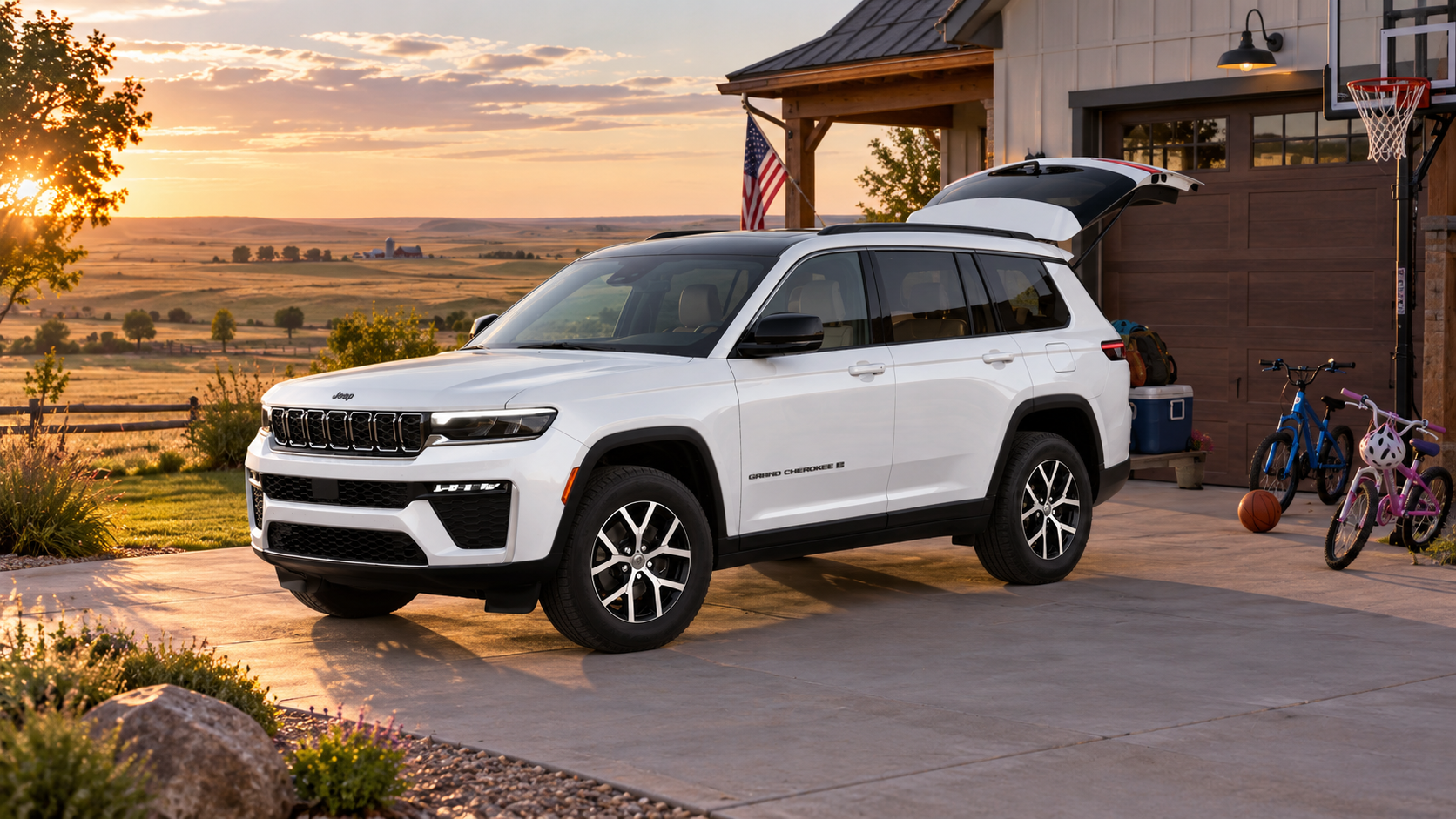
White 2026 Jeep Grand Cherokee L parked at a South Dakota home, at Beadle's Chrysler Center

Grand Cherokee vs Grand Cherokee L: Which Fits Your Family?

Jeep sells the Grand Cherokee in two sizes, and the names make it sound like the bigger one just wins: the two-row Grand Cherokee and the longer, three-row Grand Cherokee L. But "bigger" is not automatically "better for your family," and there is one cargo detail that flips what a lot of people assume before they ever get to the lot. This guide lays out the real differences — seats, cargo, and length — and then gives you an honest recommendation by family type. We help families sort through exactly this decision every week in Bowdle, so this is the same straight talk you would get standing next to both of them. Search Grand Cherokee Inventory Get Pre-Qualified On This Page What is the actual difference between them? The cargo surprise most families miss How many people can each one carry? Seating, cargo, and length side by side Which one fits your family? What Is the Actual Difference Between Them? The two-row Grand Cherokee seats five and is 193.5 inches long. The Grand Cherokee L is stretched to 204.9 inches to make room for a third row, and it seats six with second-row captain's chairs or seven with the no-cost second-row bench. Same familiar Grand Cherokee under the skin — same engines, same four-wheel-drive systems — just a longer body on the L. That extra eleven and a half inches is the whole story. It buys you the third row and more total cargo room when you fold seats down, but it also makes the L a bit longer to park and maneuver. Everything else about how they drive is very close, which is why the decision really comes down to seats and cargo — and that is where it gets interesting. The Cargo Surprise Most Families Miss Here is the detail that changes the whole conversation: with every seat up, the two-row Grand Cherokee holds more cargo behind its last row than the L does behind its third row. The two-row gives you 37.7 cubic feet behind the second row; the L gives you just 17.2 cubic feet behind the third row. That makes sense once you picture it — on the L, that third row is sitting where the two-row's cargo area would be. So if you rarely use a third row but always haul groceries, sports gear, and a week's worth of stuff, the two-row is actually the better cargo hauler for everyday life. The L only pulls ahead on total space once you fold that third row down. Think about your seats-up trunk, not the brochure number The big "maximum cargo" figure only happens with the seats folded flat and nobody in back. What matters day to day is how much fits behind the seats you actually keep up. On that measure, the two-row wins — and that catches a lot of families by surprise. How Many People Can Each One Carry? The two-row seats five, period. The Grand Cherokee L is where you get flexibility: choose the second-row captain's chairs for a six-seat layout with a walk-through to the back, or take the no-cost second-row bench and seat seven. The L's third row has 30.3 inches of legroom — genuinely usable for kids and fine for adults on shorter trips, though it is a third row, not a limousine. If you have a growing family, carpool duty, or grandparents and grandkids who all pile in for the lake, that third row earns its keep. If it is just you and one or two kids, you may never unfold it. When you do fold it down, the L opens up to 46.9 cubic feet behind the second row and 84.6 cubic feet maximum, versus the two-row's 70.8 maximum. Seating, Cargo, and Length Side by Side Here are the numbers that actually decide it, laid out together. Measure Grand Cherokee (2-row) Grand Cherokee L Seats 5 6 (captain's chairs) or 7 (bench) Overall length 193.5″ 204.9″ Cargo behind last row (all seats up) 37.7 cu ft 17.2 cu ft (behind 3rd row) Cargo behind 2nd row 37.7 cu ft 46.9 cu ft Maximum cargo 70.8 cu ft 84.6 cu ft Third-row legroom None 30.3″ Both share the same engines, four-wheel-drive systems, and 6,200-pound max towing when properly equipped — so capability is not the tiebreaker here. Our towing guide covers how to set either one up to pull a boat or camper. Which One Fits Your Family? Here is how I actually sort it out with families on the lot. If you have five or fewer people and you value everyday cargo room and easier parking, the two-row is the smarter buy — it holds more behind the seats you keep up and it is nearly a foot shorter. If you regularly carry six or seven, or you want the security of a third row for carpools and family gatherings, the L is worth the extra length. The one group that should always look at the L is the family that hauls a lot of people and a lot of stuff on the same trips — folded flat, the L's 84.6 cubic feet is the most space in the lineup. For everyone else, do not buy a third row you will never unfold. If you want to see how the Grand Cherokee stacks up as a family SUV overall, our family SUV guide goes deeper, and the trim comparison helps you pick the right version of whichever body you choose. How to Decide Between the Two-Row and the L Work through it in this order and the answer usually shows up quickly. Count your regular passengers: if you routinely carry six or seven people, the L is the answer — stop here. Picture your everyday trunk: if you rarely need a third row but always haul gear, the two-row's larger seats-up cargo area wins. Decide how often the third row is real: occasional carpools and holiday guests favor the L; a once-a-year need does not. Factor in your driveway and parking: the two-row is about a foot shorter and easier to maneuver in tight spots. Sit in both and load your own stuff: bring a car seat or a cooler and see which layout fits your real life, not the brochure. Is the Grand Cherokee L Worth the Extra Size? Consideration Two-Row Grand Cherokee Grand Cherokee L People Up to 5 Up to 6 or 7 Everyday cargo (seats up) More (37.7 cu ft) Less behind 3rd row (17.2 cu ft) Maximum cargo 70.8 cu ft More (84.6 cu ft) Parking & maneuvering Easier (shorter) Longer by 11.4″ Worth it if: you regularly seat six or seven, want a third row for carpools and guests, or need the most maximum cargo in the lineup. Skip it if: you have five or fewer people, value everyday seats-up cargo room, and would rather park something a foot shorter. Key Takeaways The two-row seats five at 193.5″; the Grand Cherokee L seats six or seven at 204.9″. With all seats up, the two-row holds more cargo (37.7 cu ft) than the L does behind its third row (17.2 cu ft). The L wins on people and on maximum cargo (84.6 vs 70.8 cu ft) once the third row is folded. Both drive, tow, and go through winter the same — so choose by seats and cargo, not capability. Frequently Asked Questions How many people does the Grand Cherokee L seat? The Grand Cherokee L seats six with second-row captain's chairs or seven with the no-cost second-row bench. The two-row Grand Cherokee seats five. Does the two-row Grand Cherokee really have more cargo room than the L? Behind the last row with all seats up, yes. The two-row offers 37.7 cubic feet behind its second row, while the L offers 17.2 cubic feet behind its third row. The L only surpasses the two-row for total space once you fold the third row down, reaching 84.6 cubic feet maximum versus 70.8. How much longer is the Grand Cherokee L? The Grand Cherokee L is 204.9 inches long versus 193.5 inches for the two-row — about 11.4 inches longer. It is still easy to live with, but the two-row is a bit simpler to park and maneuver in tight spots. Is the Grand Cherokee L third row big enough for adults? The L's third row has 30.3 inches of legroom, which is genuinely usable for kids and fine for adults on shorter trips. For long hauls, adults will be most comfortable in the first two rows, with the third row best for kids or occasional passengers. My Take on Two-Row vs the L This is one of my favorite conversations to have on the lot, because the answer surprises people so often. Folks come in assuming they need the L because it is bigger, and then I show them that the two-row actually holds more of their everyday stuff behind the seats. For a family of four or five that hauls gear more than passengers, the two-row is usually the one that fits their real life — and it saves them money and driveway space. Now, if you have a full house — six or seven riders, carpools, grandkids piling in for the lake — the L is absolutely the right call, and that folded-flat cargo number is the best in the family. The trick is being honest about how often that third row is really full. Once a year does not count. If you want the full picture on trims, engines, and towing, our 2026 Grand Cherokee guide ties it all together. And if you are near Bowdle, come load your own cooler and car seats into both at Beadle's Chrysler Center — that is the fastest way to know which one is yours. Search Grand Cherokee Inventory Get Pre-Qualified Contact Beadle's Chrysler Center About the Author Lexy Tabbert — Beadle's Chrysler Center, Bowdle, SD Lexy Tabbert is the Director of Sales and Marketing at Beadle's Chrysler Center in Bowdle, South Dakota. She covers Ram, Jeep, Dodge, and Chrysler vehicles — helping families, ranchers, and ag operators across the region find the right truck and configuration for their needs. Learn more about Lexy.
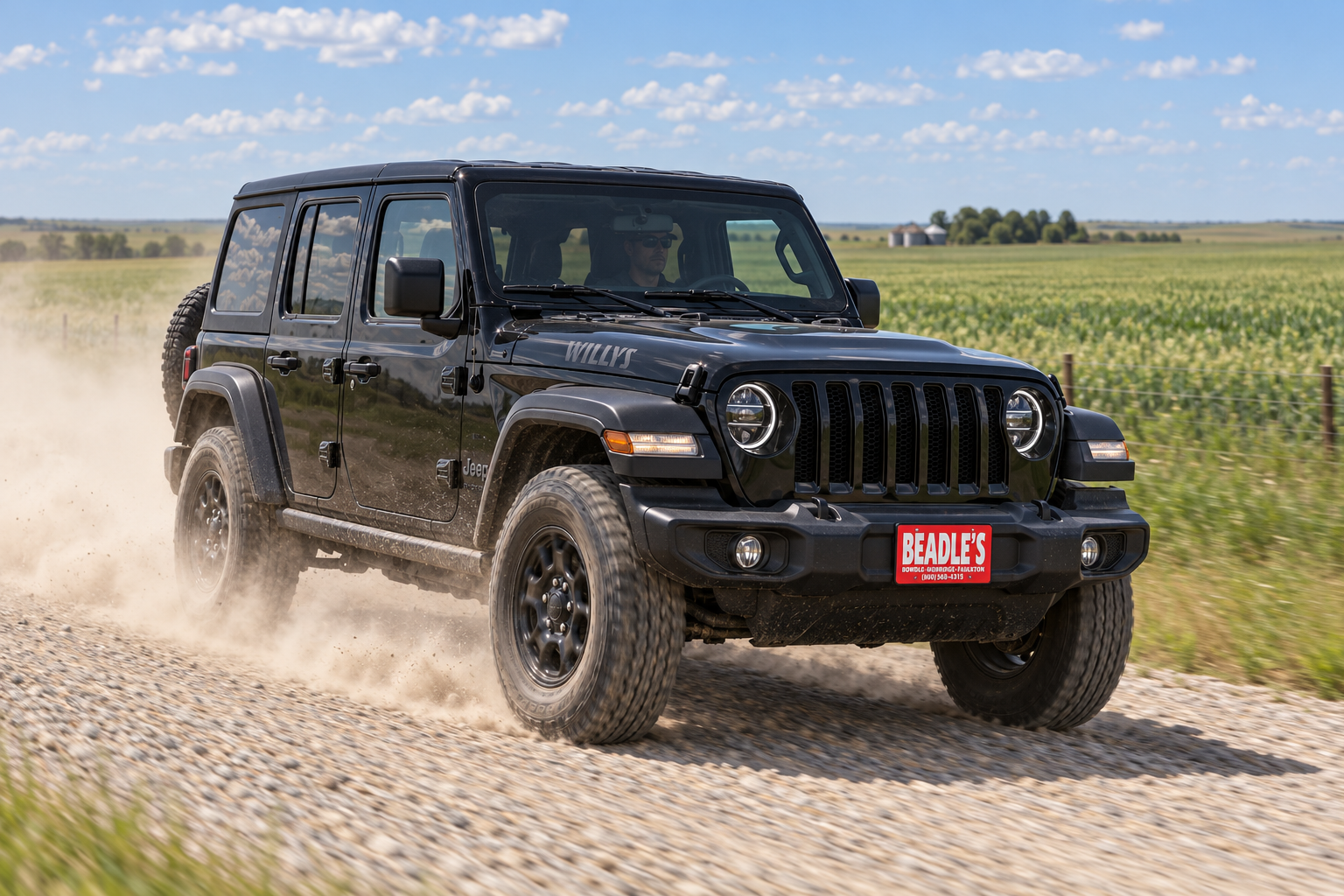
Black 2026 Jeep Wrangler Willys kicking up dust on a South Dakota gravel road, at Beadle's Chrysler Center

Wrangler Trims Explained as Hardware: Sport, Willys, Sahara, Rubicon

Most Wrangler trim guides read like a features list — this one has a bigger screen, that one has nicer seats. That is not how anybody around Bowdle decides. The question I get at the desk is simpler and harder: which one do I actually need for gravel, CRP, a boat ramp, and a drifted section line in January, without paying for a Rubicon I will never use? That is a hardware question, about transfer cases, axles, lockers, tires, and the top over your head. Short answer: every 2026 Wrangler from the base Sport up has real 4x4 with a low range, solid axles, a skid plate under the tank, and a full-size spare. What changes as you climb the ladder is how much traction hardware you get, what rubber it rides on, and how comfortable it is on the drive to Aberdeen. After three Wranglers of my own, the Willys is the value pick for a gravel-and-hunting rig, the Sahara is the comfortable daily driver, and the Rubicon is for the person who breaks trail. Here is what each trim's hardware actually does on our roads. Search Wrangler Inventory Get Pre-Qualified On This Page Sport vs Sport S vs Willys vs Sahara vs Rubicon: what does each add for our roads? Is the Willys the best value for gravel and hunting, or should you just get a Rubicon? What does a Rubicon have that a Sport does not? Is the Sahara really the nicer daily driver? What are the 85th Anniversary and Willys 41 editions, and are they worth it? How to pick a Wrangler trim by the road you drive most Sport vs Sport S vs Willys vs Sahara vs Rubicon: What Does Each Add for Our Roads? The Sport and Sport S share the same Command-Trac part-time 4x4 and all-season tires. The Willys keeps that transfer case and adds a locking rear differential and all-terrain tires. The Sahara swaps in full-time Selec-Trac 4x4 and a body-color hardtop. The Rubicon changes the whole drivetrain: Rock-Trac with a 4:1 low range, heavy-duty axles, lockers at both ends, a sway-bar disconnect, and 33-inch tires. 2026 Trim 4x4 System (Low Range) Traction Hardware Stock Tire Standard Top Sport / Sport S Command-Trac part-time (2.72:1) Open differentials, fuel-tank skid plate 245/75R17 all-season Black Sunrider soft top Willys Command-Trac part-time (2.72:1) Locking rear differential, fuel-tank skid plate 245/75R17 all-terrain Black Sunrider soft top Sahara (4-Door only) Selec-Trac full-time (2.72:1), 4-Auto stays on Open differentials, fuel-tank skid plate 255/70R18 all-season Body-color Freedom hardtop Rubicon / Rubicon X Rock-Trac heavy-duty part-time (4:1) Dana 44-class HD axles, electronic front and rear lockers, sway-bar disconnect, 4.10 gears, added skid protection LT285/70R17 (33-inch) off-road Black Sunrider soft top 392 (4-Door only) Heavy-duty 4x4, 6.4L V8, 8-speed auto Ask us for the equipment on a specific unit Ask us Body-color Freedom hardtop A few things are the same on every row of that table. Every trim has a low range and solid axles front and rear. Every trim has full metal doors on quick-release hinges, a folding windshield, a full-size spare on the tailgate, a 21.5-gallon tank, and the 12.3-inch Uconnect screen with wireless Apple CarPlay and Android Auto. Every trim from Sport through Rubicon can be had with the 3.6L V6 (6-speed manual standard, 8-speed automatic optional) or the 2.0L turbo with the automatic; which engine is its own decision. The Sport S is the Sport's hardware with more convenience and appearance content on top. Ground clearance runs about 10 inches on a Sport or Sahara, about 10.8 inches on a Rubicon with the 33s, and roughly 12.9 inches with the Xtreme 35 package. The first number already clears the ridge of packed snow in a township road or the crown of a two-track through CRP. The differences that matter day to day are the tires and the lockers, and that is where the Willys conversation starts. Is the Willys the Best Value for Gravel and Hunting, or Should You Just Get a Rubicon? For gravel roads, CRP, cattail sloughs, and a boat ramp at Lake Oahe, the Willys is the best value in the lineup, and I would put most hunting rigs on one. The Rubicon is worth the step up only if you are regularly in mud or snow deep enough to need a front locker and a 4:1 low range — and around here, that is fewer people than think so. Here is why the Willys hits the spot. The two things that get a Jeep through a wet slough edge or a drifted approach are traction at the tires and a differential that does not spin the one wheel with no grip. The Willys has both: all-terrain tires that bite in loose gravel, slush, and gumbo where a Sport's all-season just polishes, and a locking rear differential that puts drive to both rear wheels when one is in the soft stuff. The rest of it is the same Command-Trac transfer case, 2.72:1 low range, and Sunrider soft top as a Sport — a simple, proven driveline our service department in Bowdle knows well. The Rubicon costs more for a real reason, but be honest about your actual roads. Its 4:1 low range, front locker, and sway-bar disconnect are for crawling over things at walking speed, and around Bowdle the terrain that needs those tools is a stuck-in-the-mud situation, not a Tuesday. If river-bottom timber and breaking trail through drifted two-tracks after a February storm are normal for you, get the Rubicon. If what you do is gravel, CRP edges, a boat ramp, and the occasional soft field approach, the Willys does it, and the price difference buys a hardtop, winter tires, and a lot of shells. The tire is the trim If you take one thing from this post, take this: on our roads, the tire under the Jeep does more for you than the transfer case behind the engine. A Sport with a good all-terrain will out-hunt a Rubicon on its stock off-road tires in a lot of fall conditions, and a dedicated winter tire on any trim beats all of them on ice. The Willys is the one trim that comes from the factory with the tire this county actually wants, which is most of why I call it the value pick. Our winter post goes deeper on tires and 4x4 systems in snow. What Does a Rubicon Have That a Sport Does Not? A Rubicon replaces the Sport's driveline almost entirely: Rock-Trac heavy-duty part-time 4x4 with a 4:1 low range instead of 2.72:1, Dana 44-class heavy-duty front and rear axles, electronic lockers front and rear, an electronic front sway-bar disconnect, 4.10 axle gears (4.56 with the 35s), 33-inch off-road tires, added underbody protection, and a Class II hitch as standard. In plain terms: the 4:1 low range lets the Jeep creep at a walking pace with the engine barely working, which is what you want backing a trailer down a slick ramp or picking through a washout. The heavy-duty axles are built to take 33s and lockers. The front locker is the difference on a side-hill approach where one front wheel is in the air or on ice; the rear locker does what the Willys' does with more axle behind it. The sway-bar disconnect lets the front axle droop and keep both tires on the ground over a rutted pasture two-track. The 33s float over deep snow and soft mud. The red tow hooks in the photo above are rated recovery points, two up front and one in back like every trim, only in red. Two more things. The Rubicon X layers additional equipment on the Rubicon's hardware; ask us what is on the specific unit rather than trusting a generic list. And the Xtreme 35 package goes further: 35-inch LT315/70R17 tires with a full-time version of the 4:1 Rock-Trac and roughly 12.9 inches of clearance. On the road, the Rubicon's heavy-lugged tires hum on pavement and are not a winter tire on glare ice. It is a very good hunting rig and a fine daily driver; just know the hardware you are paying for is built for the days that are not normal days. Is the Sahara Really the Nicer Daily Driver? Yes. The Sahara is the trim built for the person who drives the Wrangler every day, and three pieces of hardware make that true: full-time Selec-Trac 4x4 that can stay in 4-Auto on pavement, a body-color Freedom hardtop as standard, and heated front seats and a heated steering wheel as standard. Selec-Trac is the piece most people underrate. On a Sport, Willys, or Rubicon, the 4x4 is part-time: 4-High on a snow-covered road, back to 2-High on dry blacktop, because a part-time system binds up on grip. The Sahara's 4-Auto setting sends drive to the front axle as it is needed and can stay engaged on pavement, so a Bowdle-to-Aberdeen commute that goes from black ice to dry to slush three times is handled without touching the lever. It still has the same 2.72:1 low range as the Sport when you need it. The rest of the Sahara's case is comfort you feel every morning. The body-color three-piece hardtop is quieter than the soft top, holds heat, and defrosts the rear glass like a normal vehicle, and the two front Freedom panels still lift off in about a minute when July comes. Heated seats and a heated wheel are standard instead of a package. The 255/70R18 all-season on an 18-inch wheel is a highway tire — smoother and quieter than a Willys' all-terrain, and not what I would want on wet gumbo or washboard with fresh snow. That is the Sahara's trade: the most comfortable Wrangler on the road, with open differentials and pavement rubber underneath. For a daily driver that sees gravel and a few pasture trips, it is a good trade. For a rig that lives on a section line and a boat ramp, the Willys fits better. The Sahara is 4-door only. What Are the 85th Anniversary and Willys 41 Editions, and Are They Worth It? Both are 2026-only, 4-door special editions built on the Sport model line, and neither one changes the hardware conversation above. The 85th Anniversary Edition is a badge-and-appearance take on the Jeep's birthday; the Willys 41 is a heritage-flavored take on the Willys. Worth it if you like the look and one is available; skip it if you are buying for what is under the body. My rule with special editions is to price the hardware first and the badge second. The Willys 41 is the more interesting of the two for our buyer because it starts from the Willys, so the all-terrain tires and locking rear differential are the starting point with the edition's styling on top; the 85th Anniversary sits on the Sport side of the ladder. Exactly what each includes varies by build, so ask us for the equipment on the specific unit rather than trusting a generic list. Both retire after 2026, so if the look matters, this is the year. And resale around here follows the hardware and the top, not the badge: a Willys 41 with a hardtop and the Convenience Group will be an easy Jeep to sell in five years because it is a well-equipped Willys, not because of the decal. How to Pick a Wrangler Trim by the Road You Drive Most Forget the feature list for a minute and answer these in order. The trim usually picks itself by step four. Name the worst road you drive every month: maintained gravel points to a Sport or Sahara; section lines, slough edges, and boat ramps point to a Willys; breaking trail through timber or drifts points to a Rubicon. Decide who shifts the transfer case: if the answer is "nobody wants to," you want the Sahara's full-time Selec-Trac; if 2-High and 4-High are fine, Command-Trac on a Sport or Willys is plenty. Count the lockers you will actually use: none most days means Sport; a rear locker for soft field approaches means Willys; front and rear for real mud and side hills means Rubicon. Pick the tire before the wheel: all-terrain for gravel and hunting (Willys), highway all-season for a commuter (Sport, Sahara), off-road 33s for deep mud and snow (Rubicon); plan on winter tires for any daily driver. Choose the top for January, not July: hardtop or Dual Top Group for a daily driver; the Sahara includes the body-color hardtop, the others make it an option. Add the Convenience Group on the Sport line if it will see a winter commute — heated seats, heated wheel, automatic climate control, and remote start. Drive two back to back: a Willys and a Sahara on the gravel north of town settles this faster than any table, and we will set that up. Which Wrangler Trim for Which South Dakota Job? Trim The Hardware You Are Paying For Best Fit Around Here Sport / Sport S Command-Trac, low range, solid axles, all-season tires Budget daily on maintained roads; summer top-off Jeep; a strong base to add tires to Willys Sport hardware plus rear locker and all-terrain tires Pheasant rig, Lake Oahe rig, back-pasture rig; the value pick Sahara Full-time Selec-Trac, body-color hardtop, heated seats and wheel, 18-inch all-seasons Year-round daily driver, Aberdeen commute, the household Jeep Rubicon / Rubicon X Rock-Trac 4:1, HD axles, front and rear lockers, sway-bar disconnect, 33s River-bottom timber, deep snow, breaking trail, the person who gets stuck on purpose 392 6.4L V8, 470 hp, heavy-duty 4x4, 4-door only The want-it Jeep; mid-teens mileage is the price of admission Worth it if: the Rubicon is worth the step over a Willys if you are regularly in mud, side hills, or drifts deep enough to need a front locker, a 4:1 low range, and 33s — and you know that because you have been stuck there. Skip it if: your roads are gravel, CRP edges, boat ramps, and the occasional soft approach — the Willys has the tires and the rear locker for that, and the money saved buys the hardtop and winter tires that improve every day of the year. Key Takeaways Every 2026 Wrangler has real 4x4 with a low range, solid axles, a fuel-tank skid plate, and a full-size spare; the trims differ in traction hardware, tires, and the top, not in whether it is a real 4x4. The Willys is the value pick for gravel, CRP, and boat ramps: Sport hardware plus a locking rear differential and all-terrain tires, which is the tire this county actually wants. The Rubicon swaps in Rock-Trac 4:1, Dana 44-class axles, front and rear lockers, a sway-bar disconnect, and 33s; buy it for breaking trail, not for a Tuesday on gravel. The Sahara is the comfortable daily driver thanks to full-time Selec-Trac, a standard body-color hardtop, and standard heated seats and wheel; the 85th Anniversary and Willys 41 are 2026-only styling editions on the Sport line. Frequently Asked Questions Does the base Wrangler Sport have real four-wheel drive? Yes. The Sport has Command-Trac part-time 4x4 with a 2.72:1 low range, solid front and rear axles, a skid plate under the fuel tank, and about 10 inches of ground clearance. It is the same basic driveline layout as the Willys, minus the rear locker and all-terrain tires, and it handles drifted gravel and unplowed township roads well. Can I get the Willys on a 2-door Wrangler? Yes. For 2026 the 2-door is offered as a Sport, Sport S, Willys, Rubicon, or Rubicon X, so the Willys' locking rear differential and all-terrain tires are available on the short body. The Sahara, the 392, and the 85th Anniversary and Willys 41 editions are 4-door only. Our lot stocks 4-doors; a 2-door is an order. Is the Rubicon a bad daily driver? No, plenty of people drive one every day. Just know the trade-offs: the 33-inch off-road tires hum on pavement and are not a winter tire on glare ice, the soft top is standard so a hardtop or Dual Top Group is worth adding, and you are paying for lockers and a 4:1 low range you will use a few days a year. Heated seats and a heated wheel are standard on the Rubicon, which helps the winter case. Which Wrangler trims come with a manual transmission? The 6-speed manual is the standard transmission with the 3.6L V6 on the Sport, Sport S, Willys, Sahara, and Rubicon, with the 8-speed automatic optional. The 2.0L turbo comes only with the automatic, and the 392's V8 is automatic-only as well. If you want a manual, you are choosing the V6. My Take on the Wrangler Trims One of my three Wranglers was a Rubicon, and the honest lesson is that I used its front locker a handful of times in the years I owned it and its tires every single day. The hardware was wonderful and I do not regret it, but it was a lot of Jeep for a county where the worst road most days is a washboard section line with a drift across the low spot. A Sport with a decent set of tires did most of the same work with less margin when things got soft. So here is what I tell people at the desk. If the Wrangler is a hunting and lake rig that also gets you to town, buy the Willys: it is the only trim that comes with the tires and the rear locker this country asks for, and the money you keep goes into a hardtop and winter rubber. If it is the household's daily driver, buy the Sahara and enjoy 4-Auto on a January morning without thinking about it. If you break trail through timber and drifts and you know it because you have been stuck there, buy the Rubicon and use it. Whichever you land on, put the Convenience Group and the right top on it, because those are the things you notice every day. Our 2026 Jeep Wrangler guide puts trims, body styles, engines, winter, and towing in one place if you want the whole picture. And if you are anywhere near Bowdle, stop by Beadle's Chrysler Center — we will put you in a Willys and a Sahara on the same gravel road so you can feel what the hardware does before you decide. Search Wrangler Inventory Get Pre-Qualified Contact Beadle's Chrysler Center About the Author Lexy Tabbert — Beadle's Chrysler Center, Bowdle, SD Lexy Tabbert is the Director of Sales and Marketing at Beadle's Chrysler Center in Bowdle, South Dakota. She covers Ram, Jeep, Dodge, and Chrysler vehicles — helping families, ranchers, and ag operators across the region find the right truck and configuration for their needs. Learn more about Lexy.
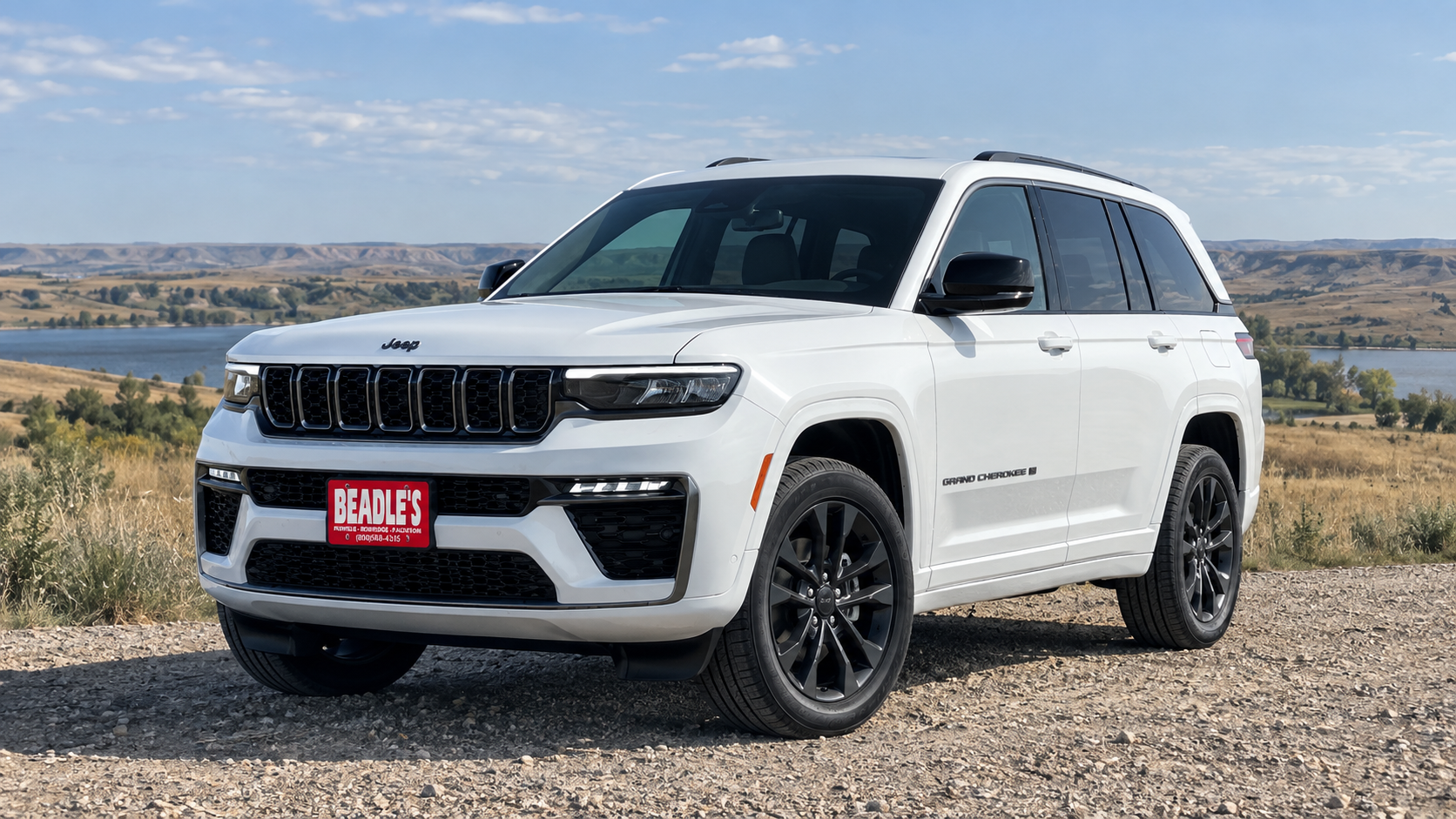
2026 Jeep Grand Cherokee front three-quarter view, at Beadle's Chrysler Center

2026 Grand Cherokee Trims: Laredo to Summit, Explained

The 2026 Jeep Grand Cherokee comes in a handful of trims that can look confusing on a spec sheet, but the choice gets simple once you frame it the right way: not "which one is best," but "which one matches how I actually use a vehicle." A rancher who wants a comfortable second vehicle for town and church wants something different than a family hauling kids and gear every weekend. This is a plain-English walk through the Laredo, Limited, Limited Reserve, and Summit — what each one adds, where the money actually goes, and how to stop overthinking it. We sell and service these in Bowdle, so this is the same framework we use standing next to the vehicles on the lot. Search Grand Cherokee Inventory Get Pre-Qualified On This Page What do you actually get in the Laredo? Is the Limited the sweet spot? What do Limited Reserve and Summit add? How do the trims compare side by side? Should you get the three-row Grand Cherokee L? What Do You Actually Get in the Laredo? The Laredo is the value play, and it is a genuinely good vehicle — not a stripped-down base model you settle for. It comes standard with the 3.6L Pentastar V6 (293 hp, 260 lb-ft), the 2.0L Hurricane Turbo four available if you want more torque, Quadra-Trac I four-wheel drive, cloth seats, and an 8.4-inch Uconnect touchscreen. If you want a capable, true four-wheel-drive family SUV and you do not care about leather or the biggest screen, the Laredo covers the important stuff. It starts in the high-$30s, and around here plenty of buyers who already own a nice truck are perfectly happy stopping right here — they want the capability and the comfort, not the country-club interior. Is the Limited the Sweet Spot? For a lot of families, yes. The Limited is where the Grand Cherokee starts to feel genuinely upscale without jumping to the top of the price ladder, and it is our most popular pick for a reason. Step up to the Limited and you get leatherette seating, heated front and second-row seats, a larger 12.3-inch touchscreen with navigation, a power liftgate, and the Selec-Terrain system that adds selectable drive modes including Snow. The 2.0L Hurricane Turbo (324 hp, 332 lb-ft) is standard here. That combination — heated seats front and back, the big screen, selectable traction modes — is exactly what most South Dakota families actually use day to day. Heated second row is a bigger deal than it sounds If you regularly haul kids or passengers in the back on cold mornings, the Limited's heated second-row seats are one of those features people do not think to ask for and then never want to give up. It is a quiet reason a lot of families land on the Limited over the Laredo. What Do Limited Reserve and Summit Add? This is where the Grand Cherokee goes from "nice family SUV" to "genuinely luxurious." Limited Reserve steps up the interior with Nappa leather over the Limited's appointments — the same well-equipped Limited underneath, dressed in nicer hides. The Summit is the top of the range, and it feels like it. You get Palermo leather, ventilated front seats, a 19-speaker premium audio system, and a surround-view camera. Mechanically it moves up to Quadra-Drive II, which adds a low range and an electronic limited-slip rear differential, and it can be equipped with the Quadra-Lift air suspension that raises ground clearance up to 10.9 inches. If you want the most comfortable, most capable Grand Cherokee and the price is not the deciding factor, the Summit lands in the low-$60s and earns it. Ventilated seats are not just a summer luxury Cooled seats sound like a warm-climate feature, but anyone who has climbed into a sun-baked vehicle after church in July knows better. On the Summit, the ventilated front seats pair with the heated seats to cover both ends of a South Dakota year. How Do the Trims Compare Side by Side? Here is the whole lineup at a glance, so you can see where each step of the ladder actually spends your money. Trim Seats & Interior Standard Engine 4x4 System Starting Point Laredo Cloth; 8.4″ Uconnect 3.6L V6 (2.0T available) Quadra-Trac I High-$30s Limited Leatherette; heated front + 2nd row; 12.3″ nav; power liftgate 2.0L Hurricane Turbo Quadra-Trac I + Selec-Terrain Step up from Laredo Limited Reserve Nappa leather; Limited features 2.0L Hurricane Turbo Quadra-Trac I + Selec-Terrain Above Limited Summit Palermo leather; ventilated seats; 19-speaker; surround-view 2.0L Hurricane Turbo Quadra-Drive II (air avail.) Low-$60s Not sure whether the standard V6 or the Hurricane Turbo is right for you? Our V6-versus-Hurricane breakdown walks through how each engine feels in daily driving and towing. Should You Get the Three-Row Grand Cherokee L? Every trim in this guide is also offered as the longer, three-row Grand Cherokee L — with one thing to know: the L comes in Laredo, Limited, and Summit (there is no Limited Reserve on the L). So if you need the third row and want Nappa leather, the Summit L is the way you get there. The choice between the two-row and the L really comes down to people and cargo, not trim level — and there is one detail about cargo that surprises almost everyone. Our family SUV guide gets into how the Grand Cherokee fits real South Dakota families, including when the extra row is worth it and when it is not. How to Pick Your Grand Cherokee Trim Skip the spec-sheet overwhelm and work through it in order. A few honest questions get you to the right trim faster than reading every line item. Start with your budget ceiling: decide the top number you are comfortable with before you fall in love with a feature you do not need. Decide if leather matters to you: if cloth is fine, the Laredo saves real money; if you want heated leather-look seats front and back, start at the Limited. Count your regular passengers: if you routinely carry more than five people, plan on the Grand Cherokee L instead of the two-row. Weigh the winter and comfort extras: heated second row, Selec-Terrain, and ventilated seats push most buyers toward the Limited or Summit. Ask whether you need max capability: if you break your own trail on unplowed roads, look at Quadra-Drive II and the air suspension on the Summit. Is the Quadra-Lift Air Suspension Worth It? Consideration Standard Suspension Quadra-Lift Air Ground clearance 8.4″ Up to 10.9″ Deep, unplowed roads Good Better — clears the ridge Where you find it Lower trims standard Higher trims / option Worth it if: you regularly break your own trail on unplowed gravel, tow, or want the easiest step-in height and the most capable Grand Cherokee. Skip it if: you mostly drive plowed roads and highways — the standard 8.4 inches handles a normal South Dakota winter just fine. Key Takeaways The Laredo is a genuinely good value — V6 standard, true 4x4, and everything a truck owner needs in a second family SUV. The Limited is the sweet spot for most families: leatherette, heated front and second-row seats, 12.3-inch nav, and Selec-Terrain. Limited Reserve adds Nappa leather; the Summit adds Palermo leather, ventilated seats, 19-speaker audio, Quadra-Drive II, and available air suspension. Pick your trim by how you use the vehicle — passengers, comfort features, and capability — not by the spec sheet. Frequently Asked Questions What is the difference between the Grand Cherokee Laredo and Limited? The Laredo comes with cloth seats, the standard V6, an 8.4-inch touchscreen, and Quadra-Trac I. The Limited adds leatherette seating, heated front and second-row seats, a 12.3-inch touchscreen with navigation, a power liftgate, Selec-Terrain drive modes, and the standard Hurricane Turbo engine. For most families, the Limited is the sweet spot. What does the Grand Cherokee Summit include over the other trims? The Summit is the top trim. It adds Palermo leather, ventilated front seats, a 19-speaker premium audio system, a surround-view camera, and the Quadra-Drive II four-wheel-drive system with low range and a limited-slip rear differential. It can also be equipped with the Quadra-Lift air suspension for up to 10.9 inches of ground clearance. Is the Limited Reserve worth it over the Limited? The Limited Reserve is essentially a well-equipped Limited upgraded with Nappa leather. If the richer interior matters to you and you want to stay below the Summit's price, it is a nice step. If you are happy with the Limited's leatherette, you can put that money elsewhere. Which trims are offered on the three-row Grand Cherokee L? The three-row Grand Cherokee L is available in Laredo, Limited, and Summit. There is no Limited Reserve on the L, so if you want a three-row Grand Cherokee with the richest interior, the Summit L is the one to look at. My Take on Choosing a Trim When someone walks up on the lot and asks which Grand Cherokee they should get, I never start with the trims — I start with questions. How many people are usually in the car? Do you want leather or is cloth fine? Are you the type to head down an unplowed road, or do you stick to the highway? The answers point to the trim almost every time, and it saves people from paying for things they will never touch. Honestly, the Limited is where most of our families land, and I think it is the smart buy — the heated second row and the bigger screen earn their keep every single week. But there is no wrong answer here. Plenty of truck owners are thrilled with a Laredo, and folks who want the nicest one drive off in a Summit and never look back. If you want the full rundown on engines, capability, and how it all fits together, our 2026 Grand Cherokee guide pulls it all into one place. And if you are near Bowdle, come sit in a couple side by side at Beadle's Chrysler Center — five minutes in the seats usually settles it faster than any spec sheet. Search Grand Cherokee Inventory Get Pre-Qualified Contact Beadle's Chrysler Center About the Author Lexy Tabbert — Beadle's Chrysler Center, Bowdle, SD Lexy Tabbert is the Director of Sales and Marketing at Beadle's Chrysler Center in Bowdle, South Dakota. She covers Ram, Jeep, Dodge, and Chrysler vehicles — helping families, ranchers, and ag operators across the region find the right truck and configuration for their needs. Learn more about Lexy.

Contact Us

Fill out this form below and we'll contact you shortly
*Required Fields